


Texas Infant Cerebral Venous Sinus Thrombosis Lawyer
Written by: Hastings Law Firm | Reviewed by: Tommy Hastings | Updated: July 27, 2026
Infant cerebral venous sinus thrombosis is a rare type of stroke caused by a clot that blocks blood drainage from the brain. When warning signs are missed or the right imaging is not ordered, pressure can build and lead to permanent neurological injury. The discussion also highlights how CVST can be confused with other infant brain injuries, why venography based imaging matters, and how delays in anticoagulation and supportive care can worsen outcomes. If you or a loved one were harmed or worse due to a missed or delayed infant CVST diagnosis in Texas, contact Hastings Law Firm for a free, confidential case review.

Top Rated Texas Medical Attorneys for Infant CVST Injuries
What You Should Know About Infant Brain Blood Clot Misdiagnosis Claims in Texas:
- Permanent neurological injury can result when infant CVST goes unrecognized and pressure builds in the skull.
- A worsened outcome can follow when CVST is misclassified as another type of infant stroke and the wrong tests or treatment are used.
- Missed opportunities for diagnosis can occur when clinicians do not act on clusters of warning signs such as seizures and extreme lethargy.
- Limited options for recovery can apply in Texas because non economic damages are capped even when lifelong care needs are significant.
- Full financial recovery for measurable costs can remain available because Texas does not cap economic damages for medical malpractice.
- Severe and irreversible harm can occur when anticoagulation and supportive care are delayed or withheld after CVST is diagnosed.
- Disputes about negligence often turn on whether venography based imaging was ordered when standard scans could miss venous clots.
- A missed radiology finding can be central when imaging shows patterns such as the empty delta sign but the report does not identify CVST.
- Case viability can depend on showing that the delay made the injury worse rather than only showing that a diagnosis was missed.
- Documentation such as imaging studies and hospital records can be decisive when reconstructing what was recognized and when action was taken.

A Healthcare Focused Law Firm
When your newborn is diagnosed with a serious brain condition that you believe could have been caught sooner, the weight of that realization can feel impossible to carry alone. You may have questions about what went wrong, whether earlier action could have changed the outcome, and what options exist to protect your child’s future. These are reasonable questions, and you deserve clear answers.
As a Texas infant cerebral venous sinus thrombosis lawyer, Hastings Law Firm focuses exclusively on medical malpractice cases involving diagnostic failures and preventable injuries. Our team of attorneys, nurse consultants, and medical experts can review your child’s records and help you understand whether the care your family received met accepted medical standards. If you believe your infant was harmed by a delayed or missed diagnosis, we invite you to contact us for a free, confidential case evaluation.
Understanding Infant Cerebral Venous Sinus Thrombosis and Medical Negligence
Cerebral venous sinus thrombosis, commonly called CVST, is a rare form of stroke caused by a blood clot that forms in the dural venous sinuses, the large channels that drain blood from the brain. Unlike the more widely recognized arterial strokes, where a clot blocks blood flowing *into* the brain, CVST blocks blood flowing *out*. This distinction matters because the consequences, diagnostic approach, and treatment differ significantly.
When a venous clot prevents blood from draining properly, pressure builds inside the skull. That rising pressure can damage brain tissue through two primary mechanisms:
- Ischemia, which occurs when the backed-up blood flow deprives surrounding brain tissue of oxygen. When ischemia sets in, brain cells are starved of the oxygen and glucose necessary for survival, leading to cell death.
- Hemorrhage, which occurs when the increased pressure causes weakened blood vessels to rupture and bleed into the brain. If the venous pressure continues to rise unchecked, the vessel walls can no longer contain the blood, resulting in a hemorrhage that adds direct pressure and toxicity to the delicate brain tissue.
Both outcomes can produce permanent neurological injury in an infant, particularly when the condition goes unrecognized. According to the National Center for Biotechnology Information (NCBI Bookshelf), CVST accounts for a small but clinically significant percentage of strokes and requires targeted diagnostic evaluation.
The condition is rare, but when an infant presents with recognized symptoms of cerebral sinovenous thrombosis, such as seizures, lethargy, or a bulging soft spot, the failure to investigate and diagnose promptly can constitute medical negligence. A Texas infant CVST malpractice attorney evaluates whether your child’s care team responded appropriately to those warning signs or whether critical steps were missed. An experienced infant blood clot lawyer can help determine if these mechanisms of injury were preventable and if the standard of care was breached.
Distinguishing CVST from Other Infant Brain Injuries
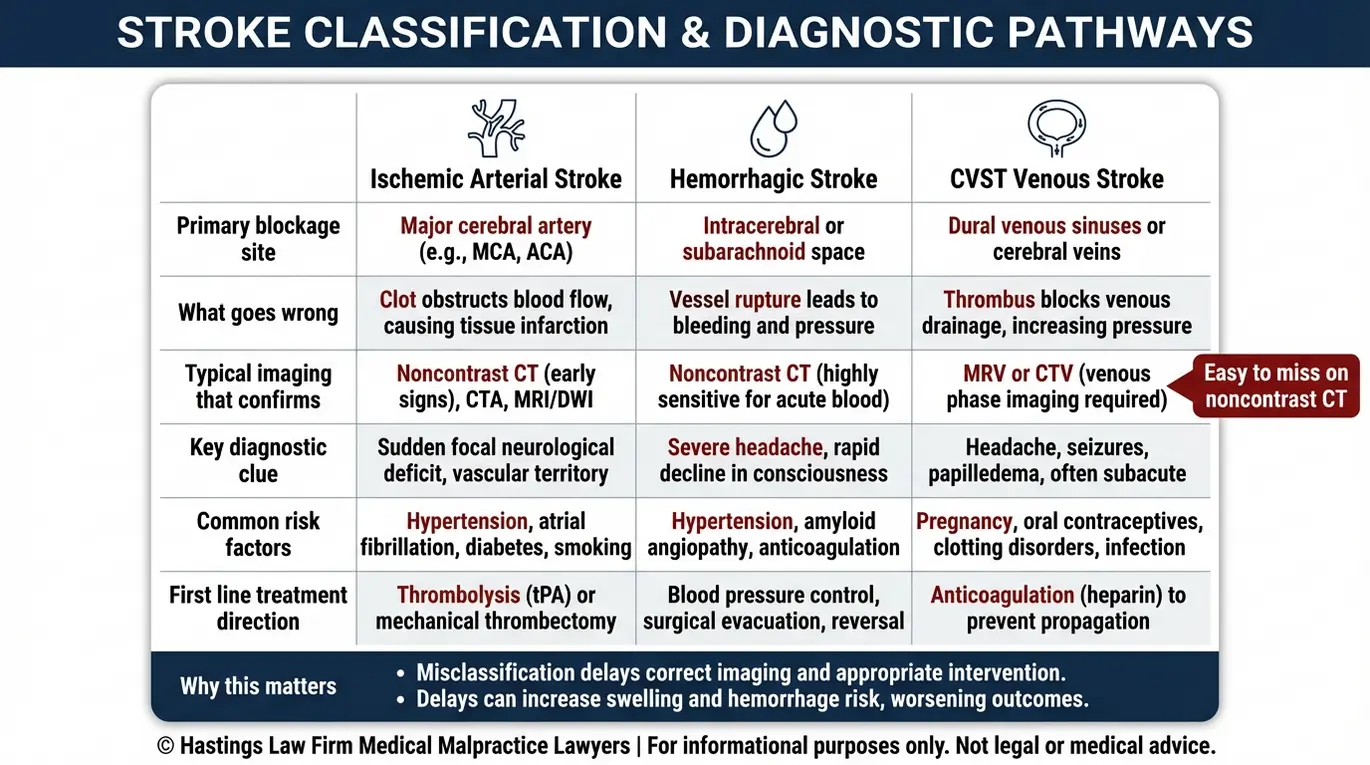
CVST differs from arterial strokes because it involves a blockage in the veins that drain blood from the brain, and it often requires different diagnostic imaging and treatment protocols than other types of stroke. Misclassifying or overlooking this distinction can lead to the wrong tests, the wrong treatment, and a worsened outcome.
To understand why this matters, it helps to know how the three main types of infant stroke differ:
| Type of Stroke | Cause | Key Diagnostic Feature |
|---|---|---|
| Ischemic Stroke | Arterial clot blocks blood flow to the brain | Diffusion-weighted MRI shows areas of restricted blood flow |
| Hemorrhagic Stroke | Ruptured blood vessel causes bleeding in the brain | CT scan reveals acute bleeding |
| CVST (Venous Stroke) | Venous clot blocks blood drainage from the brain | MR venography or CT venography shows absent flow in venous sinuses |
Perinatal stroke and neonatal stroke are umbrella terms that can include any of these types. The challenge is that CVST, also referred to as venous infarction (brain tissue damage caused by obstructed venous drainage), can produce both ischemic *and* hemorrhagic features on imaging. That overlap can lead clinicians to misidentify the underlying cause if they are not specifically looking for a venous clot.
Certain infants face a higher risk. Thrombophilia, an inherited or acquired tendency for the blood to clot more easily than normal, is one of the most significant predisposing factors. Genetic mutations like Factor V Leiden or deficiencies in Protein C and Protein S create a biological environment where clots form too easily. When these inherent risks combine with the physical stress of a difficult delivery or maternal infection, the likelihood of a venous stroke increases dramatically. Maternal infections during pregnancy have also been associated with neonatal CVST, as research published in a PubMed study on neonatal stroke and meningitis has documented.
For families working with a Texas infant stroke lawyer, establishing what type of brain injury occurred, and when it should have been identified, is a foundational part of any claim.
The Hastings Law Firm Difference
Results matter, but what truly sets us apart is how we achieve them. Every verdict, every settlement, and every Texas courtroom victory comes from one guiding promise: To treat each client’s fight for justice as if it were our own.
This balance of skill, experience, and empathy reflects our core philosophy that justice should not only compensate the injured, but also make healthcare safer nationwide.

Warning Signs of CVST in Newborns and Infants
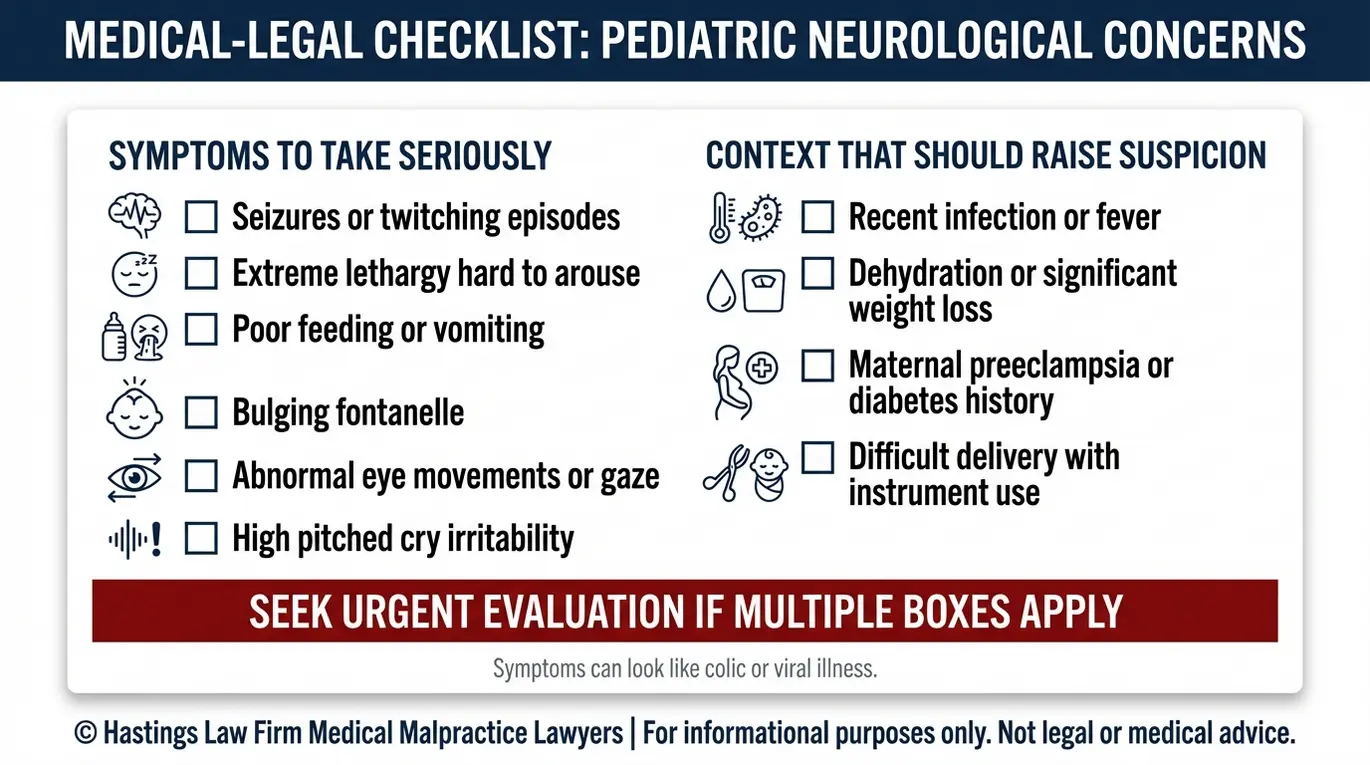
Common warning signs of CVST in infants include seizures, extreme lethargy, poor feeding, a bulging fontanelle, and abnormal eye movements. Many of these symptoms are subtle, and some overlap with more common, less serious conditions. That overlap is the reason experienced clinicians are expected to consider CVST when a cluster of these signs appears.
Here are the symptoms and risk factors that should prompt a closer evaluation:
Infant Symptoms:
- Seizures, including subtle seizure activity such as repetitive lip-smacking or eye-fluttering
- Extreme lethargy or difficulty waking the infant
- Poor feeding or refusal to feed
- Bulging fontanelle, the soft spot on the top of the baby’s skull that appears swollen or tense due to increased pressure inside the skull
- Abnormal or “sun-setting” eye movements
- Irritability that does not respond to normal soothing
- Vomiting without an obvious gastrointestinal cause
Maternal and Perinatal Risk Factors:
- Signs of fetal distress during labor
- Preeclampsia or gestational diabetes
- Difficult or prolonged delivery
- Use of forceps or vacuum extraction during birth
- Maternal infection or dehydration
- Family history of clotting disorders
According to Nationwide Children’s Hospital, stroke symptoms in children can be easily missed because they may not match the classic adult presentation. In newborns, seizures are frequently the first and sometimes only visible sign.
Too often, these symptoms are attributed to colic, a viral illness, or general newborn fussiness. When a medical team dismisses or fails to investigate a combination of these warning signs, especially in the presence of known risk factors, that can fall below the accepted standard of care. An infant brain injury attorney can evaluate whether the clinical picture should have triggered earlier diagnostic testing.
Diagnosing Infant CVST and The Critical Role of Imaging
Diagnosis of CVST requires specific neuroimaging such as MRI with venography (MRV) or CT venography (CTV), as standard non-contrast CT scans frequently miss venous clots entirely. A missed diagnosis attorney often finds that the right test was never ordered, leading to critical delays.
A non-contrast CT scan is often the first imaging study performed in an emergency setting, and it can identify bleeding or large areas of brain damage. But it was not designed to visualize blood flow through the venous sinuses. Similarly, a cranial ultrasound, while useful for detecting certain structural abnormalities in newborns, has significant limitations in identifying venous thrombosis.
Venography, a specialized imaging technique that maps blood flow through veins, is the diagnostic standard for confirming CVST. The two primary forms are:
- MR venography (MRV): Uses magnetic resonance imaging to visualize venous blood flow without radiation. This is generally the preferred method for infants.
- CT venography (CTV): Uses a contrast-enhanced CT scan to image the venous sinuses. It involves radiation exposure but can be performed more quickly.
The standard of care typically calls for escalation to one of these venography studies when an infant presents with unexplained seizures, signs of increased intracranial pressure, or imaging findings that suggest venous congestion. A study published in PubMed Central on cerebral venous sinus thrombosis in children reinforces that early and appropriate imaging is directly tied to better outcomes.
Time matters. Every hour of delayed diagnosis is an hour during which the clot may expand, intracranial pressure may rise, and additional brain tissue may be damaged. As a CVST misdiagnosis lawyer, we review cases to examine the timeline closely: when symptoms appeared, what imaging was ordered, what imaging was *not* ordered, and how long it took for the correct diagnosis to be made.
The Empty Delta Sign and Radiologic Evidence
One of the hallmark radiologic signs on imaging that can confirm CVST is the empty delta sign, a triangular area of contrast enhancement surrounding a dark, unenhanced clot in the superior sagittal sinus on a contrast-enhanced CT scan. This sign is a specific pattern on a brain scan showing a blockage in a major vein. When present, these imaging findings strongly suggest venous thrombosis.
A radiologist who fails to identify or report this finding may have missed a critical diagnostic clue. Another diagnostic consideration involves the D-dimer, a blood test that measures a protein fragment produced when a blood clot dissolves.
While an elevated D-dimer can suggest clotting activity, D-dimer testing has limitations in ruling out CVST. Doctors who rely primarily on lab work when imaging is warranted may be falling below the standard of care. Our team examines whether clinical decision-making was based on lab work alone when imaging was warranted.

Medical Treatment Standards and Failure to Treat
Standard treatment for infant CVST often involves anticoagulation therapy to prevent the clot from growing, along with supportive care including hydration and seizure management. When treatment is delayed or withheld, the consequences can be severe and irreversible.
Discussing treatment options, doctors typically prioritize anticoagulation therapy, which uses blood-thinning medications to reduce the body’s ability to form new clots. Heparin or low molecular weight heparin (LMWH) are commonly used anticoagulants for confirmed CVST in infants. Treatment options must be weighed carefully, but anticoagulation is often a key component of therapy.
Heparin is often chosen because its effects can be reversed quickly if bleeding complications arise. Throughout this process, maintaining hydration is important to ensure blood viscosity remains low, aiding flow through collateral veins. The medical team must strike a delicate balance between thinning the blood to dissolve the clot and preventing new bleeds. According to research published in PubMed Central on delayed CVST diagnosis and treatment, delays in initiating appropriate therapy can significantly worsen patient outcomes.
There is a treatment window with CVST. The sooner anticoagulation begins after diagnosis, the better the chance of limiting clot progression and reducing secondary brain injury. Alongside anticoagulation, the care team typically addresses seizures with anticonvulsant medications and monitors intracranial pressure to prevent further damage.
One factor that offers some hope in pediatric cases is neuroplasticity, the developing brain’s ability to reorganize and form new neural pathways. Infants treated early may have a greater capacity for recovery than older patients. But neuroplasticity is not a guarantee of full recovery, and its potential diminishes with every hour that effective treatment is delayed.
When we evaluate a potential failure to treat infant stroke case, we look at whether the medical team initiated anticoagulation promptly after diagnosis, whether seizure management was adequate, and whether delays in treatment allowed preventable injury to progress.
Establishing Liability for Missed CVST Diagnoses in Texas
To file a medical malpractice claim in Texas, you must demonstrate that the medical provider failed to follow the accepted standard of care and that this failure directly caused your infant’s worsening condition or permanent injury. These cases require both medical and legal proof, and the process in Texas has specific procedural requirements.
The standard of care refers to the level of treatment a reasonably competent medical professional with similar training and experience would have provided under the same circumstances. For a neonatologist or pediatric neurologist, this standard is measured against what other specialists in that field would have done. For a radiologist, it is measured against what another radiologist should have identified on imaging.
Proving causation is equally important. It is not enough to show that a doctor missed the diagnosis. You must also establish that the delay or failure made the injury worse than it otherwise would have been. This is where expert analysis becomes essential.
Here is how the legal process generally works in a Texas infant CVST malpractice case:
- Case evaluation: Medical records are reviewed by our in-house medical team to identify potential breaches in care.
- Expert report (Chapter 74 requirement): Under the Texas Civil Practice and Remedies Code, Section 74.151, a qualified medical expert must provide a written report within 120 days of filing suit. This report must identify the standard of care, how it was breached, and how the breach caused injury.
- Investigation and discovery: We build a detailed timeline using hospital records, imaging studies, nursing notes, lab results, and communication logs. The discovery phase allows your attorney to secure evidence that might otherwise be lost. We conduct depositions of the medical staff to pinpoint exactly when the standard of care was breached.
- Expert testimony: National medical experts provide testimony connecting the diagnostic failure to the child’s injuries.
The 120-day expert report deadline is also strict; missing it can be fatal to a case. This makes retaining a knowledgeable Texas infant CVST attorney early in the process essential to meeting procedural hurdles. Multiple parties may bear liability in these cases. Obstetricians, pediatricians, neonatologists, radiologists, emergency physicians, and the hospital itself can all be named as defendants depending on who was involved in the infant’s care.
As a Texas infant cerebral venous sinus thrombosis lawyer, Hastings Law Firm investigates each potential point of failure and works with qualified medical experts to determine whether the care your child received fell below acceptable standards.
Compensation for Lifelong Injuries Caused by CVST
Compensation in infant CVST cases covers past and future medical expenses, life care planning costs, pain and suffering, and loss of future earning capacity. Because these injuries often produce permanent neurological consequences, the financial scope of a claim reflects the lifetime of care a child may need.
Children who suffer brain damage from delayed CVST diagnosis may develop cerebral palsy, epilepsy, cognitive disabilities, motor impairments, or developmental delays. The cost of managing these conditions over a full lifetime is substantial, and a thorough claim accounts for every anticipated need.
Economic damages are the measurable financial losses, including:
- Past and future surgeries and hospitalizations
- Physical therapy, occupational therapy, and speech therapy
- Anticonvulsant medications and ongoing neurological care
- Specialized educational services, including Individualized Education Programs (IEPs)
- Home modifications such as wheelchair ramps or accessible bathrooms
- In-home nursing care or personal attendant services
- Assistive technology and adaptive equipment
Non-economic damages address the human cost:
- Physical pain and suffering
- Physical impairment and loss of bodily function
- Mental anguish experienced by the child and, in some cases, the parents
- Loss of enjoyment of life and diminished quality of life
A central piece of any birth injury compensation claim is the life care plan, a document prepared by a qualified expert that projects the full cost of the child’s medical, therapeutic, educational, and daily living needs over their expected lifespan.
A life care plan is more than a list of expenses; it is a complete roadmap for the child’s future. It accounts for inflation in medical costs, the replacement of prosthetic or adaptive devices, and the specialized nursing care required as parents age.
We also calculate the loss of future earning capacity, projecting what your child could have achieved professionally had the injury not occurred. In a cerebral palsy lawsuit Texas families pursue, these calculations ensure financial security. In Texas, there is no cap on economic damages in medical malpractice cases. The full cost of your child’s projected care is recoverable. Non-economic damages are capped at $250,000 against all physicians and healthcare providers combined, and up to $250,000 per hospital (maximum $500,000 for multiple hospitals), for a total maximum of $750,000 when both provider and hospital defendants are involved. Economic damages often represent the largest portion of the total recovery in serious CVST cases.
Why Choose Hastings Law Firm for Your Infant Injury Case
As a premier medical malpractice law firm Texas residents trust, Hastings Law Firm brings together board-certified legal expertise and in-house medical knowledge to ensure that every medical record is carefully analyzed for evidence of negligence. Since 2005, our firm has focused exclusively on medical malpractice to ensure accountability and safer healthcare for families. This combination of skills is not common in personal injury law, and it makes a meaningful difference in how infant brain injury cases are investigated and presented.
Our firm was founded by Tommy Hastings, a board-certified trial attorney recognized by the Texas Board of Legal Specialization, a distinction held by fewer than two percent of Texas attorneys. Our legal team includes former defense attorneys and hospital nurses who bring insider insight into the hospital systems we challenge. Every case we accept is prepared from day one as if it will go to a jury.
This trial-ready approach means we conduct a full medical reconstruction of the events, retain qualified experts early, and build the evidentiary foundation before negotiations begin. Defense attorneys and insurance carriers know this about our firm, and that preparation translates into stronger outcomes at every stage of the process.
Our team includes former defense attorneys who previously represented hospitals, giving us direct insight into the strategies the other side will use. We also employ nurse practitioners and board-certified patient advocates who review records, identify charting inconsistencies, and help translate clinical data into evidence a jury can understand.
We handle all medical malpractice cases on a contingency fee basis. You pay no attorney fees or costs unless we recover compensation on your behalf. We understand that your family is already carrying an enormous burden, and we designed our process to minimize your stress while we do the work.
Contact the Texas Birth Injury Attorneys at Hastings Law Firm Today for Help
If your child was diagnosed with cerebral venous sinus thrombosis and you believe earlier detection could have changed the outcome, our team is ready to review what happened. We will examine your child’s medical records, consult with the appropriate medical experts, and give you an honest assessment of whether a viable claim exists. Reach out for a free case evaluation to learn more.
Time limits do apply to medical malpractice claims in Texas, so reaching out sooner gives us the best opportunity to preserve evidence and protect your family’s rights.
Contact Hastings Law Firm today for a free, confidential case evaluation. There is no fee unless we win.
Frequently Asked Questions About Cerebral Venous Sinus Thrombosis in Texas


This content was researched and written by the Hastings Law Firm editorial team, which includes attorneys, medical professionals, and experienced researchers. Our writing is informed by internal knowledge and practical experience, and we cross-check critical details against authoritative sources cited throughout. Every piece undergoes human-led fact-checking and legal review. Because legal and medical information can change, if you spot an error, please contact us. Learn more about our content standards and review process on our editorial policy page.

Tommy Hastings, founder of Hastings Law Firm, is a board-certified personal injury trial lawyer dedicated exclusively to healthcare injury cases. Since 2001, he has represented injured patients and families in litigation against major hospital systems, pharmaceutical companies, and negligent healthcare providers nationwide. He has handled numerous high-profile cases that have drawn national media attention and resulted in multi-million dollar recoveries. He draws on that experience in his writing, helping readers understand how these cases work and what options may be available to them.
