


Texas Clavicle Fracture Birth Injury Lawyer
Written by: Hastings Law Firm | Reviewed by: Tommy Hastings | Updated: July 27, 2026
A broken collarbone during delivery can be terrifying for a family, especially when there are signs it might have been preventable. Some newborn clavicle fractures happen even with appropriate care, but others are linked to excessive traction, poor management of shoulder dystocia, or a failure to adjust the delivery plan when risks were known. A fracture can also signal more serious nerve injury that affects long term development and daily function. If you or a loved one were harmed or worse due to a clavicle fracture birth injury in Texas, contact Hastings Law Firm for a free, confidential case review.

Representing Families Impacted by Preventable Birth Trauma in Texas
What You Should Know About Infant Broken Collarbone Claims in Texas:
- Long term disability can follow a newborn clavicle fracture when excessive traction also damages the brachial plexus nerves.
- Options for financial recovery can depend on whether the delivery team deviated from the standard of care rather than an unavoidable complication.
- Serious disputes often focus on whether shoulder dystocia was managed without dangerous pulling on the head and neck.
- Preventable injury concerns can increase when forceps or vacuum extraction continues despite stalled progress or warning signs.
- Missed opportunities to change the delivery plan can matter when prenatal records document risk factors such as large baby size or breech presentation.
- The most severe outcomes can be overlooked when a fracture is treated as routine and follow up testing is not performed.
- Recovery can include both financial losses and human harms such as therapy needs pain and suffering and loss of future earning capacity.
- Legal options can narrow over time for both the child and the parents claims under Texas time limits.
- Access to key evidence can become harder as time passes because electronic records fetal monitoring data and staff schedules may be difficult to obtain.
- Medical records and imaging findings can be central to understanding what happened during labor delivery and newborn evaluation.

A Healthcare Focused Law Firm
Learning that your newborn suffered a broken collarbone during delivery is frightening, and it can leave you with painful questions about whether it could have been prevented. If you suspect that something went wrong in the delivery room, you are not alone in feeling that way, and your instinct to seek answers deserves to be taken seriously.
At Hastings Law Firm, our team of attorneys, in-house nurses, and medical consultants focuses exclusively on medical malpractice. We understand the medical details behind birth injuries, and we know how to determine whether the care your child received fell below acceptable standards. As your Texas clavicle fracture birth injury lawyer, we can review what happened during your delivery and explain your legal options at no cost to you.
Distinguishing Unavoidable Trauma from Medical Malpractice in Clavicle Fractures
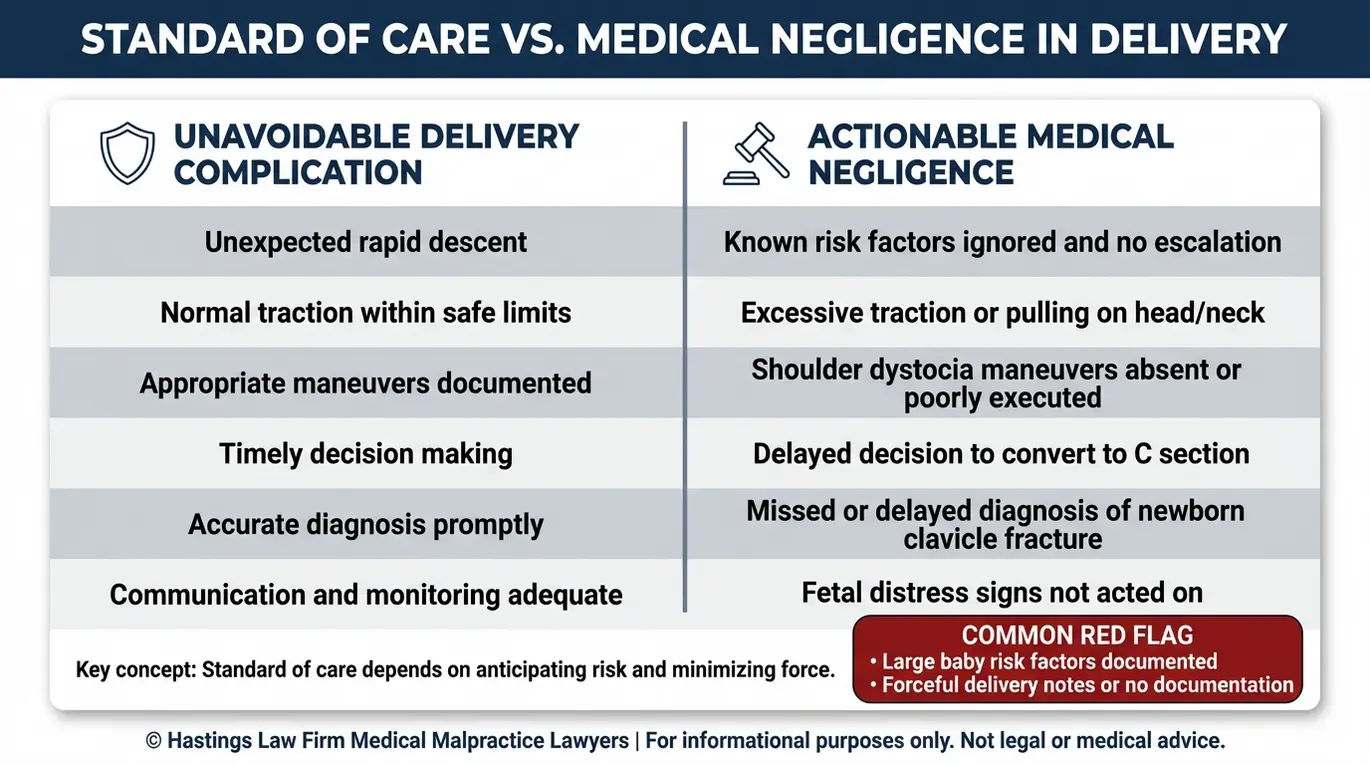
A newborn clavicle fracture (broken collarbone) becomes a matter of medical malpractice when it results from a deviation from the standard of care, the level of treatment a reasonably competent obstetrician would have provided under similar circumstances. Examples include failing to recommend a C-section despite known risk factors or applying excessive force during delivery.
Not every broken collarbone during birth is the result of medical negligence. Some fractures occur even when the delivering physician does everything right. The critical question is whether the medical team anticipated and properly managed the risks.
When a baby is large, when the mother has a narrow birth canal (a condition called cephalopelvic disproportion, or CPD), or when labor stalls, the standard of care requires the obstetric team to adjust the delivery plan. Failing to do so can cross the line from an unavoidable complication into obstetric mismanagement.
Under Texas Civil Practice and Remedies Code, Chapter 74, a medical malpractice claim requires proof that the provider’s actions fell below the accepted standard and directly caused the injury. A Texas birth injury attorney or clavicle fracture lawyer can help determine which side of that line your child’s birth trauma falls on.
| Factor | Unavoidable Complication | Actionable Negligence |
|---|---|---|
| Baby’s position | Sudden, unpredictable shift during delivery | Known breech presentation with no change in birth plan |
| Shoulder obstruction | Mild dystocia resolved with approved maneuvers | Excessive pulling on the head during shoulder dystocia |
| Baby’s size | Average-weight baby with unexpected difficulty | Documented macrosomia with no C-section discussion |
| Use of instruments | Appropriate, brief use with proper technique | Aggressive or prolonged forceps/vacuum use despite failed progress |
Common Causes Involving Forceps Vacuum Extractors and Shoulder Dystocia
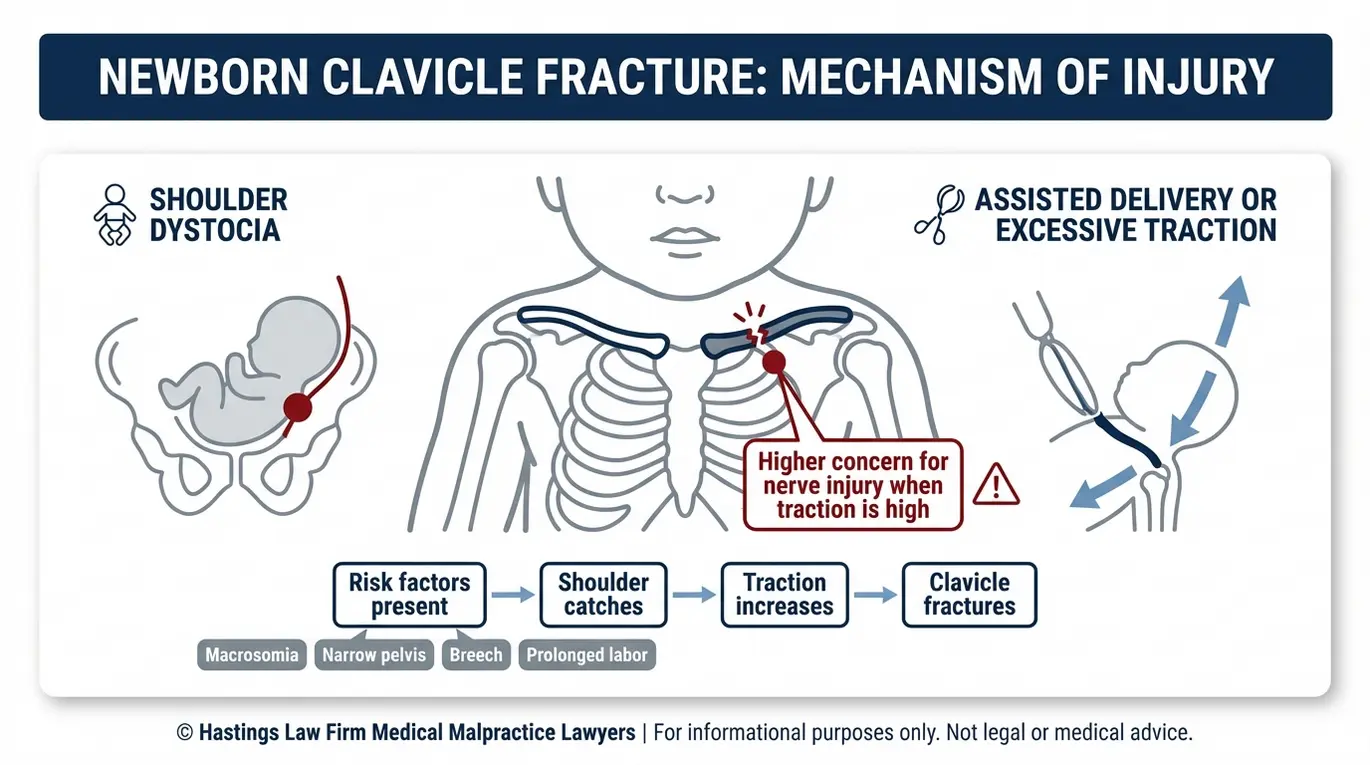
The most frequent causes of negligent clavicle fractures are improper management of shoulder dystocia, the aggressive use of forceps or vacuum extractors, and failure to recommend a C-section when the baby is too large for a safe vaginal delivery.
Shoulder dystocia, a recognized obstetric emergency where the baby’s shoulder becomes lodged behind the mother’s pubic bone, requires specific responses. The standard of care calls for well-practiced maneuvers to free the shoulder without applying dangerous downward traction on the baby’s head and neck. When a physician pulls too hard, the clavicle can fracture under the force. Research published by the National Institutes of Health on incidence and risk factors for shoulder dystocia confirms that certain maternal and fetal characteristics significantly increase the likelihood of this complication.
Operative vaginal delivery, meaning the use of forceps or a vacuum extractor to assist the baby through the birth canal, carries its own risks. These instruments can be appropriate in certain situations, but they should be abandoned in favor of a C-section when progress stalls or when warning signs are present.
Risk factors that should alert the medical team include:
- Macrosomia (high birth weight): Babies estimated at over 4,000 to 4,500 grams face higher delivery risks
- Cephalopelvic disproportion: The baby’s head or body is too large relative to the mother’s pelvis
- Breech presentation: The baby is not positioned head-down before labor
- Prolonged or difficult labor: Labor that fails to progress despite intervention
- History of shoulder dystocia: A prior delivery complicated by shoulder obstruction
When these risk factors are present and documented in prenatal records, a birth injury lawyer in Texas or newborn clavicle fracture attorney will examine whether the delivery team developed an appropriate plan or ignored the warning signs.
The Hastings Law Firm Difference
Results matter, but what truly sets us apart is how we achieve them. Every verdict, every settlement, and every Texas courtroom victory comes from one guiding promise: To treat each client’s fight for justice as if it were our own.
This balance of skill, experience, and empathy reflects our core philosophy that justice should not only compensate the injured, but also make healthcare safer nationwide.

The Critical Link Between Clavicle Fractures and Brachial Plexus Injuries
A fractured clavicle can be a red flag for accompanying nerve damage, specifically to the brachial plexus, the network of nerves running from the neck through the shoulder and down the arm. The same excessive traction that breaks the collarbone can stretch or tear these nerves, resulting in conditions like Erb’s palsy, a form of partial arm paralysis.
According to research published by the National Institutes of Health on neonatal brachial plexus palsy, early evaluation is essential for determining the extent of nerve involvement. While a clavicle fracture in a newborn typically heals within a few weeks, brachial plexus injuries can cause long-term developmental delays and disabilities that affect the child for life.
This is why immediate diagnostic imaging, including X-ray, ultrasound, and potentially MRI or CT scans, matters so much. A Texas clavicle fracture birth injury lawyer will look closely at whether the medical team performed appropriate follow-up testing or dismissed the injury as routine.
Long-Term Prognosis and Developmental Impact
A diagnosis of a “simple fracture” can sometimes mask a far more serious underlying injury. If the nerve roots were torn completely, a condition known as nerve root avulsion, the damage may be permanent and require surgical intervention. Nerve root avulsion occurs when the nerve is physically torn away from the spinal cord. Even a greenstick fracture, a partial break common in infants’ softer bones, should prompt careful evaluation for associated nerve involvement.
Children with undiagnosed or undertreated brachial plexus injuries may face permanent impairment affecting grip strength, arm mobility, and overall physical development. Ongoing physical therapy, potential surgeries, and adaptive support can become lifelong needs. Our birth injury legal team works to ensure these future costs are fully accounted for in every case we handle.
How Our Texas Medical Malpractice Team Investigates Your Case
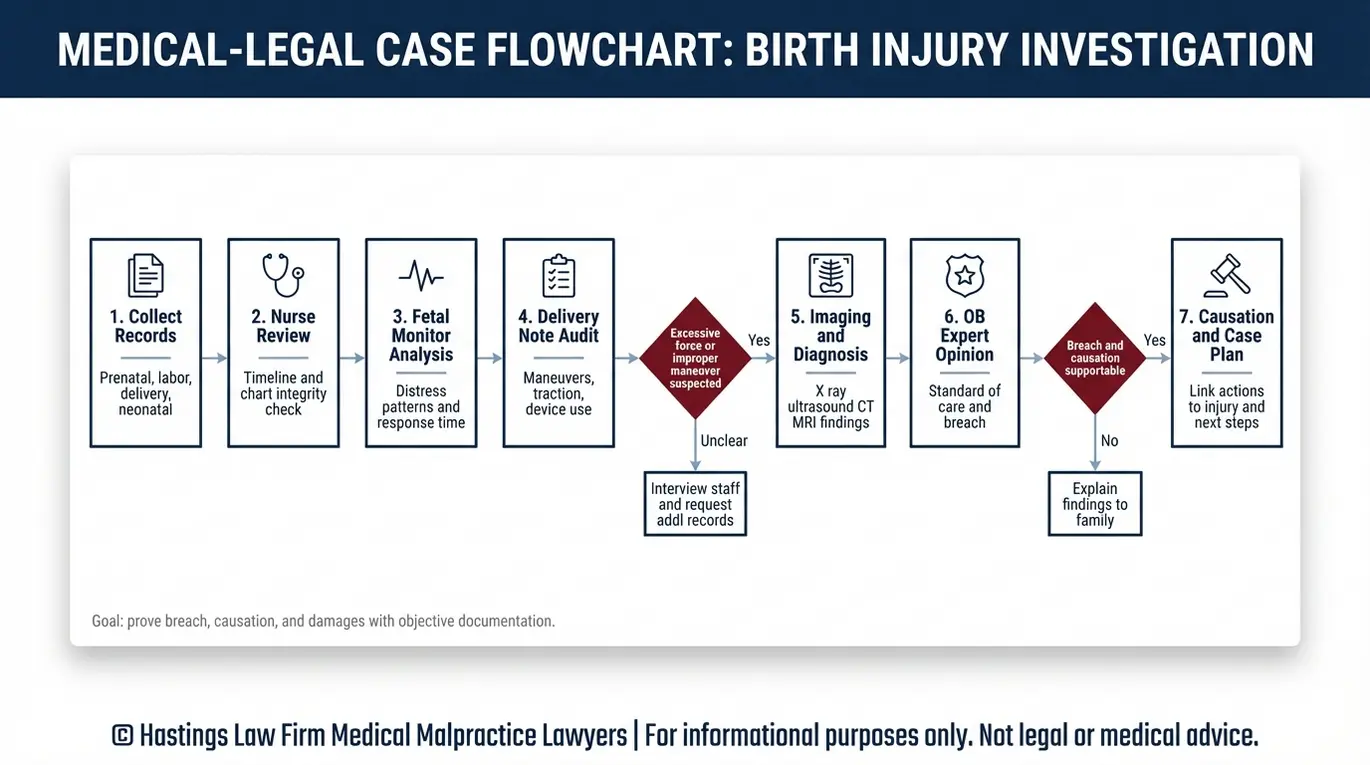
We utilize a trial-ready approach that includes record review by in-house nurses, consultation with board-certified obstetric experts, and depositions of delivery room staff to uncover evidence of excessive force or failure to intervene.
Our founder, Tommy Hastings, is board-certified in personal injury trial law and leads our team with over 20 years of experience focused on medical negligence. Here is how our Texas medical malpractice lawyer team builds a case as part of the birth injury lawsuit process:
- Step 1: Fetal monitoring strip review. We obtain and analyze the electronic fetal heart rate monitoring strips, the continuous recordings of the baby’s heart rate during labor, to identify signs of distress that should have prompted a change in the delivery plan. You have the right to obtain your medical records through the Texas Medical Board.
- Step 2: Delivery note analysis. We examine the operative report and nursing notes to determine whether the physician documented the maneuvers used to manage complications like shoulder dystocia, and whether those maneuvers were appropriate.
- Step 3: Expert witness testimony. Board-certified obstetric experts review the complete medical record and provide independent opinions on whether the standard of care was breached and whether that breach directly caused the clavicle fracture or associated nerve injury.
Our birth injury law firm also investigates whether macrosomia was identified on prenatal ultrasound and, if so, whether the medical team discussed delivery alternatives with the family. When a misdiagnosed clavicle fracture or delayed diagnosis is involved, we trace the timeline to determine what was missed and when.
We handle all of this on a contingency fee basis. As a no-win no-fee firm, you pay nothing unless we recover compensation for your family.
Recoverable Damages for Birth Injuries in Texas Courts
Recoverable damages in Texas birth injury cases include past and future medical expenses, physical and occupational therapy costs, pain and suffering, and loss of future earning capacity for the child. A Texas clavicle fracture birth injury lawyer will work to identify every category of loss that applies to your family’s situation.
Economic damages represent the actual financial costs your family pays for medical care and related needs:
- Emergency and follow-up medical bills
- Surgical procedures, including potential nerve repair
- Physical therapy and occupational therapy
- Adaptive equipment or assistive devices
Non-economic damages address the human toll:
- Pain and suffering damages and mental anguish experienced by the child
- Physical impairment and disfigurement
- Loss of quality of life
When a clavicle fracture is accompanied by permanent nerve damage such as Erb’s palsy, compensation for birth trauma can also include the projected future care costs. Medical experts and life care plan specialists help establish what the child will need, and our legal team works to make sure those future needs are reflected in any recovery.
Understanding the Texas Statute of Limitations for Minors
In Texas, minors under the age of 12 at the time of injury have until their 14th birthday to file a medical malpractice claim, but families should not wait. Understanding the statute of limitations for birth injury in Texas is essential, as a strict statute of repose under Texas Civil Practice and Remedies Code § 74.251 imposes a hard 10-year deadline that cannot be extended.
The parent’s own claims, such as medical expenses already incurred, may have a shorter filing window than the child’s claims for pain and impairment. Acting early also ensures evidence preservation, as electronic medical records, fetal monitoring data, and staff schedules can become harder to obtain as time passes.
*This information is for general educational purposes and should not be treated as legal advice specific to your situation. Contact an attorney to discuss your family’s deadlines.*
Contact the Texas Birth Injury Attorneys at Hastings Law Firm Today for Help
If your child was hurt during delivery, finding out what happened is the first step toward protecting their future. At Hastings Law Firm, we believe every family deserves honest answers, and that holding negligent providers accountable helps prevent the same thing from happening to someone else.
Our team includes former hospital nurses who help us analyze medical records from an insider’s perspective. Our Texas clavicle fracture birth injury lawyers charge no fees unless we win your case. The consultation is a free case evaluation, confidential, and led by medical professionals who understand both the clinical details and the emotional weight of what your family is going through.
You do not have to figure this out alone. Contact us today to request a free case evaluation and learn what options may be available for your child.
Frequently Asked Questions About Clavicle Fracture Birth Injury in Texas


This content was researched and written by the Hastings Law Firm editorial team, which includes attorneys, medical professionals, and experienced researchers. Our writing is informed by internal knowledge and practical experience, and we cross-check critical details against authoritative sources cited throughout. Every piece undergoes human-led fact-checking and legal review. Because legal and medical information can change, if you spot an error, please contact us. Learn more about our content standards and review process on our editorial policy page.

Tommy Hastings, founder of Hastings Law Firm, is a board-certified personal injury trial lawyer dedicated exclusively to healthcare injury cases. Since 2001, he has represented injured patients and families in litigation against major hospital systems, pharmaceutical companies, and negligent healthcare providers nationwide. He has handled numerous high-profile cases that have drawn national media attention and resulted in multi-million dollar recoveries. He draws on that experience in his writing, helping readers understand how these cases work and what options may be available to them.
