


Texas NICU Malpractice Lawyer
Written by: Hastings Law Firm | Reviewed by: Tommy Hastings | Updated: July 27, 2026
NICU care involves fragile newborns who depend on constant monitoring, accurate medication dosing, safe respiratory support, and timely treatment. When a preventable mistake happens, families can face lasting medical needs, emotional trauma, and in the most severe situations, wrongful death. Understanding how NICU negligence can occur helps clarify why accountability often turns on staffing, communication during transfers, and whether the standard of care was met in a high acuity setting. If you or a loved one were harmed or worse due to NICU malpractice in Texas, contact Hastings Law Firm for a free, confidential case review.
Protecting the Most Vulnerable Patients in Texas Healthcare
What You Should Know About Infant Intensive Care Negligence Claims in Texas:
- Life changing harm can follow NICU negligence because premature and critically ill infants are highly vulnerable to small errors.
- Accountability can extend beyond an individual clinician when hospital staffing problems or broken protocols contribute to harm.
- Dangerous delays can occur during transfers to higher level NICUs when handoffs break down between referring and receiving teams.
- Severe outcomes can include permanent disabilities and wrongful death when oxygen deprivation, infection, or other critical problems are not addressed in time.
- Medication dosing mistakes can cause catastrophic injury because NICU drugs are calculated by weight and small miscalculations can lead to overdose.
- Respiratory management errors can cause serious injury because intubation and extubation mistakes can lead to airway trauma and oxygen deprivation.
- Infection control failures can worsen outcomes because delayed recognition and treatment can allow rapid deterioration in newborns.
- Safety risks can increase in private room NICU layouts when reduced visibility and alarm fatigue delay responses to critical changes.
- Options can be lost in Texas if required malpractice filings are not completed, including an expert report requirement tied to Chapter 74.
- Key records can become harder to rely on over time because medical charts and electronic monitoring data may be altered or lost.

A Healthcare Focused Law Firm
When your newborn is admitted to the Neonatal Intensive Care Unit (NICU), a specialized hospital unit designed to care for critically ill or premature infants, you place extraordinary trust in the medical team responsible for your child’s survival. If a preventable error broke that trust, the weight of what happened can feel overwhelming.
You may be searching for answers about what went wrong and whether anyone will be held accountable. As a Texas NICU Malpractice Lawyer, Hastings Law Firm focuses exclusively on medical malpractice, and our team includes in-house medical professionals who understand the clinical realities of neonatal care. We can review what happened to your baby and explain your legal options in a free, confidential consultation.
Identifying Negligence in the Neonatal Intensive Care Unit
Negligence in the NICU occurs when a neonatologist, nurse, or other hospital staff member deviates from the accepted standard of care, resulting in preventable harm to a premature or critically ill infant. The standard of care refers to the level of treatment a reasonably competent medical professional with similar training would provide under the same circumstances. Level III or Level IV NICUs handle complex cases like extreme prematurity and surgical needs. In these units, the standard of care is exceptionally high.
These units are staffed by neonatologists, physicians who specialize in the care of newborns with serious medical conditions, along with specially trained nurses, respiratory therapists, and other support staff. Our firm uses insight from former defense attorneys and hospital nurses to identify inconsistencies in medical records. An experienced NICU injury lawyer knows that liability in a medical malpractice case depends on who made the error and what their role required.
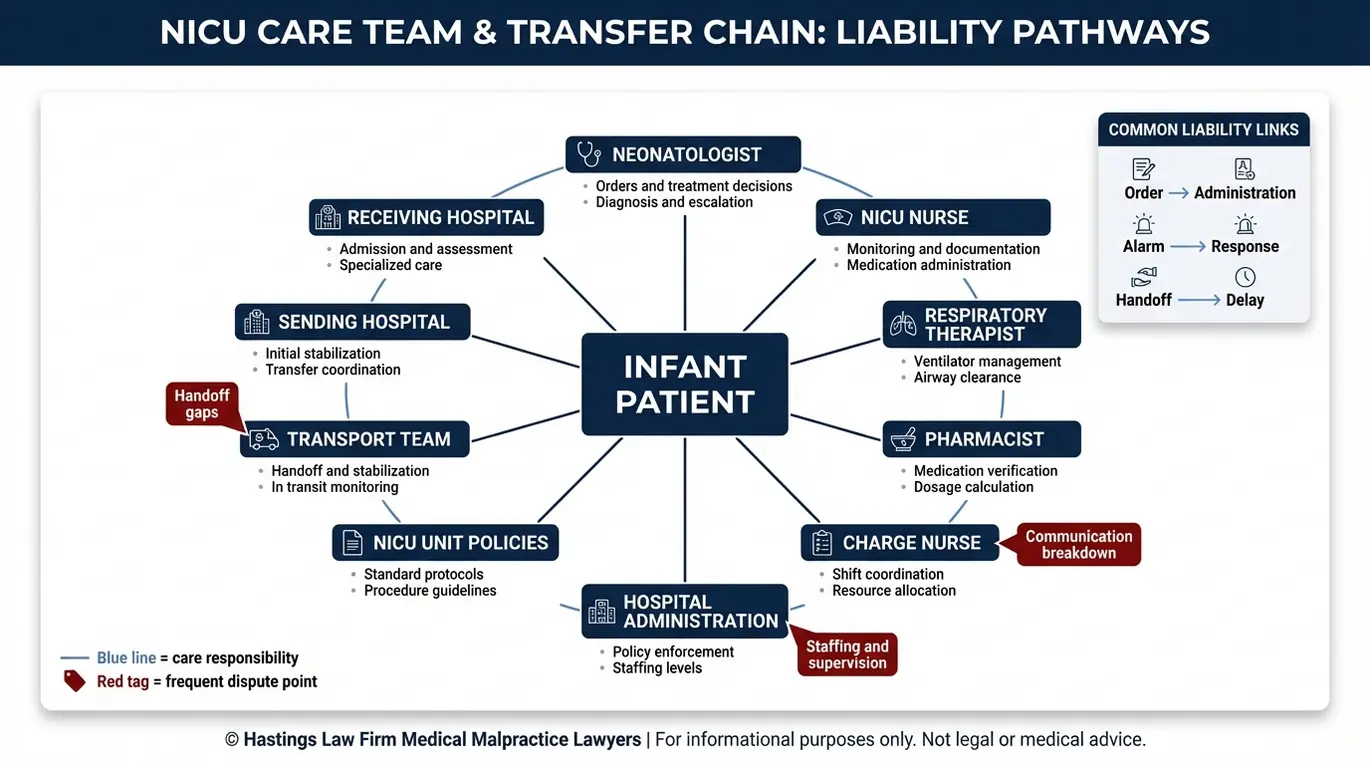
Neonatologists bear responsibility for diagnosis and treatment decisions, while NICU nurses are accountable for continuous monitoring, medication administration, and carrying out physician orders. The hospital itself may also be liable if institutional failures, such as inadequate staffing or broken protocols, contributed to the harm.
One area we examine closely involves regional transfer logistics. Many Texas hospitals lack Level III or IV NICU capabilities, which means a critically ill newborn may need to be transported to a higher-level facility. Errors during these handoffs, including communication breakdowns between the referring and receiving teams, can cause dangerous delays.
Structured communication tools like SBAR (Situation-Background-Assessment-Recommendation) are designed to reduce these risks. When transfer protocols are not followed, the consequences for a fragile infant can be severe. All NICU negligence claims in Texas are governed by the Texas Civil Practice and Remedies Code Chapter 74, which sets specific procedural requirements for filing a medical malpractice lawsuit.
Common Medical Errors Committed by Neonatal Teams
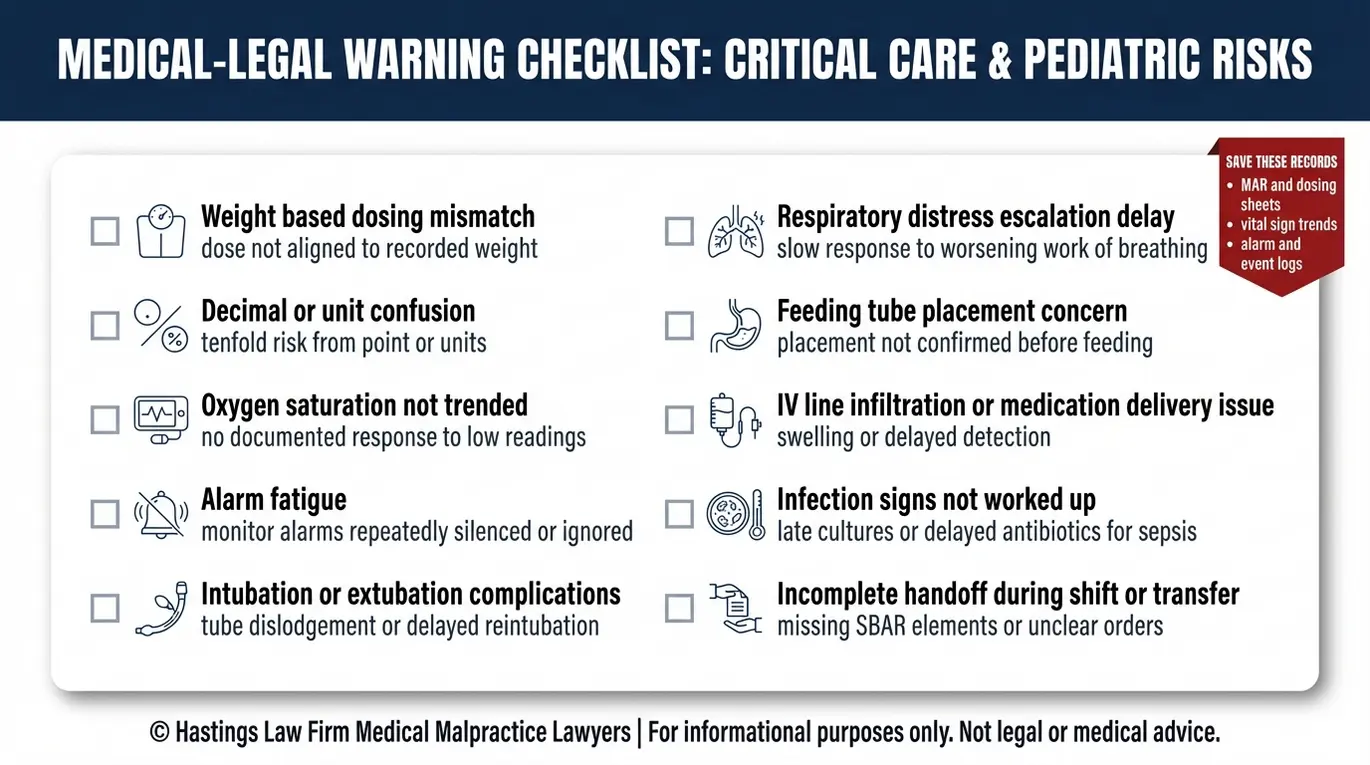
Common NICU errors include medication dosage mistakes, failure to monitor oxygen saturation levels, improper intubation or extubation, and failure to diagnose infections like sepsis or meningitis in a timely manner. Neonatal care involves treating newborns with complex medical needs during their first days of life. Infants in the NICU are physically fragile, and even a small error can lead to life-changing results. Our Texas medical negligence counsel frequently investigates errors such as:
- Decimal-point or unit-conversion mistakes in medication dosing
- Delayed or failed intubation and unsafe extubation timing
- Failure to identify and treat signs of neonatal sepsis
- Oxygen saturation drops that went unmonitored or unaddressed
- IV infiltration injuries from improperly placed or maintained lines
- Monitor alarms that were silenced, ignored, or improperly configured
Medication Errors
One of the most dangerous categories involves weight-based dosing errors. Medications in the NICU are calculated in milligrams per kilogram (mg/kg) of body weight. For an infant weighing less than two pounds, a misplaced decimal point can mean a tenfold overdose.
Research published by PLOS ONE on medication administration errors in NICUs confirms that these mistakes lead to serious medical and financial problems. Dosage errors may involve antibiotics, sedatives, or vasopressors, and even a single miscalculation can cause organ damage or death.
Respiratory Management Failures
Premature infants often require endotracheal intubation, the insertion of a breathing tube into the airway, to manage conditions like respiratory distress syndrome. Errors during intubation or extubation, the process of removing that tube, can lead to airway trauma, oxygen deprivation, or collapse of the lungs. Oxygen saturation drops represent critical monitoring failures that went unaddressed if staff are not vigilant.
Infection Control Failures
Neonatal teams are expected to recognize early signs of infection, including Group B streptococcus (GBS) and sepsis. Sepsis is a serious infection that spreads through the blood and can lead to organ failure. Delayed testing or treatment of these conditions can lead to rapid deterioration in a newborn whose immune system is not yet developed.
Equipment Issues and Alarm Fatigue
NICU care depends on technology: feeding tubes, intravenous lines, ventilators, and electronic monitors. When equipment malfunctions or when alarms are ignored due to alarm fatigue, a condition where staff become desensitized to frequent alerts, the results can be life-threatening. The Agency for Healthcare Research and Quality (AHRQ) has identified alarm safety in hospitals as a persistent patient safety concern.
The Hastings Law Firm Difference
Results matter, but what truly sets us apart is how we achieve them. Every verdict, every settlement, and every Texas courtroom victory comes from one guiding promise: To treat each client’s fight for justice as if it were our own.
This balance of skill, experience, and empathy reflects our core philosophy that justice should not only compensate the injured, but also make healthcare safer nationwide.

Serious Injuries Resulting from NICU Negligence
Negligence in the NICU can lead to permanent disabilities such as cerebral palsy, hypoxic-ischemic encephalopathy (HIE), blindness from retinopathy of prematurity, severe brain damage, and wrongful death. A qualified birth injury attorney Texas families trust can help evaluate these outcomes.
| Condition | Description | Long-Term Consequences |
|---|---|---|
| :— | :— | :— |
| Hypoxic-Ischemic Encephalopathy (HIE) | Brain injury caused by oxygen deprivation and restricted blood flow. | Cognitive deficits, motor impairment, and seizures. |
| Cerebral Palsy | A group of disorders affecting movement and muscle tone. | Lifetime need for physical therapy and adaptive equipment. |
| Retinopathy of Prematurity (ROP) | Abnormal blood vessel growth in the retina. | Partial or total blindness requiring specialized education. |
HIE and Cooling Protocols
Hypoxic-ischemic encephalopathy (HIE) is a type of brain injury caused by oxygen deprivation, also known as birth asphyxia, combined with restricted blood flow to the brain. When HIE is identified, the current medical standard calls for therapeutic hypothermia, a treatment commonly called cooling therapy, where the infant’s body temperature is carefully lowered to slow brain cell death.
According to the National Center for Biotechnology Information (NCBI), this treatment must begin within approximately six hours of the oxygen-depriving event and is maintained for about 72 hours. Missing that window can mean the difference between recovery and permanent neurological damage.
Brain Injuries and Long-Term Consequences
Oxygen deprivation during the neonatal period can result in neonatal seizures, cognitive deficits, motor impairment, and developmental delays that affect the child for life. The severity depends on how long the brain was deprived of oxygen and how quickly the medical team intervened. In cases where the deprivation was prolonged or treatment was delayed, the resulting brain injury may require lifelong supportive care.
Wrongful Death
In the most tragic cases, preventable medical errors in the NICU result in the death of an infant. Texas law allows families to pursue wrongful death claims to hold responsible parties accountable and recover compensation for funeral expenses, loss of companionship, and the profound grief that follows.
The Private Room NICU Model and Patient Safety
Many newer NICU facilities have adopted a private-room NICU model, where each infant is housed in a separate room rather than in an open ward. This design offers benefits for infection reduction and noise control, both of which support neonatal development. However, private-room layouts can also create challenges for patient safety.
Reduced line-of-sight visibility means nurses may not be able to observe multiple infants simultaneously, which can delay response times. If monitoring failures occur because monitoring systems are inadequate or alarm fatigue, where staff become desensitized to frequent alerts, leads staff to miss critical alerts in isolated rooms, the design itself may contribute to hospital negligence. We evaluate whether a facility’s physical layout and staffing model met the standard of care required for safe neonatal monitoring.

Proving Causation and Building a Case
Building a successful NICU case requires a thorough review of medical records, electronic fetal monitoring strips, and staffing logs, supported by testimony from qualified medical experts who can certify the breach of care. This process is methodical, and every step matters.
Securing Documentation Early
One of the first things we do is obtain and preserve all relevant medical records. Hospital charts, nursing notes, medication administration records, and electronic monitor data can all contain evidence of what went wrong. In some cases, records may be altered or lost over time, making evidence preservation critical.
Expert Testimony
Texas law requires plaintiffs in medical malpractice cases to serve a preliminary expert report under Texas Civil Practice and Remedies Code Section 74.351. This report must be authored by a qualified expert witness, typically a neonatologist or pediatric specialist, who can identify the standard of care, explain how it was breached, and connect that breach to the infant’s injury. Our firm works with a national network of respected medical experts to build credible, well-supported opinions.
Establishing Causation
The most difficult element in many NICU cases is proving causation, meaning the error itself caused the injury rather than the infant’s underlying prematurity or illness. We look for diagnostic errors and counter defenses by constructing detailed medical timelines using SBAR-structured communication records, along with monitor data and lab results.
As a Texas NICU malpractice law firm, our legal team builds cases by:
- Obtaining and preserving all medical records, including electronic monitoring data, before any alterations occur
- Identifying the specific standard of care that applied in the NICU setting
- Retaining qualified neonatal experts to review the case and author the required Chapter 74 report
- Building a minute-by-minute clinical timeline to isolate the point where care deviated
- Establishing through expert analysis that the deviation, not the infant’s baseline condition, caused the harm
Compensation for Long-Term Infant Care and Trauma
Compensation in NICU cases covers past and future medical expenses, cost of specialized care and therapy, pain and suffering, physical impairment, and in tragic cases, funeral expenses and loss of companionship.
Economic damages often represent the largest portion of a NICU malpractice recovery. A child with a permanent brain injury or cerebral palsy may require decades of nursing care, physical and occupational therapy, adaptive equipment, and specialized education. A life care plan, developed by medical and vocational experts, calculates these future medical costs over the child’s expected lifetime.
Non-economic damages address the pain the child has endured and the emotional toll on the family. Parents who have watched their newborn suffer preventable harm carry that burden long after the NICU stay ends. In cases involving significant future care needs, structured settlements can provide a reliable stream of income over the child’s lifetime.
Contact the Texas Birth Injury Attorneys at Hastings Law Firm Today for Help
Your baby deserved safe, competent medical care. If that standard was not met, you have the right to seek answers and hold the responsible parties accountable.
Hastings Law Firm was built on a mission to restore trust for families who have been failed by the healthcare system and to enforce accountability that helps prevent the same errors from happening again. Our founder, Tommy Hastings, is board-certified in Personal Injury Trial Law and has spent over 20 years handling medical negligence cases.
Our team of attorneys, nurse consultants, and patient advocate professionals is ready to review your case and help you understand what happened. There is no fee unless we recover compensation for your family. But time limits do apply to medical malpractice claims in Texas, so we encourage you to act promptly.
Frequently Asked Questions About NICU Malpractice in Texas


This content was researched and written by the Hastings Law Firm editorial team, which includes attorneys, medical professionals, and experienced researchers. Our writing is informed by internal knowledge and practical experience, and we cross-check critical details against authoritative sources cited throughout. Every piece undergoes human-led fact-checking and legal review. Because legal and medical information can change, if you spot an error, please contact us. Learn more about our content standards and review process on our editorial policy page.

Tommy Hastings, founder of Hastings Law Firm, is a board-certified personal injury trial lawyer dedicated exclusively to healthcare injury cases. Since 2001, he has represented injured patients and families in litigation against major hospital systems, pharmaceutical companies, and negligent healthcare providers nationwide. He has handled numerous high-profile cases that have drawn national media attention and resulted in multi-million dollar recoveries. He draws on that experience in his writing, helping readers understand how these cases work and what options may be available to them.
