


Texas Birth-Related Subdural Hemorrhage Lawyer
Written by: Hastings Law Firm | Reviewed by: Tommy Hastings | Updated: July 27, 2026
A birth related subdural hemorrhage can leave families overwhelmed and unsure how an injury happened during delivery. The condition involves bleeding around the brain that can range from mild to severe, and preventable errors during labor can increase the risk of lasting harm. The discussion covers how excessive force, delayed intervention, and missed warning signs can contribute, along with how symptoms may appear immediately or later and why imaging findings matter. If you or a loved one were harmed or worse due to birth related subdural hemorrhage in Texas, contact Hastings Law Firm for a free, confidential case review.

Advocating for Texas Families Impacted by Infant Brain Bleeds
What You Should Know About Infant Brain Bleed Negligence Claims in Texas:
- Lifelong care needs and major financial strain can follow a severe infant brain bleed, especially when lasting neurological damage occurs.
- Disputes over whether an injury was unavoidable can shape outcomes, since some subdural bleeding can occur even in uncomplicated deliveries.
- Preventable delivery errors can be central to fault, including misuse of vacuum extractors or forceps and failure to move to a timely C section during fetal distress.
- Options for non economic recovery can be limited in Texas, because state law caps non economic damages while leaving economic damages uncapped.
- Long term complications can emerge over time, including cerebral palsy or epilepsy when severe injury leads to lasting impairment.
- Delayed recognition and treatment can matter, since records may distinguish active bleeding from a pooled and clotted collection of blood.
- The risk of serious injury can increase when vacuum extraction continues after repeated cup detachments.
- Diagnostic clarity can affect what is understood about severity, because MRI can reveal subtle injuries and the scope of brain tissue damage.
- Key evidence can be hard to challenge without documentation, since fetal monitoring strips and delivery records can show whether warning signs were acted on.
- Legal options can narrow if action is not taken promptly, because medical malpractice claims are subject to filing deadlines in Texas.

A Healthcare Focused Law Firm
Learning that your newborn has suffered a brain bleed during delivery can leave you searching for answers you may not yet have. You trusted your medical team to protect both you and your baby, and if that trust was broken through preventable error, you deserve to understand what happened and what options are available to you.
At Hastings Law Firm, we focus exclusively on medical malpractice, and birth injuries involving infant brain bleeds are among the most serious cases we handle. Our team includes in-house nurse consultants and former defense attorneys who know how to investigate these claims and identify where the standard of care may have failed. If you need a Texas birth-related subdural hemorrhage lawyer, we are here to review what happened during your delivery and explain your legal options at no cost.
Understanding Birth-Related Subdural Hemorrhages and Negligence
A birth-related subdural hemorrhage is a type of intracranial hemorrhage in which blood accumulates in the subdural space between the dura mater and the arachnoid membrane, protective layers that cover the brain. The dura mater is the outermost meningeal layer, and the arachnoid lies just beneath it. This type of newborn brain bleeding is distinct from head injuries seen in adults because it originates from the unique physical forces an infant’s skull experiences during labor and delivery.
During a vaginal delivery, the infant’s head is compressed as it moves through the birth canal. This pressure can stretch and tear the small bridging veins that connect the brain’s surface to the dura mater. When those veins rupture, blood leaks into the subdural space and begins to pool. According to research published in PubMed Central on birth-related subdural hemorrhage in asymptomatic newborns, some degree of subdural bleeding can even occur in uncomplicated deliveries. But when excessive force is applied, whether from improper technique or the misuse of delivery instruments, the resulting infant brain injury can be far more severe and may constitute medical negligence.
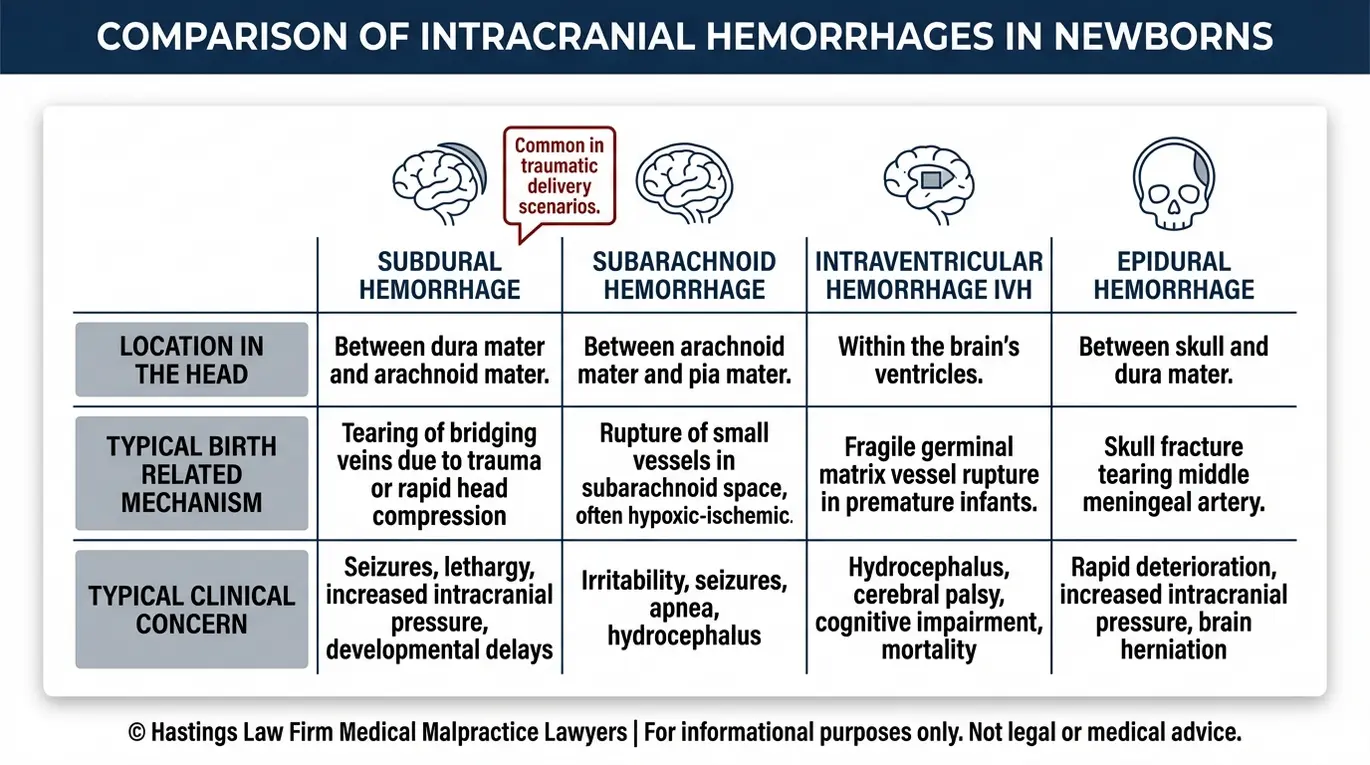
Not all infant brain bleeds are the same. They differ by location, cause, and severity. The table below outlines the four main types:
| Type | Location | Typical Severity |
|---|---|---|
| Subdural Hemorrhage | Between the dura mater and the arachnoid membrane | Mild to severe; large bleeds can cause lasting neurological damage |
| Subarachnoid Hemorrhage | Between the arachnoid membrane and the brain surface | Often mild in newborns; may resolve without intervention |
| Intraventricular Hemorrhage (IVH) | Within the brain’s ventricles (fluid-filled cavities) | Most common in premature infants; graded I–IV by severity |
| Epidural Hemorrhage | Between the dura mater and the skull bone | Rare in newborns; can be life-threatening if not treated promptly |
As described by the NCBI Bookshelf overview of intracranial hemorrhage, each type carries different clinical implications and requires specific diagnostic and treatment approaches.
The Distinction Between Hemorrhage and Hematoma
In medical records, you may see the terms “hemorrhage” and “hematoma” used in connection with your baby’s diagnosis. The distinction between these terms helps clarify the extent of the injury in a medical malpractice case. Medical records may distinguish between a hemorrhage, referring to active bleeding from a damaged vessel, and a hematoma, a localized collection of blood that has pooled and clotted.
This distinction matters in litigation. A documented hematoma can indicate how long bleeding persisted before it was identified and treated. When we review medical evidence in these cases, the timing and characterization of the brain bleed in imaging reports and clinical notes can reveal whether there were delays in diagnosis or intervention.
Common Causes of Infant Brain Bleeds During Labor
Preventable infant brain bleeds are frequently caused by the misuse of assisted delivery tools like forceps or vacuum extractors, or the failure to perform a timely cesarean section (C-section) during fetal distress. When delivery teams deviate from the accepted standard of care, the physical forces placed on an infant’s skull can cause serious and lasting harm.
A forceps delivery, which uses curved metal instruments placed around the baby’s head to guide it through the birth canal, carries inherent risks when performed improperly. Similarly, a vacuum extractor uses a soft cup attached to the baby’s scalp with suction to assist during contractions. It can cause traumatic intracranial bleeding if used with excessive force, incorrect positioning, or repeated failed attempts. The American College of Obstetricians and Gynecologists outlines specific criteria for when the misuse of delivery instruments should be avoided.
Prolonged labor also increases risk. When an infant is subjected to extended compression in the birth canal, especially when fetal monitoring shows signs of oxygen deprivation, the standard of care may require the medical team to change course and deliver by emergency C-section. A failure to act on those warning signs can lead to preventable injury.
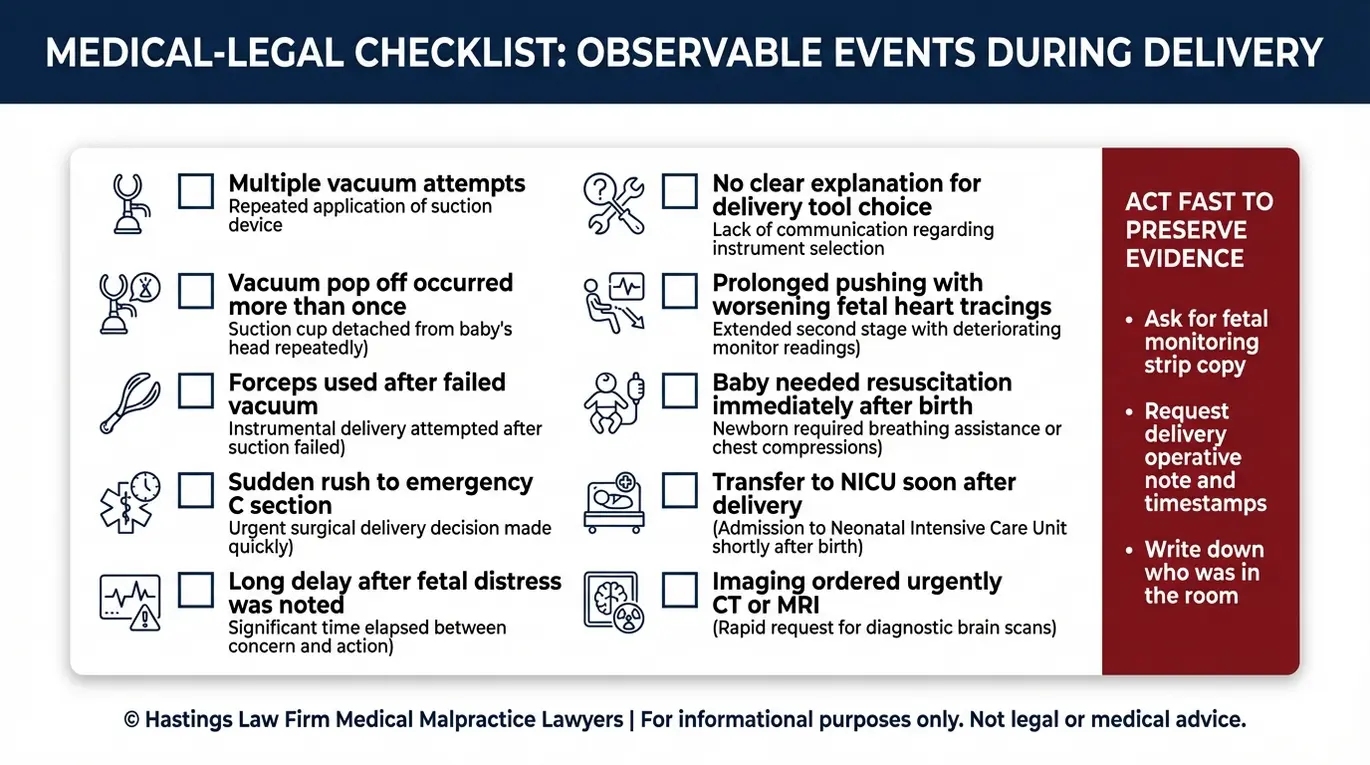
The following are red flags during delivery that our medical and legal team examines closely:
- Multiple attempts with a vacuum extractor or forceps before switching methods
- A rushed emergency C-section performed after a prolonged period of abnormal fetal heart tones
- Documented fetal distress on monitoring strips with no timely escalation or intervention
- Significant bruising, swelling, or visible trauma to the infant’s head at birth
- Use of both vacuum and forceps sequentially during the same delivery
- Delays between the recognition of a non-reassuring fetal status and the decision to deliver
The CDC’s maternal warning signs resource also identifies urgent indicators that, when present, demand immediate clinical action.
Preserving evidence in these cases is time-sensitive. Under Texas Civil Practice and Remedies Code Chapter 74, medical malpractice claims are subject to filing deadlines, so early investigation is essential to protecting your family’s rights.
The Three Pop-Offs Rule for Vacuum Extractors
The three pop-offs rule is a specific safety standard used during vacuum-assisted deliveries. One of the most specific and well-established standards in obstetric care involves the use of vacuum extractors. A pop-off is an event where the vacuum cup detaches from the baby’s scalp due to a break in the suction seal, and it is a critical safety metric.
The widely recognized standard of care limits the number of allowable pop-offs to three. If the vacuum detaches three times, the delivering physician is expected to abandon the vacuum-assisted approach and move to an alternative delivery method, typically a C-section. Continuing vacuum extraction beyond this threshold significantly increases the risk of subdural hemorrhage and other forms of brain injury.
When we investigate a birth injury case involving vacuum extraction, we examine the delivery notes and nursing records for documentation of each attempt. A breach of duty may exist when the medical team exceeded the accepted number of attempts or continued using the device despite clear signs it was not working safely.
The Hastings Law Firm Difference
Results matter, but what truly sets us apart is how we achieve them. Every verdict, every settlement, and every Texas courtroom victory comes from one guiding promise: To treat each client’s fight for justice as if it were our own.
This balance of skill, experience, and empathy reflects our core philosophy that justice should not only compensate the injured, but also make healthcare safer nationwide.

Recognizing Symptoms and Diagnosing the Injury
Symptoms of a subdural hemorrhage in newborns may include seizures, unusual lethargy, difficulty feeding, a bulging fontanelle (the soft spot on the top of an infant’s head that swells from increased pressure), or neonatal apnea, which is when a newborn has extended pauses in breathing. These signs are typically confirmed through neuroimaging tests performed in the NICU.
Some symptoms appear right away. Parents may notice that their baby seems unusually still, is not feeding well, or is having visible tremors or seizures in the hours after delivery. Medical staff may observe changes in the infant’s muscle tone, abnormal eye movements, or respiratory irregularity.
Other signs are less obvious and may not emerge until weeks or months later. Developmental delays, difficulty reaching motor milestones, or signs consistent with hypoxic-ischemic encephalopathy (HIE), a condition where oxygen deprivation and reduced blood flow cause brain tissue damage, can surface gradually. In severe cases, these delays may eventually lead to a diagnosis of cerebral palsy or epilepsy.
Imaging Specifics: Ultrasound vs. CT vs. MRI
Doctors use these imaging tools to diagnose brain bleeds and assess internal damage. Not all imaging tools provide the same level of detail, and this matters both medically and legally.
- Cranial ultrasound, a non-invasive imaging test performed through the fontanelle, is often the first study done because it is quick and portable. It can detect large bleeds but may miss smaller or more peripheral subdural hemorrhages.
- CT scan provides faster, more detailed cross-sectional images and is useful for detecting acute bleeding. It is often used in emergency situations.
- MRI is considered the gold standard for evaluating the full extent of brain tissue damage. It offers the highest resolution and can identify subtle injuries that a CT or ultrasound may miss.
From a legal perspective, the MRI findings are often the most important piece of medical evidence in a birth injury case. They can show not just the presence of a brain bleed, but the scope of tissue damage that supports claims for long-term care and compensation.
Proving Liability in Texas Birth Injury Cases
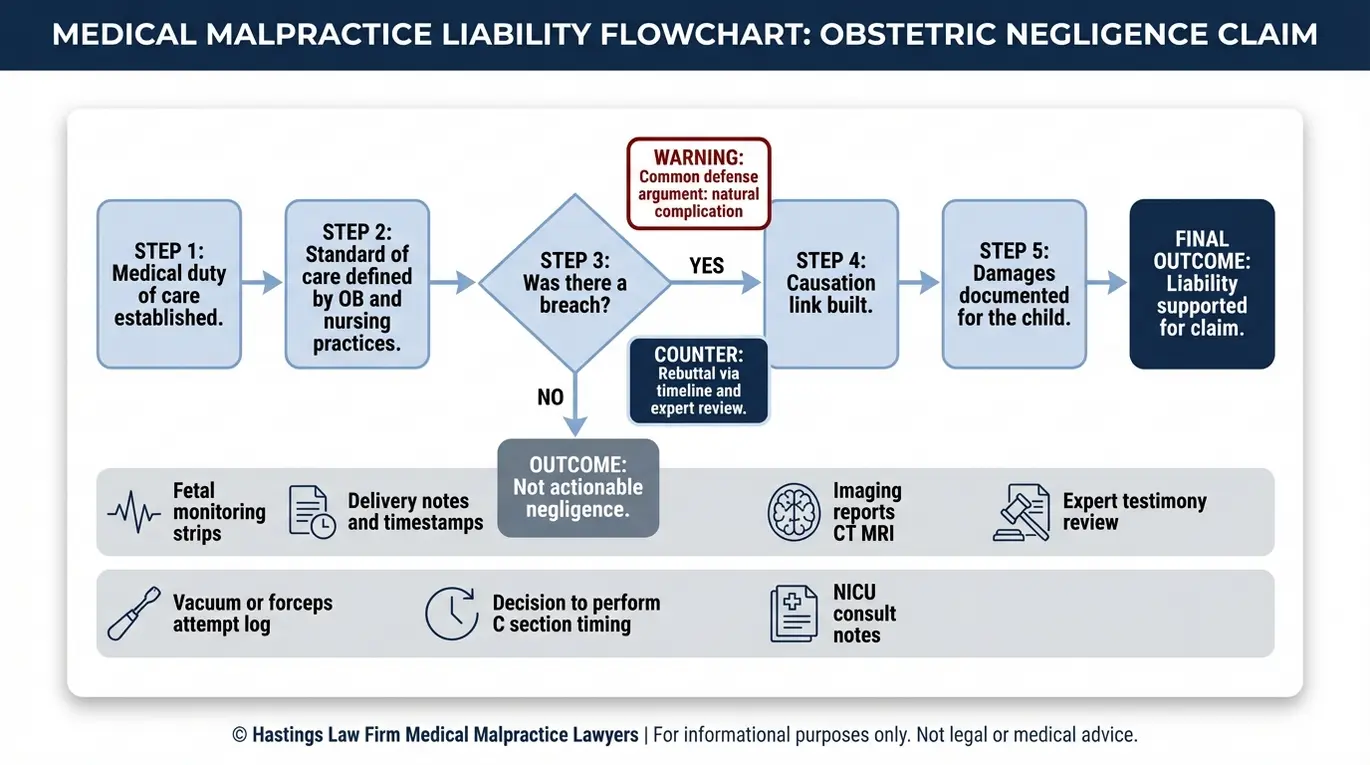
Proving liability requires demonstrating that the medical provider breached the accepted standard of care and that this specific breach directly caused the infant’s subdural hemorrhage. Texas medical malpractice cases follow a structured legal framework built on four elements.
Duty is established by the doctor-patient relationship. Once a provider assumes care during labor and delivery, they owe a duty of care to both the mother and infant. Breach occurs when the provider’s actions fall below what a reasonably competent practitioner would have done under similar circumstances. Causation connects the breach to the injury, meaning the harm would not have occurred but for the provider’s error. Damages refers to the actual losses suffered, both physical and financial.
One of the biggest challenges in birth injury litigation is overcoming what many families experience as the “White Coat Effect,” the deeply ingrained reluctance to question a doctor’s decisions. Defense teams often argue that the infant’s injury was a natural or unavoidable complication of delivery. This framing can be difficult for families to challenge on their own, especially when facing complex medical jargon. Our legal team dismantles this assumption by applying rigorous medical scrutiny to the timeline of events, proving that the outcome was preventable.
Our investigation process becomes critical at this stage. Our in-house medical staff and former defense attorneys know exactly what to look for. We obtain and analyze fetal heart rate monitoring strips, also called cardiotocography (CTG) tracings, which are continuous electronic recordings of the baby’s heart rate and the mother’s contractions during labor. We review delivery notes, nursing logs, and communication records between the care team. We then work with qualified medical experts across the country who can provide objective expert testimony about whether the standard of care was met and whether the breach caused the injury.
Every case we accept is prepared from day one as though it will go before a jury. That level of preparation gives our clients a stronger position whether the case resolves through negotiation or at trial.
Calculating Damages for Lifelong Neurological Care
Damages in birth injury cases cover both economic costs, such as lifetime medical care and therapy, and non-economic losses like pain, suffering, and physical impairment. Because many of these injuries affect a child for decades, the financial scope of these cases is significant.
One of the most important tools in calculating future economic damages is life care planning. This involves working with certified specialists to create a Life Care Plan. This document is a detailed, professionally prepared projection of the medical services, therapies, and support a child will need over their lifetime, often spanning 40 to 50 years. Life Care Plans are developed by specialists who evaluate the child’s current condition, anticipated needs, and the cost of care in the relevant geographic area.
Recoverable damages in a birth injury case may include:
- Past and future medical expenses, including surgeries, hospitalizations, and medications
- Ongoing rehabilitation, such as physical therapy, occupational therapy, and speech therapy
- Specialized equipment, including wheelchairs, adaptive devices, and home modifications
- Future lost earning capacity if the child’s injuries prevent them from working as an adult
- In-home nursing care or attendant care for children with severe disabilities
- Non-economic damages for the child’s pain, suffering, and loss of quality of life
- Parents’ claims for emotional distress and medical costs they incurred directly
Families often underestimate the financial toll of a severe birth injury. Children with significant neurological deficits may require round-the-clock attendant care, which can cost millions over a lifetime. We ensure these projected future care costs are fully accounted for, adjusting for medical inflation to protect the child’s financial security. Because Texas law caps non-economic damages but places no cap on economic damages, a thorough and well-documented Life Care Plan is essential.
Contact the Texas Birth Injury Attorneys at Hastings Law Firm Today for Help
If your child suffered a brain bleed during delivery and you believe medical negligence may have been involved, Hastings Law Firm is ready to help you find answers. Our team was built for cases like these. We bring together experienced trial attorneys, in-house nurse consultants, and a national network of medical experts, all focused exclusively on medical malpractice.
As a lawyer for birth-related subdural hemorrhage in Texas, Tommy Hastings is board-certified in Personal Injury Trial Law by the Texas Board of Legal Specialization. He and his team understand what is at stake for your family. We are committed to restoring trust, uncovering the truth, and securing the financial resources your child needs for a lifetime of care.
Every consultation is free and confidential, and you pay no fees unless we recover compensation for your family. Contact Hastings Law Firm today to start the investigation.
Frequently Asked Questions About Birth-Related Subdural Hemorrhage in Texas


This content was researched and written by the Hastings Law Firm editorial team, which includes attorneys, medical professionals, and experienced researchers. Our writing is informed by internal knowledge and practical experience, and we cross-check critical details against authoritative sources cited throughout. Every piece undergoes human-led fact-checking and legal review. Because legal and medical information can change, if you spot an error, please contact us. Learn more about our content standards and review process on our editorial policy page.

Tommy Hastings, founder of Hastings Law Firm, is a board-certified personal injury trial lawyer dedicated exclusively to healthcare injury cases. Since 2001, he has represented injured patients and families in litigation against major hospital systems, pharmaceutical companies, and negligent healthcare providers nationwide. He has handled numerous high-profile cases that have drawn national media attention and resulted in multi-million dollar recoveries. He draws on that experience in his writing, helping readers understand how these cases work and what options may be available to them.
