


Texas Retinopathy of Prematurity Lawyer
Written by: Hastings Law Firm | Reviewed by: Tommy Hastings | Updated: July 27, 2026
Retinopathy of Prematurity is a serious eye disorder in premature infants that can progress to permanent vision loss when screening or treatment is delayed. Families often feel blindsided after trusting NICU care during a fragile time, especially when records suggest missed exams, inaccurate staging, or poor oxygen management. Understanding how ROP is identified, how quickly it can worsen, and what breakdowns can occur helps clarify whether the outcome was preventable. If you or a loved one were harmed or worse due to Retinopathy of Prematurity malpractice in Texas, contact Hastings Law Firm for a free, confidential case review.
Nationally Recognized Advocacy for Infants Blinded by Preventable Birth Errors
What You Should Know About Premature Infant Blindness Claims in Texas:
- Permanent vision loss can result when Retinopathy of Prematurity is not diagnosed and treated in time.
- A preventable outcome may be suspected when NICU screening is missed, delayed, or not tracked reliably.
- Irreversible harm can follow when disease severity is documented inaccurately and treatment urgency is underestimated.
- Severe progression can be linked to oxygen management problems when saturation targets are not maintained.
- Options for recovery can be lost when Texas malpractice requirements are not met on time.
- Available compensation can be limited for non economic harms in Texas even when the injury is life changing.
- Lifetime financial needs can be central in ROP cases because care, education support, and assistive resources may be required long term.
- Medical records can be decisive when documentation shows missing exams, absent discharge follow up, or unexplained changes in findings.

A Healthcare Focused Law Firm
Learning that your premature baby has suffered vision loss from Retinopathy of Prematurity can feel overwhelming and deeply unfair. You trusted the NICU team to protect your child during the most vulnerable weeks of their life, and now you may be facing questions about whether the care they received fell short. Those questions deserve honest answers.
As a Texas Retinopathy of Prematurity Lawyer, Hastings Law Firm focuses exclusively on medical malpractice. Our team includes in-house nurse consultants and former defense attorneys who understand how hospitals document care, how NICU protocols work, and where breakdowns happen. We are here to help you understand what went wrong and whether your family has a viable legal claim.
If your child was diagnosed with ROP-related vision loss or blindness, contact us for a free, confidential case evaluation. There are no fees unless we recover compensation for your family.
Understanding Retinopathy of Prematurity and Preventable Blindness
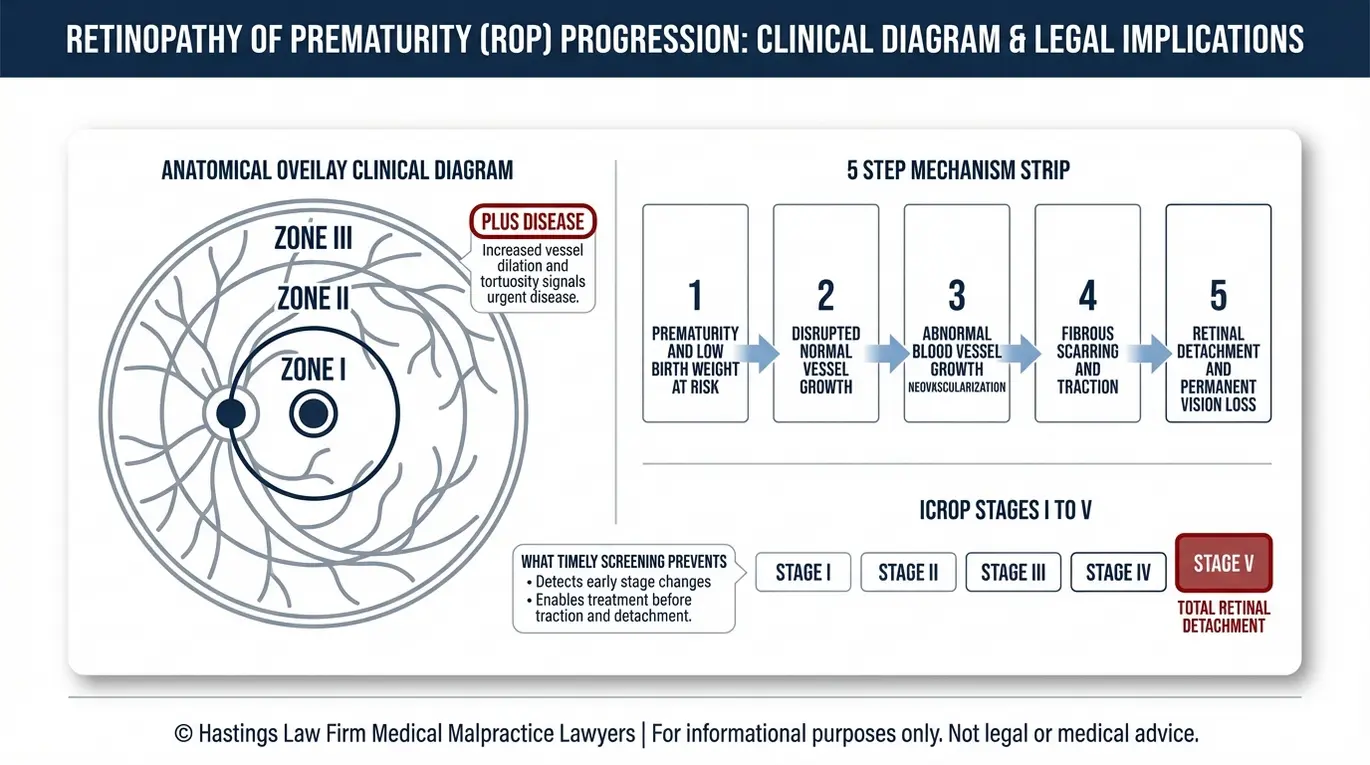
Retinopathy of Prematurity (ROP) is an eye disorder affecting premature infants in which abnormal blood vessels grow across the retina, potentially causing scarring, retinal detachment, and permanent blindness if the condition is not diagnosed and treated in time.
ROP primarily affects babies born before 31 weeks gestational age or with low birth weight (less than 3.3 pounds). In a full-term pregnancy, retinal blood vessels finish developing shortly before delivery. But when a baby is born prematurely, that development is incomplete. Instead, the vessels can proliferate in a disorganized pattern, a process called neovascularization (the abnormal growth of new blood vessels on the retina’s surface).
The retina is the light-sensitive layer of tissue at the back of the eye. According to Prevent Blindness Texas, ROP is a leading cause of childhood blindness, yet early detection and treatment can prevent the most severe outcomes.
ROP is classified into five stages based on the severity of abnormal vessel growth, as defined by the International Classification of Retinopathy of Prematurity (ICROP):
| Stage | Description |
|---|---|
| Stage I | A faint line separates the vascularized retina from the avascular (undeveloped) zone. Mild; often resolves without treatment. |
| Stage II | The demarcation line develops into a ridge with some height and width. May still resolve on its own but requires close monitoring. |
| Stage III | Abnormal blood vessels (neovascularization) grow from the ridge toward the center of the eye. Treatment is often needed at this stage. |
| Stage IV | Partial retinal detachment occurs. Divided into IVa (macula attached) and IVb (macula detached), with worsening visual outcomes. |
| Stage V | Total retinal detachment. The most severe form; typically results in complete blindness. |
While ROP is a medical condition associated with premature birth, progression to blindness often stems from failed medical management. Missed screening, inaccurate staging, or delayed treatment can turn a treatable condition into a permanent disability. An experienced Texas ROP malpractice lawyer can investigate these failures to help your family find the truth.
The Critical Role of Zones and Plus Disease
Doctors also assess the disease’s location and aggression. ROP is mapped across three retinal zones. Zone I is the smallest circle at the very back of the eye surrounding the optic nerve; disease here is the most dangerous. Zone II covers the middle area of the retina, and Zone III is the outer crescent, where ROP is generally less threatening.
Plus Disease, a separate severity indicator, is characterized by enlarged, twisted blood vessels near the optic nerve. Its presence signals that ROP is progressing aggressively and treatment is urgent. A diagnosis of Zone I disease with Plus Disease, for example, can require intervention within hours, not days.
Common Medical Errors Leading to ROP Blindness
Medical malpractice causes ROP blindness when NICU teams fail to screen at-risk infants on schedule, misdiagnose the stage of the disease, or delay critical treatments like laser therapy and anti-VEGF injections. These errors represent a departure from the medical standard of care, which is the level of care a competent professional should provide.
Oxygen Management Failures. Supplemental oxygen is essential for premature infants who cannot breathe adequately on their own. But oxygen levels must be carefully controlled. Oxygen toxicity, which occurs when blood oxygen saturation (SpO2) levels are allowed to remain too high, is a well-documented risk factor for triggering or accelerating abnormal blood vessel growth.
SpO2 monitoring and targeting, the practice of keeping oxygen saturation within a safe, defined range, is a core NICU responsibility. If staff fail to maintain appropriate targets, the risk of severe ROP increases significantly.
Screening Failures. Established guidelines require a pediatric ophthalmologist to perform an initial eye exam at a specific point based on the infant’s gestational age and postnatal age. If a neonatologist does not order that consult on time, or a facility lacks a protocol for tracking important screening milestones, the window for early detection can close before anyone looks.
Failure to Follow Up at Discharge. Some infants are discharged from the NICU before their retinas are fully developed. If the care team releases a baby without scheduling a follow-up eye exam or giving parents clear written instructions about ongoing monitoring, a developing case of ROP can progress undetected at home.
Misdiagnosis of Disease Severity. Grading errors can be catastrophic. If a pediatric ophthalmologist documents Stage II ROP when the disease has actually reached Stage III with Plus Disease, the treatment response will not match the urgency of the condition. That gap between what was recorded and what was happening in the eye can mean the difference between preserved vision and permanent blindness.
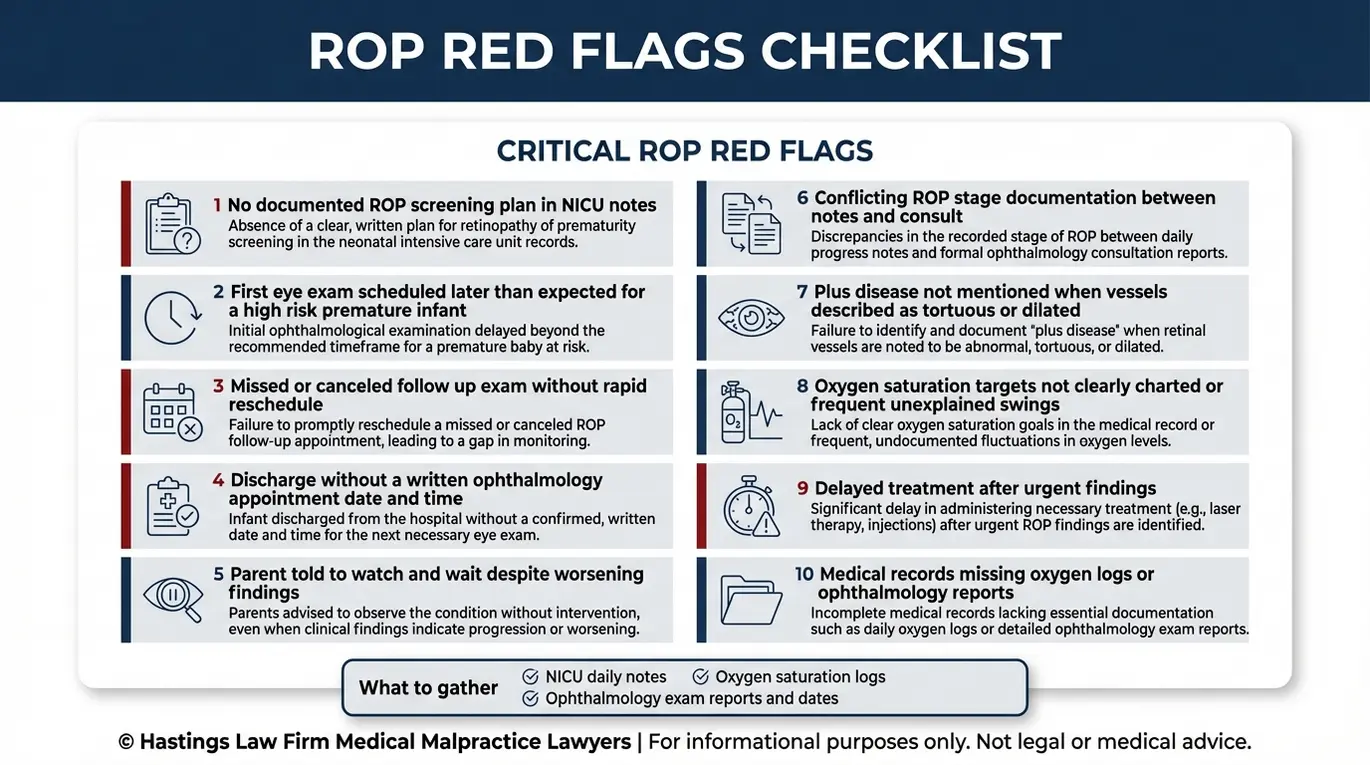
Here are some red flags that may indicate medical negligence in an ROP case:
- No documented eye exam during the NICU stay despite meeting screening criteria
- First screening performed weeks later than guidelines recommend
- Discharge paperwork with no mention of ROP follow-up or scheduled ophthalmology appointments
- Documented oxygen saturation readings consistently above or outside target ranges
- A sudden jump from mild ROP to retinal detachment with no intervening treatment notes
- Staging that changes dramatically between consecutive exams without explanation
If any of these patterns appear in your child’s records, experienced ROP blindness attorneys can help determine whether the care your baby received met accepted medical standards.
The Hastings Law Firm Difference
Results matter, but what truly sets us apart is how we achieve them. Every verdict, every settlement, and every Texas courtroom victory comes from one guiding promise: To treat each client’s fight for justice as if it were our own.
This balance of skill, experience, and empathy reflects our core philosophy that justice should not only compensate the injured, but also make healthcare safer nationwide.

Critical Screening Schedules and Timely Treatment Standards
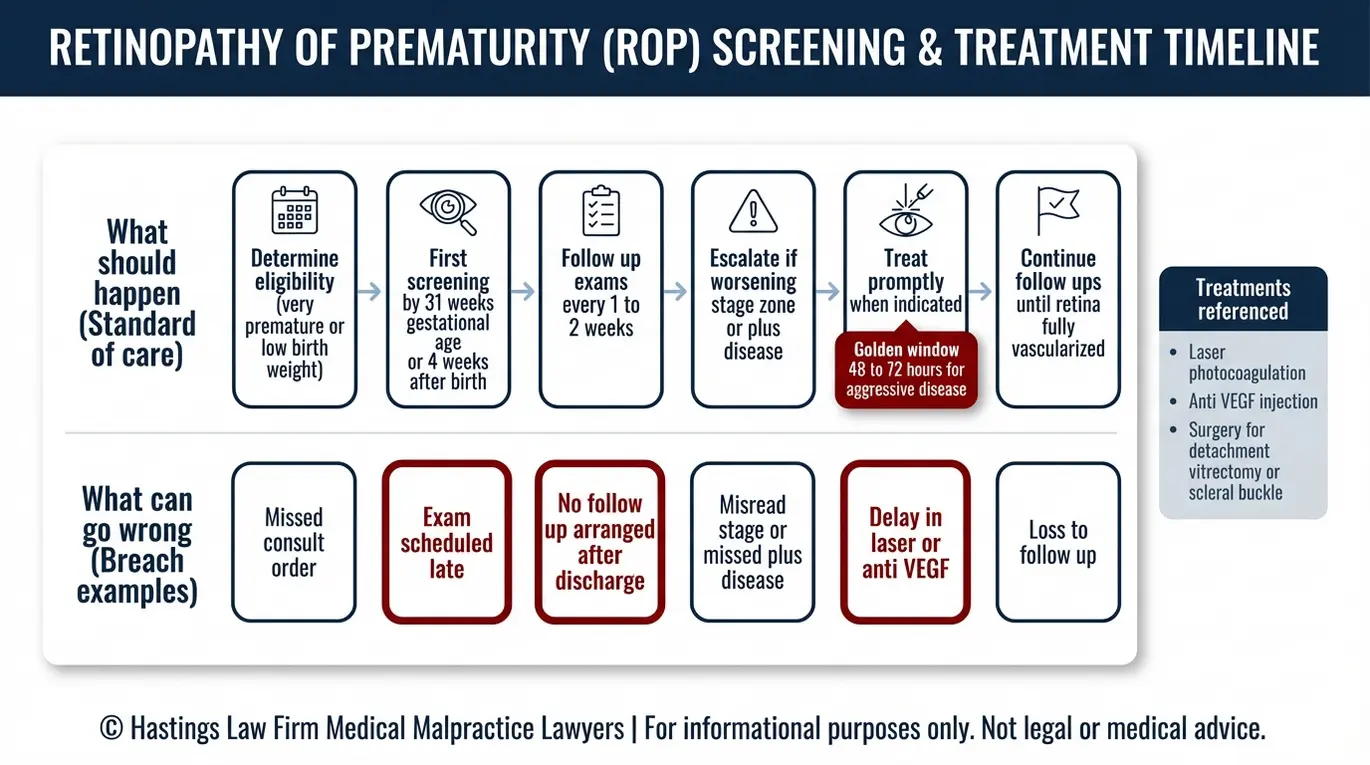
The standard of care requires initial ROP screening for at-risk premature infants by 31 weeks gestational age or 4 weeks after birth (whichever is later), with follow-up eye exams every one to two weeks until the retina is fully vascularized and the risk of progression has passed. This timeline allows doctors to identify abnormal blood vessel growth before it reaches advanced stages.
Strict adherence to this screening schedule is necessary because ROP can develop and worsen rapidly. A 30-week benchmark is often referenced as the earliest point at which screening should begin for the most premature infants. Missing even one scheduled exam can allow the disease to advance past the point where less invasive treatment is effective.
The Treatment Window. Once aggressive ROP is identified, there is typically a 48-to-72-hour window to deliver treatment before the disease progresses to a stage where vision loss may become irreversible. Missing this window can support a claim of negligence because the clinical guidelines and the urgency of the condition are well established.
The primary treatment options include:
| Treatment Option | Description |
|---|---|
| :— | :— |
| Laser Photocoagulation | Laser photocoagulation (laser therapy) uses targeted laser energy to destroy the peripheral avascular retina; it remains the gold standard treatment for threshold ROP. |
| Anti-VEGF Injections | Drugs such as bevacizumab (Avastin) block vascular endothelial growth factor (VEGF), a protein that drives abnormal blood vessel formation. |
| Surgical Intervention | Procedures like vitrectomy and scleral buckle are used for advanced disease to remove vitreous gel or relieve retinal traction. |
| Cryotherapy | An older approach using freezing temperatures to treat the peripheral retina, used in specific situations. |
A study published in PubMed Central comparing retreatment rates for bevacizumab, ranibizumab, aflibercept, and laser highlights the evolving evidence on reactivation risks associated with anti-VEGF therapy. A premature infant blindness lawyer evaluates whether the screening timeline was followed, whether the correct treatment was selected, and whether it was delivered within the essential treatment window.
Proving ROP Malpractice in Texas Courts
Proving ROP malpractice in Texas requires demonstrating that the neonatologist or ophthalmologist deviated from the accepted standard of care and that this deviation was a “substantial factor” in causing the infant’s vision loss or blindness. Medical malpractice involves a failure to meet the accepted standard of medical care. Proving causation involves showing that a medical error directly led to the injury rather than it being an unavoidable result of premature birth.
Bustamante v. Ponte. The Texas Supreme Court addressed causation in ROP litigation directly in Bustamante v. Ponte (No. 15-0509). In that opinion, the Court examined the use of statistical evidence to establish whether delayed treatment caused an infant’s blindness. The ruling clarified that plaintiffs can rely on probability-based expert witness testimony to connect the delay to the outcome, but that testimony must be grounded in the specific facts of the case, not just general statistics.
Chapter 74 Expert Report Requirements. Texas law requires any medical malpractice plaintiff to file a qualified expert report within 120 days of filing the lawsuit. For ROP cases, this means obtaining a detailed written opinion from a physician, typically a pediatric ophthalmologist or neonatologist, who identifies the specific standard of care, explains how it was breached, and connects that breach to the child’s injury. Failure to meet this strict deadline can result in the automatic dismissal of the case, barring the family from recovery.
How We Build the Case. At Hastings Law Firm, we reconstruct the clinical timeline using full medical records, including NICU logs, ophthalmology consult notes, nursing documentation, and discharge summaries. Our in-house medical staff reviews this data alongside independent experts to establish whether the blindness was preventable or the result of specific, identifiable delays. As a Texas birth injury attorney team led by Tommy Hastings, who is Board Certified in Personal Injury Trial Law by the Texas Board of Legal Specialization, we prepare every case as if it will go to a jury.
Compensation for a Lifetime of Vision Loss
Compensation in a Retinopathy of Prematurity lawsuit covers the full scope of what a child will need across an entire lifetime of living with partial or total blindness. These cases are not just about past medical bills; they are about building a financial foundation for a lifetime of care, education, and support.
Recoverable damages in Texas ROP cases typically include:
- Future medical care: Ongoing ophthalmology visits, potential corrective surgeries, and any future treatments related to the eye injury
- Specialized education and training: Programs such as Braille instruction, orientation and mobility training, and blind children resources provided through organizations like Lighthouses for the Blind
- Assistive technology and home modifications: Screen readers, adaptive devices, guide services, and changes to living spaces that support independence
- Lost earning capacity: The projected income the child will be unable to earn as a result of their visual impairment
- Non-economic damages: Compensation for physical impairment, loss of enjoyment of life, and pain and suffering
To calculate these costs accurately, our firm works with experts to create a thorough life care plan that projects the financial needs of a blind child over an expected lifespan of 80 years or more. These detailed plans are important in presenting the full picture of damages to a jury or during settlement discussions.
Contact the Texas Birth Injury Attorneys at Hastings Law Firm Today for Help
If your child lost vision because of delayed screening, missed diagnoses, or inadequate NICU care, you deserve to know what happened and why. Hastings Law Firm was built to answer those questions for families who feel let down by the medical system.
Our team includes former hospital nurses and defense attorneys who understand the systems we challenge. As a Texas Retinopathy of Prematurity Lawyer, Tommy Hastings and his team prepare every case with the depth and rigor needed to move toward holding negligent providers accountable, and to secure the resources your child will need going forward. Tommy Hastings is also a 2025 inductee into ABOTA, an invitation-only organization for elite trial lawyers.
There are no upfront costs and no fees unless we win. Contact us today for a free, confidential case evaluation. Let us help you find the answers your family deserves.
Frequently Asked Questions About Retinopathy of Prematurity in Texas


This content was researched and written by the Hastings Law Firm editorial team, which includes attorneys, medical professionals, and experienced researchers. Our writing is informed by internal knowledge and practical experience, and we cross-check critical details against authoritative sources cited throughout. Every piece undergoes human-led fact-checking and legal review. Because legal and medical information can change, if you spot an error, please contact us. Learn more about our content standards and review process on our editorial policy page.

Tommy Hastings, founder of Hastings Law Firm, is a board-certified personal injury trial lawyer dedicated exclusively to healthcare injury cases. Since 2001, he has represented injured patients and families in litigation against major hospital systems, pharmaceutical companies, and negligent healthcare providers nationwide. He has handled numerous high-profile cases that have drawn national media attention and resulted in multi-million dollar recoveries. He draws on that experience in his writing, helping readers understand how these cases work and what options may be available to them.
