


Texas Facial Paralysis Birth Injury Lawyer
Written by: Hastings Law Firm | Reviewed by: Tommy Hastings | Updated: July 27, 2026
Newborn facial nerve damage after delivery can leave families facing uncertainty about what happened and what the future may hold. Facial paralysis can affect feeding, eye protection, and facial movement, and severe injuries can lead to lasting disfigurement and long term care needs. Understanding common delivery related causes and the importance of accurate diagnosis can help families make informed medical decisions and preserve critical information. If you or a loved one were harmed or worse due to facial paralysis birth injuries in Texas, contact Hastings Law Firm for a free, confidential case review.

Top-Rated Birth Injury Attorneys for Newborn Facial Nerve Damage
What You Should Know About Newborn Facial Nerve Damage Claims in Texas:
- Long term disfigurement and ongoing care needs can follow severe facial nerve injuries when the nerve is torn or severed.
- Treatment planning and accountability can hinge on an accurate diagnosis that distinguishes delivery trauma from congenital causes and Bell palsy.
- Options for financial recovery can be limited if key Texas timing rules are missed.
- Total compensation for non economic harm can be restricted in Texas even when the injury has lasting quality of life effects.
- Disputes over what caused the injury can shape outcomes when hospitals argue natural labor pressure rather than provider error.
- Preventable delivery decisions can be central when forceps or vacuum extraction are misapplied or used with excessive force.
- A delayed C section decision can matter when prolonged labor pressure is linked to facial nerve compression.
- Full valuation of losses can depend on documenting both medical costs and non economic harm such as pain suffering and mental anguish.
- Proof of the extent of nerve injury can affect prognosis when EMG testing and clinical observation show limited recovery.
- Record integrity can become an issue when electronic audit trails reveal edits or deletions that do not appear in printed charts.

A Healthcare Focused Law Firm
When your newborn shows signs of facial nerve damage after delivery, the worry and confusion can feel overwhelming. You may not have all the answers yet, but you do not have to sort through this alone. Families across Texas trust Hastings Law Firm, founded by board-certified trial attorney Tommy Hastings, because our entire team focuses exclusively on medical malpractice. Our staff includes in-house nurse consultants and board-certified patient advocates who understand the clinical details of birth trauma.
We do not divide our attention across unrelated practice areas. Every resource we have goes toward investigating potential medical errors and holding healthcare providers accountable. If your child experienced facial paralysis during birth and you believe something went wrong, we encourage you to reach out for a free, confidential consultation. A Texas facial paralysis birth injury lawyer at our firm can review what happened and explain your options with no obligation and no fee unless we recover compensation for your family.
Understanding Facial Paralysis Birth Injuries in Newborns
Newborn facial paralysis occurs when the seventh cranial nerve, also called CN VII or simply the facial nerve, is compressed or damaged during labor or delivery. This results in a loss of voluntary muscle movement on one or both sides of the infant’s face. While some cases resolve on their own within weeks, severe injuries involving nerve tearing can cause permanent disfigurement that requires surgical correction.
The facial nerve controls a wide range of movements, from blinking and smiling to suckling. In newborns, this nerve is especially vulnerable because it runs along the surface of the skull near the ear. A condition called neuropraxia, which is a temporary disruption in nerve signaling caused by compression, accounts for many milder cases. But when the nerve is stretched, partially torn, or fully severed, the prognosis changes significantly.
Medical teams must distinguish between traumatic birth injuries, congenital conditions, and Bell’s palsy. While Bell’s palsy is an idiopathic facial paralysis that is rare in newborns, it must be clinically ruled out to confirm a birth injury.
Moebius syndrome is a rare neurological condition present from birth. It affects the cranial nerves controlling facial expression and eye movement. Unlike delivery-related injuries, Moebius syndrome is not caused by trauma during labor.
Accurate diagnosis matters because it determines whether medical malpractice or negligence may have played a role. A facial paralysis birth injury lawyer in Texas can work with medical experts to clarify the cause of your child’s condition.
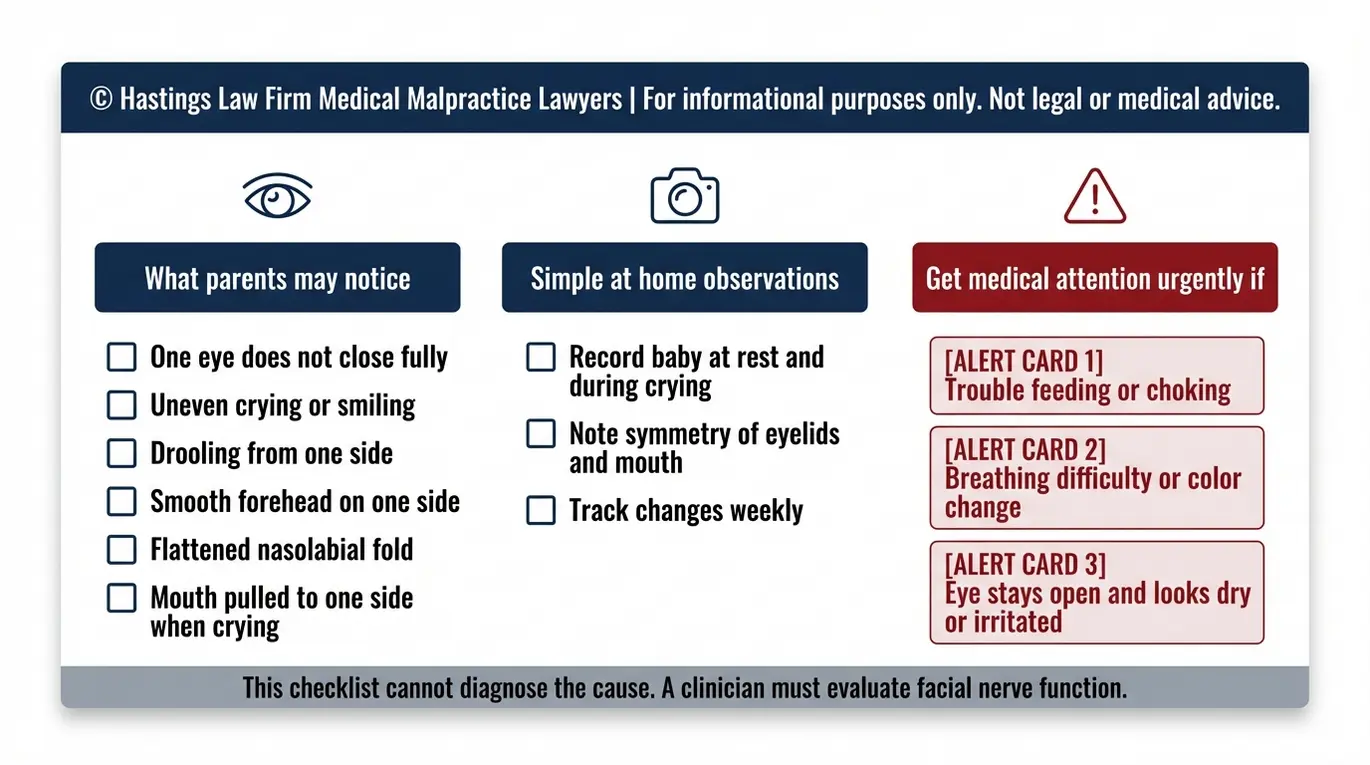
Parents are often the first to notice that something is wrong. According to MedlinePlus, common signs of facial nerve palsy due to birth trauma include:
- The baby’s eyelid on the affected side does not close fully
- Uneven facial movement when the baby cries
- Drooling from one side of the mouth
- A smooth, motionless forehead on one side compared to the other
- Difficulty latching or feeding on one side
If you observe any of these signs, prompt evaluation by a pediatric neurologist is important for both treatment planning and potential legal documentation.
Anatomical Vulnerability of the Newborn Facial Nerve
Newborns are especially susceptible to facial nerve damage because of their facial nerve anatomy. In adults, the mastoid process, which is the bony bump behind the ear, helps shield the facial nerve as it exits the skull. In newborns, this structure has not yet fully developed. Combined with limited subcutaneous fat around the face and jaw, the nerve sits much closer to the surface and has far less natural protection.
This means that even moderate external pressure during delivery, whether from the birth canal itself or from an assistive device, can compress or injure the nerve in ways that would not occur in an older child or adult.
Common Causes of Facial Nerve Damage During Delivery
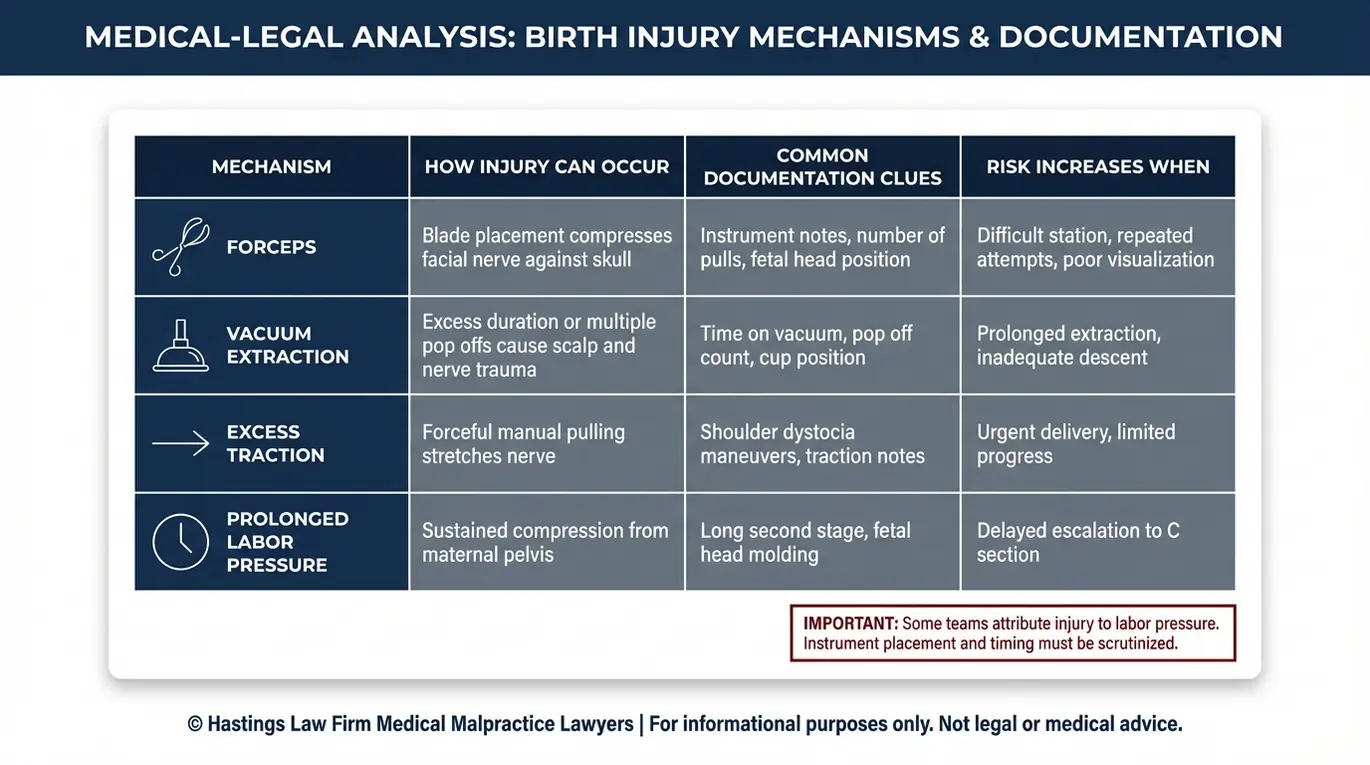
The most common cause of traumatic facial nerve damage during delivery is the improper use of assistive birthing devices, specifically forceps or vacuum extractors. These instruments can crush or compress the nerve against the infant’s skull when they are misapplied or used with excessive force. Other contributing factors include prolonged or difficult labors and the failure to perform a timely C-section when conditions warrant it.
Forceps delivery involves the use of curved, spoon-shaped metal blades placed on either side of the baby’s head to guide it through the birth canal. When positioned correctly along the cheekbones, forceps can be a safe tool. Negligence can arise when the blades are placed directly over the facial nerve pathway or when excessive traction is applied. Research published in Thieme Connect has examined whether traumatic facial nerve palsy in newborns is always iatrogenic, meaning caused by the delivery itself, highlighting the need for careful clinical evaluation.
Vacuum extraction, or vacuum-assisted delivery, uses a suction cup attached to the baby’s scalp to help guide the infant during contractions. Risks increase when the vacuum is applied for too long, when multiple “pop-offs” occur (meaning the cup detaches and is reapplied), or when the device shifts during use.
A Texas birth injury attorney for facial paralysis will evaluate the specific mechanism of injury in your child’s case. A key part of this analysis involves distinguishing between provider-caused injury and natural pressure from the birth canal.
When an obstetrician fails to recognize signs of cephalopelvic disproportion, they may allow labor to continue too long. This prolonged pressure of the infant’s face against the mother’s sacrum is a frequent cause of injury. While hospitals often argue this is a natural unavoidable event, review of the medical strip often reveals missed opportunities for a C-section that would have prevented the nerve compression entirely.
Our team scrutinizes the delivery timeline, fetal monitoring data, and provider decisions to determine whether the standard of care was met.
| Delivery Factor | How Facial Nerve Damage Can Occur |
|---|---|
| Forceps | Blades positioned over the nerve pathway; excessive force applied |
| Vacuum Extraction | Prolonged application; repeated pop-offs causing positional trauma |
| Prolonged Labor | Sustained pressure against maternal sacrum (often raised as a defense) |
| Delayed C-Section | Failure to intervene when cephalopelvic disproportion is present |
A facial paralysis lawyer examines these factors together, not in isolation, to build an accurate picture of what happened during delivery.
The Hastings Law Firm Difference
Results matter, but what truly sets us apart is how we achieve them. Every verdict, every settlement, and every Texas courtroom victory comes from one guiding promise: To treat each client’s fight for justice as if it were our own.
This balance of skill, experience, and empathy reflects our core philosophy that justice should not only compensate the injured, but also make healthcare safer nationwide.

Proving Medical Negligence and Validating Your Claim
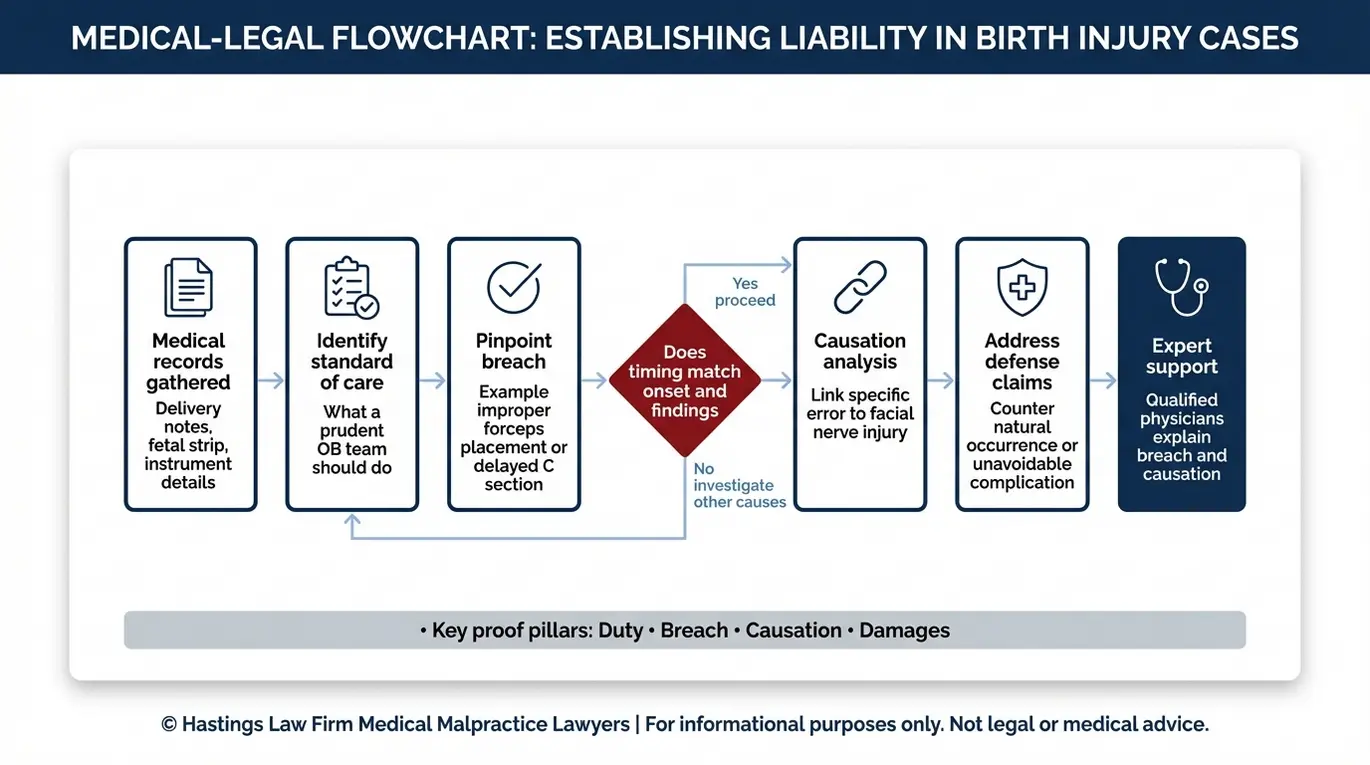
To succeed on a medical malpractice claim in Texas, the family must prove that the healthcare provider breached the accepted standard of care and that this breach directly caused the child’s facial paralysis. In practical terms, this means demonstrating that a reasonably competent obstetrician or physician, facing the same clinical circumstances, would have acted differently.
The legal framework breaks down into elements that our team investigates methodically to hold all liable parties, or those responsible for the harm, accountable:
- Duty and breach: The obstetrician or attending physician owed a duty to deliver care consistent with accepted medical standards. We examine whether their decisions, such as choosing forceps over a C-section or continuing vacuum extraction after multiple failed attempts, fell below what a qualified peer would have done.
- Causation: It is not enough to show that something went wrong. A Texas facial paralysis birth injury attorney must connect the specific medical error to the nerve damage. For example, if forceps were misplaced and the child developed paralysis on the same side where the blade rested, expert analysis can link those facts.
- The “natural occurrence” defense: Hospitals frequently argue that the injury occurred in utero or was caused by natural labor pressure rather than provider error. Countering this defense requires detailed medical record review and expert testimony. Conditions like neurotmesis, which involves the complete severance or destruction of the nerve fiber, carry distinct diagnostic markers that experts can differentiate from less severe compression injuries.
Our investigation process typically follows this path:
- Obtain and preserve the complete medical record, including electronic audit trails
- Secure fetal monitoring strips, nursing notes, and delivery logs
- Identify cephalopelvic disproportion (CPD), a condition where the baby’s head is too large to pass safely through the mother’s pelvis, as a potential indicator that a C-section should have been performed
- Retain expert witnesses to provide testimony on whether the standard of care was met
- Build a causation analysis linking the provider’s actions to the documented nerve injury
A lawyer for birth injuries works alongside medical professionals to reconstruct the delivery timeline and identify where, and whether, the care deviated from what should have happened.
Damages and Compensation for Permanent Facial Nerve Injuries
Recoverable damages in Texas birth injury cases include both economic losses, such as past and future medical bills, and non-economic losses like physical disfigurement, pain and suffering, and mental anguish. The goal of any claim is to secure resources that give the child access to the best available reconstructive care and long-term support. Families often require a detailed life care plan to accurately project these lifelong costs and maximize their recovery.
Medical costs in facial paralysis cases can be significant. Children with permanent nerve damage may require nerve graft surgery, a procedure where a healthy nerve segment is transplanted to restore function, as well as ongoing physical therapy to improve muscle tone and facial symmetry. Some children develop lagophthalmos, the inability to fully close the eyelid, which creates a risk of corneal damage and requires protective measures or corrective surgery.
A Texas facial paralysis birth injury lawyer will work to document these needs thoroughly so that Recoverable damages reflect the full scope of the child’s care:
- Past and future surgical costs, including nerve grafts and reconstructive procedures
- Physical therapy and rehabilitation programs
- Specialized eye care if the eyelid does not close properly
- Speech and feeding therapy during infancy
- Assistive devices or adaptive equipment
- Future medical expenses projected across the child’s lifetime
Texas law requires that a formal written notice be provided before filing a medical malpractice lawsuit. Under the Texas Civil Practice and Remedies Code, Chapter 74.051, this pre-suit notice triggers a 60-day waiting period designed to allow for potential early resolution. Understanding these procedural requirements is essential to preserving your child’s right to birth injury compensation.
Beyond direct medical expenses, settlements and trial verdicts can also account for non-economic harm. Insurance companies often undervalue these categories, but they represent real consequences for the child and family.
Social and Psychological Impacts on Children
Facial disfigurement carries a burden that extends well beyond the physical. As children grow, visible differences can lead to social isolation, bullying, and emotional distress. Mental health support, including counseling for anxiety, self-esteem challenges, and social skills development, may be necessary throughout childhood and into adulthood.
These psychological costs are compensable as part of a claim. Documenting the child’s emotional experience, through therapy records, school reports, and expert psychological evaluations, strengthens the case for full compensation that accounts for the child’s quality of life, not just their medical charts.
Building a Strong Case for Your Child
Building a strong case starts with immediate evidence preservation, including obtaining fetal monitoring strips, delivery logs, and the complete medical record before anything is altered or lost. Parents also have an important role to play to help establish hospital liability and hold healthcare providers accountable:
- Preserve Evidence: Request copies of fetal monitoring strips and the full medical record immediately.
- Document Visuals: Record videos and take photos of the injury to show progression.
- Maintain Records: Keep a diary of symptoms, feeding difficulties, and doctor visits.
Medical records are the foundation of every birth injury investigation. Our team works to obtain the unfiltered electronic audit trail from the hospital’s medical records system. This audit trail is a digital footprint that tracks every entry, edit, and deletion made to the chart and can reveal changes that might not appear in a standard printed record. Under federal law, including protections outlined by the U.S. Department of Health and Human Services’ Health Information Privacy rules, you have a right to access your child’s complete medical records.
Beyond records, diagnostic testing helps establish the extent of nerve damage. Electromyography (EMG), a test that measures the electrical activity of muscles and the nerves controlling them, can provide objective data about whether the facial nerve is recovering or permanently damaged. EMG results, combined with clinical observation over several months, help our medical experts assess the long-term prognosis.
Expert review is another essential component. Our firm maintains a national network of medical specialists, including pediatric neurologists, plastic surgeons, and obstetricians, who can evaluate the circumstances of delivery and provide credible testimony about whether the standard of care was met.
Parent Documentation Strategy
Visual evidence of your child’s condition is uniquely persuasive. We recommend filming your baby during moments of crying, feeding, or attempting to smile, as these are the activities that most clearly reveal asymmetry or lack of muscle movement on the affected side.
When recording, use natural lighting and film from the front so both sides of the face are visible. Take videos regularly, weekly if possible, to create a timeline that shows whether the condition is improving or remaining static. These recordings can be more compelling to a jury at trial than any medical chart. If you are considering whether to contact a Texas facial paralysis birth injury lawyer, begin this documentation as early as possible so no critical window is lost.
Contact the Texas Birth Injury Attorneys at Hastings Law Firm Today for Help
If your child suffered facial nerve damage and you believe medical negligence may have been a factor, you do not have to face the uncertainty alone. Hastings Law Firm is dedicated to helping families find answers and securing the financial resources your child needs for the future. Our team of attorneys, nurse consultants, and medical experts works exclusively on medical malpractice cases, and we prepare every case as if it will go to trial.
Tommy Hastings is board-certified in Personal Injury Trial Law by the Texas Board of Legal Specialization, a distinction held by fewer than 2% of attorneys in the state. We invite you to schedule a free, confidential consultation with a Texas facial paralysis birth injury lawyer at our firm. There is no fee unless we recover compensation for your family. Call us or fill out our online form to take the first step toward understanding what happened and what options are available for your child.
Frequently Asked Questions About Facial Paralysis Birth Injury in Texas


This content was researched and written by the Hastings Law Firm editorial team, which includes attorneys, medical professionals, and experienced researchers. Our writing is informed by internal knowledge and practical experience, and we cross-check critical details against authoritative sources cited throughout. Every piece undergoes human-led fact-checking and legal review. Because legal and medical information can change, if you spot an error, please contact us. Learn more about our content standards and review process on our editorial policy page.

Tommy Hastings, founder of Hastings Law Firm, is a board-certified personal injury trial lawyer dedicated exclusively to healthcare injury cases. Since 2001, he has represented injured patients and families in litigation against major hospital systems, pharmaceutical companies, and negligent healthcare providers nationwide. He has handled numerous high-profile cases that have drawn national media attention and resulted in multi-million dollar recoveries. He draws on that experience in his writing, helping readers understand how these cases work and what options may be available to them.
