


Texas Kernicterus Malpractice Lawyer
Written by: Hastings Law Firm | Reviewed by: Tommy Hastings | Updated: July 27, 2026
A kernicterus diagnosis can leave families overwhelmed, especially when the injury may have been preventable with proper monitoring and timely treatment of newborn jaundice. Kernicterus is described as severe brain damage caused by toxic bilirubin levels, and the article highlights how missed testing, ignored risk factors, delayed phototherapy, and communication breakdowns can allow a treatable condition to become permanent. It also addresses the lifelong care needs that can follow. If you or a loved one were harmed or worse due to kernicterus malpractice in Texas, contact Hastings Law Firm for a free, confidential case review.

Helping Texas Families After Preventable Newborn Brain Injury
What You Should Know About Untreated Infant Jaundice Claims in Texas:
- Lifelong neurological impairment can follow when severe newborn jaundice is not identified and treated before bilirubin reaches toxic levels in the brain.
- Permanent injury can be linked to delays in emergency treatment during the early stage of bilirubin toxicity.
- Preventable harm may be indicated when kernicterus occurs despite modern hospital safety checks intended to stop dangerous bilirubin levels from being missed.
- Options in Texas can be limited early if a required medical expert report is not served on time, since missing that requirement can lead to dismissal.
- Overall financial recovery can be shaped by Texas limits on non economic damages even when long term care needs are extensive.
- Future care planning can drive the largest part of compensation when economic losses like medical expenses and life care costs are not capped in Texas.
- Disputes over causation can arise when hospitals claim the brain injury was inevitable or due to an unrelated genetic condition.
- A clear timeline of bilirubin testing and treatment can be central when records show gaps between lab results becoming available and clinical action.
- Objective bilirubin measurement can matter when care relied on visual assessment rather than documented TSB or TcB results plotted on an hour specific risk chart.
- Electronic audit trail data can be pivotal when it shows when critical results were available and when they were reviewed.

A Healthcare Focused Law Firm
When your child has been diagnosed with kernicterus, the weight of that news can feel unbearable. You trusted the medical team to protect your baby, and learning that a preventable condition may have caused lasting brain damage can leave you searching for answers. You are not alone, and what you are feeling is valid.
As a Texas kernicterus malpractice lawyer team, Hastings Law Firm focuses exclusively on medical negligence cases, including newborn brain injuries caused by untreated jaundice. Our firm is dedicated to this niche area of law, ensuring our clients benefit from deep experience in medical liability. We invite you to contact us for a free, confidential case evaluation if you believe your child’s injury was preventable.
Understanding Kernicterus and How Negligence Causes It
Kernicterus is a rare but preventable type of brain damage that occurs when high levels of bilirubin, a yellow pigment produced during the normal breakdown of red blood cells, cross the blood-brain barrier due to delayed or inadequate treatment of newborn jaundice. When the condition progresses to this point, the damage to a child’s brain can be permanent and severe.
Most newborns develop some degree of physiological jaundice in the first few days of life. This is common and generally harmless. The baby’s immature liver simply needs time to process bilirubin efficiently, and levels typically drop on their own or with minor intervention.
Pathological jaundice is different. It develops when bilirubin levels rise too high, too fast, or fail to decrease as expected. This condition, known medically as hyperbilirubinemia, becomes dangerous when left unmonitored or untreated. Bilirubin is toxic to brain tissue at high concentrations, and once it crosses into the brain, the resulting injury follows a recognizable progression.
A prospective cohort study published in the Journal of Paediatrics and Child Health documented the serious neurodevelopmental consequences of extreme neonatal hyperbilirubinemia, reinforcing that early identification and treatment are essential to preventing permanent injury.
That progression typically moves through two stages:
- Acute bilirubin encephalopathy (early signs): This is the initial phase of bilirubin toxicity. Symptoms may include poor feeding, high-pitched crying, decreased muscle tone or abnormal arching of the back, and excessive sleepiness. At this stage, emergency treatment can still prevent permanent damage.
- Chronic bilirubin encephalopathy (permanent damage): Often called chronic kernicterus, this stage occurs if acute encephalopathy is not treated promptly. The injury becomes irreversible, causing lasting neurological damage, including movement disorders, hearing loss, vision problems, and intellectual disability.
In modern medicine, kernicterus is widely considered a “never event.” This is a term used to describe outcomes so preventable that they should not occur when proper protocols are followed. Hospitals are expected to have safety checks, such as mandatory bilirubin screenings or automatic alerts, to prevent this outcome. When these systems fail, it is not an accident; it is a preventable error.
When a baby develops kernicterus, it often points to a failure in monitoring, communication, or treatment. Our legal team investigates the full timeline of care, from the first bilirubin reading to the moment injury became irreversible, looking for the gaps that allowed a treatable condition to become a permanent one.

Failure to Treat and Diagnose Severe Infant Jaundice
Medical malpractice occurs when healthcare providers fail to monitor bilirubin levels, ignore risk factors like blood type incompatibility, or delay phototherapy (a treatment that uses special light to break down bilirubin in the baby’s skin) until permanent brain injury has already occurred. These failures can take many forms, and understanding them helps families recognize whether their child’s care fell below the accepted standard.
Testing Failures
Reliable bilirubin screening requires objective measurement, not just a visual assessment. The standard of care calls for measuring bilirubin using either a total serum bilirubin (TSB) blood draw or a transcutaneous bilirubin (TcB) skin scan. This result is then plotted on a nomogram, which is a risk-zone chart that compares the baby’s bilirubin level against their age in hours. A visual check alone cannot accurately determine bilirubin severity, especially in babies with darker skin tones. As outlined by the University of Texas Medical Branch’s neonatology guidelines, distinguishing between physiologic and pathologic hyperbilirubinemia is essential for guiding clinical decisions.
Ignoring Risk Factors
Certain newborns carry a higher risk of dangerous bilirubin levels. Babies born with blood type incompatibility, such as Rh or ABO incompatibility between the mother and infant, are at elevated risk for rapid bilirubin accumulation. Premature infants, babies with bruising from delivery, and those with a family history of hemolytic disease also require closer monitoring. When providers dismiss or overlook these risk factors, bilirubin can climb to toxic levels before anyone intervenes. We look for whether the medical team adjusted their monitoring frequency based on these known variables.
Treatment Delays
Once bilirubin levels reach a critical threshold on the nomogram, prompt treatment is essential. Phototherapy should be initiated without unnecessary delay to help the body break down excess bilirubin. In the most severe cases, an exchange transfusion, a procedure in which the baby’s blood is partially replaced with donor blood to rapidly lower bilirubin, may be required. Waiting hours to begin light therapy or failing to escalate to exchange transfusion can mean the difference between a full recovery and permanent brain damage.
Communication Failures
A specific form of negligence involves failures in how critical lab values are communicated. When a bilirubin result comes back at a dangerously high level, the lab must notify the treating physician immediately. If that result sits in an electronic system unread, the delay in treatment can be just as harmful as never ordering the test at all. Our team examines the electronic audit trail, which is the digital log showing when results were available and when they were reviewed, to identify these gaps.
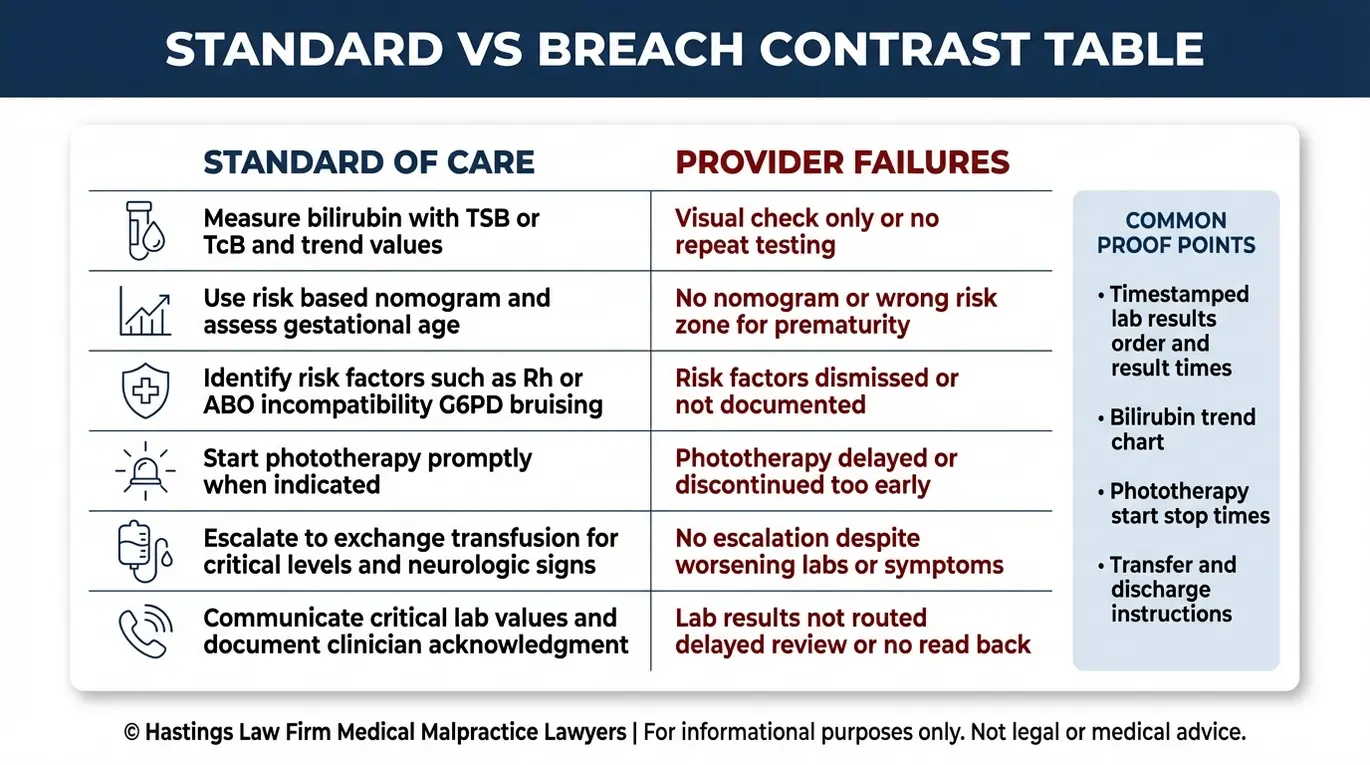
The table below outlines common provider failures alongside what the standard of care generally requires:
| Provider Failure | Standard of Care |
|---|---|
| Relying on visual assessment alone to gauge jaundice severity | Measure bilirubin using TSB or TcB and plot on hour-specific nomogram |
| Dismissing known risk factors such as Rh or ABO incompatibility | Identify and document risk factors at birth; increase monitoring frequency accordingly |
| Delaying initiation of phototherapy after elevated bilirubin result | Begin phototherapy promptly when bilirubin reaches the treatment threshold for the infant’s age and risk category |
| Failing to escalate to exchange transfusion when phototherapy is insufficient | Perform exchange transfusion when bilirubin continues to rise despite phototherapy or reaches critical exchange levels |
| Critical lab values not communicated to the treating physician in a timely manner | Establish and follow critical value notification protocols to ensure immediate physician awareness |
| Discharging the newborn without scheduling a follow-up bilirubin check | Arrange follow-up within 24 to 48 hours of discharge based on risk zone at the time of release |
When malpractice for untreated jaundice is suspected, identifying which of these failures occurred, and when, is central to building a case.
The Hastings Law Firm Difference
Results matter, but what truly sets us apart is how we achieve them. Every verdict, every settlement, and every Texas courtroom victory comes from one guiding promise: To treat each client’s fight for justice as if it were our own.
This balance of skill, experience, and empathy reflects our core philosophy that justice should not only compensate the injured, but also make healthcare safer nationwide.

Identifying the Long-Term Impact of Kernicterus Injuries
Children with kernicterus often suffer from cerebral palsy, auditory neuropathy (a type of hearing loss caused by damage to the auditory nerve), gaze abnormalities, and intellectual disabilities requiring lifelong care. The severity of these outcomes depends on how high bilirubin levels climbed and how long the brain was exposed to toxic concentrations.
The spectrum of injury associated with kernicterus is described by the medical concept of bilirubin-induced neurologic dysfunction, or BIND. BIND recognizes that bilirubin brain injury is not an all-or-nothing event. This spectrum includes the initial phase, acute bilirubin encephalopathy (ABE), which if untreated leads to chronic impairment. Research published through the SHARE at Children’s Mercy scholarly repository on neurological sequelae of neonatal hyperbilirubinemia documents the range of neurological damage seen in children who experienced severe neonatal jaundice.
The most common long-term effects of kernicterus include:
- Athetoid cerebral palsy: Involuntary, uncontrolled movements affecting the arms, legs, and trunk. This is the hallmark motor disorder of chronic kernicterus and often requires mobility assistance. These movements can make daily tasks like walking or eating much more difficult.
- Hearing loss and auditory neuropathy: Damage to the auditory pathways in the brain can cause partial or complete hearing loss. Many children with kernicterus require cochlear implants or specialized hearing support to communicate.
- Gaze abnormalities: Difficulty with upward gaze is a distinctive neurological sign of bilirubin toxicity. It reflects damage to specific areas of the brainstem and can affect a child’s ability to focus or track objects.
- Dental enamel dysplasia: Discoloration or malformation of the baby teeth is a unique marker of bilirubin injury. This occurs because the bilirubin staining happens while the teeth are still developing in the gums.
- Cognitive and developmental delays: Some children experience intellectual disability or learning difficulties, while others retain normal cognitive function despite physical impairments. These delays often require specialized educational plans to help the child learn.
For families, these injuries translate into decades of specialized medical care, adaptive equipment, therapy, and educational support. Families must work through a maze of medical appointments and therapies. Children with BIND may require assistance with daily tasks, from feeding to mobility, for the rest of their lives. Our firm works with medical experts and life care planners to ensure every aspect of your child’s future care needs is accounted for.
Proving Liability in Texas Kernicterus Cases
Proving liability requires demonstrating that the physician violated the accepted standard of care regarding bilirubin management and that this violation directly caused the infant’s brain injury. In Texas, this process follows a structured legal framework with specific procedural requirements that must be met early in the case.
The Expert Report Requirement
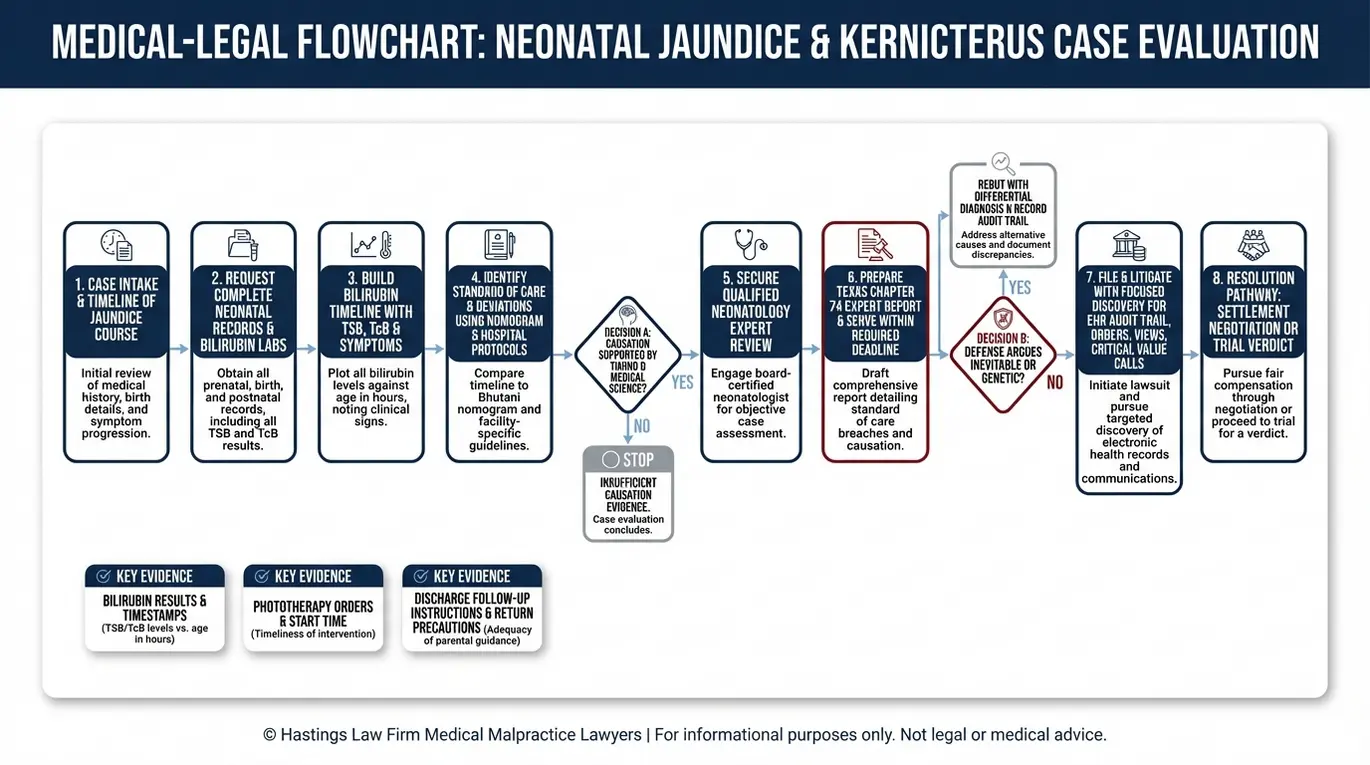
Texas law imposes a strict early hurdle in medical malpractice cases. Under Civil Practice and Remedies Code Chapter 74, a plaintiff must serve a qualified expert report on each defendant within 120 days of the date that defendant files an original answer. This report must identify the applicable standard of care and explain how the provider deviated from it. Failure to meet this deadline can result in dismissal of the case. Our team handles the identification and coordination of medical experts so families are not at risk of missing this requirement.
Evidence Gathering
Kernicterus cases are built on detailed medical records, and the most important evidence often lives in the electronic audit trail. We obtain the full neonatal medical record, including lab orders, timestamped bilirubin results, nursing assessments, and physician notes. Our staff reviews when labs were ordered versus when they were viewed by the provider, looking for gaps that reveal delayed responses. We also evaluate whether the provider correctly used the hour-specific bilirubin risk-zone chart.
Defeating Common Defense Arguments
Hospitals and their defense attorneys frequently argue that the brain injury was inevitable or caused by an unrelated genetic condition. Our team, which includes former defense attorneys who understand these strategies from the inside, is prepared to address these arguments. We work with independent specialists to establish causation, linking the injury timeline directly to bilirubin toxicity. We show that timely intervention would have changed the outcome.
As your legal team, we build the case step by step:
- Obtain and preserve the complete neonatal medical record, including the electronic audit trail
- Retain qualified medical experts to prepare the required Chapter 74 report
- Reconstruct a minute-by-minute bilirubin timeline from birth through diagnosis
- Identify each point where the standard of care was breached
- Establish causation through expert analysis linking the treatment failures to the brain injury
The Role of Prematurity and Risk Factors in Liability
Premature babies have lower treatment thresholds for bilirubin toxicity. Their brains are more vulnerable, and the treatment nomograms reflect adjusted risk zones based on gestational age. Failure to account for prematurity when interpreting bilirubin levels is a recognized form of negligence. We evaluate whether the care team identified known risk factors, adjusted their monitoring accordingly, and acted within the expected timeframes for the baby’s specific clinical picture.
Recovering Damages for Lifelong Special Needs Care
Families can recover compensation for kernicterus aimed at covering past and future medical expenses, loss of earning capacity, pain and suffering, and the cost of life care plans tailored to the child’s specific disabilities. Because kernicterus injuries are permanent, the financial compensation required often extends across an entire lifetime.
Economic Damages
The cost of caring for a child with severe kernicterus can reach into the millions of dollars. These economic damages are uncapped in Texas and typically include 24-hour skilled nursing, physical and occupational therapy, and specialized medical treatment. We use certified life care plans to project these costs over a life expectancy that may exceed 50 years. This ensures no future need is overlooked during settlement negotiations or trial.
Non-Economic Damages
Texas law caps non-economic damages, which include compensation for pain, suffering, and physical impairment. For claims against individual physicians and healthcare providers, the cap is $250,000 per claimant regardless of the number of providers involved. Separate caps apply to healthcare institutions. While this limits one category of recovery, it does not diminish the overall value of a kernicterus case. The uncapped economic damages represent the largest component of compensation in these claims.
Life Care Plans
A life care plan is the foundation of damage calculations in kernicterus cases. This document details every category of care the child will need for the rest of their life, along with the associated future medical costs. It accounts for inflation and changes in care needs as the child ages. We ensure these costs are calculated with precision to reflect the increasing complexity of the child’s needs over time.
For families already facing overwhelming medical bills, a compensation claim for kernicterus can provide the financial security needed to ensure their child receives proper care. While many cases are resolved through settlements, securing fair compensation often requires preparing the case for trial. A lawyer experienced in these cases understands how to present these damages in a way that reflects the true scope of the injury.
How We Investigate Jaundice Malpractice Claims
We conduct a thorough forensic review of neonatal records, consult with independent specialists, and identify gaps in the hospital’s screening protocols to build a compelling case for negligence. Investigating medical malpractice in these cases involves peeling back the layers of the electronic medical record. Our process is designed to give families clarity about what happened while building a strong foundation for their claim.
Every investigation begins with a free, confidential case evaluation. A patient advocate on our team listens to your family’s experience and helps determine if the case warrants a full medical record review. Once we accept a case, our in-house medical staff, including nurse practitioners, conducts a detailed analysis of the neonatal records. We look for:
- Whether bilirubin screening was performed and plotted on the appropriate nomogram
- Whether risk factors like prematurity or blood type incompatibility were identified
- Whether phototherapy was initiated at the appropriate threshold
- Whether critical lab values were communicated to the physician without delay
- Whether the electronic audit trail reveals gaps between when results were available and when they were acted upon
Our team digs deep into the data. We do not just accept summary reports; we look at the metadata that shows who accessed a file and when. This level of detail often reveals that a doctor was aware of a rising bilirubin level long before they ordered treatment. Our firm operates on a contingency fee basis, meaning your family pays no attorney fees or costs unless we secure a recovery on your behalf.
Contact the Texas Birth Injury Attorneys at Hastings Law Firm Today for Help
Kernicterus is a preventable injury. When a newborn suffers permanent brain damage because jaundice was not properly monitored or treated, the family deserves both answers and the financial resources to provide their child with a lifetime of care.
Hastings Law Firm focuses exclusively on medical negligence. Founded by Tommy Hastings, a board-certified trial attorney, our firm has secured millions in recoveries for families affected by preventable birth injuries. We have the resources to handle the most complex kernicterus cases in Texas.
Texas statutes of limitations apply to these claims, and acting promptly helps preserve critical evidence. If your child was diagnosed with kernicterus or suffered brain damage after untreated jaundice, we encourage you to contact us for a free case evaluation. There is no fee unless we recover compensation for your family.
Frequently Asked Questions About Kernicterus Malpractice in Texas


This content was researched and written by the Hastings Law Firm editorial team, which includes attorneys, medical professionals, and experienced researchers. Our writing is informed by internal knowledge and practical experience, and we cross-check critical details against authoritative sources cited throughout. Every piece undergoes human-led fact-checking and legal review. Because legal and medical information can change, if you spot an error, please contact us. Learn more about our content standards and review process on our editorial policy page.

Tommy Hastings, founder of Hastings Law Firm, is a board-certified personal injury trial lawyer dedicated exclusively to healthcare injury cases. Since 2001, he has represented injured patients and families in litigation against major hospital systems, pharmaceutical companies, and negligent healthcare providers nationwide. He has handled numerous high-profile cases that have drawn national media attention and resulted in multi-million dollar recoveries. He draws on that experience in his writing, helping readers understand how these cases work and what options may be available to them.
