


Texas Placental Abruption Lawyer
Written by: Hastings Law Firm | Reviewed by: Tommy Hastings | Updated: July 27, 2026
Placental abruption is a time sensitive obstetric emergency that can cut off a baby’s oxygen and cause dangerous bleeding in the mother. When warning signs are missed or symptoms are dismissed, delays in diagnosis or emergency delivery can lead to permanent brain injury, serious maternal complications, or worse. Understanding concealed abruption, fetal monitoring concerns, and common points where care breaks down can help families make sense of what happened and why outcomes changed so quickly. If you or a loved one were harmed or worse due to mismanaged placental abruption in Texas, contact Hastings Law Firm for a free, confidential case review.

Top Rated Attorneys Helping Texas Families After Preventable Birth Injuries
What You Should Know About Detached Placenta Injury Claims in Texas:
- Long term infant harm can follow when placental abruption is missed or mismanaged because oxygen deprivation can progress quickly.
- Severe maternal complications can occur when abruption is not recognized or treated promptly because dangerous bleeding and shock can develop.
- Options can narrow in Texas medical malpractice claims because missing required expert support can lead to dismissal.
- Recovery can be limited in Texas because non economic damages are capped for claims against physicians.
- Claims can be harder against county or government hospitals because special notice requirements can apply and missed notice can end the claim.
- Preventable delays can occur when concealed abruption is present because severe pain without visible bleeding may be treated as normal labor.
- Permanent injury risk can increase when emergency cesarean delivery is delayed after fetal distress is detected because minutes can matter.
- Disputes often focus on the timing of fetal distress because fetal heart monitoring strips and nursing notes can show when warning signs first appeared.
- Key evidence can come from placental pathology because it may clarify the timing and extent of separation.
- Clinical decision making can be questioned when additional testing is not ordered despite red flags because tools such as ultrasound or laboratory evaluation may be documented as absent.

A Healthcare Focused Law Firm
When a baby suffers harm because placental abruption was missed or mismanaged, the emotional weight can feel impossible to carry. You may be facing a child with serious medical needs, unanswered questions about what happened in the delivery room, and uncertainty about what comes next. Those feelings are valid, and you deserve clear answers.
At Hastings Law Firm, we focus exclusively on medical malpractice litigation. As a Texas placental abruption lawyer, founder Tommy Hastings is Board Certified in Personal Injury Trial Law by the Texas Board of Legal Specialization. Our team includes former defense attorneys and hospital nurses who understand the strategies used by hospital legal systems.
If you believe your baby’s injury was preventable, we welcome the chance to review what happened and explain your options. Consultations are free and confidential, and you pay no fees unless we recover for you.
Understanding Placental Abruption and the Mechanism of Injury
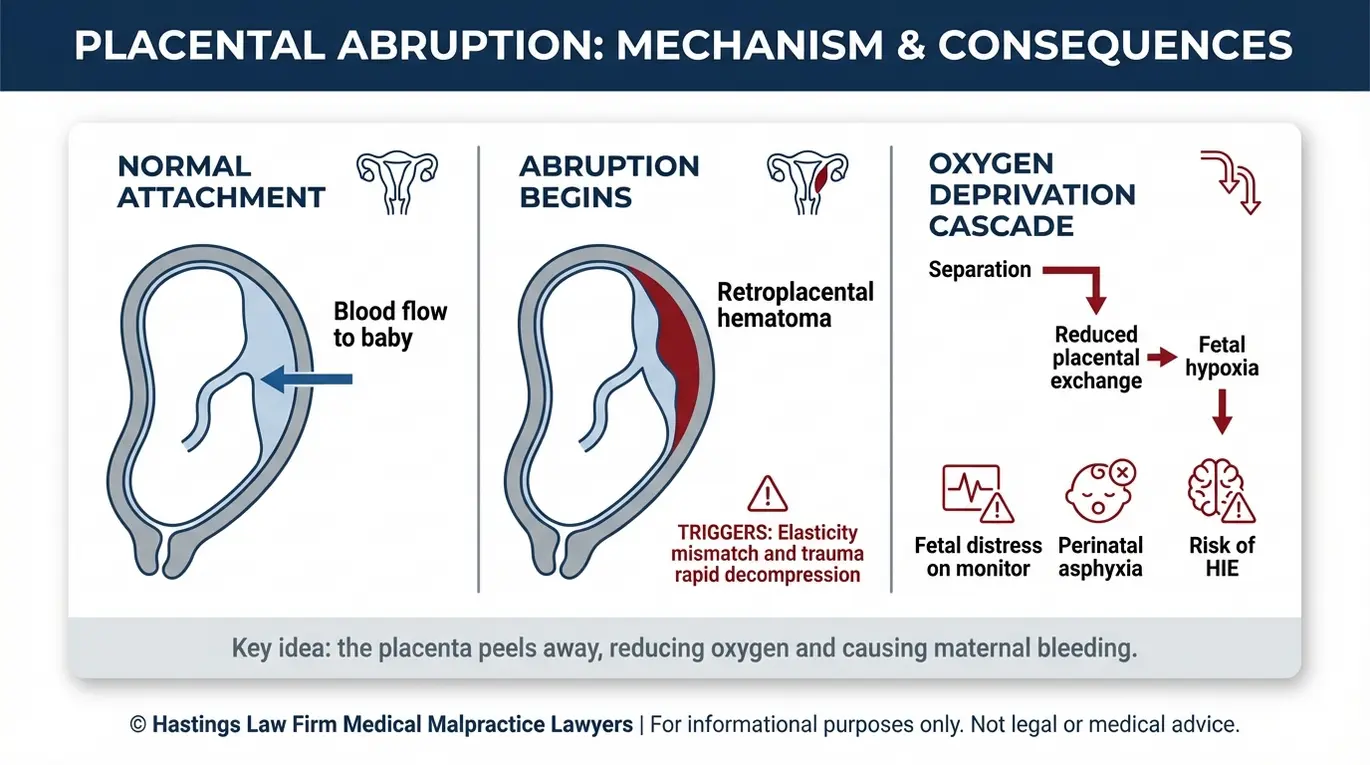
Placental abruption occurs when the placenta prematurely separates from the uterine wall before delivery, cutting off the baby’s oxygen supply and causing dangerous bleeding in the mother. It is one of the most time-sensitive emergencies in obstetric medicine, and how quickly a medical team responds can determine whether a child survives without injury.
The placenta is the organ that delivers oxygen and nutrients from the mother to the baby through the umbilical cord. When it detaches, even partially, a pocket of blood called a retroplacental hematoma can develop behind it. This blood clot forms between the placenta and the uterine wall. It pushes the placenta further away and accelerates oxygen deprivation, a condition known as perinatal asphyxia.
One explanation for why abruption occurs involves what researchers describe as an elasticity mismatch between the uterus and the placenta. The uterine wall can stretch and contract during labor, but the placenta is less flexible. During trauma, sudden changes in pressure, or rapid decompression of the uterus, this difference in tissue behavior can cause the placenta to shear away. According to the National Center for Biotechnology Information (NCBI Bookshelf), the condition complicates roughly 1% of pregnancies and remains a leading cause of maternal and fetal injury.
Research published by PubMed Central on the severity of placental abruption confirms the dual threat: abruption endangers both mother and baby simultaneously, making rapid identification essential. A detached placenta lawyer or placental abruption attorney will look closely at whether known risk factors were present and whether the care team responded appropriately.
Several conditions increase the likelihood of abruption. Recognizing these risk factors matters because patients with them often require closer monitoring:
- Gestational hypertension or preeclampsia, which damages blood vessels supplying the placenta
- Prior history of abruption in a previous pregnancy
- Abdominal trauma, such as a car accident or fall
- Substance use, including tobacco or cocaine
- Premature rupture of membranes or rapid decompression of the uterus
- Advanced maternal age or carrying multiples
As MedlinePlus explains, women with any of these risk factors should be identified early in prenatal care and monitored accordingly. When a provider fails to account for a high-risk profile, the consequences can be devastating.
Failure to Diagnose and the Danger of Concealed Abruption
Medical negligence in abruption cases often occurs when doctors fail to diagnose placental abruption because bleeding is trapped behind the placenta rather than flowing visibly. This type, called concealed placental abruption, can lead providers to dismiss a mother’s severe pain as normal labor discomfort, delaying the intervention that could save her baby’s life.
Placental abruption generally presents in two ways. In a “revealed” abruption, blood escapes through the cervix and is visible as vaginal bleeding. This visible sign typically triggers faster clinical action. In a “concealed” abruption, the blood stays trapped behind the placenta with no external bleeding at all. The mother may report intense abdominal pain, back pain, or a feeling that something is wrong, but without visible blood, some providers may fail to investigate further.
Concealed abruption creates a dangerous legal scenario for families because the clinical picture can be misleading. A mother presenting with severe pain but no vaginal bleeding may have her symptoms attributed to routine contractions or round ligament discomfort. Texas placental abruption attorneys see this pattern repeatedly: the absence of visible blood becomes the reason a medical team delays further testing.
One diagnostic tool that can help confirm abruption is the Kleihauer-Betke test, a blood test that detects the presence of fetal blood cells in the mother’s circulation. When fetal blood crosses into maternal circulation, it often signals that the placental barrier has been compromised. According to the University of Wisconsin Department of Obstetrics and Gynecology, this test can identify fetal-maternal hemorrhage and guide the urgency of clinical response. A medical malpractice lawyer for birth injury cases will examine whether this test was ordered when clinical signs warranted it.
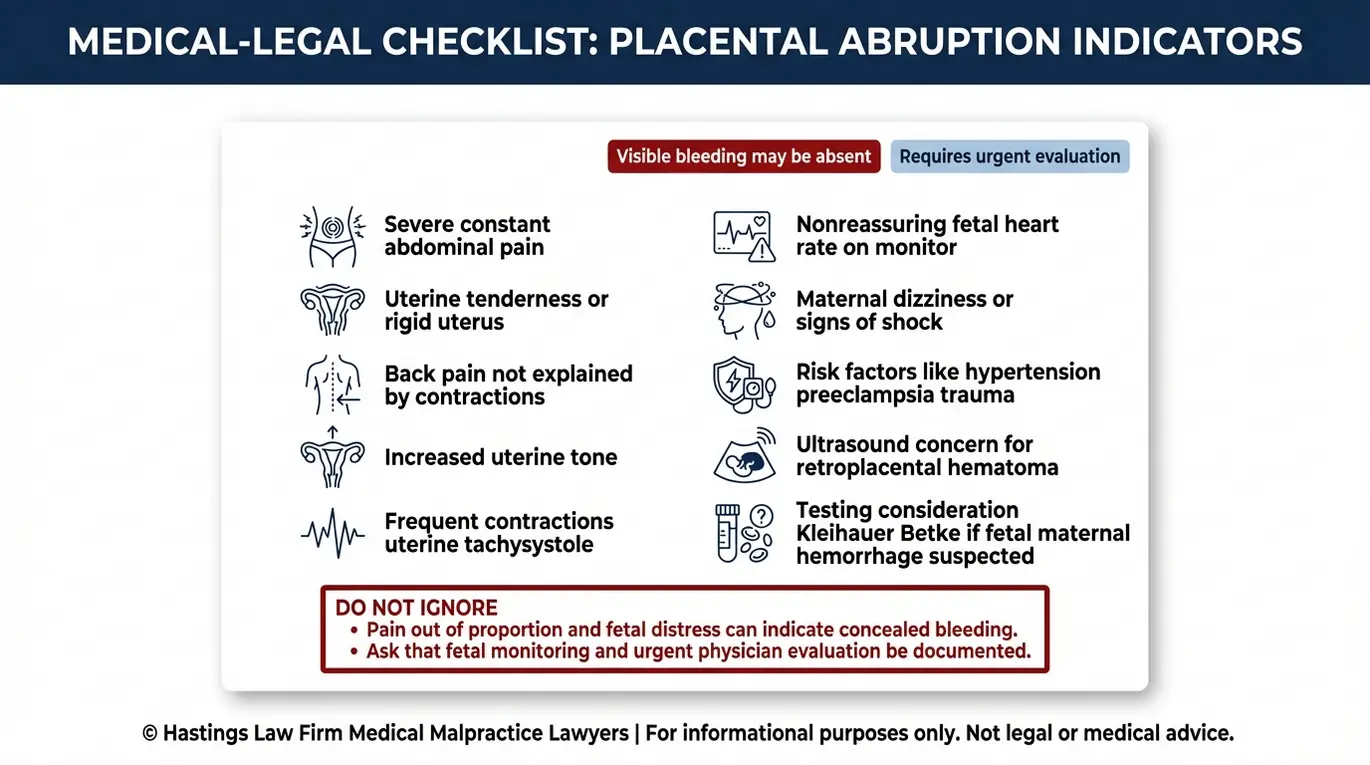
Warning signs that should prompt immediate investigation for abruption include:
- Sudden, severe abdominal or back pain that does not follow a normal contraction pattern
- A rigid or “board-like” uterus on palpation
- Uterine tenderness that worsens between contractions
- Maternal tachycardia (elevated heart rate) or signs of shock without visible bleeding
- Nonreassuring fetal heart rate patterns on the monitor
- Decreased fetal movement reported by the mother
Hidden Bleeding and Missed Symptoms
In many cases of placental abruption, classic textbook symptoms like vaginal bleeding may be completely absent. That absence does not mean the abruption is less severe. In many instances, it means the opposite: a large volume of blood is collecting behind the placenta with nowhere to escape.
Uterine tenderness and persistent back pain are red flags that should prompt further investigation, even when bleeding is not visible. A rigid or “woody” uterus on physical exam can indicate significant hidden bleeding. Uterine tachysystole, a condition where the uterus contracts too frequently with inadequate rest between contractions, may also develop and further compromise blood flow to the baby.
When a provider attributes these signs to normal labor and does not order additional testing, such as ultrasound imaging or laboratory evaluation, the window to intervene safely can close. Our team examines the medical records to determine whether these symptoms were documented, how they were interpreted, and whether the clinical response met the expected standard of care.
The Hastings Law Firm Difference
Results matter, but what truly sets us apart is how we achieve them. Every verdict, every settlement, and every Texas courtroom victory comes from one guiding promise: To treat each client’s fight for justice as if it were our own.
This balance of skill, experience, and empathy reflects our core philosophy that justice should not only compensate the injured, but also make healthcare safer nationwide.

The Countdown to Delivery and Emergency C-Section Delays
In cases of placental abruption, the standard of care requires an immediate emergency C-section once fetal distress is detected. A delay of even a few minutes can result in permanent brain damage or death. The timeline between recognizing danger and delivering the baby is where many abruption cases are won or lost.
During labor complicated by placental abruption, Electronic fetal heart rate monitoring (EFM) is used to track the baby’s health. This is the continuous recording of the heart rate using sensors placed on the mother’s abdomen or attached to the baby’s scalp. These recordings, known as fetal heart strips, create a minute-by-minute record of how the baby is tolerating labor. When the strips show a nonreassuring heart rate pattern, the medical team is expected to act.
A Texas placental abruption lawyer will analyze those fetal heart strips alongside nursing notes and physician orders to identify the exact moment signs of distress first appeared. The gap between that moment and the moment of delivery is the central question in most delayed C-section cases.
Decision-to-incision time refers to the interval between when a provider decides to perform a cesarean delivery and when the surgical incision is made. According to research from the University of San Francisco on standardizing decision-to-incision intervals, the widely accepted benchmark for emergency cesarean delivery is 30 minutes or less. In a true abruption with active fetal distress, many experts argue the target should be even shorter.
Uterine tachysystole, where the uterus contracts too frequently without adequate resting time, can compound the danger during an abruption. Each contraction temporarily reduces blood flow through the placenta. When the placenta is already partially detached, excessive contractions accelerate oxygen deprivation.
How delays typically develop in abruption cases:
A pattern our team frequently identifies in medical records involves a sequence of missed opportunities. The fetal heart strips begin showing warning signs, but the nurse does not escalate to the attending physician. Or the physician is notified but orders additional monitoring rather than calling for an emergency cesarean delivery.
The operating room may not be prepared, or the anesthesia team may not be available. Each of these gaps adds minutes to the timeline. Every minute matters when a placenta has detached and the baby is losing oxygen.
Consider a general example of how these delays compound:
- Minute 0: Fetal heart strips begin showing late decelerations and reduced variability
- Minutes 5–15: Nursing staff reposition the mother and administer oxygen but do not page the physician
- Minutes 15–25: Physician is notified, orders continued monitoring instead of an emergency C-section
- Minutes 25–40: Decision is finally made for cesarean delivery; operating room is not immediately available
- Minutes 40–60+: Baby is delivered with signs of severe oxygen deprivation
A delayed C-section attorney will reconstruct this timeline from the medical records, nursing flowsheets, and electronic monitoring data to determine exactly when the standard of care required action.
At Hastings Law Firm, our in-house medical staff know how to read fetal heart strips and identify charting inconsistencies. That clinical experience allows our birth injury counsel to build cases grounded in the same data the medical team was seeing in real time.
Maternal and Fetal Consequences of Untreated Abruption
Untreated placental abruption can lead to catastrophic outcomes, including hypoxic-ischemic encephalopathy (HIE) and cerebral palsy for the infant, and hemorrhage or organ failure for the mother. The severity depends on how much of the placenta separated, how long oxygen was interrupted, and how quickly the baby was delivered.
Infant Injuries from Oxygen Deprivation
When a baby’s oxygen supply is interrupted during abruption, brain cells begin to die within minutes. Hypoxic-ischemic encephalopathy (HIE) is a type of brain damage caused by a combination of reduced oxygen (hypoxia) and restricted blood flow (ischemia) around the time of birth. HIE is one of the most common diagnoses in placental abruption cases and ranges from mild to severe.
Babies with moderate to severe HIE may develop neonatal seizures within the first hours or days of life. These seizures are often the first clinical sign that significant brain injury has occurred. Over time, oxygen deprivation injuries can lead to cerebral palsy, which affects muscle tone and motor function.
The long-term care needs for a child with HIE or cerebral palsy are significant. An infant brain damage lawyer will work with medical and economic experts to develop a life-care plan for the child’s lifetime. This plan covers the costs of physical therapy, specialized equipment, and continuous care.
Maternal Injuries
Mothers face their own set of serious risks when abruption goes unrecognized or unmanaged. The following table outlines common maternal complications:
| Complication | Description |
|---|---|
| Postpartum hemorrhage | Severe, potentially life-threatening blood loss requiring transfusion or surgical intervention |
| Disseminated intravascular coagulation (DIC) | A clotting disorder where the blood loses its ability to clot normally, causing uncontrolled bleeding |
| Hysterectomy | Emergency surgical removal of the uterus to control hemorrhage, ending future fertility |
| HELLP syndrome | A severe complication of preeclampsia involving hemolysis, elevated liver enzymes, and low platelets |
| Organ failure | Kidney or liver failure resulting from prolonged shock or inadequate blood volume |
A maternal injury attorney in Texas understands that these injuries carry their own damages, including additional surgeries and emotional trauma. The full scope of harm to both mother and child must be reflected in any legal claim. We examine medical records to ensure all complications are documented and linked to the medical negligence.
Proving Medical Malpractice in Texas Abruption Cases
To win a placental abruption case in Texas, a plaintiff must prove that the healthcare provider violated the standard of care and that this violation directly caused the specific injury, supported by qualified expert testimony. This is not a simple disagreement about medical judgment. It requires a structured, evidence-based investigation led by a qualified medical negligence attorney.
Texas medical malpractice law, governed largely by Texas Civil Practice and Remedies Code Chapter 74, imposes specific procedural requirements that do not apply in other personal injury cases. One of the most significant is the requirement to serve a qualified expert report within 120 days after the date each defendant’s original answer is filed. This report must identify the applicable standard of care, explain how the provider breached it, and establish how that breach caused the injury. If the report is insufficient or late, the court can dismiss the case entirely, making it challenging to sue a hospital in Texas without precise legal guidance.
Our investigation process in Texas abruption cases typically follows these steps:
- Complete medical records collection: We obtain all prenatal records, labor and delivery records, nursing notes, electronic fetal monitoring strips, laboratory results, operative reports, and neonatal records.
- In-house medical review: Our nurse consultants and patient advocates review the records to build an initial clinical timeline. They identify when risk factors were present, when symptoms appeared, and how the care team responded.
- Expert witness engagement: We retain qualified specialists, often board-certified OBGYNs and neonatologists, to provide independent opinions on whether the care met accepted medical standards.
- Placental pathology analysis: The placental pathology report often holds critical evidence. A pathologist can determine the timing and extent of the abruption and signs of chronic versus acute separation. This report can confirm or refute the clinical timeline.
- Causation analysis: Establishing that a breach of duty occurred is not enough. Our experts must also demonstrate that the specific breach directly caused the baby’s brain injury or the mother’s complications.
- Life-care plan development: For cases involving permanent injury, we work with medical economists and life-care planners to calculate the full cost of future care and lost earning capacity.
A Texas placental abruption lawyer experienced with Chapter 74 requirements understands that the defense will challenge every element of this framework. Our team prepares every case as though it will go before a jury. This preparation allows us to pursue fair outcomes for families, whether the case resolves through settlement or at trial.
Contact the Texas Birth Injury Attorneys at Hastings Law Firm Today for Help
A placental abruption injury can change the course of a family’s life in ways that are difficult to fully describe. The medical needs may be lifelong. The questions about what happened may feel overwhelming. And the path forward may seem unclear.
Hastings Law Firm is a medical malpractice law firm built for exactly these cases. Our team focuses exclusively on medical negligence, giving families the specialized resources needed to hold hospital systems accountable. Board-certified trial lawyer Tommy Hastings has spent over two decades representing families in cases involving preventable birth injuries, and every case is prepared with the same level of detail and commitment.
If your family has been affected by a placental abruption that you believe was mismanaged, a Texas placental abruption lawyer at our firm can review your records and help you understand what happened. The consultation is free, confidential, and carries no obligation. You pay nothing unless we recover on your behalf.
Frequently Asked Questions About Placental Abruption in Texas


This content was researched and written by the Hastings Law Firm editorial team, which includes attorneys, medical professionals, and experienced researchers. Our writing is informed by internal knowledge and practical experience, and we cross-check critical details against authoritative sources cited throughout. Every piece undergoes human-led fact-checking and legal review. Because legal and medical information can change, if you spot an error, please contact us. Learn more about our content standards and review process on our editorial policy page.

Tommy Hastings, founder of Hastings Law Firm, is a board-certified personal injury trial lawyer dedicated exclusively to healthcare injury cases. Since 2001, he has represented injured patients and families in litigation against major hospital systems, pharmaceutical companies, and negligent healthcare providers nationwide. He has handled numerous high-profile cases that have drawn national media attention and resulted in multi-million dollar recoveries. He draws on that experience in his writing, helping readers understand how these cases work and what options may be available to them.
