


Texas Forcep & Vacuum Birth Injury Lawyer
Assisted vaginal delivery using forceps or a vacuum can be safe, but misuse or poor decision making can lead to serious newborn and maternal injuries. Liability often turns on whether the instrument was appropriate for the situation, whether safety standards were followed, and whether informed consent and documentation were handled properly. When errors occur, families may face long term medical needs, intensive therapy, and lasting disability that changes daily life. If you or a loved one were harmed or worse due to forceps or vacuum assisted delivery malpractice in Texas, contact Hastings Law Firm for a free, confidential case review.

Last Updated: July 27, 2026
Assisted Delivery Malpractice Attorneys in Texas
When a child is injured during an operative vaginal delivery, where forceps, curved metal instruments used to guide the baby, or a vacuum device is used to help guide the baby through the birth canal, parents are often left with more questions than answers. You may be wondering whether what happened was preventable, whether the medical team made the right call, and what options exist to protect your child’s future.
As a Texas Forcep & Vacuum Birth Injury Lawyer, Hastings Law Firm focuses exclusively on medical malpractice, including injuries caused by the misuse of delivery instruments. Our team of attorneys, in-house nurses, and medical consultants understands both the medicine and the law behind these cases. If your child was harmed during an assisted delivery, we can review what happened and explain your options in a free, confidential consultation.

Liability in Operative Vaginal Deliveries and Instrument Use
Operative vaginal delivery, sometimes referred to as assisted vaginal delivery, involves using forceps or a vacuum extractor to assist the mother during the second stage of labor, but liability arises when medical professionals use these tools without proper indication or fail to abandon them when safety protocols call for a cesarean section (C-section). These instruments are not inherently dangerous when used correctly and under the right circumstances. The legal question centers on whether the decision to use them was appropriate and whether the physician followed accepted safety standards.
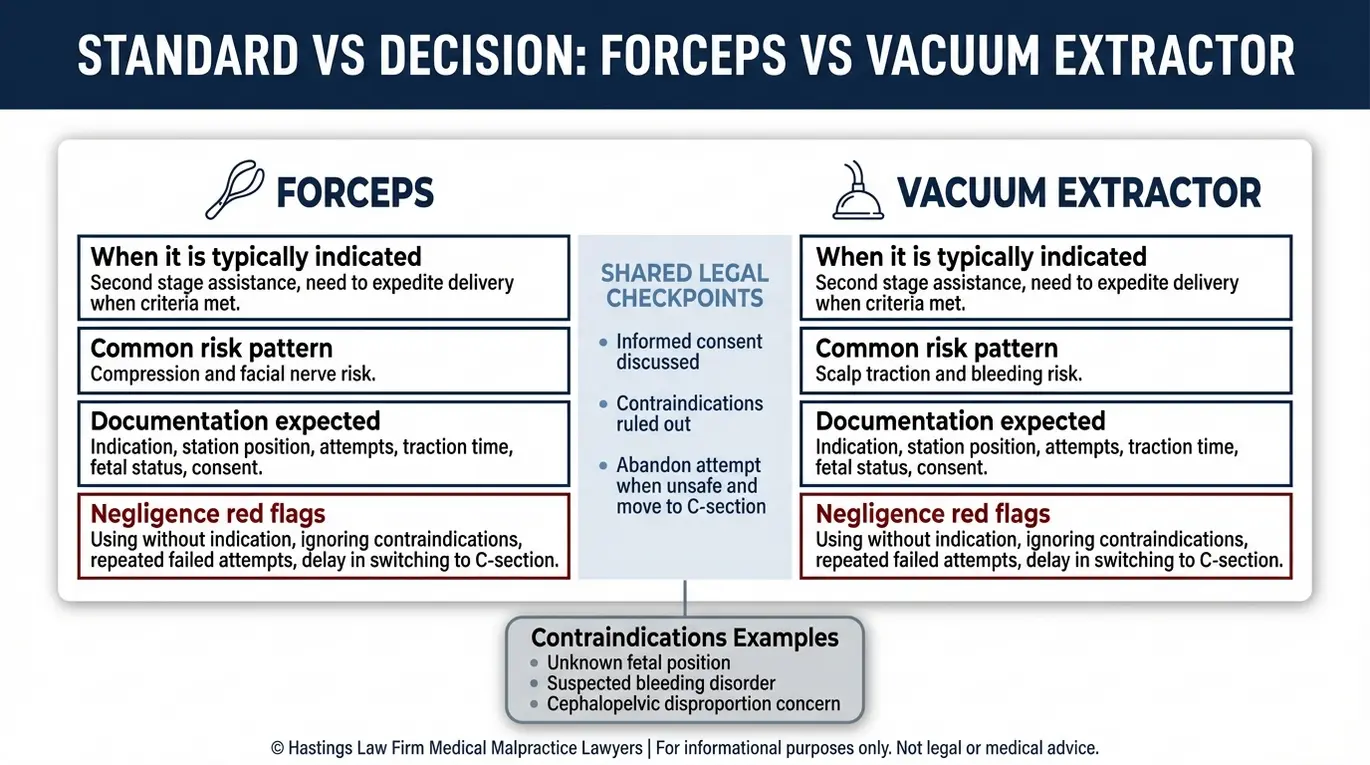
Forceps are metal instruments shaped like curved tongs that cradle the baby’s head to guide it through the birth canal. Vacuum extraction uses a soft or rigid cup attached to the baby’s scalp, with suction applied to assist with delivery. According to guidelines published by Vanderbilt University Medical Center, both tools carry distinct risk profiles, and the choice between them depends on clinical factors like fetal position, gestational age, and the mother’s anatomy.
A forcep injury attorney or vacuum extraction negligence lawyer will examine whether the physician had a valid medical reason, known as an “indication,” to use these instruments at all. Equally important is whether the mother gave informed consent, meaning the physician explained the specific risks of the chosen instrument and the alternatives available, including a C-section. In emergency situations, instruments are sometimes applied without a full informed consent discussion, but the medical record must still reflect the clinical reasoning behind that decision.
Contraindications, which are medical reasons why an instrument should not have been used, are a frequent basis for liability. For example, vacuum extraction is generally contraindicated in premature infants or when a fetal bleeding disorder is suspected. As a birth injury legal team, we review the medical records to determine whether known contraindications were present and ignored.
Forceps Risks vs. Vacuum Risks:
- Forceps: Higher risk of facial nerve injury, skull fractures, and maternal lacerations. Requires precise positioning; misapplication can cause direct compression injuries to the infant’s head and face.
- Vacuum Extractor: Higher risk of scalp injuries such as cephalohematoma and subgaleal hematoma. Improper suction pressure or prolonged application increases the risk of intracranial hemorrhage and brain damage.
Both instruments carry the risk of brachial plexus injury if excessive traction is applied. An instrument delivery malpractice attorney evaluates whether the physician’s choice of tool and technique met the standard of care given the specific clinical circumstances.
Physical Trauma and Brain Injuries Caused by Instrument Negligence
Improper use of birth instruments can cause severe physical trauma ranging from temporary skull fractures and facial nerve damage to permanent brain injuries like cerebral palsy and hypoxic-ischemic encephalopathy (HIE) due to intracranial hemorrhage, or bleeding within the skull. The type and severity of injury often depend on which instrument was used, how much force was applied, and how long the attempt lasted.
A Texas birth injury lawyer reviews these injuries in the context of what the medical team did or failed to do during delivery. External injuries are sometimes the most immediately visible. Facial palsy, a condition where the baby cannot move one side of the face, can result from forceps compressing the facial nerve. Cephalohematoma, a collection of blood between the skull bone and its covering, is more commonly associated with vacuum extraction. While cephalohematoma often resolves on its own, it can indicate that excessive force was applied.
Internal and neurological injuries are far more serious. Intracranial hemorrhage, or bleeding inside or around the brain, can occur when a vacuum cup is applied with too much pressure or for too long. This bleeding can lead to hypoxic-ischemic encephalopathy (HIE), a condition where the brain is deprived of adequate oxygen and blood flow.
HIE is one of the leading causes of cerebral palsy in newborns. Research published by JAMA Network Open has examined the relationship between operative vaginal delivery outcomes and clinical practice patterns, underscoring the importance of physician experience and adherence to protocols.
A subgaleal hematoma, which is bleeding between the skull’s periosteum and the scalp’s connective tissue layer, is among the most dangerous vacuum-related injuries. Unlike a cephalohematoma, a subgaleal hematoma can spread across a large area and lead to life-threatening blood loss in a newborn.
Brachial plexus injuries occur when the network of nerves running from the spine through the neck and into the arm is stretched or torn during delivery. This often results in Erb’s palsy, a condition that limits movement and strength in the affected arm. A forcep trauma attorney or vacuum pump injury lawyer investigates whether excessive downward traction during an instrument-assisted delivery caused or contributed to this type of nerve damage.
| Instrument Used | Common Injury Type | Long-Term Potential Impact |
|---|---|---|
| Forceps | Facial nerve palsy, skull fracture, cephalohematoma | Permanent facial paralysis, developmental delays, need for reconstructive surgery |
| Forceps | Brachial plexus injury (Erb’s palsy) | Limited arm mobility, chronic pain, potential surgical intervention |
| Vacuum Extractor | Subgaleal hematoma, intracranial hemorrhage | Life-threatening blood loss, brain damage, seizure disorders |
| Vacuum Extractor | Hypoxic-ischemic encephalopathy (HIE) | Cerebral palsy, cognitive impairment, lifelong need for supportive care |
| Both | Brain injury from prolonged or excessive application | Seizures, developmental disabilities, 24-hour care requirements |
An infant delivery negligence counsel examines whether the documented injuries are consistent with the type of instrument used and the delivery timeline recorded in the medical chart.
The Hastings Law Firm Difference
Results matter, but what truly sets us apart is how we achieve them. Every verdict, every settlement, and every Texas courtroom victory comes from one guiding promise: To treat each client’s fight for justice as if it were our own.
This balance of skill, experience, and empathy reflects our core philosophy that justice should not only compensate the injured, but also make health care safer nationwide.

Proving Negligence Through Standard of Care Violations
Proving negligence in instrument delivery cases requires demonstrating that the physician violated the standard of care, the level of treatment a reasonably competent obstetrician would have provided under similar circumstances, by failing to recognize fetal distress, applying excessive force, or persisting with instrument attempts beyond safe limits.
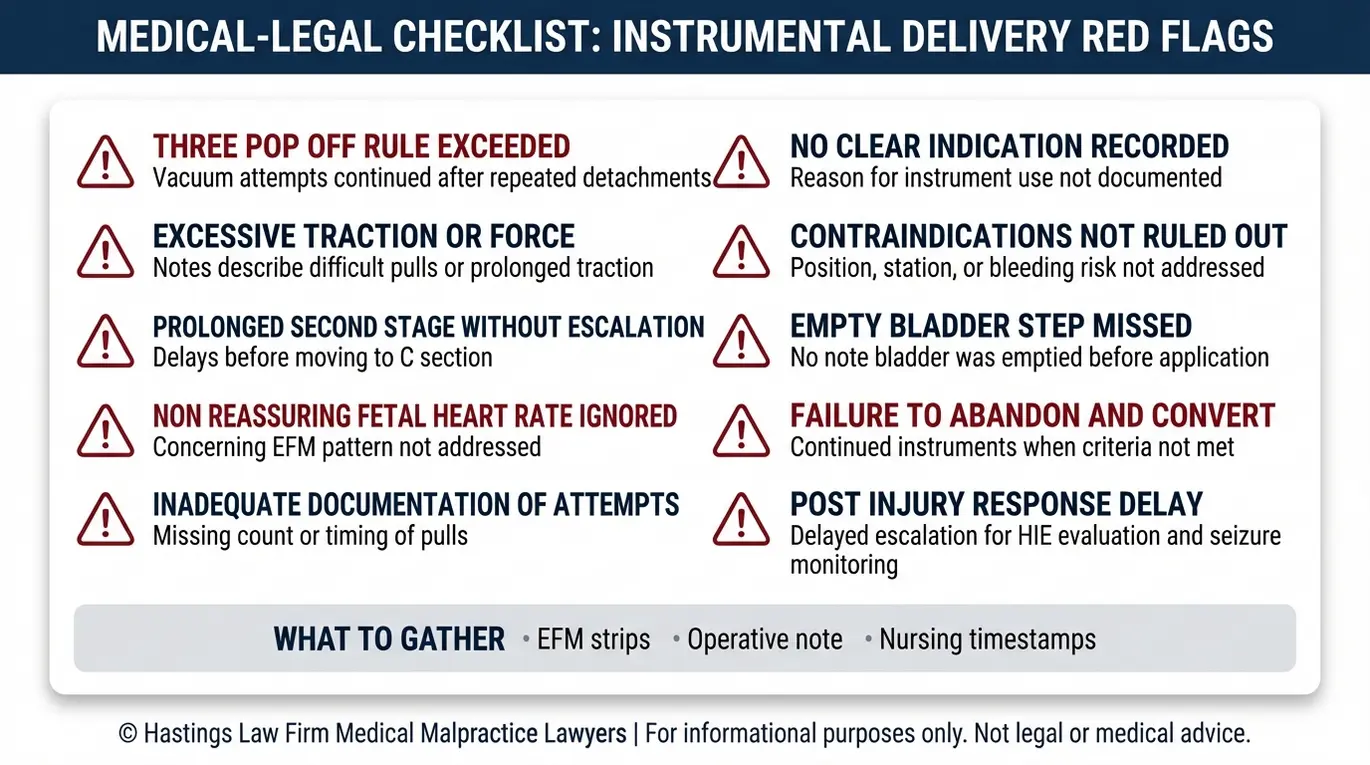
A medical malpractice lawyer for birth injuries builds these cases around specific, well-established safety rules. One of the most important is the guideline regarding vacuum detachments. In vacuum extraction, if the suction cup detaches from the baby’s scalp two or more times, the physician is expected to abandon the vacuum attempt and proceed to a C-section. Each detachment increases the risk of scalp injury and intracranial hemorrhage. Continuing beyond the recommended limit is widely recognized as a departure from accepted standard of care, and a vacuum birth negligence attorney will look for documentation of how many attempts were made.
According to clinical guidelines published by CRICO (Harvard’s Risk Management Foundation), operative vaginal delivery protocols include specific criteria that must be met before instrument application. The mother’s bladder should be emptied before forceps or vacuum placement. A full bladder can obstruct the baby’s descent and increase the risk of maternal injury, making this a basic preparatory step that should never be skipped.
Fetal heart rate monitoring negligence is another common basis for a claim. Electronic fetal monitoring (EFM) strips record the baby’s heart rate patterns throughout labor. Signs of fetal distress, such as late decelerations or prolonged bradycardia, may indicate that the baby is not tolerating labor. A Texas forcep error lawyer examines whether the medical team recognized these warning signs before or during instrument application and whether they responded appropriately.
Standard of Care “Red Flags” in Instrument Deliveries:
- Vacuum cup detached two or more times and the physician continued the attempt
- No documentation that the mother’s bladder was emptied before instrument application
- Fetal heart rate strips showing distress patterns before the instrument was applied
- Instrument applied for longer than the recommended time limits
- No documented informed consent discussion about instrument risks and alternatives
- Failure to have an operating room ready for an emergency C-section during the attempt
- Brachial plexus injury, which is damage to the nerve network controlling the arm (sometimes called Erb’s palsy), resulting from excessive traction during delivery
If you or a loved one recognize any of these issues, seeking legal help for birth trauma can help determine whether a standard of care violation occurred.
Therapeutic Hypothermia and Post-Injury Response
When a baby shows signs of hypoxic-ischemic encephalopathy (HIE), a condition where the brain suffers damage from oxygen deprivation and reduced blood flow, the standard of care calls for therapeutic hypothermia, commonly called “cooling.” This treatment involves lowering the newborn’s body temperature to slow the brain’s metabolic processes and reduce the extent of injury. Cooling must be initiated within six hours of birth to be most effective.
A delay in recognizing that a baby needs this intervention, or a failure to transfer the infant to a facility equipped to provide it, can worsen the brain damage significantly. If a traumatic instrument delivery resulted in signs of HIE, such as seizures, poor muscle tone, or abnormal reflexes, and the medical team did not promptly begin therapeutic hypothermia, that delay can constitute a separate act of negligence.
Investigating Instrument Errors with Medical-Legal Experts
A specialized birth injury investigation attorney investigates instrument errors by securing fetal monitoring strips and operative reports, then working with independent medical experts to reconstruct the delivery and identify where the physician deviated from safety protocols.
One of the first steps our team takes is obtaining the original electronic fetal monitoring (EFM) data, which tracks the baby’s heart rate during labor, including the digital metadata and audit trail. This is different from a printed copy of the strips. The audit trail can reveal whether records were accessed, modified, or reprinted after the delivery, which helps ensure the evidence has not been altered. Our Texas medical negligence lawyers understand that these electronic records must be preserved quickly, as some hospital systems overwrite data on a set schedule.
The operative note is another critical document. This is the physician’s own account of the delivery, including what instruments were used, how many attempts were made, and the duration of the procedure. Our in-house nursing staff and Board Certified Patient Advocates review these records alongside labor and delivery logs, nursing notes, and NICU admission records to build a detailed timeline.
Hastings Law Firm maintains a national expert network of obstetricians, neonatologists, and pediatric neurologists who provide independent, objective analysis. A forcep lawsuit attorney uses these expert opinions to establish whether the physician’s actions fell below the standard of care and whether those actions directly caused the child’s injuries. Our legal team includes former defense attorneys and experienced hospital nurses who previously worked for the systems they now challenge. Our founder, Tommy Hastings, is Board Certified in Personal Injury Trial Law, a distinction held by fewer than 2% of Texas attorneys.
Ultimately, expert testimony is required to explain complex medical standards to a jury, bridging the gap between raw medical data and legal proof. Establishing liability often depends on this detailed reconstruction. We also scrutinize technical details like the “station” of the baby’s head recorded in the operative note; applying instruments when the baby is too high in the birth canal is a significant deviation from safety protocols. By rigorously analyzing these factors, we build a compelling argument that the injury was not an unavoidable complication, but a preventable error. This expert-driven approach is how we determine whether a case has merit and how we present the evidence if it moves to litigation.
Compensation for Lifelong Care: Quantifying Damages in Birth Injury Cases
Compensation in birth injury cases is calculated to cover the infant’s lifetime needs, including future medical treatments, occupational therapy, around-the-clock care, specialized equipment, and non-economic damages for pain, suffering, and physical impairment. Because many instrument-related injuries result in permanent conditions, the financial analysis often spans decades.
A Texas birth injury compensation lawyer works with life care planners and forensic economists to project costs 50 or more years into the future. This life care plan accounts for every anticipated medical need the child will face, from surgeries and medications to adaptive technology and home modifications. Without this type of detailed planning, families risk accepting a settlement that falls far short of what their child will actually need. This projection forms the basis of a future cost claim, which must account for the reality that medical expenses often rise faster than general inflation.
Recoverable damages in birth injury cases may include:
- Past and future medical expenses, including surgeries, hospitalizations, therapy, and specialist care
- Rehabilitation costs, such as physical therapy, occupational therapy, and speech therapy
- Home health aides or 24-hour attendant care
- Specialized medical equipment, including wheelchairs, orthotics, and communication devices
- Lost earning capacity for the child over their expected working lifetime
- Pain and suffering endured by the child
- Mental anguish experienced by the child and, in some cases, the parents
- Physical impairment and disfigurement
Economic damages, which cover measurable financial losses like medical bills and lost earning capacity, are uncapped in Texas. Non-economic damages, which address pain, suffering, and quality of life, are subject to statutory caps. Our team ensures that every category of harm is thoroughly documented so that the full scope of your child’s needs is presented. We also evaluate the impact on parents, who often sacrifice careers to provide full-time care.
This ensures the family has the resources to access the best possible support systems, from private nursing to accessible housing, maximizing the child’s quality of life. We evaluate every potential resource to provide for the child’s long-term security.
Contact the Texas Birth Injury Attorneys at Hastings Law Firm Today for Help
If your child was injured during a forceps or vacuum-assisted delivery, you deserve to know what happened and why. At Hastings Law Firm, our mission is to restore trust for families who feel the medical system failed them, and to hold negligent providers accountable so that the same mistakes are not repeated with another family.
As a Texas Forcep & Vacuum Birth Injury Lawyer, our entire team of attorneys, in-house nurses, and medical consultants is dedicated solely to medical malpractice. We prepare every case as if it will go to trial, and we work on a contingency fee basis, meaning you pay no attorney fees or costs unless we recover compensation for your family.
Contact Hastings Law Firm today for a free, confidential case evaluation. Let us review your child’s medical records, explain your legal options, and help you take the first step toward answers.
Frequently Asked Questions About Forcep & Vacuum Birth Injury in Texas


This content was researched and written by the Hastings Law Firm editorial team, which includes attorneys, medical professionals, and experienced researchers. Our writing is informed by internal knowledge and practical experience, and we cross-check critical details against authoritative sources cited throughout. Every piece undergoes human-led fact-checking and legal review. Because legal and medical information can change, if you spot an error, please contact us. Learn more about our content standards and review process on our editorial policy page.

Tommy Hastings, founder of Hastings Law Firm, is a board-certified personal injury trial lawyer dedicated exclusively to healthcare injury cases. Since 2001, he has represented injured patients and families in litigation against major hospital systems, pharmaceutical companies, and negligent healthcare providers nationwide. He has handled numerous high-profile cases that have drawn national media attention and resulted in multi-million dollar recoveries. He draws on that experience in his writing, helping readers understand how these cases work and what options may be available to them.
