


Texas Prolonged Rupture of Membranes Lawyer
Written by: Hastings Law Firm | Reviewed by: Tommy Hastings | Updated: July 27, 2026
Delayed delivery after a mother’s water breaks can raise the risk of infection and serious birth injury when timely monitoring and intervention do not occur. Prolonged rupture of membranes can remove a protective barrier, and delays in antibiotics, induction, or escalation to cesarean delivery can allow infection and fetal distress to worsen. Families may be left facing complex medical records and uncertainty about whether the harm was preventable. If you or a loved one were harmed or worse due to delayed delivery after prolonged rupture of membranes in Texas, contact Hastings Law Firm for a free, confidential case review.

Securing Justice for Birth Injuries Caused by Delayed Delivery Malpractice
What You Should Know About Delayed Delivery Malpractice Claims in Texas:
- The risk of severe infection and lasting brain injury can rise when delivery is delayed after membranes rupture without clear medical justification.
- A preventable birth injury can be harder to dispute when the record shows missed monitoring, delayed antibiotics, or a lack of timely escalation in care.
- Options for recovery in Texas can be limited for pain and suffering because non economic damages are capped.
- Long term financial needs can remain recoverable because economic damages for medical care and related costs are not capped under Texas law.
- Compensation planning can be shaped by court ordered payment structures because future damages may be paid over time rather than as a single lump sum.
- A delayed delivery timeline can become central when documentation shows gaps in communication between nurses and the attending obstetrician.
- Infection can be harder to deny when placental pathology shows evidence of infection even without obvious symptoms during labor.
- Permanent harm can follow when fetal distress is not addressed promptly because abnormal fetal heart rate patterns may require urgent cesarean delivery.
- Disputes about whether infection was recognized in time can turn on charted warning signs such as fever or sustained fetal tachycardia.
- Legal options can be lost if filing deadlines are missed because Texas imposes time limits that can bar claims even when injury discovery is delayed.

A Healthcare Focused Law Firm
When a mother’s water breaks and delivery is delayed without clear medical justification, the risk of serious infection and injury to the baby rises with every passing hour. If your child was harmed because a doctor failed to act within a safe timeframe after membrane rupture, you may be dealing with questions that feel impossible to answer on your own.
A Texas prolonged rupture of membranes lawyer can help you understand what happened, why it happened, and whether the care your family received fell below accepted medical standards. At Hastings Law Firm, our team of attorneys, nurse consultants, and board-certified patient advocates focuses exclusively on medical malpractice cases like these. We are here to review your records, explain your options, and help you take the next step toward answers and accountability.
Understanding Negligence in Prolonged Rupture of Membranes Cases
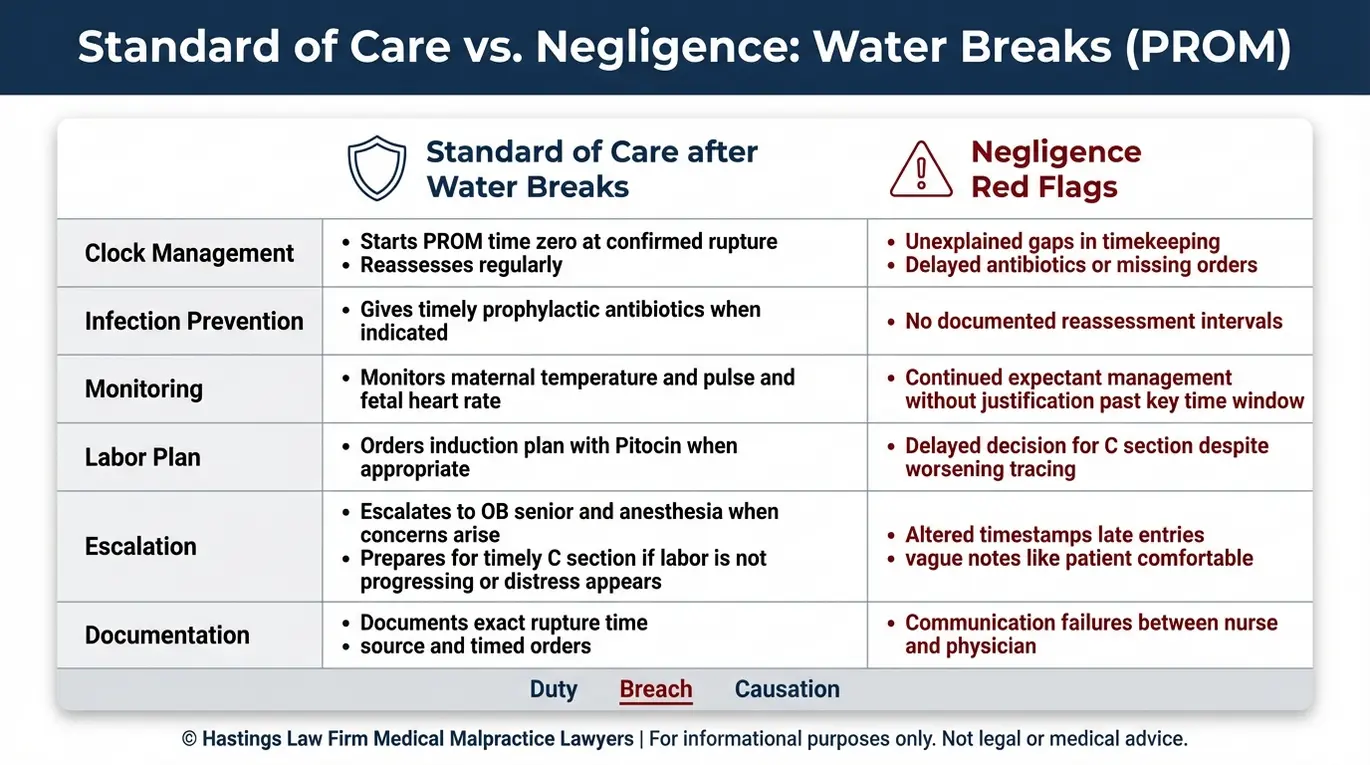
Medical negligence in PROM cases occurs when a physician fails to follow the standard of care after a mother’s water breaks, such as neglecting to administer prophylactic antibiotics or delaying induction of labor, resulting in preventable infection or injury.
Prolonged rupture of membranes (PROM) removes the sterile barrier that protects the baby from bacteria. This occurs when the amniotic sac breaks and fluid leaks before labor begins. Once that barrier is gone, the clock starts. The latency period, the time between membrane rupture and delivery, becomes a window of increasing risk. Research published by the National Center for Biotechnology Information (PubMed Central) confirms that a longer latency period at term is associated with higher rates of neonatal infectious disease.
The standard of care requires physicians to closely monitor both mother and baby after rupture and to take timely action to prevent infection. This typically includes administering antibiotics, initiating labor when it does not begin on its own, and preparing for a cesarean section if complications arise. Our founder, Tommy Hastings, is board-certified in personal injury trial law by the Texas Board of Legal Specialization, a distinction held by fewer than 2% of attorneys in the state.
A birth injury becomes a question of medical negligence when the physician’s failure to act, not the complication itself, causes the harm. Not every difficult delivery involves malpractice. But when a doctor fails to monitor, fails to induce, or fails to deliver within a medically appropriate window, that inaction may cross the line from an unavoidable complication to a preventable one.
Our team examines what the provider did, what they should have done, and how the gap between the two contributed to your child’s injury. A PROM malpractice lawyer builds this case by reconstructing the medical timeline and comparing it against established clinical guidelines.
| Element | Standard of Care | Negligence |
|---|---|---|
| Monitoring | Continuous assessment of maternal and fetal status after membrane rupture | Failure to track vital signs, temperature, or fetal heart rate |
| Antibiotics | Timely administration to prevent infection, especially for GBS-positive mothers | Delayed or omitted antibiotic treatment |
| Delivery Timing | Initiation of induction or cesarean section within a medically appropriate timeframe | Allowing hours to pass without intervention or medical justification |
| Communication | Clear documentation and team coordination regarding infection risk | Gaps in communication between nurses, obstetricians, and support staff |
The 24-Hour Rule and Investigating Failure to Induce Labor
The standard of care often requires that delivery occur within 24 hours of membrane rupture to reduce infection risk. Failure to induce labor or perform a cesarean section beyond this window, without documented medical justification, may constitute delayed delivery malpractice.
The 24-hour delivery rule, a widely recognized clinical benchmark for delivery timing after membrane rupture, is supported by guidelines from the American College of Obstetricians and Gynecologists (ACOG) Practice Bulletin No. 217. While individual clinical judgment can affect timing, expert testimony in malpractice cases often centers on whether the physician had a defensible reason for allowing the latency period to extend beyond this threshold.
When labor does not begin on its own after rupture, physicians typically use Oxytocin to stimulate contractions and move delivery forward. This medication is commonly known by the brand name Pitocin. If Pitocin is not started in a timely manner, or if labor stalls and no alternative plan is executed, the risk of maternal infection climbs. Delays can occur due to hospital scheduling or staffing issues rather than clinical necessity.
As a prolonged rupture of membranes lawyer in Texas, we review medical records for specific red flags that may indicate a failure to act:
- No documented order for induction despite prolonged rupture
- Pitocin initiated but stopped without explanation or follow-up plan
- No evidence of communication between nursing staff and the attending obstetrician about the elapsed time since rupture
- Absence of a contingency plan for emergency C-section
- Maternal vital signs showing early signs of infection (fever, elevated heart rate) without documented response
- Staffing records showing no obstetrician was physically present or available
These gaps often tell the story of a delayed delivery that should not have happened.
Diagnosing Asymptomatic Chorioamnionitis Through Placental Pathology
In delayed delivery cases, the placenta can reveal evidence of infection even if a mother shows no obvious symptoms during labor. Placental pathology, the microscopic examination of placental tissue after delivery, can identify histologic chorioamnionitis. This is a form of infection that develops without visible symptoms during labor.
This evidence is important because defense attorneys often argue that no infection was present since the mother did not appear sick. Our medical team works with pathology specialists to provide expert testimony. We use these reports to determine whether the placental findings confirm that infection was developing before delivery and whether earlier intervention could have prevented injury.
The Hastings Law Firm Difference
Results matter, but what truly sets us apart is how we achieve them. Every verdict, every settlement, and every Texas courtroom victory comes from one guiding promise: To treat each client’s fight for justice as if it were our own.
This balance of skill, experience, and empathy reflects our core philosophy that justice should not only compensate the injured, but also make healthcare safer nationwide.

Chorioamnionitis and the Devastating Impact of Untreated Infection
Chorioamnionitis, a bacterial infection of the membranes surrounding the fetus, can lead to maternal sepsis, fetal brain injury, and cerebral palsy if left untreated due to medical negligence.
After the membranes rupture, bacteria such as Group B streptococcus (GBS) can travel upward into the uterine environment. GBS is a common bacterium found in the birth canal. When the sterile barrier is gone, this path is open. This upward migration is dangerous because the amniotic fluid, once a protective cushion, becomes a breeding ground for bacteria that can overwhelm the fetus. A physician who fails to screen for GBS, delays antibiotics, or ignores early warning signs may allow infection to take hold.
A meta-analysis published in the journal Pediatrics (PubMed) found a significant association between chorioamnionitis and the development of cerebral palsy. The progression can be severe. Infection triggers an inflammatory response that compromises blood flow and oxygen to the baby’s brain. This can cause hypoxic-ischemic encephalopathy (HIE), a form of brain damage caused by oxygen deprivation. Families often do not realize the severity of the infection until days after birth when neurological symptoms appear.
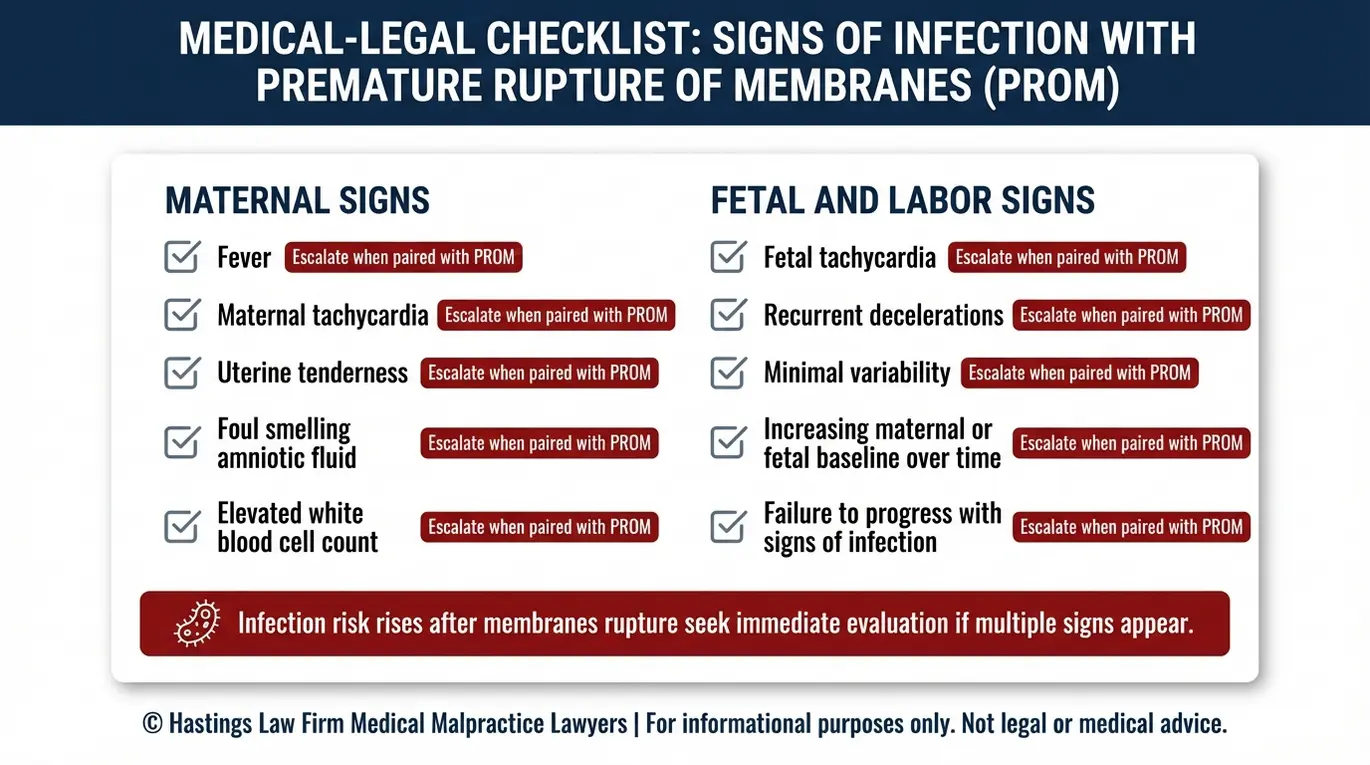
As a Texas PROM injury attorney, we investigate whether the medical team recognized and responded to warning signs in time. An infection birth injury lawyer reviews the chart for symptoms that may have been present but not acted upon:
- Maternal fever above 100.4°F (38°C)
- Maternal tachycardia (elevated heart rate)
- Fetal tachycardia (sustained elevated fetal heart rate above 160 bpm)
- Uterine tenderness on examination
- Foul-smelling or discolored amniotic fluid
- Elevated white blood cell count in maternal labs
When these symptoms appear in the records but no escalation of care follows, it raises serious questions about whether the standard of care was met.
Fetal Distress Signals and the Failure to Perform C-Sections
When infection sets in, the fetus often shows signs of distress on the heart rate monitor, and these signs may require an immediate emergency C-section to prevent permanent brain damage or death.
Fetal heart rate monitoring is the primary tool used during labor to assess the baby’s well-being. Infection and inflammation can cause fetal tachycardia, a sustained elevation of the fetal heart rate above the normal range, which signals that the baby’s body is under stress. As the condition worsens, the monitor may show decelerations, sudden drops in heart rate that can indicate the baby is losing oxygen.
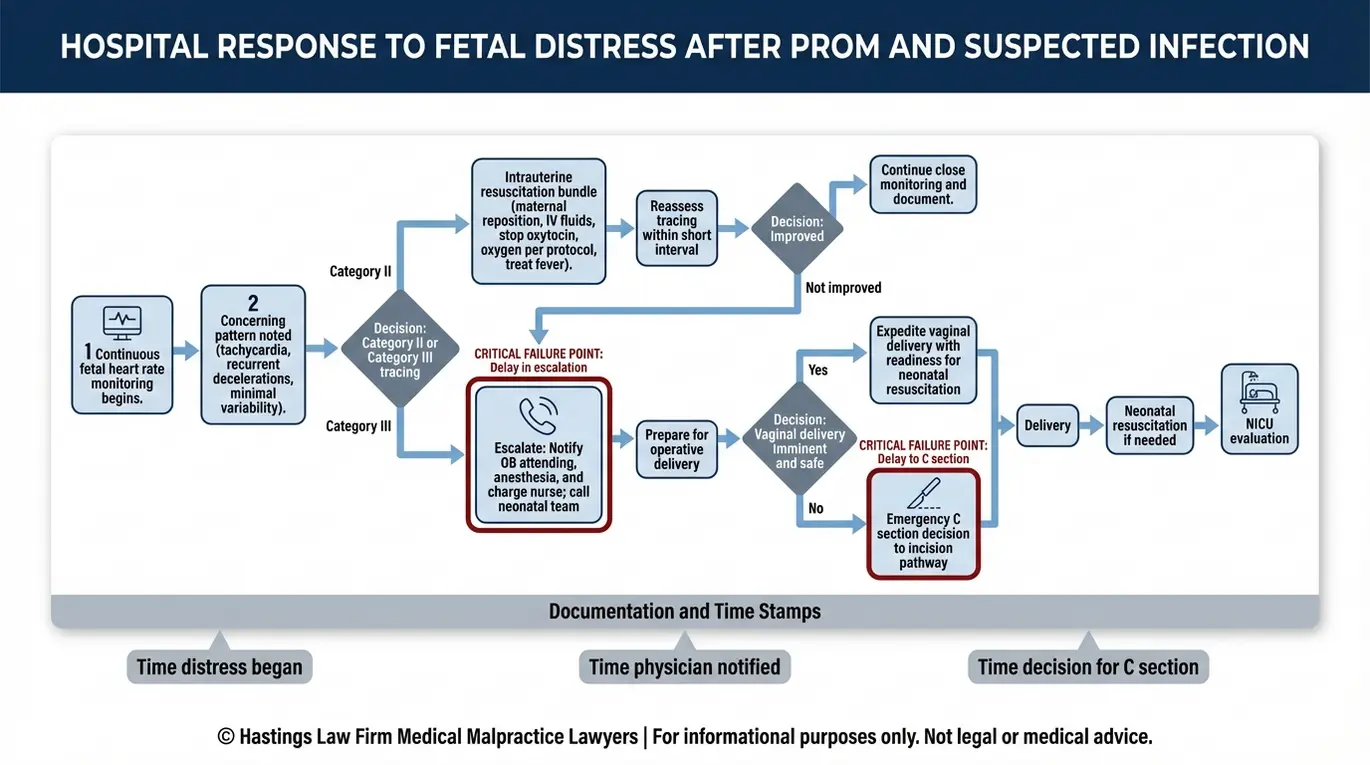
According to the USF Health Fetal Monitoring Practice Guidelines, abnormal fetal heart rate patterns demand a structured response. Our team includes former hospital nurses and defense attorneys who use their insider knowledge to anticipate defense tactics and identify charting inconsistencies. The expected protocol generally follows this sequence:
- Recognition: Nursing staff identifies a non-reassuring fetal heart rate pattern on the monitor.
- Notification: The attending obstetrician is immediately notified of the abnormal tracing.
- Intrauterine Resuscitation: Interventions such as repositioning the mother, administering oxygen, and adjusting or stopping Pitocin are initiated.
- Decision: If the pattern does not improve, the decision for an emergency cesarean section should be made promptly.
- Delivery and Neonatal Resuscitation: The baby is delivered and, if necessary, transferred to the NICU for stabilization and further care.
Texas law provides additional legal protections that reinforce the framework around proper neonatal care in emergency circumstances.
When any link in this chain breaks, whether through miscommunication, delayed response, or failure to escalate, the consequences can include birth asphyxia and hypoxic-ischemic encephalopathy (HIE), a type of brain injury caused by prolonged oxygen deprivation. As an emergency C-section malpractice lawyer and Texas prolonged rupture of membranes counsel, we build a minute-by-minute timeline from the fetal monitoring strips, nursing notes, and physician orders to determine exactly where the process failed.
Texas Medical Malpractice Laws and Compensation
Texas law allows families to recover compensation for past and future medical expenses, pain and suffering, and loss of earning capacity, though non-economic damages are subject to caps under Chapter 74.
Understanding medical malpractice damages Texas statutes allow is essential for families preparing a claim. Economic damages cover the measurable financial losses caused by the injury. These are not capped under Texas law and can include:
- Past and future medical expenses, including surgeries, therapy, and medication
- NICU costs and hospitalization
- Rehabilitation and assistive devices
- Loss of future earning capacity
- Home modifications and ongoing attendant care
For a child diagnosed with cerebral palsy or HIE after a prolonged rupture of membranes, these costs can extend across an entire lifetime. A life care plan, a detailed projection of the medical and supportive services a child will need, becomes one of the most important pieces of evidence in these cases. Our team works with medical and economic experts to build a life care plan that reflects the true cost of your child’s future needs.
Non-economic damages cover pain and suffering, mental anguish, and loss of companionship. Texas caps non-economic damages at $250,000 per claimant against all physicians and individual health care providers combined, and $250,000 per health care institution (up to $500,000 total across all institutions), with a total aggregate cap of $750,000 when both providers and institutions are involved.
Texas law also provides for periodic payments of future damages under Texas Civil Practice & Remedies Code §74.503(a). In cases involving large awards for future medical costs, the court may structure payments over time rather than issuing a single lump sum. This structure ensures funds remain available for the child’s care indefinitely. A Texas prolonged rupture of membranes lawyer can explain how this may affect your family’s recovery and help plan accordingly.
Contact the Texas Birth Injury Attorneys at Hastings Law Firm Today for Help
If your child suffered an infection or brain injury due to a delayed delivery after your water broke, you do not have to face the hospital’s legal team or insurance carriers on your own. Our team at Hastings Law Firm includes attorneys, nurse consultants, and patient advocates who focus exclusively on medical malpractice, and we understand both the medical and emotional weight of what your family is going through.
We offer a free case evaluation, and you pay no fees unless we recover compensation on your behalf. A Texas prolonged rupture of membranes lawyer at our firm can review your hospital records, consult with medical experts, and help you understand whether your child’s injury was preventable.
Contact Hastings Law Firm today to speak with a board-certified patient advocate about your potential claim.
Frequently Asked Questions About Prolonged Rupture of Membranes in Texas


This content was researched and written by the Hastings Law Firm editorial team, which includes attorneys, medical professionals, and experienced researchers. Our writing is informed by internal knowledge and practical experience, and we cross-check critical details against authoritative sources cited throughout. Every piece undergoes human-led fact-checking and legal review. Because legal and medical information can change, if you spot an error, please contact us. Learn more about our content standards and review process on our editorial policy page.

Tommy Hastings, founder of Hastings Law Firm, is a board-certified personal injury trial lawyer dedicated exclusively to healthcare injury cases. Since 2001, he has represented injured patients and families in litigation against major hospital systems, pharmaceutical companies, and negligent healthcare providers nationwide. He has handled numerous high-profile cases that have drawn national media attention and resulted in multi-million dollar recoveries. He draws on that experience in his writing, helping readers understand how these cases work and what options may be available to them.
