


Texas Failed Induction of Labor Lawyer
Written by: Hastings Law Firm | Reviewed by: Tommy Hastings | Updated: July 27, 2026
A failed or improperly managed labor induction can leave a mother with serious complications and can cause life changing harm to a baby. Problems often involve Pitocin use, missed warning signs on fetal monitoring, or delays in moving to a C section when an induction is not progressing safely. These situations can raise concerns about whether safety protocols were followed and whether the hospital shares responsibility for staff actions. If your child suffered harm due to failed induction of labor in Texas, contact Hastings Law Firm for a free, confidential case review.

Trusted Texas Medical Attorneys for Labor Induction Malpractice Claims
What You Should Know About Labor Induction Malpractice Claims in Texas:
- Severe birth injuries can result when Pitocin is continued despite fetal distress or uterine hyperstimulation.
- Catastrophic outcomes can follow when tachysystole reduces fetal oxygen recovery between contractions.
- Maternal harm can be life threatening when overstimulation leads to uterine rupture, placental abruption, or hemorrhage.
- Hospital responsibility may apply when hospital staff fail to follow induction protocols within the scope of their duties.
- Liability disputes can turn on whether the delivering physician was a hospital employee or an independent contractor.
- Recovery can depend on whether fetal monitoring strips show warning signs that were not addressed in time.
- Long term financial needs can be substantial when induction errors cause permanent brain damage or cerebral palsy.
- Compensation may be limited for pain and suffering in Texas while economic losses like medical care and future earnings are not capped.
- Options can be lost if legal time limits are missed, including special timing rules that can apply in birth injury cases.
- Informed consent issues can matter when key induction risks and alternatives were not disclosed before an injury occurred.

A Healthcare Focused Law Firm
When a labor induction causes harm to your baby or leaves you with serious complications, the weight of that experience can feel impossible to carry alone. You trusted your medical team to keep you and your child safe, and that trust may have been broken during one of the most vulnerable moments of your life.
If something went wrong during your induction, you are not imagining it. Your instincts matter, and you deserve clear answers about what happened and why.
As a Texas failed induction of labor lawyer, Hastings Law Firm focuses exclusively on medical malpractice. Our team includes in-house nurses, former defense attorneys, and board-certified trial lawyers who understand both the medicine and the law behind these cases. We prepare every case as if it will go to trial. We work on a contingency fee basis, so you pay nothing unless we recover compensation for your family.
If you or your child were harmed during a labor induction, we can review what happened and explain your options.
Common Errors During Labor Induction and Pitocin Administration
Negligence during labor induction often involves administering Pitocin, a synthetic form of the hormone oxytocin, despite clear contraindications, failing to stop the drug when signs of fetal distress appear, or ignoring uterine hyperstimulation. A failed induction of labor often involves medical mismanagement where safety protocols were ignored, leading to avoidable birth injuries.
Labor induction is the process of using medications or mechanical methods to start or strengthen contractions before labor begins on its own. When Pitocin is part of that process, the standard of care generally requires careful patient screening, conservative dosing, and continuous monitoring of both the mother and baby. Errors in any of these areas can lead to preventable injuries.
One scenario we often investigate involves increasing the Pitocin dosage too rapidly without properly assessing the baby’s response. In other cases, the drug is continued after the fetal monitor shows warning signs. A delay in performing a timely emergency C-section when the induction is clearly failing can also compound the harm.
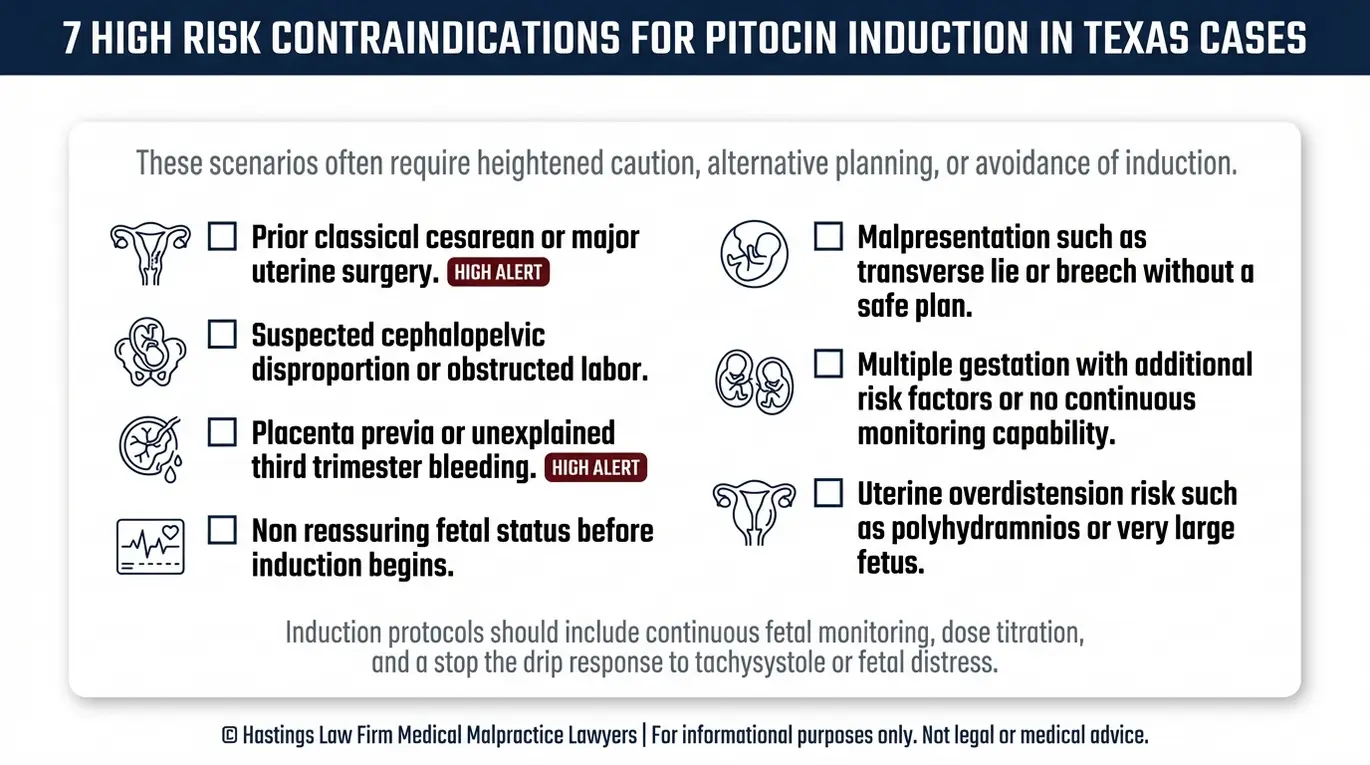
Before attempting to induce labor, providers should evaluate whether any contraindications or high-risk factors are present, including:
- Prior classical (vertical) uterine incision from a previous Cesarean section. This type of scar is more likely to tear during a forced induction.
- Cephalopelvic disproportion, where the baby’s head is too large for the mother’s pelvis. This can cause the baby to become stuck in the birth canal.
- Placenta previa, where the placenta covers the cervix. Inducing labor in this situation can cause severe bleeding.
- Active genital herpes infection. Doctors often avoid induction to prevent transmitting the virus during a vaginal delivery.
- Prolapsed umbilical cord. This occurs when the cord drops through the cervix, which can cut off the baby’s oxygen supply.
- Abnormal fetal positioning, such as transverse lie. Attempting an induction when the baby is sideways is generally unsafe.
- Prior uterine rupture. If the uterus has torn before, the risk of another rupture during induction is high.
Our team reviews medical records and hospital protocols to determine if proceeding with induction under these conditions violated the standard of care.
Understanding Vicarious Liability in Hospital Induction Cases
Vicarious liability is a legal principle that allows patients to hold a medical facility responsible for the mistakes of its staff. Liability in these cases does not always rest solely with the delivering physician. If a hospital-employed nurse failed to follow established induction protocols, such as failing to reduce Pitocin when fetal distress was evident, the hospital may be held responsible.
This responsibility often falls under a legal theory called vicarious liability. This rule means a hospital is held responsible for the negligence of its staff performed within the scope of their duties.
If the attending physician was an independent contractor rather than a hospital employee, the analysis changes. We look at employment relationships, hospital policies, and nursing records to determine who bears responsibility.
Health Risks Associated with Improper Labor Induction
Improper induction can cause tachysystole, a condition where the uterus contracts too frequently, leading to oxygen deprivation, uterine rupture, and severe brain injuries such as cerebral palsy. Pitocin is a high-alert medication that requires precise management to avoid overwhelming the mother’s body and the baby’s oxygen supply.
The core risk stems from how Pitocin behaves differently than the body’s own oxytocin:
| Factor | Natural Oxytocin Pulses | Continuous Pitocin Drip |
|---|---|---|
| Release Pattern | Released in small, intermittent bursts | Delivered as a steady, continuous infusion |
| Uterine Rest Periods | Allows the uterus to relax between contractions | Can eliminate adequate rest periods |
| Fetal Oxygen Recovery | Baby recovers oxygen between contractions | Sustained contractions reduce oxygen supply |
| Dose Regulation | The body self-regulates based on feedback | Requires manual adjustment by nursing staff |
| Tachysystole Risk | Low | Significantly elevated |
When Pitocin causes tachysystole, the uterus may contract more than five times in a ten-minute window. This leaves the baby without enough time to recover oxygen between contractions, potentially resulting in fetal distress, hypoxia (reduced oxygen), anoxia (complete oxygen loss), or asphyxia. Research published in Frontiers in Neurology confirms that birth asphyxia is associated with increased risk of cerebral palsy.
Overstimulation can also cause uterine rupture, a tear in the uterine wall, or placental abruption, where the placenta separates from the uterine wall prematurely. Both conditions can trigger catastrophic hemorrhage for the mother and rapid oxygen deprivation for the baby. Mothers may also face postpartum hemorrhage from uterine atony, a condition where the uterus fails to contract properly after prolonged overstimulation.

The Hastings Law Firm Difference
Results matter, but what truly sets us apart is how we achieve them. Every verdict, every settlement, and every Texas courtroom victory comes from one guiding promise: To treat each client’s fight for justice as if it were our own.
This balance of skill, experience, and empathy reflects our core philosophy that justice should not only compensate the injured, but also make healthcare safer nationwide.

Proving Liability: How We Use Fetal Monitoring Strips as Evidence
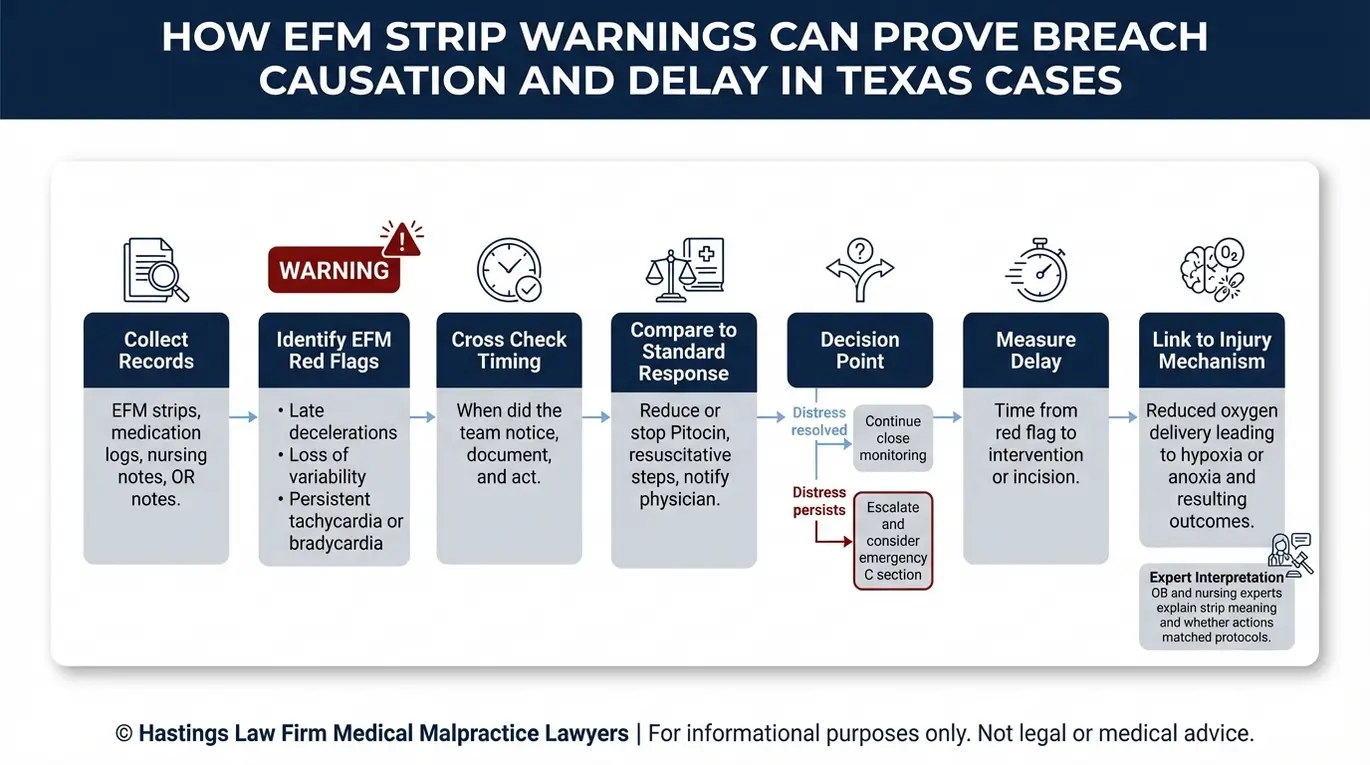
Liability is often proven by analyzing electronic fetal monitoring (EFM) strips, which provide a continuous record of the baby’s heart rate and mother’s contractions. These strips serve as primary evidence in determining if a healthcare provider breached their duty of care during labor. Electronic fetal monitoring strips act as a flight recorder for labor, revealing exactly when the baby began struggling.
The Role of Electronic Fetal Monitoring (EFM) in Litigation
Electronic monitoring allows the legal team to pinpoint exactly when medical intervention should have occurred. Our team works with medical expert witnesses to interpret fetal heart rate tracings. They look for patterns indicating hypoxia, or fetal oxygen deprivation, such as late decelerations, or drops in heart rate after contractions suggesting the placenta is not delivering enough oxygen. Hypoxia is a condition where the baby is deprived of adequate oxygen during birth.
They also evaluate fetal heart rate variability, the normal fluctuation in the baby’s baseline heart rate. A loss of variability can signal that the baby’s brain is oxygen-starved. As outlined by the National Center for Biotechnology Information’s clinical resource on Antenatal Fetal Surveillance, these tracings are a primary tool for assessing fetal well-being.
We investigate the gap between when warning signs appeared and when the team responded. A delay in ordering a Cesarean section can mean the difference between a healthy delivery and a severe birth injury, such as permanent brain damage, cerebral palsy, or stillbirth.
Recovering Damages for Birth Injuries Caused by Induction
Compensation in birth injury cases typically includes past medical bills, future life care costs, pain and suffering, and loss of earning capacity for the child. These legal damages are intended to provide for the long-term needs of a child injured by medical error.
When a child suffers brain damage or cerebral palsy due to induction errors, the lifetime cost of care can be substantial. It may include ongoing therapy, specialized equipment, home modifications, educational support, and full-time assisted living. To calculate these figures accurately, we work with life care planning experts and economists who project costs over the child’s expected lifespan.
Texas law divides damages into two categories. Economic damages cover the actual financial costs resulting from the injury, such as measurable financial losses like medical expenses and lost future earnings. Non-economic damages address pain and suffering.
Under the Texas Civil Practice and Remedies Code Chapter 74, non-economic damages are capped at $250,000 against all individual health care providers combined and $250,000 per health care institution, up to $750,000 total when multiple defendants are involved. There is no cap on economic damages, which often represent the largest portion of a birth injury settlement.
Contact the Texas Birth Injury Attorneys at Hastings Law Firm Today for Help
No amount of money can undo what happened to your child or your family. But securing the right financial resources can protect your child’s future, covering the therapies, care, and support they will need for years to come.
As a nationally recognized firm, our entire team is dedicated to medical malpractice. Our founder, Tommy Hastings, is a board-certified trial lawyer with over 20 years of experience handling these complex cases. Our in-house nurses review medical records while our trial-ready approach ensures we are prepared to present your case to a jury. That preparation strengthens every negotiation we enter.
We handle these cases on a contingency fee basis. You pay no attorney fees or costs unless we recover compensation for your family.
If your child was harmed during a labor induction, contact us for a free, confidential case evaluation. We can help you find out what happened and whether you have a path forward.
Frequently Asked Questions About Failed Induction of Labor in Texas


This content was researched and written by the Hastings Law Firm editorial team, which includes attorneys, medical professionals, and experienced researchers. Our writing is informed by internal knowledge and practical experience, and we cross-check critical details against authoritative sources cited throughout. Every piece undergoes human-led fact-checking and legal review. Because legal and medical information can change, if you spot an error, please contact us. Learn more about our content standards and review process on our editorial policy page.

Tommy Hastings, founder of Hastings Law Firm, is a board-certified personal injury trial lawyer dedicated exclusively to healthcare injury cases. Since 2001, he has represented injured patients and families in litigation against major hospital systems, pharmaceutical companies, and negligent healthcare providers nationwide. He has handled numerous high-profile cases that have drawn national media attention and resulted in multi-million dollar recoveries. He draws on that experience in his writing, helping readers understand how these cases work and what options may be available to them.
