


Texas Birthing Center Malpractice Lawyer
Written by: Hastings Law Firm | Reviewed by: Tommy Hastings | Updated: July 27, 2026
Birthing center malpractice claims often involve preventable breakdowns in screening, monitoring, emergency readiness, or timely transfer when complications arise. In Texas, freestanding birth centers and midwives are regulated and expected to follow specific safety protocols designed to protect mothers and newborns outside a hospital setting. When those obligations are not met, families can face severe birth injuries, long term disability, or fatal outcomes, along with lasting emotional and financial strain. If your child suffered harm due to birthing center malpractice in Texas, contact Hastings Law Firm for a free, confidential case review.

Compassionate Texas Medical Attorneys for Birth Center Negligence Claims
What You Should Know About Birth Center Negligence Claims in Texas:
- Lifelong consequences can follow when a birthing center fails to recognize complications and delays transfer to a hospital.
- Severe brain injury can result when fetal distress is not identified or acted on promptly during labor.
- Harm can occur when a birthing center admits high risk patients who should have been referred to a hospital setting.
- Catastrophic outcomes can follow when required emergency resuscitation equipment is missing or not properly maintained.
- Liability can extend beyond a midwife when a birthing center is responsible for staff actions through employment or contracting relationships.
- Responsibility can also involve a consulting physician when oversight is inadequate or guidance is not provided when requested.
- Recovery options can be limited by Texas rules that cap non economic damages in medical malpractice cases.
- The ability to pursue a claim can be lost if Texas filing deadlines are missed.
- Options can be affected when required expert report requirements are not satisfied in time.
- Accountability can still be possible despite a signed waiver when safety regulations and required transfer protocols are not followed.

A Healthcare Focused Law Firm
When something goes wrong during childbirth at a freestanding birth center, the confusion and grief can feel overwhelming. You may be searching for answers about what happened, why your baby was injured, or whether the care you received met the standards required by Texas law. Those questions deserve honest, informed responses from a legal team that understands both the medicine and the law behind these cases.
At Hastings Law Firm, founded by board-certified trial attorney Tommy Hastings, we focus exclusively on medical malpractice litigation. Our team includes in-house nurses, former defense attorneys, and board-certified trial lawyers who have spent decades holding negligent providers accountable. If your family experienced a preventable birth injury at a Texas birthing center, a Texas birthing center malpractice lawyer at our firm can review what happened and explain your options in a free, confidential consultation.
Legal Standards for Birthing Centers in Texas
Birthing centers in Texas must adhere to strict licensing requirements under the Texas Administrative Code, which mandates specific protocols for risk assessment, equipment, and emergency transfers. These rules exist to protect mothers and newborns receiving care outside a hospital setting.
A freestanding birthing center, which is a facility that provides labor and delivery services independent of a hospital, is regulated by the Texas Health and Safety Code Chapter 244. The Texas Health and Human Services Commission (HHSC) is responsible for licensing these facilities and enforcing compliance. Detailed operational standards are outlined in 26 TAC Chapter 503, which governs everything from staffing qualifications to emergency preparedness.
One of the most important regulatory obligations is risk assessment, the process of screening patients before admission to identify pregnancies that carry elevated medical risks. Birth centers are generally prohibited from accepting high-risk patients, including those with breech presentation, twins, preeclampsia, or certain prior surgical histories.
Texas regulations also require birthing centers to maintain:
- Written transfer protocols with a designated receiving hospital
- Functional emergency resuscitation equipment for both mother and newborn
- A consulting physician arrangement for medical oversight
- Documented policies for identifying and responding to complications during labor and delivery
- Compliance with equipment maintenance and safety inspection schedules
When a birth center fails to follow these requirements, and a mother or baby is harmed as a result, that failure can form the basis of a claim for birth center negligence. A lawyer for birthing center errors evaluates whether the facility met its legal obligations and whether any regulatory violation contributed to the standard of care being breached. Our team at Hastings Law Firm examines licensing records, internal policies, and clinical documentation to identify where errors occurred.

Midwife Negligence & Liability: Who is Responsible?
Liability often depends on the midwife’s certification; Certified Nurse-Midwives (CNMs) have a higher scope of practice and insurance requirements compared to Licensed Midwives (LMs), but both can be sued for deviating from the standard of care.
A Certified Nurse-Midwife (CNM), an advanced practice registered nurse with graduate-level training in midwifery, operates under a broader scope of practice and is typically required to carry malpractice insurance. A Licensed Midwife (LM), a practitioner certified under the Texas Midwifery Act (Texas Occupations Code Chapter 203), completes a different educational pathway and practices under separate regulatory oversight. Both can be held accountable for deviating from the standard of care, but the legal framework differs.
| Factor | Certified Nurse-Midwife (CNM) | Licensed Midwife (LM) |
|---|---|---|
| Training | Graduate nursing degree + midwifery certification | Approved midwifery education program |
| Regulatory Authority | Texas Board of Nursing | Texas Department of Licensing and Regulation (TDLR) |
| Prescriptive Authority | Yes, under physician oversight | No |
| Insurance Requirement | Typically required | Not always required |
| Liability Pathway | Individual + employer/facility | Individual + facility (if employed) |
The 26 Tex. Admin. Code § 503.48 outlines specific labor and birth procedures that must be followed in licensed birthing centers. When a midwife fails to adhere to these protocols, they may be personally liable for medical negligence.
However, when suing a birthing center, the midwife is not always the only responsible party. In many cases, the birthing center itself can be held vicariously liable for the actions of its staff. If the center employed or contracted the midwife, the facility may share legal responsibility. A consulting physician who failed to provide adequate oversight or respond to a midwife’s request for guidance may also face liability.
A malpractice lawyer for midwife negligence will investigate the employment structure, supervision arrangements, and clinical decision-making to determine every party that contributed to the harm. When you work with a birth center injury attorney at Hastings Law Firm, we trace the full chain of responsibility so no one is overlooked.

The Hastings Law Firm Difference
Results matter, but what truly sets us apart is how we achieve them. Every verdict, every settlement, and every Texas courtroom victory comes from one guiding promise: To treat each client’s fight for justice as if it were our own.
This balance of skill, experience, and empathy reflects our core philosophy that justice should not only compensate the injured, but also make healthcare safer nationwide.

Common Causes of Malpractice in Texas Birthing Centers
Negligence in birthing centers frequently stems from a failure to recognize high-risk complications, such as fetal distress or shoulder dystocia, resulting in delayed transfers to a hospital. These delays can lead to oxygen deprivation, permanent brain injury, or worse.
A Texas birthing center malpractice lawyer at our firm has reviewed many cases where the warning signs were present but not acted on in time. Birth center negligence can take several forms, and a midwife malpractice lawyer will evaluate the clinical record to identify specific failures such as shoulder dystocia.
Failure to Monitor Fetal Heart Tones
Monitoring is essential in birthing centers to ensure the safety of the newborn. Fetal heart tones, the baby’s heart rate patterns tracked during labor, are one of the primary indicators of fetal well-being. A birth center negligence attorney will check for inadequate monitoring that may have caused care providers to miss signs of fetal distress. This includes dangerous drops in heart rate that may signal oxygen deprivation or hypoxia.
Admitting High-Risk Patients
Birthing centers in Texas are intended for low-risk pregnancies. Some birth centers accept patients who should have been referred to a hospital from the start. Pregnancies involving breech presentation, prior cesarean sections, or conditions like preeclampsia pose risks that exceed what a freestanding birth center is equipped to manage safely.
Equipment and Resuscitation Failures
The law requires birth centers to maintain specific lifesaving tools. When a newborn needs immediate intervention, seconds matter. A lack of properly maintained resuscitation equipment can turn a manageable complication into a catastrophic outcome.
Mismanagement of Delivery Complications
Staff must be prepared to manage emergencies that occur outside of a hospital. Shoulder dystocia, a complication where the baby’s shoulder becomes trapped behind the mother’s pelvic bone, postpartum hemorrhage, and umbilical cord prolapse each require specific, time-sensitive responses. Errors can also involve the improper use of labor-inducing drugs like Pitocin. Delayed or improper management of these emergencies can cause severe birth injuries or maternal harm.
Red flags that a lawyer for birth center injury may look for include:
- Gaps in fetal monitoring documentation
- No written evidence of risk screening at admission
- Delayed communication with a consulting physician
- Absence of emergency equipment logs
- Transfer to a hospital that took significantly longer than expected
Texas Maternal Mortality Task Force & Safety Statistics
Public health data from the Texas Maternal Mortality Task Force has highlighted that several pregnancy-related deaths in Texas are preventable. For certain demographics and clinical profiles, out-of-hospital births carry additional risk. These findings reinforce why strict adherence to transfer protocols and risk screening is so important, and why wrongful death claims may arise when those safeguards fail.
Failure to Transfer: Emergency Protocols & Legal Liability
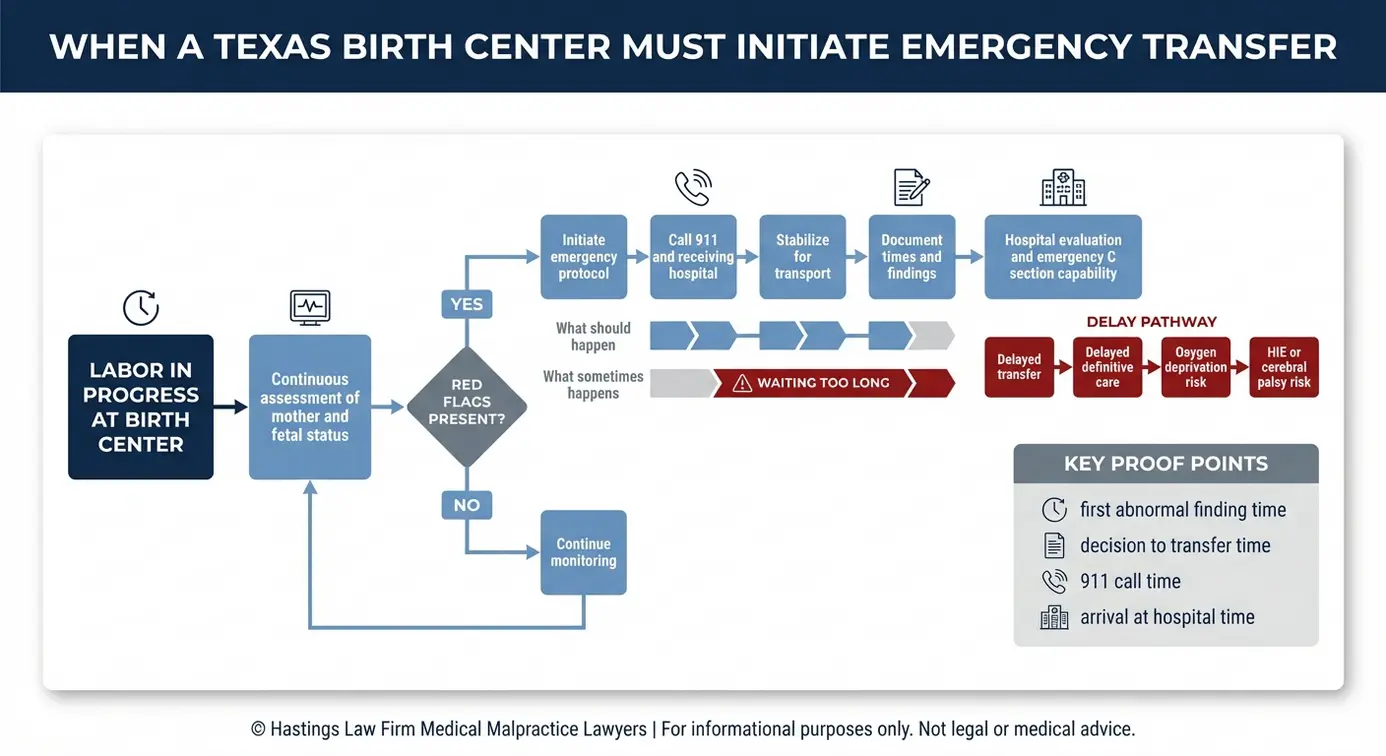
A birthing center’s most critical duty is the timely transfer of a mother or infant to a hospital when complications arise; delaying this transfer violates the standard of care and creates grounds for a malpractice claim.
Transfer protocols, the written plans that outline when and how a patient should be moved to a hospital for higher-level care, are not optional. Texas regulations require every licensed birth center to have a transfer agreement with a nearby hospital and a clear process for initiating emergency transport. The “travel time” rule means a center should only operate within a reasonable distance of a receiving hospital equipped to perform an emergency C-section.
The concept of the “Golden Hour” is especially relevant in birth injury cases. When a baby is in distress and not receiving adequate oxygen, every minute of delay increases the risk of permanent brain damage. Hypoxic-ischemic encephalopathy (HIE), a type of brain injury caused by oxygen deprivation during or near the time of birth, can result in cerebral palsy, developmental disabilities, and lifelong care needs.
In cases we investigate, we look closely at the timeline between the first signs of trouble and when the transfer was actually initiated. We examine whether 911 was called promptly, whether the receiving hospital was notified in advance, and whether the midwife continued to attempt delivery when escalation was clearly needed. An attorney for midwife error at our firm works with medical experts to reconstruct these critical minutes and determine whether the delay caused or worsened the injury.
Birth center negligence involving delayed transfers often produces some of the most serious outcomes we see. When the evidence supports it, these cases can establish the basis for a delayed transfer lawsuit.
The Investigation Process: How We Prove Negligence
We utilize a “Trial-Ready” approach involving immediate record acquisition, review by in-house nurses, and consultation with national medical experts to satisfy the rigorous Texas Chapter 74 expert report requirements. Our founder, Tommy Hastings, is Board Certified in Personal Injury Trial Law by the Texas Board of Legal Specialization, a credential held by fewer than 2% of the state’s attorneys.
Here is how we build a birth injury claim from the ground up:
- Record Retrieval: We obtain the midwife’s clinical charts, the birth center’s admission and monitoring records, transfer documentation, and hospital records from the receiving facility. Birth center records are often less detailed than hospital charts, which makes early preservation important.
- In-House Medical Review: Our nurse consultants and patient advocates analyze the records to identify gaps in documentation, deviations from protocol, and inconsistencies in the timeline.
- Expert Consultation: We retain a qualified expert witness, typically an OBGYN or a certified nurse-midwife with relevant experience, to evaluate whether the standard of care was breached and to prepare the expert report required under Chapter 74.
- Causation Analysis: Our medical and legal teams work together to establish the direct link between the provider’s actions (or inactions) and the injury.
- Damages Valuation: For children with birth injuries, we calculate the full lifetime cost of care, including medical treatment, therapy, adaptive equipment, and lost future earning capacity.
As a medical malpractice lawyer specializing in birth centers, our firm prepares every case as though it will go before a jury. That level of preparation strengthens negotiations and signals to the defense that we will not accept less than fair value.
Contact the Texas Birth Injury Attorneys at Hastings Law Firm Today for Help
If your child was injured during birth at a Texas birthing center, you deserve to know what happened and whether it could have been prevented. The answers are in the medical records, the protocols, and the timeline of care, and our team knows exactly how to find them.
Time matters in these cases. Evidence can be lost, and Texas law sets firm deadlines for filing a claim. Contact a Texas birthing center malpractice lawyer at Hastings Law Firm for a free, confidential case evaluation. You pay no fees or costs unless we recover compensation for your family.
Call us today or reach out online. Let us help you find the truth and protect your child’s future.
Frequently Asked Questions About Birthing Center Malpractice in Texas


This content was researched and written by the Hastings Law Firm editorial team, which includes attorneys, medical professionals, and experienced researchers. Our writing is informed by internal knowledge and practical experience, and we cross-check critical details against authoritative sources cited throughout. Every piece undergoes human-led fact-checking and legal review. Because legal and medical information can change, if you spot an error, please contact us. Learn more about our content standards and review process on our editorial policy page.

Tommy Hastings, founder of Hastings Law Firm, is a board-certified personal injury trial lawyer dedicated exclusively to healthcare injury cases. Since 2001, he has represented injured patients and families in litigation against major hospital systems, pharmaceutical companies, and negligent healthcare providers nationwide. He has handled numerous high-profile cases that have drawn national media attention and resulted in multi-million dollar recoveries. He draws on that experience in his writing, helping readers understand how these cases work and what options may be available to them.
