


Texas Athetosis Malpractice Lawyer
Written by: Hastings Law Firm | Reviewed by: Tommy Hastings | Updated: July 27, 2026
Athetoid movement disorders can place lifelong demands on a child and family, especially when the injury traces back to labor, delivery, or newborn care. Athetosis is linked to damage in the basal ganglia and is often associated with oxygen deprivation or untreated jaundice at birth. The condition can involve involuntary movements, fluctuating muscle tone, and challenges with feeding, speech, and daily activities, along with extensive long term care needs. If your child suffered harm due to athetosis malpractice in Texas, contact Hastings Law Firm for a free, confidential case review.
Compassionate Texas Medical Attorneys for Athetoid Movement Disorder Claims
What You Should Know About Athetoid Movement Disorder Injury Claims in Texas:
- Long term care needs can be extensive when basal ganglia injury leads to athetoid cerebral palsy with involuntary movements and fluctuating muscle tone.
- Preventable brain injury can be tied to failures during labor and delivery such as missed fetal distress or delayed emergency cesarean delivery.
- Severe harm can follow newborn care lapses when oxygen deprivation is not addressed promptly and therapeutic hypothermia is delayed.
- Permanent brain injury can result when newborn jaundice is not monitored and treated and kernicterus develops.
- Disputes over timing can shape outcomes because MRI patterns may distinguish an acute birth related injury from earlier developmental causes.
- Recovery can be constrained by limits on non economic damages in Texas medical malpractice cases.
- Options can be lost if legal time limits are missed because Texas applies both a statute of limitations framework for minors and an outer cutoff that cannot be extended.
- Case strength can erode with delay because key records and fetal monitoring data may become difficult to obtain and witnesses may forget details.
- Financial recovery often centers on future medical expenses because care needs can extend across a lifetime.
- Compensation may address medical expenses and support needs such as assistive devices and home modifications.

A Healthcare Focused Law Firm
When your child is diagnosed with athetosis or athetoid cerebral palsy, the weight of that moment is difficult to put into words. You may be searching for answers about what happened during labor, delivery, or the hours that followed, and wondering whether the care your child received fell short of what it should have been. Those questions deserve honest, informed answers from someone who understands both the medicine and the law.
At Hastings Law Firm, we focus exclusively on medical malpractice, including birth injury cases involving athetoid movement disorders. Founded by Tommy Hastings, who is Board Certified in Personal Injury Trial Law by the Texas Board of Legal Specialization, our legal team is here to help you understand what may have gone wrong and what legal options may be available.
If your child’s condition may be linked to a preventable medical error, we can review what happened and explain your options in a free, confidential consultation.
Understanding Athetosis and Dyskinetic Cerebral Palsy
Athetosis is a symptom of dyskinetic cerebral palsy characterized by slow, involuntary, writhing movements of the fingers, hands, toes, and feet, often caused by damage to the basal ganglia due to oxygen deprivation or untreated jaundice at birth.
Athetosis refers to the involuntary, slow movements that often signal underlying brain damage. Athetoid cerebral palsy is a condition caused by damage to the brain’s basal ganglia. It is most commonly associated with dyskinetic cerebral palsy, a form of cerebral palsy caused by damage to the basal ganglia, the region of the brain responsible for coordinating and regulating voluntary movement. When that area of the brain is injured, typically through oxygen deprivation or untreated jaundice at birth, a child may develop the uncontrolled movements that define athetosis.
Dyskinetic cerebral palsy, sometimes referred to as athetoid cerebral palsy, differs from other types of cerebral palsy in how it affects the body. Rather than causing constant muscle stiffness, it produces fluctuating muscle tone. A child’s muscles may shift from unusually loose to rigid within seconds, making controlled movement extremely difficult. These movements can manifest as chorea (rapid, jerky movements) or dystonia (sustained twisting postures), adding to the complexity of the child’s daily challenges.
The Cerebral Palsy Research Network describes dyskinetic cerebral palsy as a condition that primarily affects a person’s ability to control movement due to abnormal signals from the damaged basal ganglia. This brain injury disrupts the signals that tell muscles when to contract and when to relax, resulting in the involuntary twisting and repetitive motions parents often notice as their child grows.
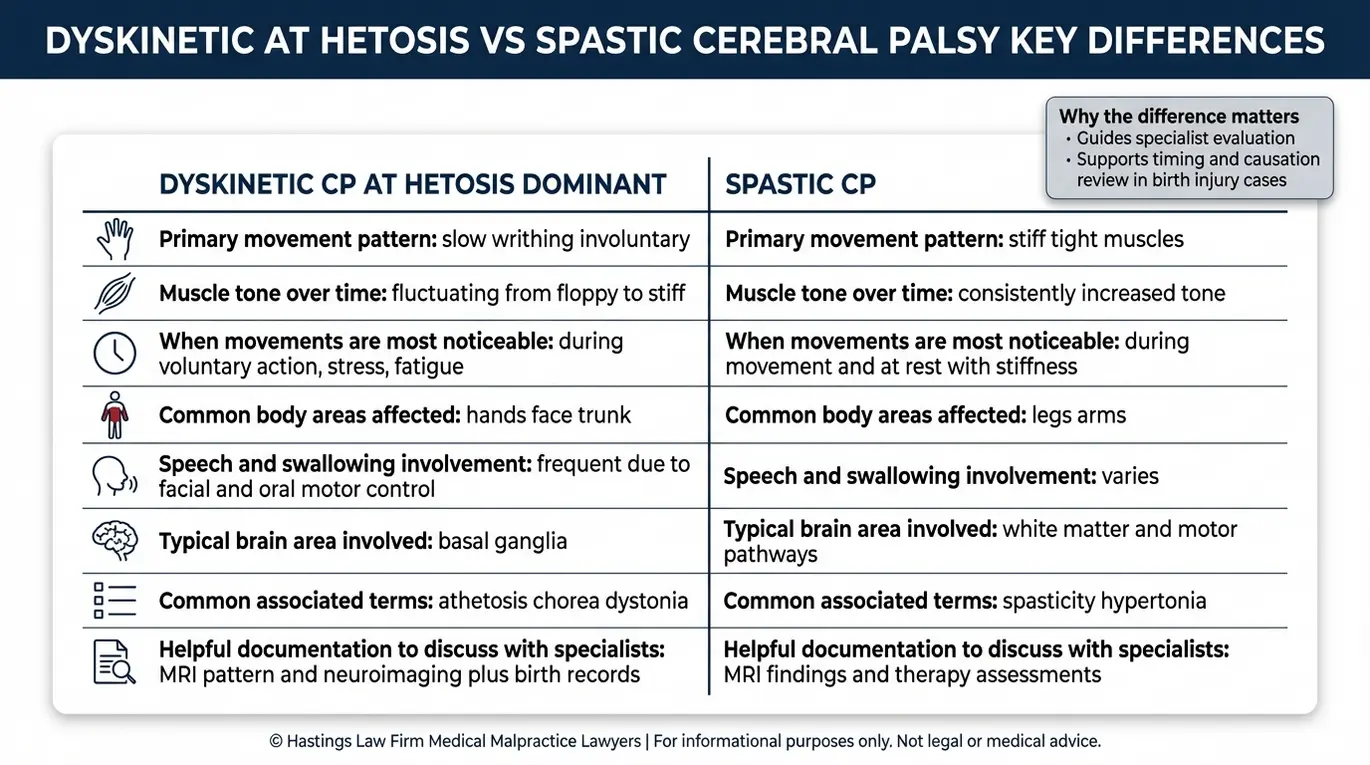
For families consulting with a Texas athetosis malpractice lawyer, understanding how athetoid cerebral palsy differs from spastic cerebral palsy is an important first step. Spastic CP, the most common form, is caused by damage to the motor cortex and results in tight, stiff muscles. Athetoid CP affects the basal ganglia and results in involuntary, uncontrollable movements. These distinctions matter because they point to different types of brain injury, different potential causes, and different patterns of medical evidence in an athetosis malpractice case.
Families often need the guidance of an athetoid cerebral palsy attorney to manage these medical details. Understanding the physiology helps your athetosis birth injury lawyer pinpoint exactly when the negligence occurred. Since the basal ganglia are highly sensitive to metabolic changes, a skilled dyskinetic CP attorney knows that specific injury patterns here often point to preventable birth trauma rather than genetic causes.
The following table highlights the key differences:
| Feature | Dyskinetic (Athetoid) Cerebral Palsy | Spastic Cerebral Palsy |
|---|---|---|
| Brain Area Affected | Basal ganglia | Motor cortex |
| Muscle Tone | Fluctuating (shifts between floppy and stiff) | Consistently high (tight, rigid muscles) |
| Movement Pattern | Involuntary writhing, twisting movements | Stiff, jerky movements |
| Primary Challenge | Controlling voluntary movement | Muscle tightness restricting range of motion |
| Common Cause | Oxygen deprivation (HIE), untreated jaundice (kernicterus) | Oxygen deprivation, brain hemorrhage |
If your child has been diagnosed with athetoid cerebral palsy or is showing signs of athetosis, the diagnosis itself may point to a specific type of brain injury that occurred during or shortly after birth. A Texas athetosis malpractice lawyer can help determine whether medical negligence contributed to that injury.
Medical Negligence Causes of Athetoid Cerebral Palsy
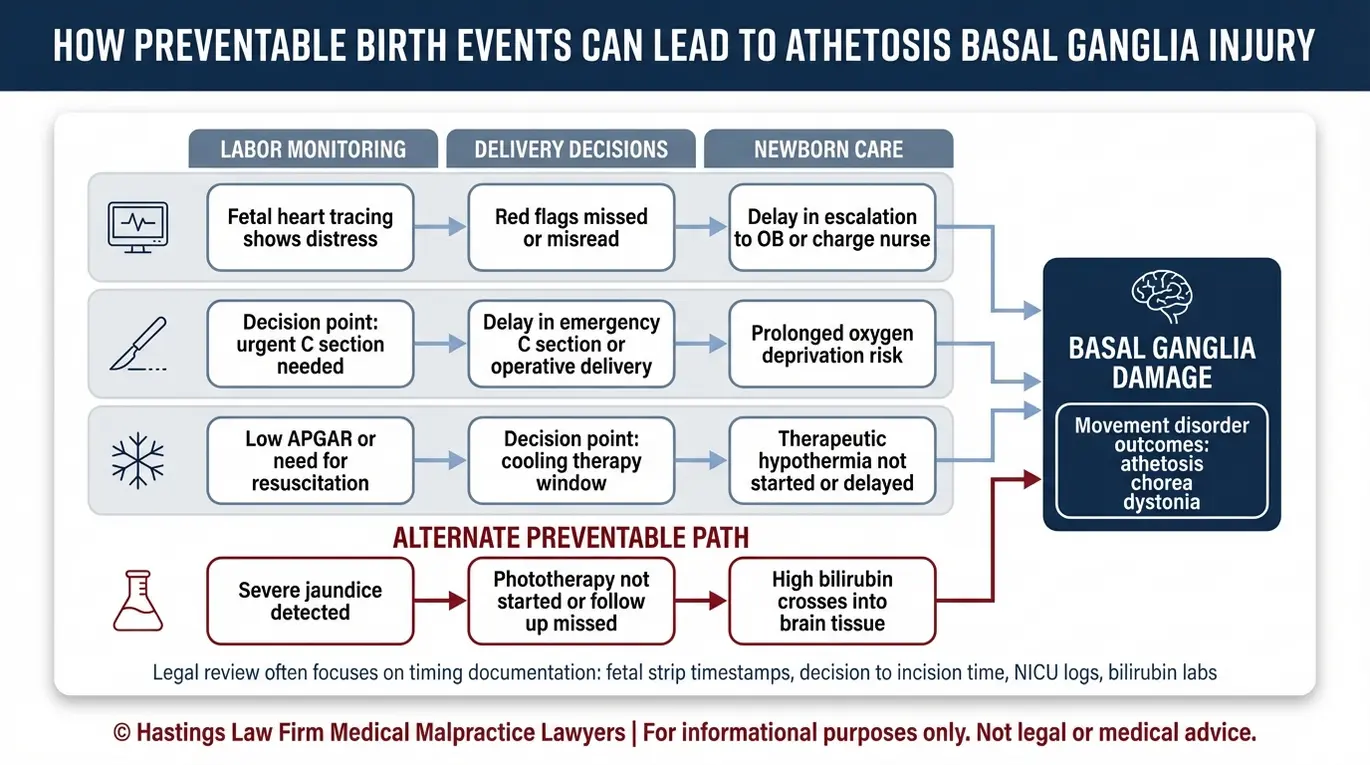
Medical negligence causes athetoid cerebral palsy when healthcare providers fail to manage fetal distress, delay necessary C-sections, or improperly treat neonatal jaundice, leading to basal ganglia damage from oxygen deprivation or bilirubin toxicity.
In many athetosis malpractice cases, the injury was not inevitable. It was the result of a breakdown in the standard of care.
Hypoxic-Ischemic Encephalopathy (HIE)
The most common cause of athetoid cerebral palsy is hypoxic-ischemic encephalopathy (HIE), a type of brain damage that occurs when a baby’s brain is deprived of adequate oxygen and blood flow around the time of birth. HIE is a serious birth injury caused by birth asphyxia. The basal ganglia are particularly vulnerable to this type of oxygen deprivation because they have high metabolic demands, meaning they are among the first brain structures to sustain damage when oxygen levels drop.
HIE can result from several labor and delivery complications, including placental abruption (when the placenta separates from the uterine wall too early), uterine rupture, and umbilical cord problems such as cord compression or prolapse. When these emergencies occur, providers are expected to recognize the signs quickly and intervene. Failure to do so can lead to prolonged oxygen deprivation and permanent brain injury.
Labor and Delivery Errors
Many athetosis malpractice claims in Texas involve errors that happen during labor itself. These errors often involve a failure to monitor the baby’s heart rate. Fetal heart rate monitoring is designed to detect signs of fetal distress, giving the medical team an early warning that the baby is not tolerating labor well. When providers fail to interpret or respond to abnormal fetal monitoring strips, critical minutes pass. Those minutes can make the difference between a healthy outcome and a permanent brain injury.
Common labor and delivery errors that may lead to athetoid cerebral palsy include:
- Failure to recognize non-reassuring fetal heart rate patterns on the monitor
- Delaying an emergency C-section when signs of fetal distress are present
- Improper administration or dosing of Pitocin, causing excessive uterine contractions that restrict blood flow to the baby
- Misuse of forceps or vacuum extractors, causing mechanical trauma to the infant’s head and brain
- Failure to call for specialist assistance when complications arise
Each of these errors represents a potential breach of the standard of care. A Texas athetosis malpractice lawyer investigates the timeline of events, minute by minute, to determine whether providers acted within accepted medical standards. An experienced athetosis injury attorney knows how to identify these subtle lapses in judgment that cause catastrophic harm.
Post-Birth Negligence
The window for preventing or reducing brain damage does not close at delivery. When a baby shows signs of oxygen deprivation at birth, such as low APGAR scores or the need for neonatal resuscitation, the medical team is expected to act immediately. One of the most well-established interventions is therapeutic hypothermia, a controlled cooling treatment where the baby’s body temperature is lowered to slow the progression of brain injury. This cooling treatment helps minimize permanent damage to the brain. According to the NCBI Bookshelf’s overview of neonatal therapeutic hypothermia, this treatment must be initiated within six hours of birth to be effective.
When hospitals fail to resuscitate promptly or delay therapeutic hypothermia, the opportunity to reduce the severity of HIE, and potentially prevent athetoid cerebral palsy, can be lost. Our medical negligence lawyer team reviews NICU records to ensure every protocol was followed.
Critical Warning: Untreated Jaundice and Kernicterus
Not all athetoid cerebral palsy cases involve oxygen deprivation during delivery. Some result from a completely separate, and entirely preventable, failure: untreated jaundice. Kernicterus is the permanent brain damage that occurs when jaundice is left untreated.
Jaundice is common in newborns and occurs when bilirubin, a yellow pigment produced by the normal breakdown of red blood cells, builds up in the blood. In most cases, jaundice is mild and resolves with routine monitoring or phototherapy (light treatment). But when bilirubin levels rise dangerously high and go untreated, the toxin crosses the blood-brain barrier and damages basal ganglia tissue. This condition is called kernicterus, a form of permanent brain damage that directly causes severe athetosis.
Kernicterus is considered a “never event” in modern medicine because it is entirely preventable with standard bilirubin screening and timely treatment. When a hospital fails to monitor bilirubin levels, discharges a jaundiced newborn without follow-up, or ignores warning signs of rising bilirubin, the resulting brain damage may form the basis of a Texas athetosis malpractice claim. Our attorneys examine hospital discharge protocols, lab results, and nursing records to determine whether the standard of care was met.
The Hastings Law Firm Difference
Results matter, but what truly sets us apart is how we achieve them. Every verdict, every settlement, and every Texas courtroom victory comes from one guiding promise: To treat each client’s fight for justice as if it were our own.
This balance of skill, experience, and empathy reflects our core philosophy that justice should not only compensate the injured, but also make healthcare safer nationwide.

Recognizing the Signs of Athetoid Movement Disorders
Signs of athetoid cerebral palsy include involuntary writhing movements, difficulty holding objects, drooling, speech impairments (dysarthria), and fluctuating muscle tone that changes from floppy to stiff, often becoming noticeable as the infant misses developmental milestones.
Early detection of these symptoms can help families seek timely intervention and understand the underlying cause of the movement disorder. These symptoms often become noticeable gradually as an infant misses milestones, though some red flags may appear shortly after birth.
Early Signs at Birth
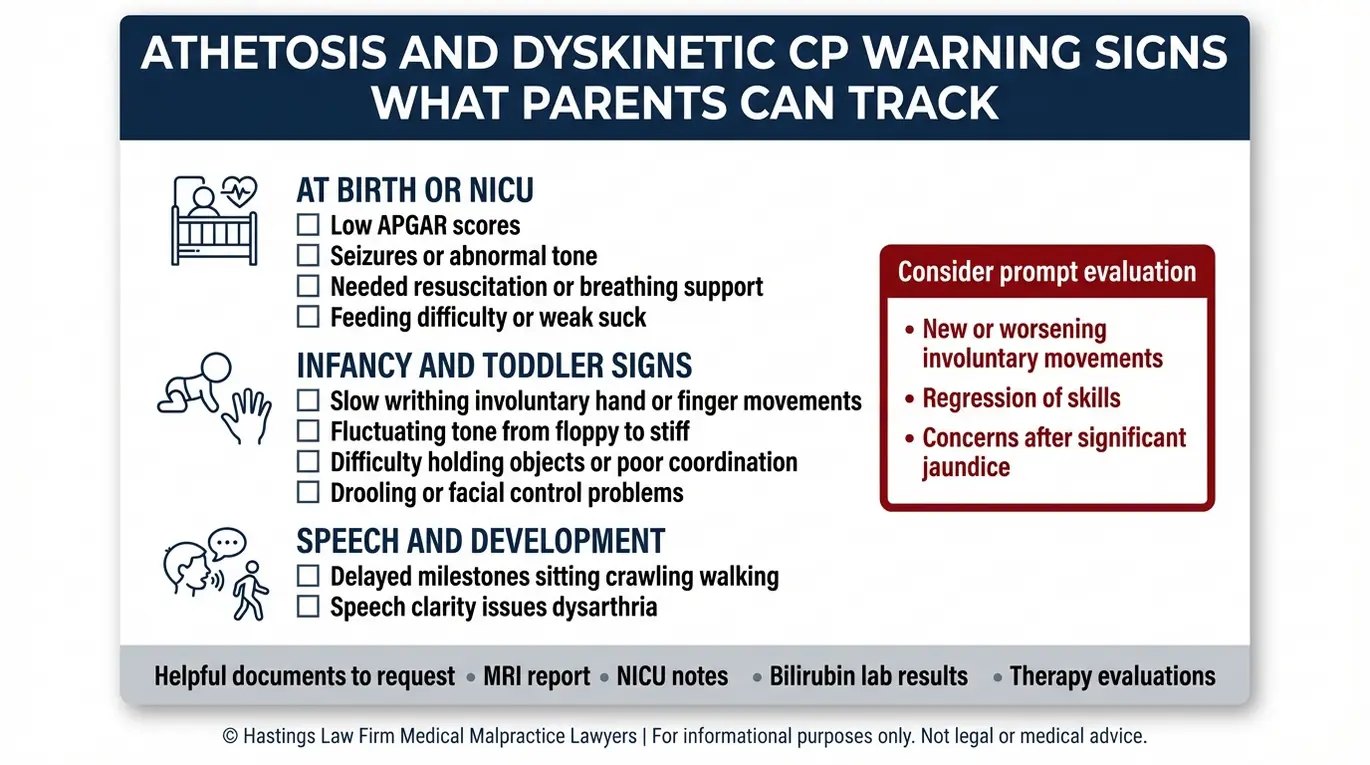
Certain indicators present within the first hours or days of life may suggest that a brain injury has occurred. Indicators like low APGAR scores, which measure a newborn’s heart rate, breathing, muscle tone, reflexes, and skin color at one and five minutes after birth, can be an early signal. Seizures in the first 24 to 72 hours, difficulty feeding, and generalized “floppiness,” sometimes called hypotonia, may also indicate basal ganglia damage.
These early signs do not confirm a diagnosis on their own, but they can be significant medical-legal evidence. In an athetosis malpractice investigation, our team reviews NICU records and newborn assessments to correlate these early findings with what happened during labor and delivery.
Developing Symptoms (9 to 18 Months)
The involuntary movements that define athetoid cerebral palsy typically become more apparent between 9 and 18 months of age. Athetosis involves slow, writhing movements of the hands, fingers, feet, or toes. Parents may notice that their child:
- Makes slow, writhing movements of the hands, fingers, feet, or toes (athetosis)
- Exhibits sudden, jerky, unpredictable movements (chorea, which refers to rapid, irregular, involuntary motion)
- Holds their body in unusual, twisted postures (dystonia, a condition involving sustained muscle contractions that cause abnormal postures)
- Has difficulty grasping toys or bringing objects to their mouth
- Drools excessively or struggles with swallowing
- Shows delayed speech or produces speech that is difficult to understand
- Misses milestones for sitting, crawling, or walking
- Displays muscle tone that fluctuates noticeably, sometimes appearing limp and other times stiff
If your child is showing several of these signs, early referral to physical therapy, occupational therapy, and speech therapy is important. Consulting both a pediatric neurologist and a Texas athetosis malpractice lawyer may help you understand whether a preventable birth injury is the cause.
The Role of MRI and Neuroimaging
An MRI is one of the most powerful diagnostic tools for confirming athetoid cerebral palsy and establishing the timing of the brain injury. Specific MRI patterns can distinguish between an acute injury that occurred around the time of birth and a developmental brain malformation that may have formed earlier in pregnancy.
Research published in PubMed Central on MRI findings in neonatal encephalopathy confirms that characteristic imaging patterns, such as injury to the basal ganglia and thalamus, are strongly associated with acute hypoxic-ischemic events during labor and delivery. This type of neuroimaging evidence is often central to an athetosis malpractice case because it can show, objectively, that the injury occurred during a window when medical intervention could have made a difference.
As your athetoid movement disorder lawyer will explain, the MRI acts as the “black box” of the birth injury. If the scan shows damage to the deep gray matter while sparing other areas, it strongly suggests an acute event at birth: precisely the time when medical negligence often occurs. Our legal team works with neuroradiologists to analyze these findings and connect them to the clinical timeline, a critical step for any dyskinetic CP attorney building a strong claim.
Securing Compensation for a Lifetime of Care
Compensation in athetoid malpractice cases covers past and future medical expenses, assistive devices, home modifications, physical therapy, and non-economic damages for pain, suffering, and physical impairment.
Compensation provides families with the resources to manage the lifelong medical and developmental needs of a child with athetoid cerebral palsy. Future medical expenses often represent the largest portion of a recovery because the care needs are permanent. Because athetosis affects a child for their entire life, the financial needs extend decades into the future, and the legal claim must account for every one of those years.
The High Cost of Lifelong Care
Children with athetoid cerebral palsy often require around-the-clock care. The involuntary movements and fluctuating muscle tone that define the condition can make daily tasks, from eating to dressing to communicating, extraordinarily difficult without assistance. According to data from the Centers for Disease Control and Prevention, the lifetime cost of caring for a person with cerebral palsy can reach well over a million dollars, and that figure may be significantly higher for children with severe dyskinetic forms that require constant support.
Expenses accumulate across every area of a child’s life: specialized wheelchairs and seating systems, communication devices, accessible vehicle modifications, and home renovations to accommodate mobility equipment. These are not luxuries. They are the basic tools your child needs to participate in daily life. An athetosis birth injury lawyer fights to ensure the verdict or settlement covers these immense costs. We know that inflation will drive these prices up over the next 50 years, and our financial experts account for that reality.
Building a Life Care Plan
One of the most important components of an athetosis malpractice case is the Life Care Plan. This is a detailed, evidence-based document created by medical and financial experts that projects every anticipated need and cost across a child’s expected lifespan. It accounts for:
- Ongoing physical therapy, occupational therapy, and speech therapy
- Future surgeries and medical procedures
- Prescription medications
- 24/7 attendant care or skilled nursing
- Specialized equipment, including power wheelchairs, orthotics, and augmentative communication devices
- Home and vehicle modifications
- Educational support and vocational planning
- Inflation adjustments for all projected costs
At Hastings Law Firm, we work closely with Life Care Planners to make sure no future need is overlooked. A Texas athetosis malpractice lawyer must present a Life Care Plan that reflects the real cost of the child’s care, not a generalized estimate, because this document often forms the foundation of the damages calculation.
Non-Economic Damages
Beyond the financial costs, compensation in an athetosis malpractice claim also addresses the human toll. Non-economic damages account for the child’s loss of enjoyment of life, pain and physical impairment, and the mental anguish experienced by the parents. While these damages are harder to quantify, they represent a real and significant part of what the family has endured and will continue to face. Whether through a negotiated settlement or a jury verdict, our goal is to secure justice for the intangible losses as well.
Texas does impose certain limits on non-economic damages in medical malpractice cases, which makes it even more important that economic damages, the measurable costs of care, are documented thoroughly and accurately by your medical negligence lawyer.
How Our Texas Attorneys Establish Liability
Establishing liability requires proving a provider-patient relationship existed, the medical professional breached the accepted standard of care, and this breach directly caused the child’s athetoid brain injury.
Establishing liability involves a complex review of medical records to determine how a provider’s actions deviated from the accepted standard of care. Each element must be supported by medical evidence and expert analysis. This is the core work of a Texas athetosis malpractice lawyer, and it demands a team with both legal experience and deep medical knowledge.
Investigation: Gathering the Evidence
The first step in any athetosis malpractice case is a thorough investigation. Our team collects and reviews the complete medical record, including prenatal charts, labor and delivery records, fetal monitoring strips, nursing notes, NICU logs, and discharge summaries. We build a minute-by-minute timeline of what happened before, during, and after delivery to determine if the standard of care was met.
According to the NCBI Bookshelf’s overview of fetal monitoring, electronic fetal heart rate monitoring is the standard method for assessing fetal well-being during labor. The data captured on those monitoring strips can reveal whether signs of fetal distress were present, how long they persisted, and whether providers responded appropriately. These strips are often the single most important piece of evidence in a birth injury case.
Expert Medical Review
Once the records are assembled, we work with qualified medical experts, including board-certified OBGYNs, neonatologists, and neuroradiologists, to evaluate whether the standard of care was met. The standard of care is the level of treatment that a reasonably competent healthcare professional would have provided under similar circumstances.
Our experts analyze the clinical decisions that were made and identify where the care fell short. They review MRI findings to confirm the location and timing of the brain injury to the basal ganglia, the area of the brain that controls motor coordination and is characteristically damaged in athetoid cerebral palsy cases.
Proving Causation
Establishing that negligence occurred is not enough on its own. We must also prove causation, meaning the breach of the standard of care directly led to the child’s athetoid brain injury. Proving causation connects the medical error to the physical injury sustained by the patient. As the patient, the burden is on the family to prove this link. We use an expert witness to rule out other potential causes, such as genetic conditions, congenital infections, or metabolic disorders, and demonstrate that the preventable medical error was the primary factor.
Our in-house medical staff, which includes nurse practitioners and Board Certified Patient Advocates, assists in interpreting clinical data. This collaboration allows a Texas athetosis malpractice lawyer at our firm to build cases that hold up under scrutiny.
Prepared for Trial from Day One
At Hastings Law Firm, we prepare every athetosis malpractice case as if it will go before a jury. This trial-ready approach means that from the initial investigation through expert depositions and discovery, every element of the case is built to withstand the challenges that defense attorneys and hospital systems will raise. Our team includes former defense counsel who previously represented hospitals, giving us direct insight into the strategies the other side will use. This level of preparation positions us to negotiate from a place of strength and, when necessary, present a compelling case at trial.
Texas Statute of Limitations for Birth Injury Claims
In Texas, the statute of limitations for medical malpractice is generally two years, but for birth injuries involving minors under 12, the statute is tolled, allowing parents to file a claim on behalf of the child until their 14th birthday.
This legal deadline dictates how much time a family has to file a claim after a birth injury occurs. The statute of limitations sets a strict deadline for when a legal claim must be filed. This tolling provision, found in Texas Civil Practice and Remedies Code Chapter 74, gives families additional time to identify and pursue a claim. Many parents do not realize their child’s athetoid cerebral palsy may be linked to medical negligence until the child begins missing developmental milestones months or even years after birth. The extended deadline acknowledges that reality.
However, there is a critical limitation that families should be aware of. Texas also imposes a statute of repose, which acts as an absolute outer deadline. Under this rule, a medical malpractice claim must generally be filed within 10 years of the date of the negligent act or omission, regardless of when the injury was discovered or diagnosed. The statute of repose cannot be extended, even for minors.
Even when the legal deadlines allow more time, waiting can weaken a case. Medical records can be lost or destroyed after retention periods expire. Witnesses move, retire, or forget details. Fetal monitoring strips may be stored on outdated systems that become inaccessible.
A Texas athetosis malpractice lawyer will tell you that the sooner an investigation begins, the stronger the evidence will be. Parents should act quickly to engage an athetosis injury attorney to interview nurses and doctors while events are fresh. Contacting a dyskinetic cerebral palsy lawyer immediately ensures your rights are protected before any clocks run out.
If your child has been diagnosed with athetoid cerebral palsy and you suspect medical negligence may have been involved, consulting with an experienced Texas athetosis malpractice lawyer early protects your ability to file a claim and preserves the evidence needed to support it.
Contact the Texas Birth Injury Attorneys at Hastings Law Firm Today for Help
You do not have to accept “it just happened” as an answer. If your child has athetosis caused by a preventable birth injury, you deserve to know the truth about what went wrong, and your child deserves the resources to live the fullest life possible.
Our legal team provides the specialized knowledge necessary to handle birth injury claims involving athetoid disorders. Hastings Law Firm focuses exclusively on medical malpractice. Our Texas athetosis malpractice lawyer team brings together board-certified trial attorneys, former defense counsel, and in-house medical professionals to investigate and build birth injury cases with the depth and precision they demand. With a track record of success in birth injury and neurological injury cases, we have the experience to take on the hospitals and providers responsible.
The consultation is free and confidential. You pay no fees unless we recover compensation for your family. Contact Texas Hastings Law Firm today for a risk-free case evaluation, and let us help you find the answers and accountability your family deserves.
Frequently Asked Questions About Athetosis Malpractice in Texas


This content was researched and written by the Hastings Law Firm editorial team, which includes attorneys, medical professionals, and experienced researchers. Our writing is informed by internal knowledge and practical experience, and we cross-check critical details against authoritative sources cited throughout. Every piece undergoes human-led fact-checking and legal review. Because legal and medical information can change, if you spot an error, please contact us. Learn more about our content standards and review process on our editorial policy page.

Tommy Hastings, founder of Hastings Law Firm, is a board-certified personal injury trial lawyer dedicated exclusively to healthcare injury cases. Since 2001, he has represented injured patients and families in litigation against major hospital systems, pharmaceutical companies, and negligent healthcare providers nationwide. He has handled numerous high-profile cases that have drawn national media attention and resulted in multi-million dollar recoveries. He draws on that experience in his writing, helping readers understand how these cases work and what options may be available to them.
