


Texas Klumpke’s Palsy Lawyer
Written by: Hastings Law Firm | Reviewed by: Tommy Hastings | Updated: July 27, 2026
Klumpke’s palsy is a rare birth injury that can follow a difficult delivery when the lower brachial plexus nerves are stretched or torn. It can affect a newborns hand and forearm function and may involve long term therapy, possible surgery, and lasting limits on strength and sensation. The article describes delivery scenarios linked to this injury, early signs families may notice, and how severity can shape prognosis and lifetime care needs. If you or a loved one were harmed or worse due to Klumpke’s palsy malpractice in Texas, contact Hastings Law Firm for a free, confidential case review.

Top Rated Attorneys Helping Texas Families After Preventable Birth Injuries
What You Should Know About Infant Hand Paralysis Claims in Texas:
- Lifelong functional limits and long term care needs can follow Klumpkes palsy when nerve damage is permanent.
- Disputes about whether the injury was preventable can shape outcomes, since the article links many cases to excessive traction or improper delivery maneuvers.
- Early recognition of newborn hand and forearm weakness can affect medical decisions, since prompt evaluation and documentation are emphasized.
- More severe nerve injuries can reduce the chance of full recovery, since avulsion injuries are described as not directly repairable.
- Treatment burdens can be extensive, since care may range from therapy to microsurgery and prolonged rehabilitation.
- Financial impact can be substantial, since damages discussed include future medical expenses, adaptive equipment, and loss of future earning capacity.
- Recovery limits can apply in Texas, since non economic damages are described as capped while economic damages are described as uncapped.
- Options can narrow if filing requirements are missed, since strict deadlines and an expert report requirement are described.
- Records can be central to what happened during delivery, since delivery documentation and fetal monitoring data are described as important to preserve.
- Diagnostic testing can influence how severity is documented, since EMG and nerve studies and imaging are described as tools used to assess injury extent.

A Healthcare Focused Law Firm
When your child is diagnosed with Klumpke’s palsy after a difficult delivery, the mix of confusion, fear, and anger can feel overwhelming. You may be wondering whether something went wrong during birth and whether the injury could have been prevented. Those questions deserve honest answers.
At Hastings Law Firm, we focus exclusively on medical malpractice. Our founder, Tommy Hastings, is Board Certified in Personal Injury Trial Law by the Texas Board of Legal Specialization, a distinction held by fewer than 2% of Texas attorneys. Our team of attorneys, in-house nurses, and medical experts has spent nearly two decades helping families across Texas understand what happened during delivery and hold negligent providers accountable. As a Texas Klumpke’s Palsy Lawyer, we know how to investigate these cases, identify where the standard of care was violated, and build a case designed to secure your child’s future.
If your baby was born with signs of hand or arm paralysis, we invite you to contact us for a free, confidential case evaluation. There are no upfront costs, and we can review what happened and explain your options.
Medical Negligence and the Causes of Klumpke’s Palsy
Klumpke’s palsy is a rare birth injury affecting the lower brachial plexus, specifically the C8 and T1 nerve roots, often caused by excessive traction or improper maneuvering by medical staff during a difficult delivery. Unlike more common upper brachial plexus injuries that affect the shoulder, Klumpke’s palsy damages the nerves that control the forearm, wrist, and hand. These medical malpractice claims center on preventable errors during delivery.
The lower brachial plexus is the bundle of nerves originating from the C8 and T1 vertebrae at the base of the neck. These nerves travel through the shoulder and down the arm to control fine motor function in the hand and fingers. Because these nerve roots are positioned lower in the neck, they are particularly vulnerable when the arm is forced upward or the neck is stretched away from the shoulder. When a delivery becomes complicated, the force applied to free the baby can stretch, compress, or tear these delicate nerve roots.
This type of injury most commonly occurs during shoulder dystocia, a situation where the baby’s shoulder becomes lodged behind the mother’s pubic bone after the head has already been delivered. It can also happen during a breech presentation, where the baby is positioned feet-first.
In both scenarios, the delivering physician faces a time-sensitive decision. How that decision is handled, and how much force is applied, can mean the difference between a healthy delivery and permanent nerve damage. This specific form of nerve damage requires a legal team that understands the medical nuances involved.
When we evaluate a potential case as a Klumpke’s palsy attorney, we look at whether the medical team’s actions fell below the standard of care. A Texas Klumpke’s Palsy Lawyer understands that specific acts of negligence in these cases may include:
- Applying excessive downward traction on the baby’s head or neck during shoulder dystocia
- Failing to recognize risk factors for shoulder dystocia and plan accordingly
- Continuing a difficult vaginal delivery when a C-section was medically indicated
- Improper or excessive use of forceps or vacuum extraction
- Failing to use accepted shoulder dystocia maneuvers (such as the McRoberts maneuver) before resorting to force
- Pulling on the baby’s arm during a breech delivery with excessive force
A birth injury lawyer in Texas handling these claims must understand both the obstetric decision-making process and the precise mechanism that caused the nerve damage. That medical-legal analysis is the foundation of every case we take.
Identifying Signs of Nerve Damage in Newborns
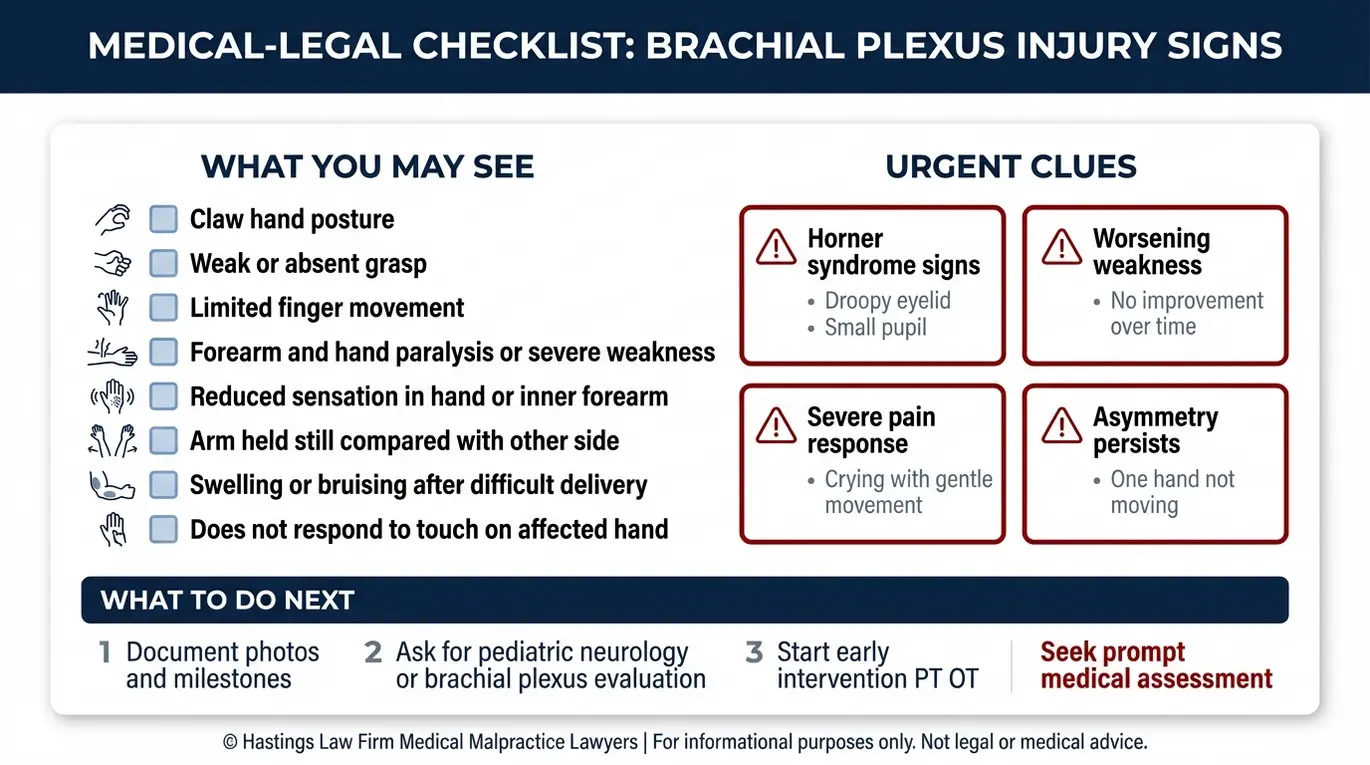
Signs of Klumpke’s palsy typically include a “claw hand” deformity, paralysis of the forearm and hand, and potentially Horner’s syndrome, which affects the eyelid and pupil on the impacted side. Parents often notice something wrong within the first hours or days after birth, even before a formal diagnosis is made.
The most recognizable sign is the claw hand deformity, a condition where the wrist extends while the finger joints curl inward, creating a claw-like posture. This happens because the muscles that open and close the hand are no longer receiving proper nerve signals from the damaged C8 and T1 roots. The baby may be unable to grip, and the affected hand may appear limp or curled compared to the other.
Sensory loss is another hallmark. Because the same nerves that control movement also carry sensation, the baby may show little or no response to touch along the inner forearm and hand. Parents sometimes notice that the baby does not react when the affected hand is touched or stimulated during routine exams.
In more severe cases involving the T1 nerve root, a condition called Horner’s syndrome may develop. Horner’s syndrome is a cluster of symptoms caused by disruption of nerve pathways running from the brain to the face, resulting in a drooping eyelid, a smaller pupil, and decreased sweating on the affected side of the face. When Horner’s syndrome is present alongside hand paralysis, it often indicates a more serious nerve injury that may require surgical intervention.
If you notice any of the following signs in your newborn, request a referral to a pediatric neurologist and consider speaking with a Texas Klumpke’s Palsy Lawyer about your child’s delivery:
- Limp or motionless hand and forearm on one side
- Claw-like posture of the fingers
- Lack of grip reflex in the affected hand
- No response to touch on the inner arm or hand
- Drooping eyelid or unequal pupil size on the same side as the injury
- Absence of sweating on one side of the face
Early evaluation matters. Resources like the Brachial Plexus and Peripheral Nerve Rehab Exercises from WVU Medicine demonstrate the type of gentle physical therapy that may begin shortly after diagnosis, and early documentation of symptoms strengthens both the medical and legal record. An infant hand paralysis lawyer can help ensure that what happened during delivery is properly preserved and investigated.
Types of Nerve Injuries and Prognosis
Not all Klumpke’s palsy injuries are the same. The severity of the injury depends on how the nerve was damaged, and this directly affects your child’s chances of recovery.
Neuropraxia is the mildest form of nerve injury in Klumpke’s palsy cases, involving a stretching of the nerve without tearing. The nerve remains intact but is temporarily unable to transmit signals. Most neuropraxia injuries resolve on their own within a few months with therapy.
In Klumpke’s palsy cases, a Neuroma occurs when the nerve is more significantly damaged and scar tissue forms around the healing site. This scar tissue can block nerve signals and may require surgical intervention if function does not return.
In the context of a birth injury, a Rupture means the nerve has been torn, though not at the spinal cord. Ruptured nerves will not heal on their own and typically require surgical repair, such as nerve grafting.
Nerve root avulsion, the most severe form of Klumpke’s palsy, occurs when the nerve root is torn completely from the spinal cord. Avulsion injuries cannot be directly repaired. Surgeons may attempt nerve transfers, rerouting a functioning nerve to restore some movement, but full recovery is unlikely. When an avulsion is confirmed, the long-term impact on the child’s hand function is significant, and the damages in a legal claim reflect that permanence.
The Hastings Law Firm Difference
Results matter, but what truly sets us apart is how we achieve them. Every verdict, every settlement, and every Texas courtroom victory comes from one guiding promise: To treat each client’s fight for justice as if it were our own.
This balance of skill, experience, and empathy reflects our core philosophy that justice should not only compensate the injured, but also make healthcare safer nationwide.

Medical Interventions and Long-Term Rehabilitation Needs
Treatment for Klumpke’s palsy ranges from physical and occupational therapy for mild cases to complex microsurgery, such as nerve grafts or transfers, for severe tears or avulsions. The treatment path depends heavily on the type and severity of the nerve injury, and decisions made in the first months of life can shape outcomes for decades.
Conservative care begins almost immediately. Physical therapy and occupational therapy focus on maintaining range of motion, preventing joint contractures, and reducing muscle atrophy in the affected hand and arm. Therapists use gentle stretching and stimulation exercises to keep the muscles and joints responsive while waiting to see if the nerves recover on their own. According to a review of rehabilitation protocols published in Frontiers in Neurology, early and consistent therapy is associated with better functional outcomes across all severity levels.
When recovery stalls or does not occur within the first three to six months, surgical options become the focus. Research from Stony Brook Medicine on the natural history and management of brachial plexus birth palsy confirms that timely surgical referral is critical for children who are not meeting recovery milestones.
Nerve grafting involves replacing the damaged nerve segment with a healthy nerve taken from another part of the body, creating a bridge for nerve regrowth. Nerve transfers reroute a less critical, functioning nerve to take over the job of the damaged one. Both procedures are specialized nerve surgery performed by microsurgeons and require months of post-surgical rehabilitation.
In some cases, botulinum toxin (Botox) injections are used to manage muscle imbalance. When certain muscles overpower their weakened counterparts, Botox can temporarily relax the dominant muscle group, allowing therapy to be more effective and preventing further deformity.
The following table outlines the general treatment timeline a Texas Klumpke’s Palsy Lawyer and medical malpractice attorney would expect to document when building a case:
| Timeframe | Intervention | Goal |
|---|---|---|
| Birth to 3 months | Physical/occupational therapy | Maintain range of motion; monitor nerve recovery |
| 3 to 6 months | Specialist evaluation; EMG/nerve studies | Assess whether surgical intervention is needed |
| 6 to 12 months | Nerve graft or nerve transfer surgery (if indicated) | Restore nerve signal pathways |
| 1 to 5+ years | Ongoing PT/OT; possible Botox; secondary surgeries | Maximize function; manage muscle imbalance |
| Lifetime | Adaptive equipment; vocational support | Support independence and quality of life |
Each stage generates medical costs, and those costs factor directly into the damages we pursue.

Calculating Damages for a Lifetime of Care
Compensation in Klumpke’s palsy cases covers past and future medical expenses, loss of future earning capacity, physical pain, mental anguish, and the costs of long-term therapy and adaptive equipment. Because these injuries often affect a child for life, the financial projections must account for decades of care. We fight to secure full compensation for birth injury claims so that your child has every resource they need.
Economic damages represent the measurable financial losses tied to the injury. These include the cost of surgeries already performed, ongoing physical therapy and occupational therapy, future nerve procedures, Botox treatments, adaptive devices, and any modifications needed for daily living. For a child with permanent hand impairment, these costs extend well into adulthood, requiring a financial safety net that lasts a lifetime.
Loss of future earning capacity is one of the most significant economic categories. A permanent hand injury can limit career options and reduce lifetime income. Data from the Bureau of Labor Statistics shows that only 22.7 percent of people with a disability were employed in 2024, underscoring the long-term financial impact these injuries carry. We work with economists and vocational experts to project what your child’s earning potential would have been without the injury and calculate the gap.
To build a complete picture, we work with life care planners who project the cost of your child’s needs 50 to 70 years into the future. Life care plans also account for the long-term educational impact, such as the need for specialized tutors or technology in the classroom. This includes:
- All past and anticipated surgeries, including nerve grafts and transfers
- Lifetime physical therapy and occupational therapy
- Botox injections and other medical management
- Adaptive equipment, prosthetics, and assistive technology
- Psychological counseling and support services
- Lost future earning capacity based on vocational analysis
- Pain, suffering, mental anguish, and physical disfigurement
Non-economic damages address the human cost: physical pain, mental anguish, disfigurement, and the loss of the ability to fully participate in activities that other children take for granted. While these damages are harder to quantify, they are no less real, and they form an important part of the recovery we seek.
Our firm works as a Texas Klumpke’s Palsy Lawyer to make sure your child’s financial future is protected for the full scope of their life. As a specialized malpractice firm, our goal is to ensure a settlement or verdict reflects the true cost of your child’s injury, not just the bills that have arrived so far.
How Hastings Law Firm Proves Liability in Birth Injury Cases
We prove liability by utilizing a team of former defense attorneys and medical experts to demonstrate that the obstetrician’s failure to follow established protocols directly caused the permanent nerve injury. Proving a Klumpke’s palsy case requires connecting the clinical decisions made during delivery to the specific damage sustained by the C8 and T1 nerve roots.
Our trial-ready approach means that every case is prepared as if it will go before a jury, starting from day one. We do not wait for settlement negotiations to begin building the evidence. Instead, we aggressively preserve evidence and depose witnesses early in the process to lock in the facts before memories fade.
Our in-house nursing staff reviews the complete delivery records, fetal monitoring strips, nursing logs, and operative notes to reconstruct a detailed timeline of what happened. This level of preparation sends a clear signal to insurance carriers and defense counsel that the case has been thoroughly investigated and is ready for trial, often prompting them to offer fair settlements rather than risk a verdict in court.
Our team’s background gives families a distinct advantage when countering defense tactics in birth injury litigation. Hastings Law Firm includes former defense counsel who previously represented hospitals in cases exactly like these. They know the strategies defense teams rely on, including attempts to attribute the injury to “maternal forces.”
Our team also identifies arguments claiming shoulder dystocia was an unforeseeable event rather than a manageable complication. We know how to identify and challenge these arguments before they gain traction. Excessive traction during delivery, meaning the amount of pulling force applied to the baby’s head or body, is often the central issue.
We also draw on a national network of qualified medical experts, board-certified obstetricians, neurologists, and pediatric surgeons, who provide objective expert testimony about whether the standard of care was met. Their opinions carry weight because they are grounded in the same clinical guidelines the delivering physician was expected to follow. Our work as a Texas Klumpke’s Palsy Lawyer is dedicated to this mission of holding negligent providers accountable.
Contact the Texas Birth Injury Attorneys at Hastings Law Firm Today for Help
Your child’s medical records, fetal monitoring data, and witness recollections are most valuable when preserved early. Texas imposes strict filing deadlines on medical malpractice claims, and evidence can deteriorate or disappear over time. Acting sooner gives your legal team the best foundation to work with.
There are no upfront fees to work with us. We handle every case on a contingency basis, meaning you pay nothing unless we secure a recovery for your family. Our mission has always been to restore trust for families who feel let down by the healthcare system and to protect your child’s future.
If your baby was born with signs of hand or arm paralysis, and you believe the delivery was mismanaged, contact our Texas Klumpke’s Palsy Lawyer for a free, confidential evaluation. A patient advocate is ready to listen, review your situation, and help you understand your options.
Frequently Asked Questions About Klumpke’s Palsy Malpractice in Texas


This content was researched and written by the Hastings Law Firm editorial team, which includes attorneys, medical professionals, and experienced researchers. Our writing is informed by internal knowledge and practical experience, and we cross-check critical details against authoritative sources cited throughout. Every piece undergoes human-led fact-checking and legal review. Because legal and medical information can change, if you spot an error, please contact us. Learn more about our content standards and review process on our editorial policy page.

Tommy Hastings, founder of Hastings Law Firm, is a board-certified personal injury trial lawyer dedicated exclusively to healthcare injury cases. Since 2001, he has represented injured patients and families in litigation against major hospital systems, pharmaceutical companies, and negligent healthcare providers nationwide. He has handled numerous high-profile cases that have drawn national media attention and resulted in multi-million dollar recoveries. He draws on that experience in his writing, helping readers understand how these cases work and what options may be available to them.
