


Texas Cephalohematoma Lawyer
Written by: Hastings Law Firm | Reviewed by: Tommy Hastings | Updated: July 27, 2026
Cephalohematoma after delivery can leave families facing uncertainty about what happened and what comes next. This newborn head injury involves bleeding beneath the scalp that may resolve, but it can also lead to serious complications when it is severe, misdiagnosed, or not properly monitored and treated. Concerns often focus on whether excessive force, instrument misuse, or a missed need for a safer delivery method contributed to the harm. If you or a loved one were harmed or worse due to cephalohematoma birth injuries in Texas, contact Hastings Law Firm for a free, confidential case review.
Experienced Legal Representation for Infant Birth Injuries in Texas
What You Should Know About Infant Head Swelling Negligence Claims in Texas:
- Long term harm can follow when cephalohematoma complications such as severe jaundice progress to brain damage.
- Urgent care can be delayed when dangerous newborn head bleeding is mistaken for routine swelling.
- Preventable injury concerns can arise when delivery involves excessive force or improper use of vacuum extractors or forceps.
- Liability disputes can turn on whether warning signs showed a safer delivery method was needed.
- Recovery can be limited because Texas caps non economic damages in medical malpractice cases.
- Financial support for ongoing care can remain available because economic damages are not capped under Texas law.
- Options can be lost when strict Texas malpractice requirements are not met and a case is dismissed.
- Clarity about what occurred can depend on detailed delivery documentation such as fetal monitoring data and nursing notes.

A Healthcare Focused Law Firm
When your newborn has been diagnosed with a cephalohematoma, the mix of fear, confusion, and frustration can feel overwhelming. You may be wondering whether something went wrong during delivery and what options your family has now. Those questions deserve honest answers.
As a Texas cephalohematoma lawyer team led by board-certified trial attorney Tommy Hastings, we focus exclusively on medical malpractice. Our in-house medical staff and attorneys review birth injury cases every day, and we understand both the clinical details and the emotional weight families carry. If your child was harmed during delivery, we can review what happened and explain your options in a free, confidential consultation.
Understanding Cephalohematoma and Birth Trauma
A cephalohematoma is a collection of blood that forms between a newborn’s skull bone and the periosteum, the thin membrane of tissue that covers the outer surface of the bone. It develops when blood vessels rupture during delivery, resulting in blood pooling in a confined space just beneath the scalp.
This type of birth trauma typically appears as a soft, raised head swelling on one side of the skull within hours after birth. Unlike a simple bruise, the blood is trapped beneath the periosteum and does not cross the skull’s suture lines, which are the joints between the skull bones. According to the National Center for Biotechnology Information (NCBI Bookshelf), cephalohematomas occur in an estimated 1 to 2 percent of all live births.
The mechanics behind the injury matter. During a vaginal delivery, pressure from the birth canal naturally compresses the baby’s head. Friction between the skull and the mother’s pelvic bone can shear delicate blood vessels. While the infant’s skull plates are designed to overlap slightly to help with birth, the vessels traversing the bone and the periosteum are vulnerable to tearing under significant stress.
In many cases, this pressure alone can cause minor vessel damage. When a delivery involves additional external force, such as traction from instruments or prolonged compression during a difficult labor, the risk of a more significant rupture increases.
This distinction is important from both a medical and legal perspective. Some cephalohematomas develop as part of a difficult but otherwise well-managed delivery. Others result from excessive force applied by medical staff or from a failure to recognize that a safer delivery method was needed.
Reviewing the medical records helps determine if the medical team responded appropriately to signs of cephalopelvic disproportion, where the baby’s head is too large to fit through the mother’s pelvis. Our legal team includes former hospital nurses who previously worked for the systems they now challenge. Texas cephalohematoma attorneys evaluate the circumstances surrounding the birth to determine which category a case falls into.
Medical Negligence Leading to Infant Head Injuries
Medical negligence occurs when a physician deviates from the standard of care, such as using excessive force with extractors or failing to order a C-section, resulting in injury. Hastings Law Firm handles complex liability cases by focusing exclusively on medical malpractice litigation. In cephalohematoma cases, this often involves the misuse of delivery instruments or a failure to act when warning signs called for a different approach.
Two of the most common instruments involved are vacuum extractors and forceps. Vacuum extraction uses a suction cup to guide the infant through the birth canal. Forceps involve curved metal instruments placed around the head to assist with traction.
Negligence often involves:
- Applying excessive traction or repeated attempts with a vacuum extractor
- Incorrect forceps placement causing direct pressure on the skull
- Failing to perform a timely C-section when risk factors like fetal macrosomia (a baby significantly larger than average) or prolonged labor were present
- Ignoring signs of fetal distress that indicated a vaginal delivery was no longer safe
- Failing to account for a breech presentation or other positioning concerns before attempting instrumental delivery
A cephalohematoma lawyer in Texas examines the delivery records, nursing notes, and fetal monitoring data to identify whether any of these failures occurred. Our birth injury legal team works with in-house nurse consultants who understand hospital charting and can spot inconsistencies that might otherwise go unnoticed.
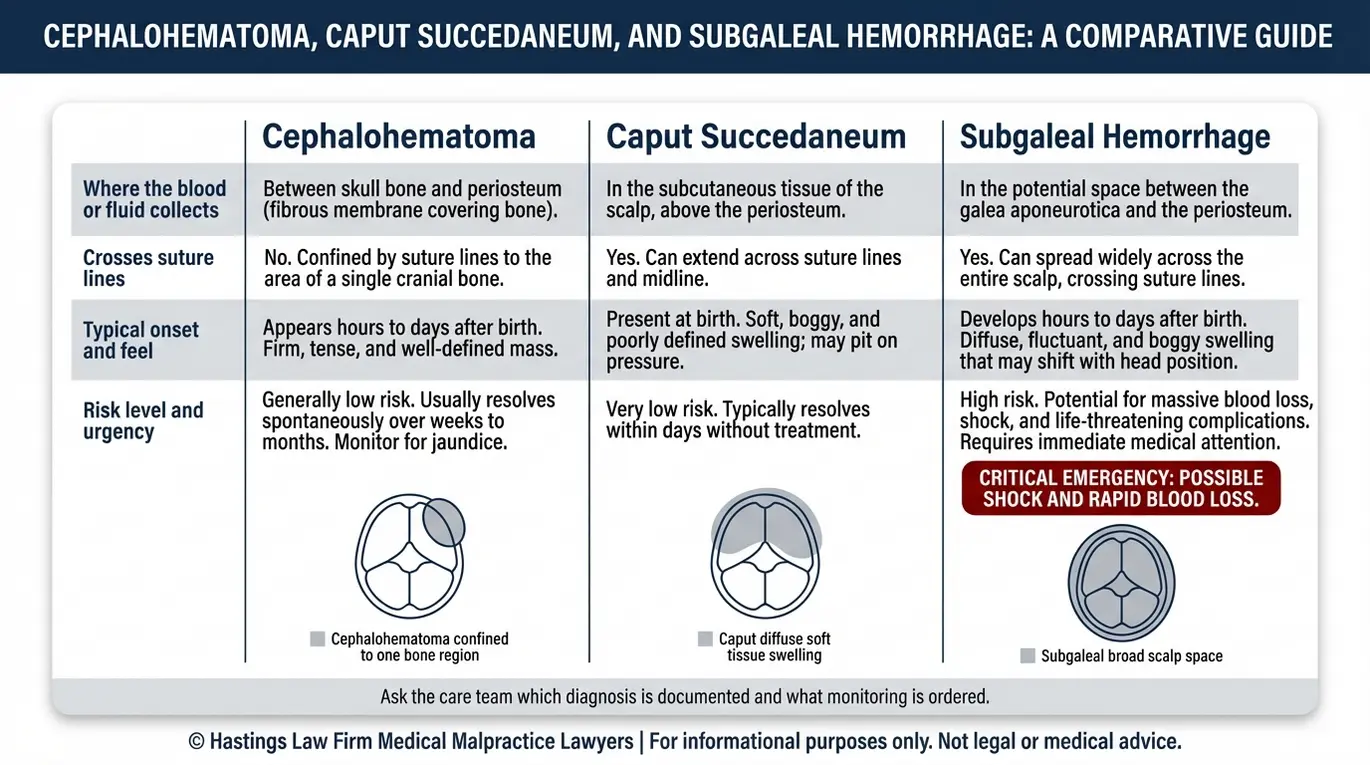
Differential Diagnosis: Cephalohematoma vs. Caput Succedaneum
Not all newborn head swelling is the same, and misdiagnosis can delay critical treatment. Differential diagnosis is the process of distinguishing between conditions with similar symptoms. Three conditions commonly present with scalp swelling at birth, and distinguishing between them is essential.
Caput succedaneum is superficial swelling of the scalp caused by pressure during delivery. It sits above the periosteum, can cross suture lines, and typically resolves on its own within days. A subgaleal hemorrhage is a far more dangerous condition in which blood collects between the periosteum and the skull’s connective tissue layer. It can spread across the entire head and lead to life-threatening blood loss.
| Condition | Location of Blood/Fluid | Crosses Suture Lines? | Severity |
|---|---|---|---|
| Caput Succedaneum | Above the periosteum (superficial) | Yes | Mild; resolves on its own |
| Cephalohematoma | Between skull and periosteum | No | Moderate; may cause complications |
| Subgaleal Hemorrhage | Below the periosteum, above the skull | Yes | Severe; can be life-threatening |
A failure to correctly distinguish between these conditions can delay emergency intervention. Unlike a simple bruise, the blood is trapped beneath the periosteum and does not cross the skull sutures, which are the thin joints between a baby’s skull bones. If a subgaleal hemorrhage or brain bleed is misidentified as a routine cephalohematoma, the baby may not receive the urgent care needed to prevent permanent injury.
The Hastings Law Firm Difference
Results matter, but what truly sets us apart is how we achieve them. Every verdict, every settlement, and every Texas courtroom victory comes from one guiding promise: To treat each client’s fight for justice as if it were our own.
This balance of skill, experience, and empathy reflects our core philosophy that justice should not only compensate the injured, but also make healthcare safer nationwide.

Serious Complications Requiring Legal Action
While some hematomas resolve, complications like calcification, infection, and severe jaundice can cause permanent damage requiring lifetime care.
One of the most common complications is jaundice. As the pooled blood breaks down, it releases bilirubin, a yellow pigment processed by the liver. In newborns, the liver is still developing and may not be able to clear excess bilirubin quickly enough. This can lead to hyperbilirubinemia, an abnormally high level of bilirubin in the blood.
Left untreated, severe jaundice can progress to kernicterus, which is a form of brain damage. The Centers for Disease Control and Prevention provides clinical guidelines emphasizing that early identification and treatment of jaundice are critical to preventing neurological injury.
Infection is another serious risk. If the hematoma is aspirated improperly, or if bacteria enter the site, the result can be sepsis, meningitis, or osteomyelitis, an infection of the underlying skull bone. Research published in Surgical Neurology International describes cephalohematomas as a potential hidden source of infection and inflammation.
A Texas birth injury lawyer also evaluates whether the hematoma is associated with underlying skull fractures caused by instrument trauma during delivery. A calcified cephalohematoma, where the blood deposit hardens into a permanent bony lump on the infant’s skull, can result in visible disfigurement and may require surgical correction.
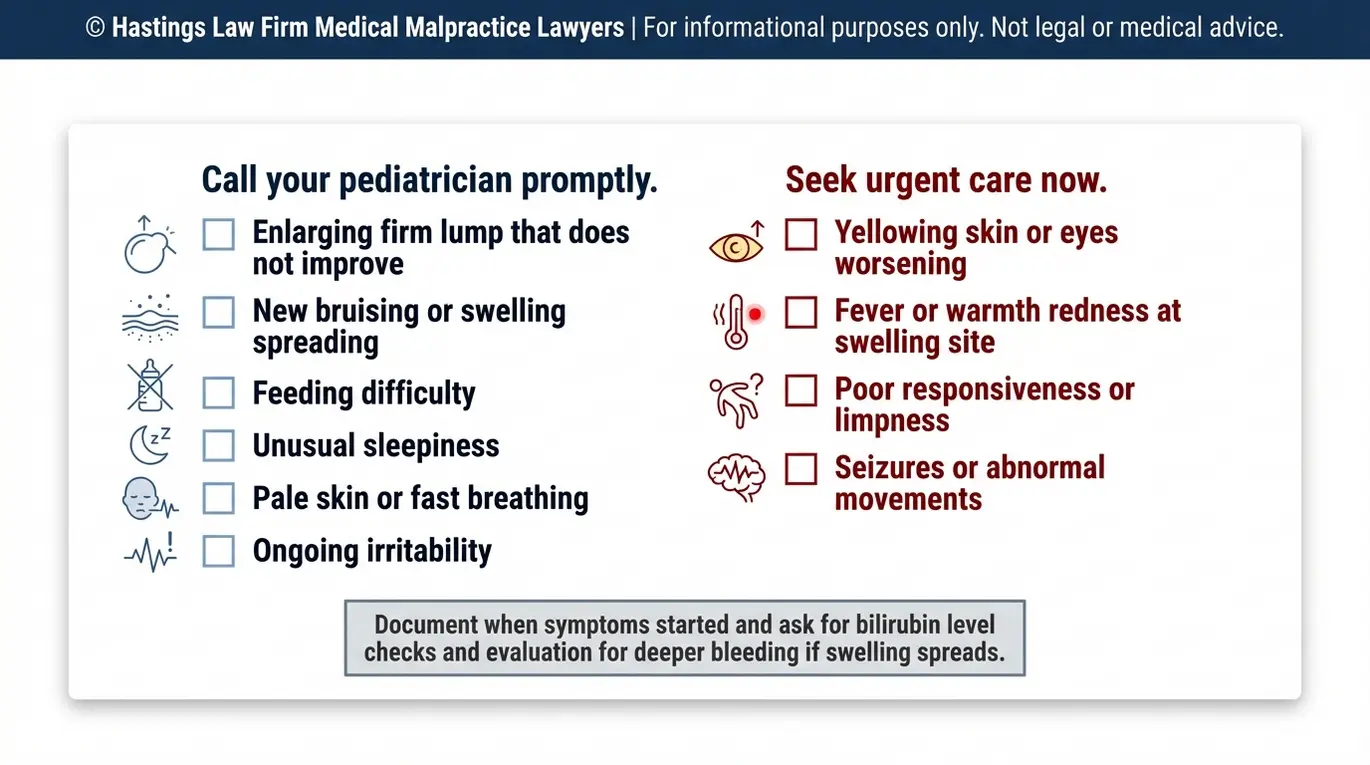
Watch for these warning signs that may signal complications:
- Yellowing of the skin or eyes that worsens after birth
- Increasing head swelling that does not improve within the first few weeks
- Fever, irritability, or poor feeding suggesting possible infection
- A firm or hardening lump that persists beyond six to eight weeks
- Pale skin or lethargy, which may indicate anemia from blood loss
If your child is showing any of these signs, prompt medical evaluation is essential. A cephalohematoma malpractice attorney can help determine whether the original injury, or a failure to properly monitor and treat it, warrants a legal claim.
Proving Malpractice in Texas Birth Injury Cases
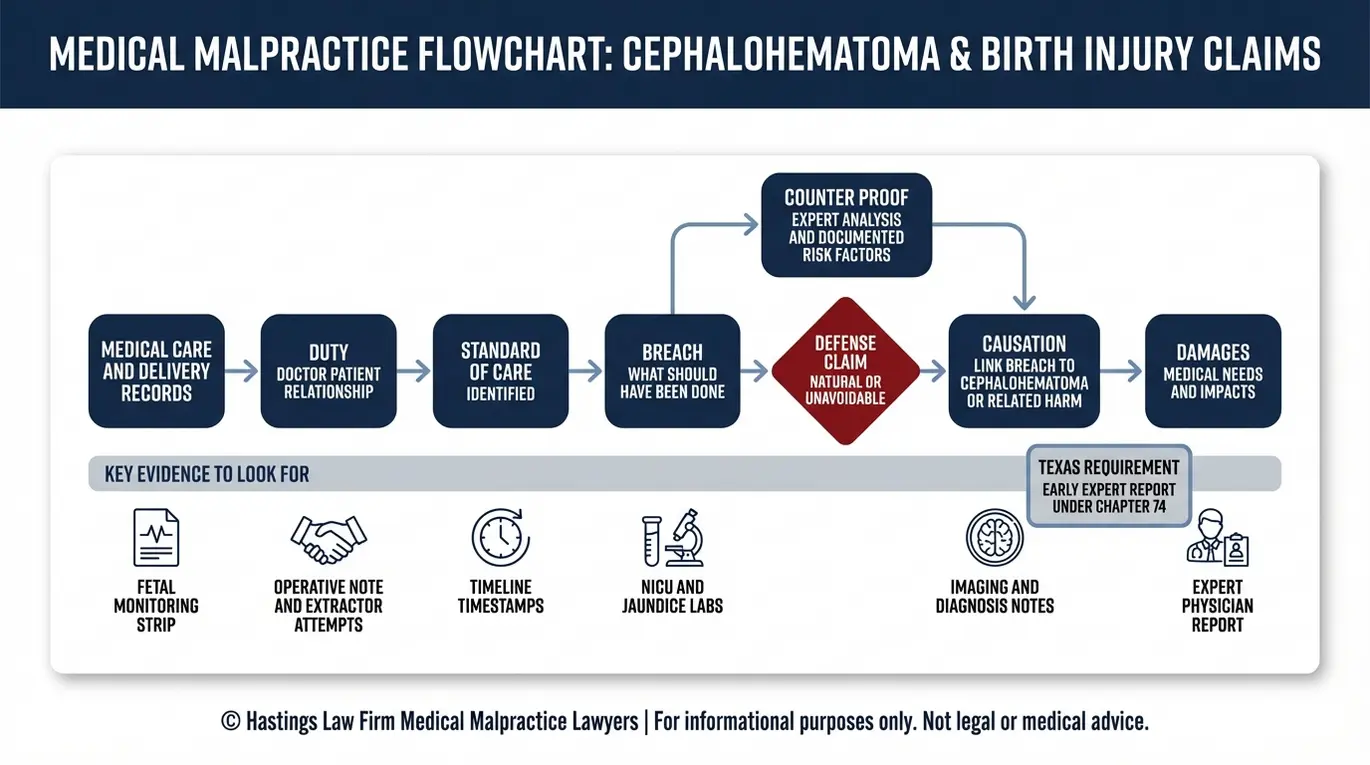
To succeed in a malpractice claim in Texas, a family must prove that a doctor-patient relationship existed, the standard of care was breached, and that breach directly caused the infant’s injury. The standard of care is the level of care a competent professional would provide under similar circumstances.
These cases are built on four legal elements:
- Duty: The healthcare provider owed a duty of care to the mother and baby during delivery, establishing a professional relationship.
- Breach: The provider committed a breach of duty by deviating from the standard of care, meaning they failed to act as a reasonably competent physician would have under the same circumstances.
- Causation: The breach directly caused or contributed to the infant’s cephalohematoma or related complications. It is not enough to show an error occurred; we must link that error definitively to the physical harm.
- Damages: The infant suffered measurable harm, whether physical, financial, or both.
Texas imposes strict procedural requirements on medical malpractice cases. Under Texas Civil Practice and Remedies Code Chapter 74, a plaintiff must serve a qualified expert report within 120 days of the defendant filing an answer. This report must identify the specific standard of care violations and explain how those violations caused the injury.
Because Texas law is unforgiving on this point, finding an expert who is both qualified and willing to testify against other medical professionals is a substantial hurdle that requires an experienced legal team. Failure to meet this strict 120-day deadline can result in the automatic dismissal of the case with no chance to refile.
This is one reason early legal help for birth trauma cases is so important. A Texas cephalohematoma lawyer at Hastings Law Firm begins the investigation immediately, well before filing. Our team reviews delivery records, the electronic fetal monitoring (EFM) strip, nursing logs, and physician notes to build a detailed timeline.
Hospital defense teams often argue that the injury occurred naturally or was an unavoidable complication. They may claim the cephalohematoma was an inevitable consequence of labor forces. Our attorneys counter this by highlighting specific moments where the medical team ignored protocols or misused tools. Because we prepare every case as if it will go to trial, we engage those experts early and build the evidence from day one.
Compensation for Families of Injured Infants
Compensation covers past and future medical bills, pain and suffering, and the costs associated with any long-term disability or developmental care. Damages are the legal term for the financial and personal losses caused by the injury.
Economic damages include measurable financial losses such as:
- Hospital and NICU costs from the initial injury
- Surgical procedures, including correction of calcified cephalohematomas
- Ongoing therapy, rehabilitation, and developmental support
- Future medical care if the child requires long-term treatment
- Loss of earning capacity if the injury results in permanent disability
Non-economic damages account for losses that are real but harder to quantify:
- The infant’s physical pain and suffering
- Physical impairment affecting daily life
- Disfigurement, such as a permanent lump from calcification
- Emotional distress experienced by the child and family
Texas does place caps on non-economic damages in medical malpractice cases. Under current law, non-economic damages are generally limited to $250,000 against all physicians and individual healthcare providers combined, plus up to $250,000 per healthcare institution (with a maximum of $500,000 if multiple institutions are involved), for a total cap of up to $750,000.
Economic damages are not subject to these caps. For a child who may need decades of specialized care, the uncapped economic recovery often represents the largest portion of the claim. A lawyer for cephalohematoma cases can help your family identify the full scope of both current and future losses. By calculating the lifetime value of care, we ensure that settlements reflect the true cost of raising a child with medical needs, protecting your family’s financial stability for years to come.
Contact the Texas Birth Injury Attorneys at Hastings Law Firm Today for Help
Many birth injuries are preventable, and families deserve to know what happened during their child’s delivery. If your baby was diagnosed with a cephalohematoma and you believe the care provided fell short, time matters. Texas law imposes strict deadlines for filing a medical malpractice claim.
Hastings Law Firm handles these cases on a contingency fee basis, meaning you pay no attorney fees unless we recover compensation for your family. As a dedicated Texas cephalohematoma lawyer team led by Tommy Hastings, who is board-certified in personal injury trial law, we have the medical knowledge and trial preparation to hold negligent providers accountable.
Contact us today for a free, confidential case evaluation. Let us review your child’s records and help you understand your legal options.
Frequently Asked Questions About Cephalohematoma Injury in Texas


This content was researched and written by the Hastings Law Firm editorial team, which includes attorneys, medical professionals, and experienced researchers. Our writing is informed by internal knowledge and practical experience, and we cross-check critical details against authoritative sources cited throughout. Every piece undergoes human-led fact-checking and legal review. Because legal and medical information can change, if you spot an error, please contact us. Learn more about our content standards and review process on our editorial policy page.

Tommy Hastings, founder of Hastings Law Firm, is a board-certified personal injury trial lawyer dedicated exclusively to healthcare injury cases. Since 2001, he has represented injured patients and families in litigation against major hospital systems, pharmaceutical companies, and negligent healthcare providers nationwide. He has handled numerous high-profile cases that have drawn national media attention and resulted in multi-million dollar recoveries. He draws on that experience in his writing, helping readers understand how these cases work and what options may be available to them.
