


Texas Preterm Labor Negligence Lawyer
Written by: Hastings Law Firm | Reviewed by: Tommy Hastings | Updated: July 27, 2026
Preterm labor that is not recognized or treated in time can lead to a premature delivery with lasting consequences for a child and family. Some early births happen despite appropriate care, but negligence may be involved when warning signs are dismissed, risk factors are not addressed, or proven interventions are delayed or omitted. These situations often turn on whether the care met accepted obstetric standards and whether different actions could have reduced harm. If you or a loved one were harmed or worse due to preterm labor negligence in Texas, contact Hastings Law Firm for a free, confidential case review.

Representing Texas Families Impacted by Preventable Premature Birth
What You Should Know About Preterm Pregnancy Injury Claims in Texas:
- Lifelong disability and infant death can follow when preterm labor is not properly delayed or managed.
- Severe outcomes can include brain injury and chronic lung disease when a pregnancy is shortened by provider error.
- Options to prevent or reduce harm can be lost quickly when early warning signs are dismissed.
- Liability can turn on whether documented risk factors were identified and acted on in a high risk pregnancy.
- Preventable injury may be alleged when proven interventions are delayed or omitted despite clear indications.
- Additional harm can be tied to delivery at an under equipped hospital when transfer to a higher level NICU facility is not initiated.
- Causation is often the most contested issue because expert testimony must link the care failure to the specific infant injuries.
- Financial recovery can be shaped by the difference between economic damages for lifetime care costs and non economic damages for suffering.
- Non economic damages are limited in Texas medical malpractice cases while economic damages are not capped.
- Medical records across prenatal care and the NICU can be central when evaluating whether care met the standard and what caused the injuries.

A Healthcare Focused Law Firm
When a baby arrives weeks or months too early, and the medical team had the tools to prevent it, the weight of that reality can feel impossible to carry. You may be spending long hours in the NICU, watching monitors and searching for answers about what went wrong during your pregnancy care.
Not every premature birth is preventable. But when a healthcare provider fails to recognize the signs of preterm labor, dismisses symptoms, or delays treatment that could have prolonged a pregnancy, that failure may be medical negligence. As a Texas preterm labor negligence lawyer, Hastings Law Firm represents families if you or a loved one has a child harmed by preventable premature delivery. Our team of attorneys, nurse consultants, and medical experts is ready to review what happened and explain your legal options at no cost and no obligation.
Understanding Preterm Labor Negligence and Medical Malpractice
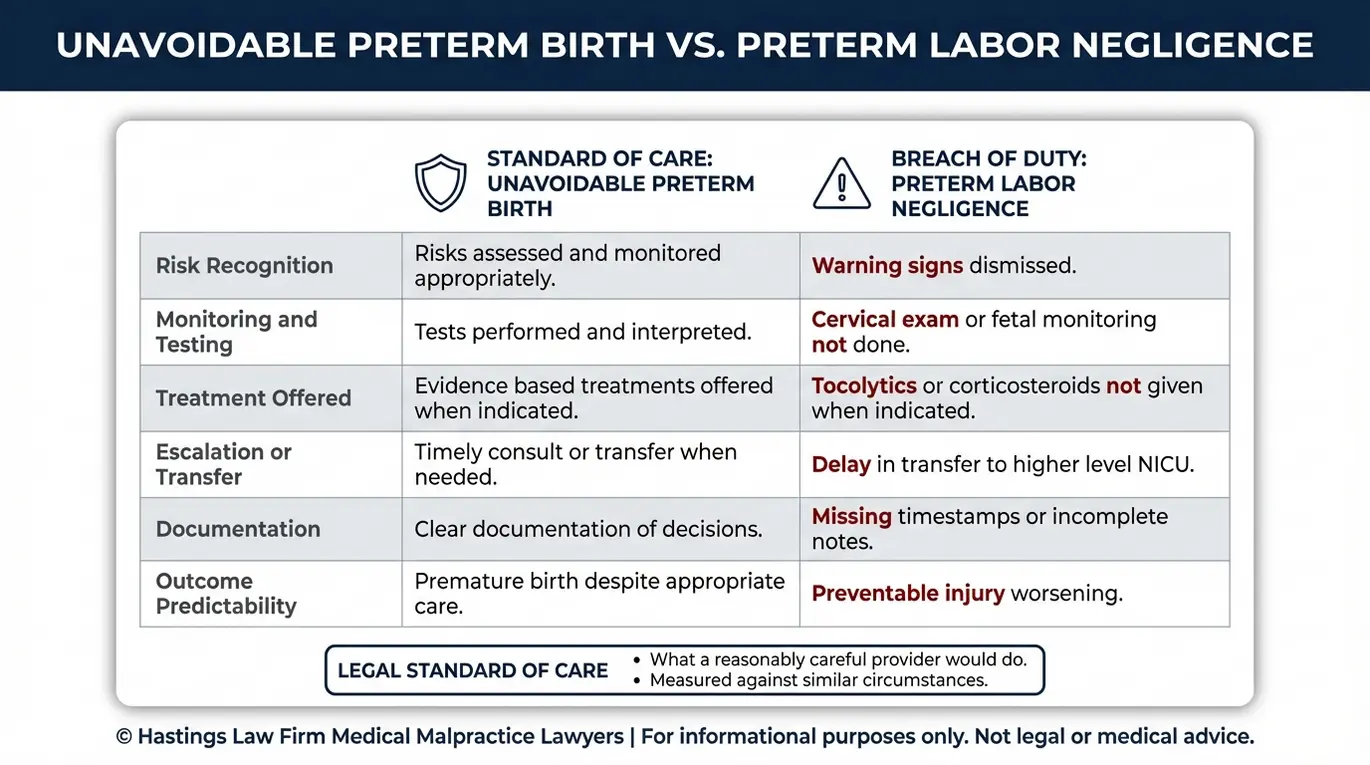
Medical malpractice in the context of preterm labor occurs when a healthcare provider fails to meet the accepted standard of care, the level of treatment a reasonably competent physician would have provided under similar circumstances, in monitoring, diagnosing, or managing the signs of early labor, and that failure directly leads to premature birth and injury.
Preterm labor occurs when the body prepares for birth too early. Not every baby born early is the result of negligence. Preterm labor, defined as labor beginning before 37 weeks of gestation, can sometimes occur despite appropriate medical care. Conditions like preterm premature rupture of membranes (PPROM), where the amniotic sac breaks too early, may develop suddenly and unpredictably.
The legal question is not simply whether a baby was born prematurely. It is whether the medical team’s actions or inactions fell below what modern obstetric medicine requires. A seasoned preterm labor negligence attorney can help families distinguish between an unavoidable outcome and one caused by provider error.
For high-risk pregnancies, the standard of care is well-established. Physicians are expected to identify risk factors such as a prior history of preterm delivery, cervical insufficiency, or infection, and then act on those findings with appropriate monitoring and intervention. When a provider ignores documented risk factors or delays proven treatments, the birth may cross the line from an unavoidable complication to a preventable injury.
Working with a specialized preterm labor negligence attorney ensures that families understand the challenges of these medical distinctions. Texas medical malpractice claims are governed by Texas Civil Practice and Remedies Code Chapter 74, which sets specific procedural requirements for bringing these cases.
The concept of preventability is central to what a Texas preterm labor negligence lawyer evaluates. Modern medicine offers effective tools to delay preterm delivery and protect vulnerable infants. When those tools are available and a provider fails to use them, the resulting harm can often be traced directly to that failure. Establishing that the outcome was preventable requires a deep understanding of obstetric protocols.
Did Your Obstetrician Fail to Recognize Warning Signs
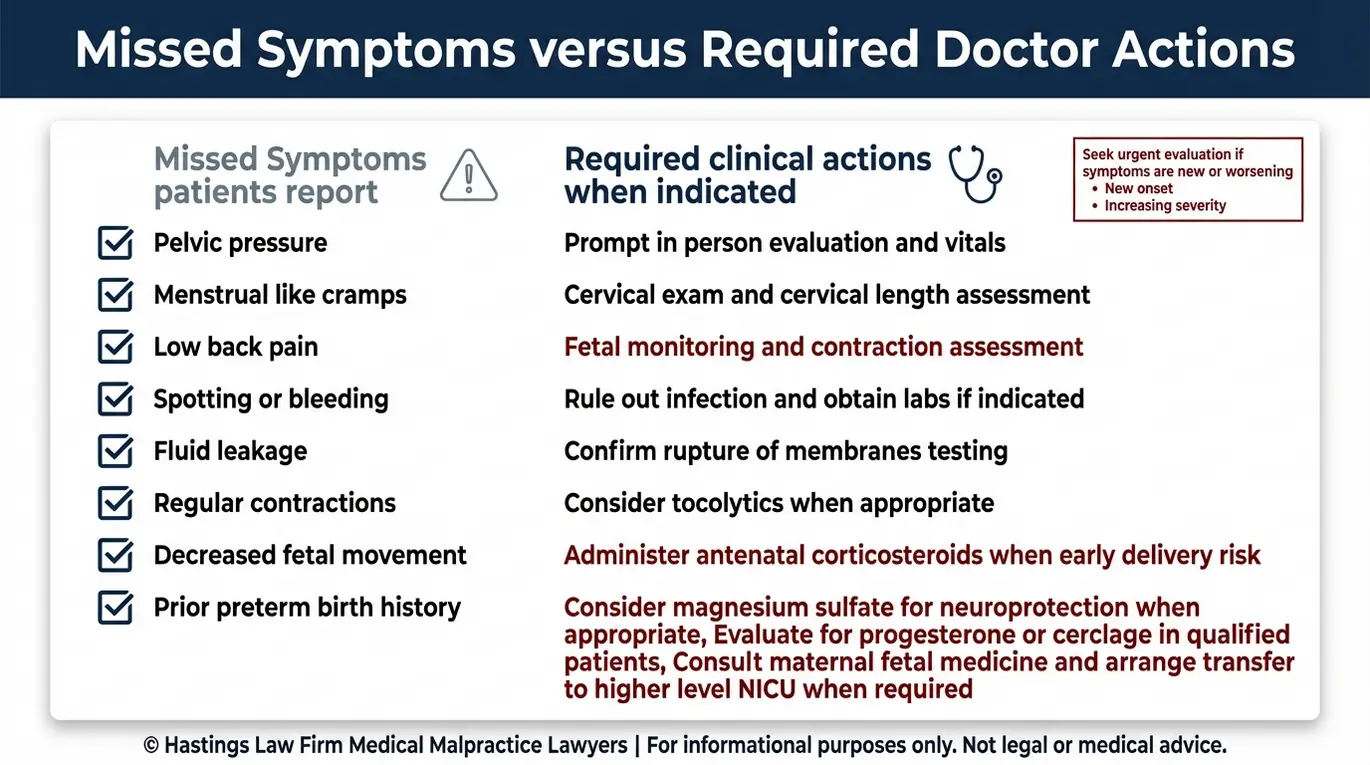
Obstetricians can be held liable for negligence when they dismiss a patient’s complaints of cramping, persistent back pain, pelvic pressure, or fluid leakage, or when they fail to perform necessary diagnostic tests like cervical length measurement (a transvaginal ultrasound used to assess the cervix) or fetal monitoring in the presence of known risk factors.
Preterm labor does not always present dramatically. Symptoms can be subtle, and patients often rely on their doctors to take those symptoms seriously.
When a provider does not respond to early warning signs, the window to intervene can close quickly. A lawyer for preterm labor negligence will examine the medical records to determine whether the provider responded appropriately to reported symptoms. Consulting a Texas preterm labor negligence lawyer is important for evaluating these subtle failures.
The standard of care for a high-risk pregnancy typically includes specific medical interventions designed to delay delivery and protect the baby. An experienced lawyer for preterm labor negligence understands the details of these protocols. When those interventions are delayed or omitted entirely, the consequences for the infant can be severe.
Warning Signs and Required Medical Responses:
- Pelvic pressure, cramping, or low back pain before 37 weeks: Should prompt cervical evaluation, fetal monitoring, and assessment for preterm labor
- Vaginal spotting or fluid leakage: Requires testing for amniotic fluid (PPROM) and immediate clinical assessment
- History of prior preterm birth: Standard of care calls for progesterone supplementation or cervical cerclage, a procedure in which the cervix is stitched closed to prevent premature dilation
- Short cervix identified on ultrasound: Should trigger a treatment plan that may include progesterone, cerclage, or increased monitoring
- Signs of infection or preterm labor confirmed: Administration of tocolytic medications to slow contractions, corticosteroids to mature the baby’s lungs, and magnesium sulfate for fetal neuroprotection
Another common failure involves the decision about where the patient delivers. If a hospital lacks a high-level NICU capable of caring for a very premature infant, the standard of care may require a maternal transfer to a facility with the appropriate designation. The Texas Department of State Health Services maintains a list of designated neonatal facilities across the state. When a transfer is not initiated and the infant is born at an under-equipped facility, that decision can be a significant factor in a Texas preterm labor negligence case.
The Hastings Law Firm Difference
Results matter, but what truly sets us apart is how we achieve them. Every verdict, every settlement, and every Texas courtroom victory comes from one guiding promise: To treat each client’s fight for justice as if it were our own.
This balance of skill, experience, and empathy reflects our core philosophy that justice should not only compensate the injured, but also make healthcare safer nationwide.

Severe Injuries Caused by Mismanaged Premature Delivery
When preterm labor is not properly delayed or managed, infants face a high risk of catastrophic injuries, including cerebral palsy, brain bleeds, and life-threatening organ complications that may require a lifetime of care.
Premature babies are medically fragile. Their organs, particularly the brain and lungs, have not finished developing. According to the Centers for Disease Control and Prevention (CDC), preterm birth is a leading cause of infant death and long-term disability in the United States. When a physician’s negligence shortens a pregnancy by even a few critical weeks, the consequences can be devastating.
Brain injuries are among the most serious outcomes. Hypoxic-ischemic encephalopathy (HIE), a form of brain damage caused by oxygen deprivation, can result in permanent neurological impairment. Intraventricular hemorrhage (IVH), or bleeding into the brain’s ventricles, occurs because the blood vessels in a premature infant’s brain are extremely fragile and underdeveloped. Both conditions can lead to cerebral palsy, developmental delays, and cognitive disabilities.
Respiratory complications are also common. Respiratory distress syndrome (RDS) develops when a premature baby’s lungs lack sufficient surfactant to function properly. Bronchopulmonary dysplasia (BPD) can follow, causing chronic lung disease that requires extended ventilation and oxygen therapy.
Other conditions a preterm labor negligence lawyer in Texas may link to mismanaged delivery include:
- Necrotizing enterocolitis (NEC), a serious intestinal disease that can require emergency surgery
- Patent ductus arteriosus (PDA), a heart condition common in premature infants
- Neonatal sepsis, an infection that spreads rapidly in underdeveloped immune systems
- Kernicterus, which is brain damage caused by untreated severe jaundice
Many of these injuries result in lifelong disabilities requiring 24/7 care, specialized therapies, and adaptive equipment. A Texas birth injury attorney evaluates the full scope of these injuries to determine the long-term impact on both the child and the family. Your Texas birth injury attorney will advocate for the resources needed to manage these lifelong challenges. A trusted Texas birth injury attorney can also connect families with medical experts who can validate the extent of the harm.
The Role of Corticosteroids and Tocolytics in Prevention
Tocolytic medications and steroids are essential treatments used by doctors to delay labor and help the baby’s development when premature birth is a risk.
Antenatal corticosteroids are steroid injections given to the mother before delivery to accelerate the development of the baby’s lungs. When given within the appropriate window, they significantly reduce the risk of RDS, IVH, and death in premature infants. The standard of care requires their administration when preterm delivery is anticipated.
Tocolytic medications are drugs used to temporarily slow or stop contractions, giving physicians time to administer corticosteroids and, if necessary, arrange a transfer to a higher-level facility. Magnesium sulfate, another medication frequently used in preterm labor management, has been shown to provide neuroprotection for the fetal brain.
When a physician fails to prescribe these treatments despite clear indications, and the baby is born with injuries that the medications could have prevented or reduced, that omission can form the basis of a medical malpractice claim.
Proving Causation in Preterm Labor Lawsuits
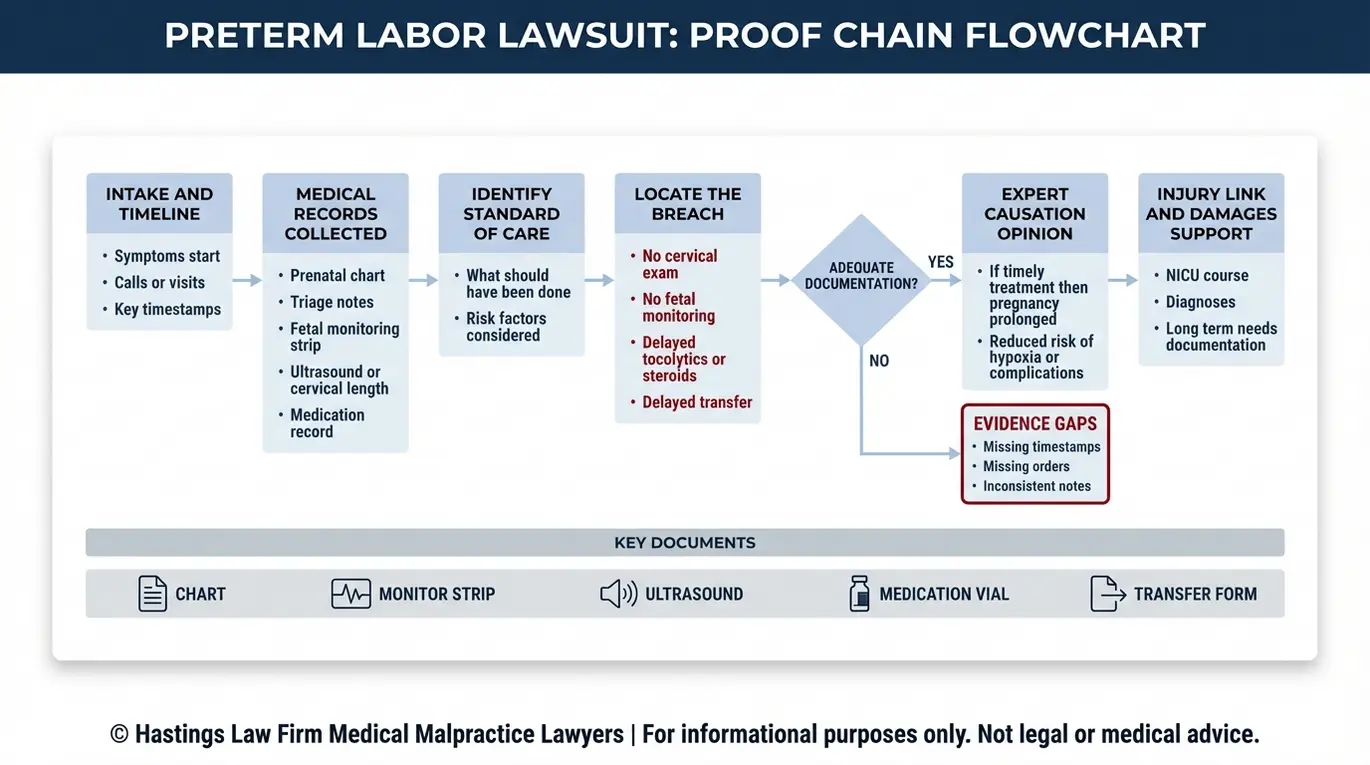
Proving causation requires expert testimony establishing that had the physician acted within the standard of care, such as administering tocolytics or performing a cerclage, the pregnancy would have been prolonged and the infant’s specific injuries would have been avoided or significantly reduced.
Causation is the legal requirement to prove that a doctor’s mistake was the direct cause of the baby’s injury. It is often the most contested element in a preterm labor malpractice case. It is not enough to show that a doctor made a mistake.
A Texas preterm labor negligence lawyer must connect that mistake directly to the harm suffered by the baby. Founded by board-certified trial attorney Tommy Hastings, we build this link meticulously. Our legal team includes former defense attorneys and nurse consultants who understand hospital systems from the inside. As a firm focused exclusively on medical malpractice litigation, we use our in-house medical staff to evaluate clinical data.
Our team approaches causation through a structured investigation:
- Gathering medical records and prenatal history. We obtain the complete obstetric chart, prenatal visit records, lab results, ultrasound reports, nursing notes, and NICU records. Our in-house medical staff reviews every entry to build a detailed clinical timeline.
- Identifying the specific breach. We pinpoint exactly where the provider deviated from the standard of care. This could be a failure to measure cervical length, a failure to prescribe progesterone, a missed diagnosis of infection, or a delay in administering corticosteroids. Our team uses our background in hospital defense to understand how facilities document care and where charting inconsistencies often appear.
- Connecting the breach directly to the injury. Working with maternal-fetal medicine specialists and neonatologists from our national expert network, we establish whether the injuries would have been prevented had the provider acted appropriately. For example, we investigate if the failure to administer magnesium sulfate, a medication used for fetal neuroprotection, contributed to the severity of the brain injury. Similarly, we assess if delaying delivery caused conditions like necrotizing enterocolitis (NEC), a serious intestinal disease. The medical evidence directly supports the legal standard.
This thorough process is why a malpractice attorney for premature birth cases must have both the legal skill and the medical knowledge to handle these claims effectively.
Compensation for Families of Premature Infants
Families of premature infants harmed by negligence may recover economic damages for past and future medical expenses, therapy, assistive devices, and home modifications, as well as non-economic damages for pain, suffering, physical impairment, and the child’s diminished quality of life.
The financial reality of caring for a child with disabilities caused by premature birth is staggering. This compensation helps cover the extensive costs associated with life-altering birth injuries. When the child requires ongoing therapies, surgeries, and in-home care, the total can reach into the millions over a lifetime. A Texas preterm labor negligence lawyer works with life care planning experts to document these future needs in detail.
A life care plan is a professionally prepared document that projects the medical, therapeutic, and supportive care a child will need for the rest of their life. It is one of the most important tools in calculating economic damages because it translates a child’s injuries into concrete, evidence-based cost projections. This plan accounts for inflation, rising medical costs, and the changing needs of the child as they grow into adulthood. By itemizing every necessary expense, from wheelchair replacements to daily nursing care, the plan ensures that the settlement demand reflects the true lifetime cost of the injury.
| Economic Damages | Non-Economic Damages |
|---|---|
| Past and future medical bills (NICU, surgeries, specialists) | Physical pain and suffering |
| Rehabilitation and therapy costs (physical, occupational, speech) | Mental anguish of the child and parents |
| Assistive devices and home modifications | Physical impairment and disfigurement |
| In-home nursing or attendant care | Loss of quality of life and companionship |
| Parents’ lost wages and reduced earning capacity | Emotional distress |
Texas law caps non-economic damages in medical malpractice cases, but there is no cap on economic damages. This means that the full cost of lifetime medical care, lost earning capacity, and related financial losses can be recovered. To protect your child’s future, accurately documenting economic damages is essential.
Hastings Law Firm handles every case on a contingency fee basis. You pay no attorney fees or costs unless we recover compensation for your family.
Contact the Texas Birth Injury Attorneys at Hastings Law Firm Today for Help
If your child was born prematurely and you believe the medical team failed to act when intervention could have made a difference, you deserve answers. At Hastings Law Firm, our mission is to restore trust for families who have been let down by the healthcare system.
Our team of attorneys, nurse consultants, and medical experts is ready to review your case immediately. The free consultation is confidential and carries no obligation. We charge no fees unless we win.
You do not have to carry this alone. Contact Hastings Law Firm today to speak with a Texas birth injury attorney who can help you understand what happened and what comes next.
Frequently Asked Questions About Preterm Labor Negligence in Texas


This content was researched and written by the Hastings Law Firm editorial team, which includes attorneys, medical professionals, and experienced researchers. Our writing is informed by internal knowledge and practical experience, and we cross-check critical details against authoritative sources cited throughout. Every piece undergoes human-led fact-checking and legal review. Because legal and medical information can change, if you spot an error, please contact us. Learn more about our content standards and review process on our editorial policy page.

Tommy Hastings, founder of Hastings Law Firm, is a board-certified personal injury trial lawyer dedicated exclusively to healthcare injury cases. Since 2001, he has represented injured patients and families in litigation against major hospital systems, pharmaceutical companies, and negligent healthcare providers nationwide. He has handled numerous high-profile cases that have drawn national media attention and resulted in multi-million dollar recoveries. He draws on that experience in his writing, helping readers understand how these cases work and what options may be available to them.
