


Texas Infant Congenital Heart Disease Misiagnosis Lawyer
Written by: Hastings Law Firm | Reviewed by: Tommy Hastings | Updated: July 27, 2026
A missed or delayed diagnosis of a newborn heart defect can leave families facing urgent treatment decisions, major medical needs, and lasting uncertainty. Prenatal imaging and newborn screening are meant to catch serious heart problems early, but errors in ultrasound views, referrals, or hospital screening can allow a dangerous condition to go unnoticed until a rapid decline occurs. Understanding how these breakdowns happen can clarify why outcomes can worsen so quickly and why accountability matters. If you or a loved one were harmed or worse due to infant congenital heart disease misdiagnosis in Texas, contact Hastings Law Firm for a free, confidential case review.
Top Rated Texas Attorneys for Undiagnosed Heart Defects in Newborns
What You Should Know About Undiagnosed Fetal Heart Defect Claims in Texas:
- Life threatening deterioration can occur quickly when a ductal dependent heart defect is not diagnosed before the newborn circulatory changes after delivery.
- Severe outcomes including heart failure or wrongful death can follow when congenital heart defects are left undiagnosed.
- Options for financial recovery in Texas can be limited for non economic harms because state law caps certain damages.
- Compensation in Texas can still cover extensive medical needs because economic damages such as medical expenses and future care costs are not capped.
- Liability can extend to multiple providers when required prenatal imaging views are missed or misread and follow up testing is not ordered.
- Hospital discharge decisions can be central when required newborn screening is not completed or abnormal findings are not addressed.
- Disputes often focus on whether screening protocols were followed for prenatal ultrasound views and newborn pulse oximetry.
- Proof can depend on whether earlier detection would have changed the outcome because causation must connect the delay to the harm.
- Medical records and original ultrasound images can be pivotal when independent review shows the defect was visible before birth.

A Healthcare Focused Law Firm
When your child is born with a heart defect that should have been caught during pregnancy or at the hospital, the shock can be overwhelming. You trusted your medical team to watch for the signs, and now your family is facing surgeries, uncertainty, and questions that deserve honest answers. As a Texas infant congenital heart disease misdiagnosis lawyer, Hastings Law Firm focuses exclusively on medical malpractice, and our team includes in-house nurses and former defense attorneys who know exactly how to examine what went wrong. If you believe your child’s heart condition was missed or diagnosed too late, we can review the medical records and explain your legal options at no cost.
Commonly Missed Congenital Heart Defects and Diagnostic Errors
Congenital heart defects (CHDs) are structural problems with the heart present at birth that, if left undiagnosed, can lead to heart failure or death. Diagnostic screening is a standard medical procedure used to identify heart abnormalities early, but errors during these exams can have devastating consequences.
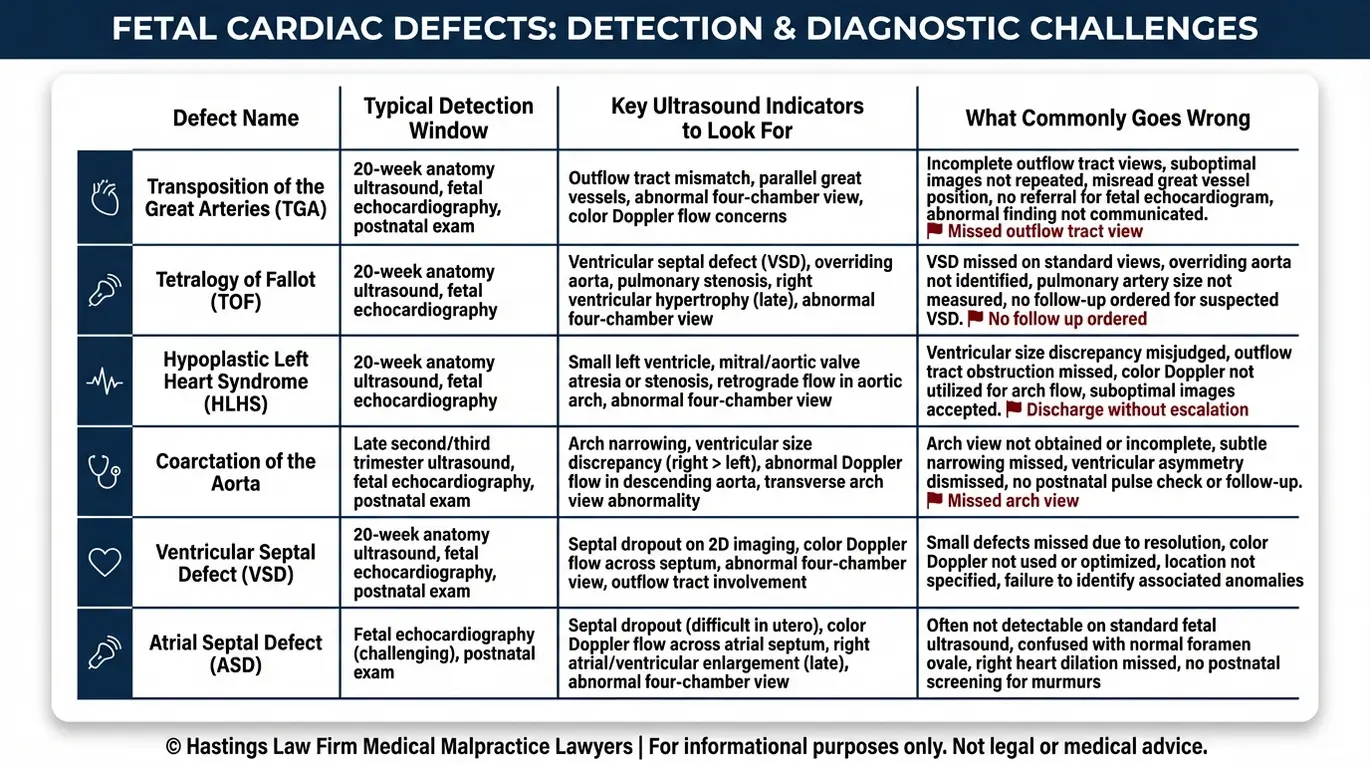
Some defects carry greater risk when missed. Transposition of the great arteries, a condition where the two main arteries leaving the heart are reversed, often requires urgent intervention within hours of birth. Hypoplastic left heart syndrome, where the left side of the heart is critically underdeveloped, is fatal without a series of staged surgeries. A ventricular septal defect (VSD), a hole between the heart’s lower chambers, and tetralogy of Fallot, a combination of four structural abnormalities, can also cause serious complications if detection is delayed.
Many of these defects are identifiable during the 20-week anatomy ultrasound, a detailed scan performed around the midpoint of pregnancy to evaluate fetal development. The American Society of Echocardiography’s guidelines for fetal echocardiography describe specific imaging views that can reveal these abnormalities. When a sonographer fails to capture or correctly interpret those views, including the four-chamber view, which shows all four heart chambers in a single image, critical findings can be missed entirely.
For families working with an infant heart defect diagnosis lawyer, investigating a failure to diagnose is an important first step.
| Defect Name | Typical Detection Window | Key Ultrasound Indicators |
|---|---|---|
| Transposition of the Great Arteries | 18–22 weeks (anatomy scan) | Abnormal outflow tract views; parallel great vessels |
| Hypoplastic Left Heart Syndrome | 18–22 weeks (anatomy scan) | Asymmetric four-chamber view; small or absent left ventricle |
| Tetralogy of Fallot | 18–22 weeks (anatomy scan) | Overriding aorta; ventricular septal defect on four-chamber view |
| Ventricular Septal Defect (VSD) | 18–22 weeks or postnatally | Visible gap in ventricular septum; abnormal Doppler flow |
| Coarctation of the Aorta | Often missed prenatally; postnatal signs | Size discrepancy between ventricles; abnormal aortic arch view |
Standard of Care for Prenatal and Newborn Screening Protocols
The standard of care requires obstetricians and sonographers to visualize specific views of the fetal heart during the anatomy scan and mandates pediatricians perform pulse oximetry screening on all newborns before discharge. These screening protocols are standard medical guidelines that doctors must follow to ensure patient safety and detect life-threatening conditions.
During the prenatal ultrasound (20-week anatomy scan), protocols require imaging the outflow tracts to show how blood exits the heart. When abnormal or incomplete images are obtained, the standard of care generally requires a referral to a maternal-fetal medicine specialist for fetal echocardiography. This is a specialized ultrasound of the baby’s heart that uses advanced imaging and Doppler technology to assess blood flow patterns. A study published in PubMed Central on prenatal detection rates of critical congenital heart disease highlights that detection still falls short of where it should be, particularly when referral pathways break down.
After birth, Texas law mandates that hospitals screen every newborn for critical congenital heart disease (CCHD), a group of severe heart defects that require surgery or catheter intervention within the first year of life. The Texas Department of State Health Services CCHD screening rules outline the specific protocols hospitals must follow.
A Texas infant congenital heart disease diagnosis failure lawyer examines whether the following protocols were properly carried out:
- Imaging: Obtaining clear outflow tract views during the prenatal ultrasound.
- Referral: Sending patients for fetal echocardiography if views are suboptimal.
- Screening: Conducting pulse oximetry to detect low oxygen levels or cyanosis.
Physiological Changes at Birth and Rapid Deterioration
Understanding why timing matters so much requires a basic understanding of the newborn circulatory system. Before birth, a small blood vessel called the patent ductus arteriosus (PDA) allows blood to bypass the lungs because the baby receives oxygen through the placenta. Within hours or days after delivery, this vessel naturally closes.
For babies with a ductal-dependent congenital heart defect, a type of heart defect that relies on the PDA to maintain blood flow, the closure of this vessel can trigger rapid deterioration. Oxygen levels may plummet, leading to hypoxemia, cyanosis (a bluish discoloration of the skin), and respiratory distress. If the defect was not diagnosed before birth, the medical team may not be prepared for this emergency, and the window for life-saving intervention narrows quickly.
The Hastings Law Firm Difference
Results matter, but what truly sets us apart is how we achieve them. Every verdict, every settlement, and every Texas courtroom victory comes from one guiding promise: To treat each client’s fight for justice as if it were our own.
This balance of skill, experience, and empathy reflects our core philosophy that justice should not only compensate the injured, but also make healthcare safer nationwide.

Identifying Liability in Cases of Delayed Diagnosis
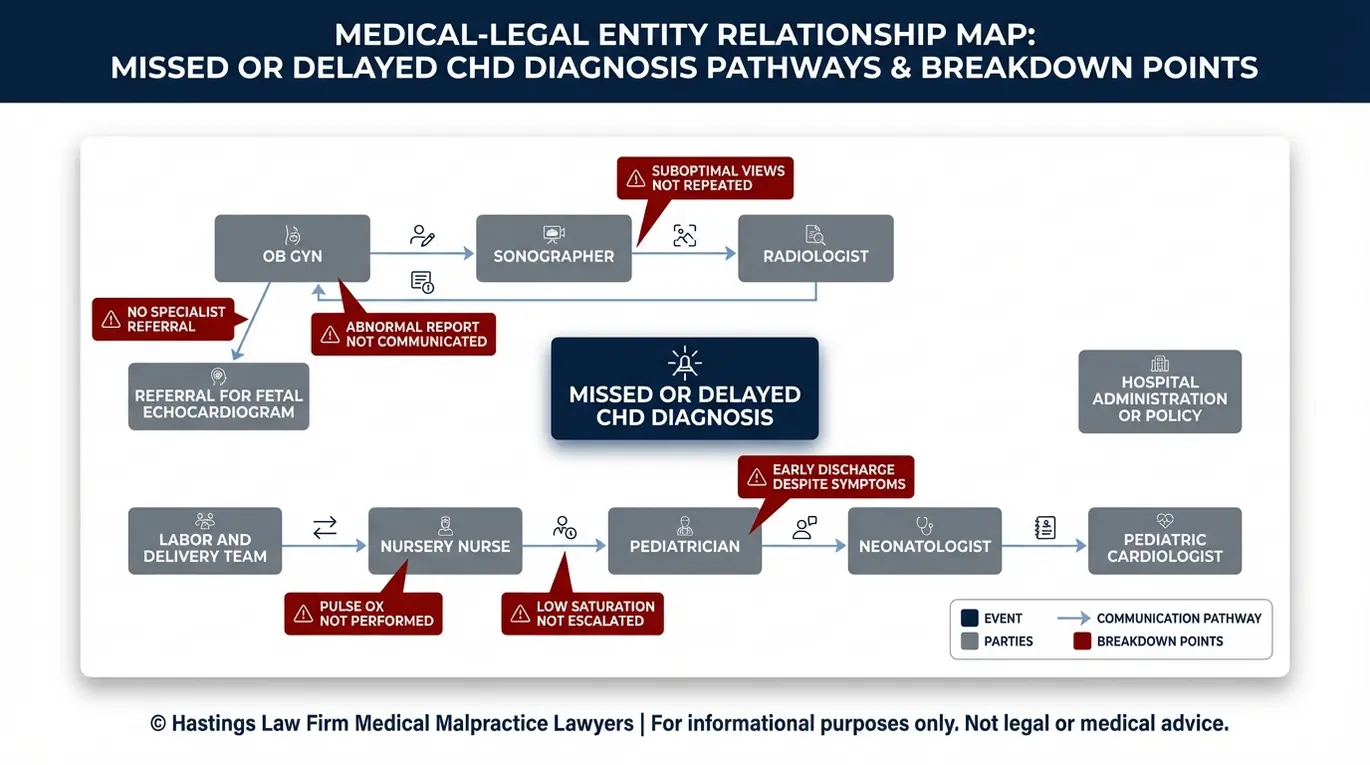
Liability for a missed heart defect often extends beyond the OBGYN to include radiologists who misread ultrasounds, sonographers who failed to capture required images, or pediatricians who dismissed signs of respiratory distress. In a medical malpractice case, we evaluate whether healthcare providers followed established standards.
Potential liable parties in these cases include:
- Sonographers and radiologists who did not obtain or correctly interpret the standard outflow tract views (LVOT/RVOT), which are the left and right ventricular outflow tracts that show blood leaving the heart
- Obstetricians who received a report noting “suboptimal” or incomplete cardiac views but failed to order follow-up testing or a fetal echocardiogram
- Pediatricians, pediatric cardiologists, or neonatologists who dismissed a heart murmur, abnormal pulse oximetry screening results (which indicate compromised oxygenation), or visible cyanosis as a normal part of the newborn transition period
- Hospital negligence may involve facilities that failed to follow mandated CCHD screening protocols or discharged the infant before completing required testing
Each handoff between providers creates an opportunity for critical information to be lost. Our investigation traces the full timeline from prenatal imaging through hospital discharge to identify liability for injury or wrongful death.
Recoverable Damages and Future Care Costs in Texas
Texas law allows parents to recover compensation for past and future medical expenses, pain and suffering, physical impairment, and in tragic cases, wrongful death damages. Because children with congenital heart disease often require long-term care, the financial stakes in these cases are significant.
In a lawsuit involving a misdiagnosed heart defect, a child born with an undiagnosed complex condition may need multiple open-heart surgeries to survive. These include procedures like the Fontan procedure, a surgery that redirects blood flow in children born with a single functioning ventricle. Research published in Frontiers in Surgery on surgical healthcare for infants with congenital anomalies in Texas documents the increasing demand for these interventions. Ongoing cardiology visits, medications, developmental therapy, and potential future surgeries add up to substantial future medical costs.
Texas recognizes separate categories of recoverable damages:
Economic Damages (No Cap)
- Past and future medical bills, including surgeries, hospitalizations, and medications
- Future care costs outlined in a life care plan
- Lost earning capacity if the child’s condition limits future employment
Non-Economic Damages (Capped)
- The child’s physical pain and suffering
- The child’s physical impairment and disfigurement
- Parental claims for mental anguish and loss of companionship
If the diagnostic failure resulted in the child’s death, parents may pursue a wrongful death claim. A Texas heart defect malpractice attorney can help identify which claims apply to your family’s situation and work with medical economists and life care planners to establish the full scope of damages.
How We Investigate Failure to Diagnose Heart Defects
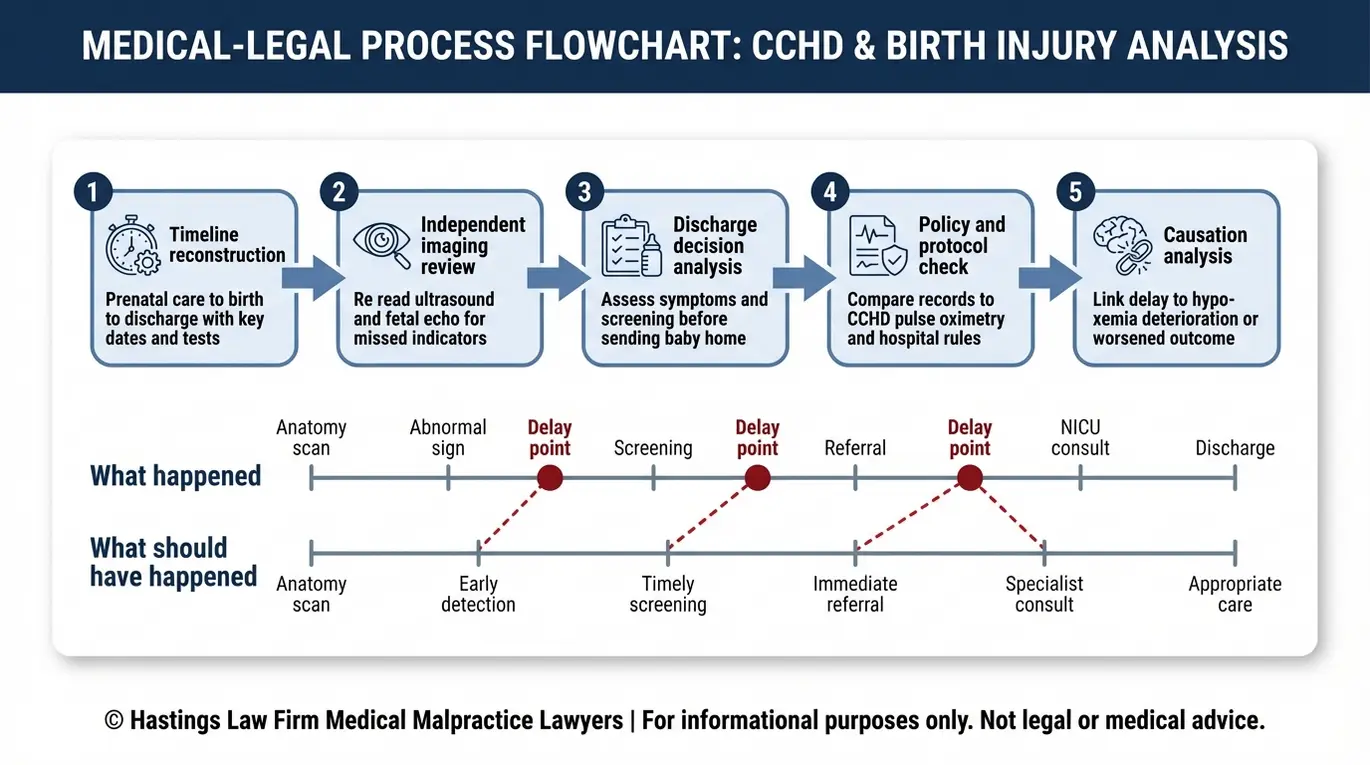
Our investigation involves a forensic review of prenatal ultrasound images by independent experts to prove the defect was visible and should have been detected before birth. Our founder, Tommy Hastings, is board-certified in Personal Injury Trial Law by the Texas Board of Legal Specialization, a distinction held by fewer than 2% of Texas attorneys.
Our process follows five key steps:
- Timeline reconstruction: We map every prenatal visit, ultrasound, lab result, and clinical note from pregnancy through hospital discharge to identify gaps in care.
- Expert re-read of ultrasound images: We retain a qualified expert witness to independently review the original imaging and determine whether the defect was detectable at the time.
- Discharge decision analysis: We evaluate whether the hospital sent the baby home before completing required screenings or while symptoms were still present.
- Hospital policy review: We compare what happened against the facility’s own protocols and Texas CCHD screening mandates.
- Causation analysis: Our team assesses whether earlier detection would have changed the outcome, gathering the evidence needed to prove that intervention could have prevented the harm.
This structured approach allows us to build a clear case that connects the missed diagnosis directly to the harm your child suffered.
Contact the Texas Birth Injury Attorneys at Hastings Law Firm Today for Help
No amount of money can undo what your family has been through, but compensation can help fund the lifelong cardiac care your child needs and hold the responsible parties accountable. Hastings Law Firm focuses exclusively on medical negligence. Our team of attorneys, nurse consultants, and former defense lawyers is ready to examine what happened and pursue the truth on your family’s behalf.
There are no upfront fees or costs. We only get paid if we recover compensation for you. Contact us today for a free case evaluation to understand your legal options.
Frequently Asked Questions About Infant Congenital Heart Disease Misdiagnosis in Texas


This content was researched and written by the Hastings Law Firm editorial team, which includes attorneys, medical professionals, and experienced researchers. Our writing is informed by internal knowledge and practical experience, and we cross-check critical details against authoritative sources cited throughout. Every piece undergoes human-led fact-checking and legal review. Because legal and medical information can change, if you spot an error, please contact us. Learn more about our content standards and review process on our editorial policy page.

Tommy Hastings, founder of Hastings Law Firm, is a board-certified personal injury trial lawyer dedicated exclusively to healthcare injury cases. Since 2001, he has represented injured patients and families in litigation against major hospital systems, pharmaceutical companies, and negligent healthcare providers nationwide. He has handled numerous high-profile cases that have drawn national media attention and resulted in multi-million dollar recoveries. He draws on that experience in his writing, helping readers understand how these cases work and what options may be available to them.
