


Texas Maternal Hypotension Epidural Error Lawyer
Written by: Hastings Law Firm | Reviewed by: Tommy Hastings | Updated: July 27, 2026
Maternal hypotension after an epidural is a known risk during labor, but serious harm can follow when blood pressure is not monitored closely or treated promptly. A preventable drop in maternal blood pressure can reduce placental blood flow, trigger fetal distress, and lead to permanent neurological injury or worse. The discussion also highlights how fever during labor may compound risk when it occurs alongside hypotension. Clear documentation and careful review of anesthesia and fetal monitoring records often shape how these events are understood. If you or a loved one were harmed or worse due to a maternal hypotension epidural error in Texas, contact Hastings Law Firm for a free, confidential case review.

Top Rated Malpractice Attorneys for Birth-Related Injuries in Texas
What You Should Know About Labor Anesthesia Low Blood Pressure Claims in Texas:
- Permanent brain injury or stillbirth can follow unmanaged maternal hypotension because reduced placental blood flow can deprive a baby of oxygen.
- Long term disability can result when fetal distress is not addressed promptly, since prolonged oxygen loss is linked to hypoxic ischemic encephalopathy and cerebral palsy.
- Medical negligence concerns can arise when monitoring and rapid treatment are not provided, because a blood pressure drop after an epidural is expected but still requires timely response.
- Liability disputes often turn on whether the anesthesia team had appropriate medications and equipment ready, since delayed use of vasopressors can be alleged as a cause of harm.
- Hospital responsibility can be implicated when staffing, monitoring equipment, or protocols are inadequate, because systemic failures can contribute to missed warning signs.
- Recovery options can be limited by caps on non economic damages in Texas, even when economic losses like medical care and lost earning capacity are substantial.
- Military hospital claims can follow a different path, because anesthesia errors at on base facilities fall under the Federal Tort Claims Act.
- Case outcomes can hinge on the completeness of medical records, since anesthesia logs, nursing flow sheets, and fetal monitoring strips are used to reconstruct what happened.
- Causation is often contested, because defenses may attribute injury to unavoidable complications or genetic causes rather than hypotension.
- The risk picture can worsen when maternal fever occurs alongside hypotension, because the combination is described as increasing the risk of neonatal brain injury.

A Healthcare Focused Law Firm
If your family experienced a serious complication during labor linked to an epidural, you are not alone, and what you are feeling right now is valid. A sudden drop in a mother’s blood pressure during delivery can set off a chain of events that no family should have to face. When that drop was preventable and the medical team failed to respond, it may be more than a complication; it may be medical negligence.
At Hastings Law Firm, our team of attorneys, nurse consultants, and medical staff focuses exclusively on medical malpractice. We understand both the medical science and the legal standards involved in these cases. As a Texas maternal hypotension epidural error lawyer, founder Tommy Hastings has spent over two decades holding negligent providers accountable for preventable birth injuries. He is Board Certified in Personal Injury Trial Law by the Texas Board of Legal Specialization, a distinction achieved by less than 2% of Texas attorneys.
If you believe something went wrong during your delivery, we can review what happened and explain your options during a free, confidential consultation.
Understanding Maternal Hypotension and Epidural Anesthesia Errors
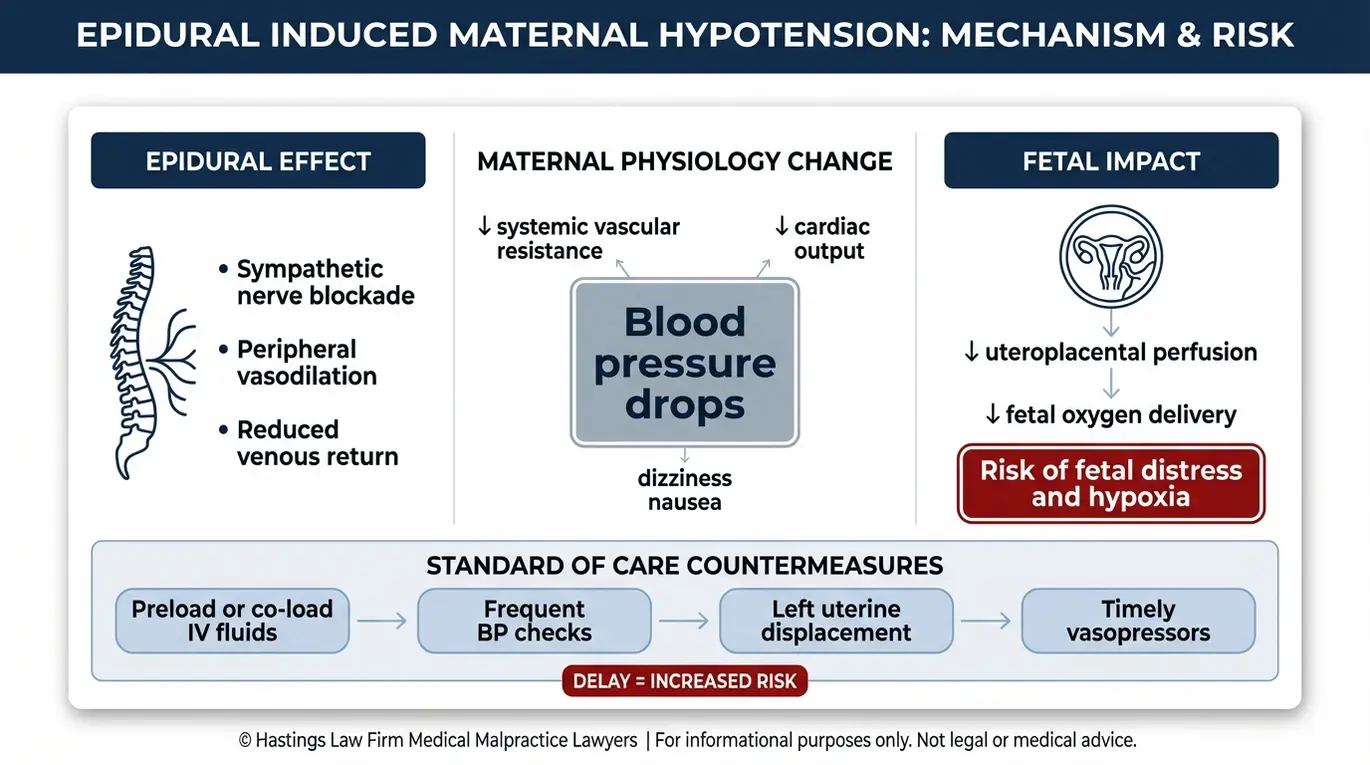
Maternal hypotension, a dangerous drop in a mother’s blood pressure, is one of the most common and well-known side effects of epidural anesthesia, the regional pain block routinely administered during labor. When an epidural is placed, the medication blocks sympathetic nerves that help regulate blood vessel tone. This causes blood vessels to dilate, which can lead to a rapid fall in blood pressure. If not corrected quickly with fluids or medication, that drop restricts blood flow to the placenta and can deprive the baby of oxygen, potentially causing permanent brain injury.
Here is how the process typically unfolds:
- The epidural medication numbs pain signals but also blocks the nerves controlling blood vessel constriction.
- Blood vessels widen, causing blood to pool in the lower extremities and reducing the volume returning to the heart.
- Cardiac output drops, and blood pressure falls.
- Reduced blood pressure means less blood reaches the placenta, cutting off the baby’s primary oxygen supply.
- Without rapid correction, the baby can experience prolonged oxygen deprivation and lasting harm.
The medical community has long recognized this risk. The Association of Anaesthetists’ international consensus statement on managing hypotension with vasopressors during caesarean section outlines clear protocols for prevention and treatment. The standard of care, meaning the level of treatment a reasonably competent anesthesiologist would provide under similar circumstances, typically requires pre-loading the mother with IV fluids before the epidural is placed and continuously monitoring her blood pressure afterward.
This process, often called “coloading” or “preloading,” is critical because it boosts blood volume to counteract the impending vasodilation. When medical providers skip this step or ignore dropping numbers, they endanger the lives of both patients.
A drop in blood pressure after an epidural is a known side effect. That alone is not malpractice. The line between a recognized risk and medical negligence is crossed when the anesthesia team fails to monitor for the drop, fails to respond promptly, or fails to have the proper medications and equipment ready. Under Texas Civil Practice and Remedies Code Chapter 74, a maternal hypotension lawyer must demonstrate that this failure to monitor or respond fell below accepted medical standards and directly caused harm to the mother or baby.
Our team, which includes in-house nurses and former defense attorneys, examines anesthesia records, nursing flow sheets, and fetal monitoring strips to determine whether the standard of care was met. An experienced epidural error attorney knows how to investigate these specific failures to see if critical warning signs were missed. Families handling anesthesia malpractice Texas laws often face complex medical arguments, requiring legal counsel who can confidently challenge hospital defenses.
How Unmanaged Hypotension Leads to Severe Birth Injuries
When a mother’s blood pressure drops significantly and stays low, uteroplacental perfusion, the flow of blood through the placenta, decreases. This reduction triggers fetal distress and oxygen deprivation. Prolonged oxygen loss can result in hypoxic-ischemic encephalopathy (HIE), a type of brain damage caused by lack of blood flow and oxygen, cerebral palsy, or fatal organ failure. What should be a routine delivery can become a medical emergency requiring immediate intervention.
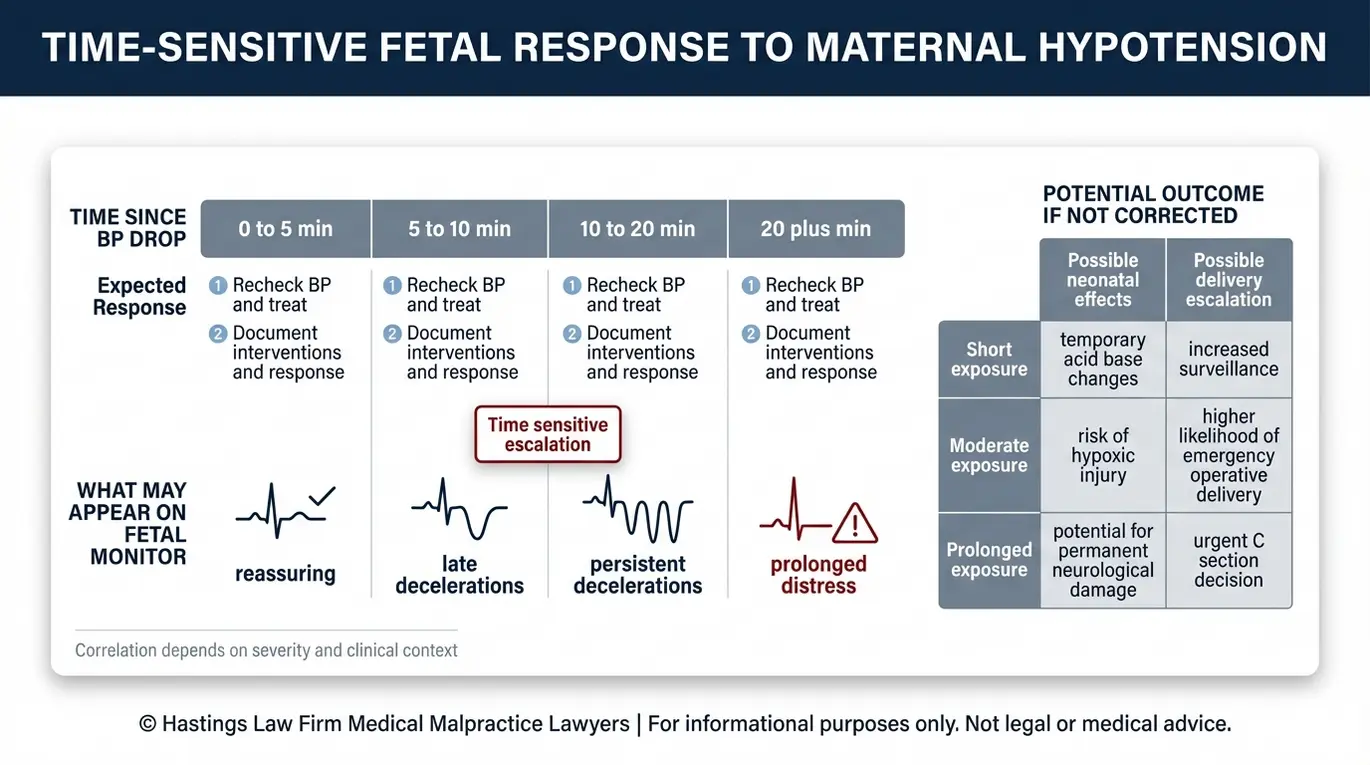
The connection between maternal blood pressure and fetal well-being is direct. The baby depends entirely on the placenta for oxygen, which functions through a pressure gradient. When the mother’s blood pressure falls, the placenta cannot deliver enough oxygenated blood against that gradient. Fetal heart rate monitoring often reveals the earliest warning signs, including late decelerations, which are drops in the baby’s heart rate that occur after a contraction peaks.
According to the National Center for Biotechnology Information (NCBI) overview of late decelerations, these patterns indicate reduced placental blood flow and require prompt clinical action. Proving maternal hypotension negligence involves showing that the medical team ignored these clear distress signals.
The longer hypotension persists without correction, the greater the risk of permanent injury. As the table below illustrates, the window for correcting hypotension is narrow, and the danger escalates rapidly:
| Duration of Unmanaged Hypotension | Potential Fetal/Neonatal Outcome |
|---|---|
| Brief (under 2 minutes, quickly corrected) | Typically recoverable with minimal risk |
| Moderate (2 to 10 minutes without intervention) | Fetal heart rate decelerations, increasing distress |
| Prolonged (over 10 minutes) | Risk of HIE, cerebral palsy, organ damage |
| Severe and sustained | Permanent neurological injury or stillbirth |
When fetal heart monitoring shows persistent late decelerations and the anesthesia team has not corrected the mother’s blood pressure, the obstetric team faces a critical decision about emergency delivery. A delayed C-section in this context can mean the difference between a healthy outcome and a lifetime of neurological disability. HIE is particularly devastating because it affects the entire brain.
The severity depends on the depth and duration of the hypotension. Even a few minutes of critically low blood pressure can alter a child’s future permanently. An epidural malpractice attorney can help families determine if the delay in delivery was the primary cause of the injury.
These severe birth injuries are life-altering. Families facing these outcomes should consult a Texas birth injury lawyer to understand their rights and evaluate whether the medical team failed to protect their child.
The Link Between Epidural Induced Fever and Brain Injury
Epidural anesthesia can also cause epidural-associated maternal fever, also known as intrapartum fever. This is an elevation in the mother’s temperature during labor that is not caused by infection. Medical research suggests that when this fever occurs alongside hypotension, the two conditions can act together to create a dangerous synergy that increases the risk of neonatal brain injury.
A baby already experiencing fetal hypoxia, or oxygen deprivation, is especially vulnerable to the added stress of elevated maternal temperature. The combination can worsen inflammation in the baby’s brain and amplify the damage caused by reduced oxygen supply. This connection is important because it explains how two different side effects of anesthesia can combine to cause severe harm.
This is one reason our medical team reviews temperature logs alongside blood pressure records and fetal heart tracings. Identifying whether both conditions were present, and whether either was properly managed, can be central to establishing what went wrong.
The Hastings Law Firm Difference
Results matter, but what truly sets us apart is how we achieve them. Every verdict, every settlement, and every Texas courtroom victory comes from one guiding promise: To treat each client’s fight for justice as if it were our own.
This balance of skill, experience, and empathy reflects our core philosophy that justice should not only compensate the injured, but also make healthcare safer nationwide.

Proving Liability Against Anesthesiologists and Hospitals
Establishing liability requires proving that the anesthesia provider committed a breach of duty regarding the standard of care by failing to monitor vital signs or administer vasopressors, medications such as phenylephrine or ephedrine used to raise blood pressure, in a timely manner. It also requires demonstrating causation: that the injury was directly caused by this delay rather than by natural complications of childbirth.
Building this proof starts with the medical records. Our team works with qualified expert witnesses to reconstruct the timeline of care, minute by minute. We examine when the epidural was placed and whether an IV fluid bolus was administered. A fluid bolus is a rapid infusion of fluids, also known as preloading or coloading, given to maintain blood volume.
We look at how frequently blood pressure was checked and how quickly the team responded to any drop. The Harris County Medical Society’s guidance on medical records underscores the importance of complete and accurate documentation in these cases. Expert review is non-negotiable.
Defense attorneys will often argue that the drop in blood pressure was unavoidable or that the baby’s injury had a genetic cause. Our experts counter these narratives with data from the medical record itself. This identifies where critical warning signs were missed and constituted medical negligence.
Several parties may bear responsibility in a maternal hypotension case. A Texas maternal hypotension lawyer will identify each liable party, which may include:
- The anesthesiologist: for dosage errors, failure to pre-load fluids, or failure to remain available to manage complications after placing the epidural. The process of suing an anesthesiologist requires precise evidence of their specific role and failures.
- The hospital or birth center: for inadequate staffing levels, lack of functioning monitoring equipment, or failure to maintain proper protocols. Systemic failures can also support a claim of hospital negligence Texas statutes recognize.
- Nursing staff: for failing to recognize and report dropping blood pressure trends to the physician in time.
Our former defense attorneys know how hospitals and their insurers build their cases. That insider perspective allows us to anticipate arguments and build stronger evidence from the start.
Federal Tort Claims Act for Military Hospitals
Texas is home to several large military installations with on-base medical facilities. Families who experience anesthesia errors at a military hospital face a different legal process. These cases, involving military medical malpractice, fall under the Federal Tort Claims Act (FTCA), not standard Texas state law.
The FTCA requires an administrative claim to be filed with the appropriate federal agency before a lawsuit can proceed in federal court. The timelines and procedural requirements differ from civilian medical malpractice claims. This makes experienced legal counsel especially important for military families.
Recoverable Damages for Families Affected by Anesthesia Errors
Texas law allows families to recover economic damages for past and future medical care, lost earning capacity, and specialized therapy. Non-economic damages for pain, suffering, and physical impairment are also available. In cases involving gross negligence, punitive damages may be pursued as well. Securing full compensation for birth injury claims is essential for the child’s future.
The financial impact of a preventable birth injury can be staggering. Research published through the National Institutes of Health on the economic costs of childhood disability documents the long-term financial burden families face when a child requires lifelong care. A child diagnosed with cerebral palsy or HIE may need decades of physical therapy, occupational therapy, specialized education, adaptive equipment, and around-the-clock attendant care. Calculating medical malpractice damages involves projecting costs over a lifetime, often with the help of financial experts.
Economic damages may include:
- Past and future medical expenses, including surgeries, hospitalizations, and medications
- Rehabilitation and therapy costs
- Home modifications and adaptive equipment
- Lost earning capacity for the child
- Lost wages for a parent who must leave work to provide care
Non-economic damages may include:
- Physical pain and suffering
- Mental anguish and emotional distress
- Loss of enjoyment of life
- Physical impairment and disfigurement
If the mother suffered direct harm, such as nerve damage or complications from unmanaged hypotension, her own losses are recoverable separately.
A life care planner often works alongside our legal team to calculate the full scope of future needs. This professional creates a detailed, evidence-based projection of every medical service, therapy, and support the injured child will require over a lifetime. Families often underestimate the cost of future care.
Inflation in the healthcare sector typically outpaces general inflation, making early settlements dangerous if they are not calculated correctly. We ensure every potential expense, from diaper changes for an adult child to specialized communication devices, is accounted for. This ensures that any epidural error settlement or verdict covers the true cost of the injury.
The Texas Medical Malpractice Litigation Process
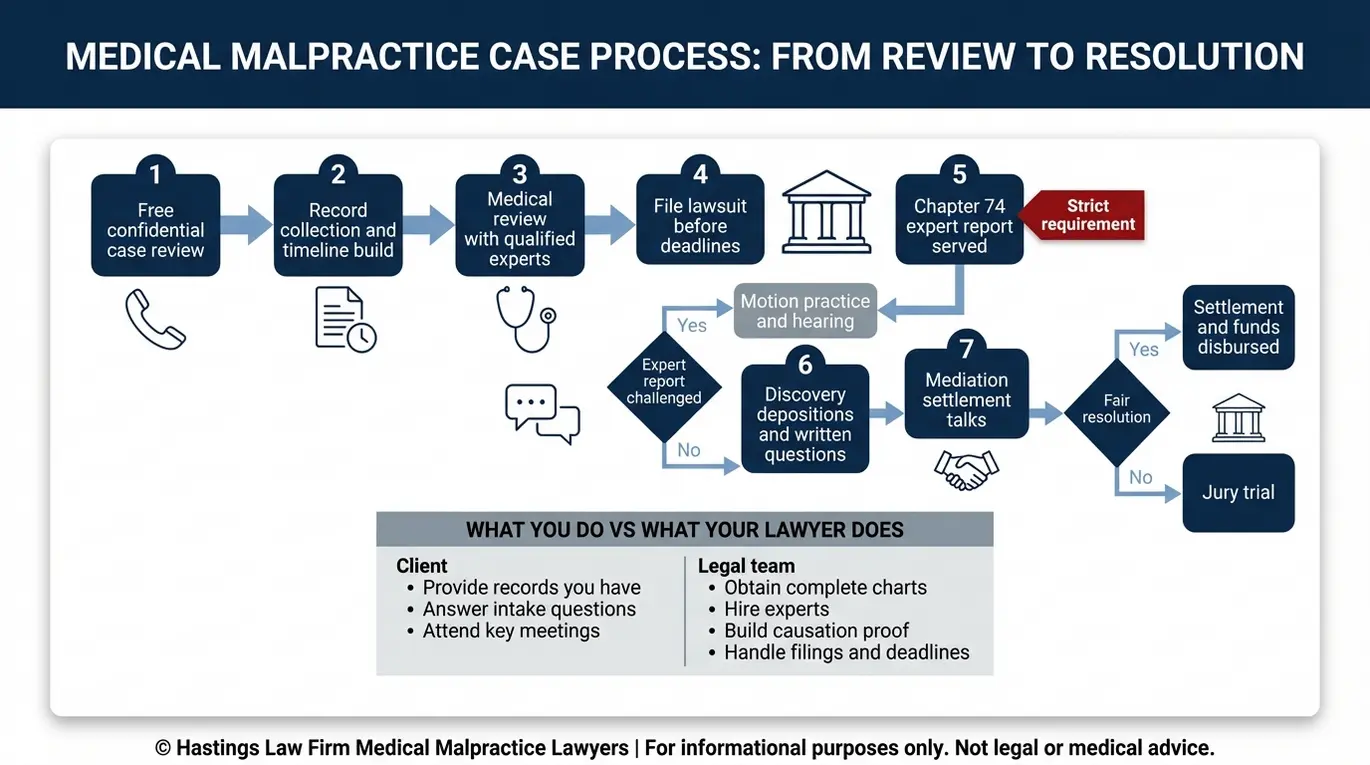
The litigation process in Texas begins with a thorough investigation and requires an expert report to be served within 120 days after each defendant’s original answer is filed. The case then moves through discovery, depositions, and scrutiny of the medical records, typically concluding with mediation or a jury trial if a fair settlement cannot be reached. Understanding the medical malpractice lawsuit process helps alleviate anxiety during a difficult time.
Here is how the process typically works, step by step:
- Free case evaluation. A patient advocate at our firm conducts a confidential screening to determine whether the facts suggest a viable claim. There is no cost and no obligation.
- Medical investigation. Once we accept a case, our in-house nursing staff and outside medical experts conduct a detailed review of delivery records. We examine anesthesia logs, fetal monitoring strips, and hospital protocols to identify where the standard of care may have been breached.
- Filing the lawsuit and the Chapter 74 expert report. Texas law imposes strict requirements under Civil Practice and Remedies Code Chapter 74. A qualified expert must provide a written report supporting the claims within 120 days after each defendant’s original answer is filed. Missing this deadline can result in dismissal. Your Texas epidural error lawyer manages these deadlines to ensure compliance.
- Discovery and depositions. Both sides exchange documents and take sworn testimony from the medical providers, experts, and family members involved.
- Mediation or trial. Many cases resolve through negotiated settlement during mediation. If a fair resolution is not offered, we are prepared to take the case to a jury. Every case at Hastings Law Firm is prepared for trial from the first day we accept it. That preparation strengthens our position at every stage, including settlement negotiations.
The statute of limitations for medical malpractice in Texas is generally two years, but exceptions may apply when the injured patient is a minor. Acting quickly helps preserve critical evidence, including electronic fetal monitoring data that hospitals may not retain indefinitely, before filing a birth injury claim.
Contact the Texas Birth Injury Attorneys at Hastings Law Firm Today for Help
Maternal hypotension during delivery is a known, well-documented risk, and the medical protocols for preventing and treating it are clear. When those protocols are not followed and a child is harmed as a result, families deserve honest answers about what happened and why.
Tommy Hastings founded this firm on the belief that accountability is the only path to prevention. Our team of board-certified attorneys, former defense counsel, and in-house medical professionals is built specifically to handle complex birth injury cases across Texas and nationwide.
If you or someone in your family experienced a serious complication that may have been caused by an epidural error, contact Hastings Law Firm for a free, confidential case evaluation. You pay no fees unless we recover compensation on your behalf. Call us or reach out online to take the first step toward getting the answers your family deserves.
Frequently Asked Questions About Maternal Hypotension Epidural Error in Texas


This content was researched and written by the Hastings Law Firm editorial team, which includes attorneys, medical professionals, and experienced researchers. Our writing is informed by internal knowledge and practical experience, and we cross-check critical details against authoritative sources cited throughout. Every piece undergoes human-led fact-checking and legal review. Because legal and medical information can change, if you spot an error, please contact us. Learn more about our content standards and review process on our editorial policy page.

Tommy Hastings, founder of Hastings Law Firm, is a board-certified personal injury trial lawyer dedicated exclusively to healthcare injury cases. Since 2001, he has represented injured patients and families in litigation against major hospital systems, pharmaceutical companies, and negligent healthcare providers nationwide. He has handled numerous high-profile cases that have drawn national media attention and resulted in multi-million dollar recoveries. He draws on that experience in his writing, helping readers understand how these cases work and what options may be available to them.
