


Texas Pitocin Overuse Malpractice Lawyer
Written by: Hastings Law Firm | Reviewed by: Tommy Hastings | Updated: July 27, 2026
Pitocin is a high alert medication used to induce or strengthen labor, and errors in dosing or monitoring can lead to uterine hyperstimulation that reduces oxygen to the baby. Families may struggle to understand what happened when records are complex and communication is limited. Common concerns include delayed response to fetal distress, failure to stop Pitocin, gaps in monitoring, and delays in emergency delivery, which can result in permanent injury and other severe outcomes. If you or a loved one were harmed or worse due to Pitocin overuse malpractice in Texas, contact Hastings Law Firm for a free, confidential case review.

Representing Texas Families Impacted by Preventable Birth Injuries
What You Should Know About Oxtocin-Induced Labor Injury Claims in Texas:
- Permanent brain injury and other catastrophic outcomes can follow Pitocin overuse when contractions become too frequent for fetal recovery.
- Options for recovery can be limited in Texas because non economic damages in medical malpractice cases are capped.
- Severe maternal and fetal outcomes can occur when hyperstimulation leads to uterine rupture, hemorrhage, or fetal or maternal death.
- Accountability can extend beyond one clinician because nurses, physicians, and hospitals may share responsibility when communication failures or understaffing contribute to delayed responses.
- Clarity about what went wrong can be hard to obtain because medical records and fetal monitoring data are technical and may be incomplete.
- A missed opportunity to prevent harm can occur when Pitocin is continued despite signs of fetal distress on monitoring.
- A preventable injury can worsen when emergency surgical delivery is delayed after clear signs of distress.
- A major dispute driver can be whether Pitocin dose increases were made before prior dosing reached full effect, increasing the risk of sudden hyperstimulation.
- Long term financial impact can be substantial because damages may include lifetime care needs supported by a life care plan.
- Objective documentation can be central because electronic fetal monitoring strips and medication administration records can show the timing of contractions, fetal heart rate changes, and dosing decisions.

A Healthcare Focused Law Firm
When a child suffers a birth injury linked to Pitocin, a synthetic form of oxytocin classified as a high-alert medication, families are often left searching for answers. This drug bears a heightened risk of causing significant patient harm when used in error. You may know something went wrong during labor and delivery, but the medical records, the clinical language, and the silence from the hospital can make the truth feel out of reach.
As a Texas Pitocin overuse malpractice lawyer, Hastings Law Firm focuses exclusively on medical malpractice. Our team includes in-house nurse consultants and former defense attorneys who know how to uncover what happened, why it happened, and who is responsible. If your child was harmed during a Pitocin-augmented delivery, we can review the medical records and explain your legal options in a free, confidential consultation.
Understanding Pitocin Risks and Uterine Hyperstimulation
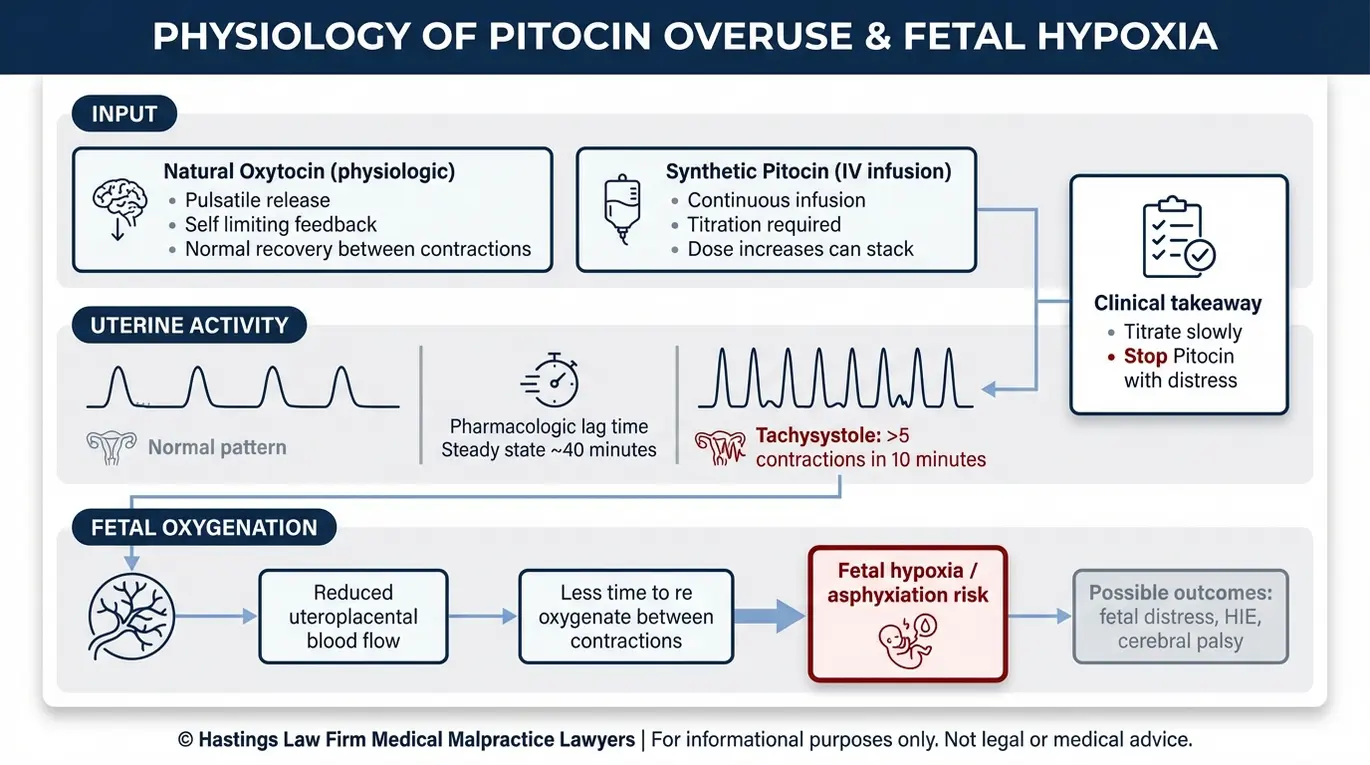
Pitocin is a high-alert medication that, when overused, causes uterine hyperstimulation (tachysystole), leading to contractions so frequent and intense that the fetus cannot recover adequate oxygen levels between them, resulting in hypoxia and permanent brain injury. The distinction between natural oxytocin and synthetic Pitocin matters.
Your body produces oxytocin in carefully regulated pulses during labor, with built-in feedback mechanisms that adjust contraction intensity. Pitocin, by contrast, is delivered through an IV drip and must be carefully titrated. Without careful adjustment, uterine contractions can quickly overwhelm both the mother and baby.
As a Pitocin malpractice attorney often explains to families, the danger lies in how the drug forces the uterus to contract without the body’s natural breaks. Uterine hyperstimulation is defined as more than five contractions in a ten-minute window.
When contractions stack this closely together, they compress the blood vessels supplying the placenta and restrict uteroplacental blood flow, or placental perfusion, the oxygen-rich circulation between the placenta and the fetus. The baby essentially experiences repeated episodes of asphyxiation with no recovery window between them. A lawyer for Pitocin errors in Texas can help investigate if these critical safety limits were ignored during your labor.
| Normal Labor | Hyperstimulated Labor (Tachysystole) | |
|---|---|---|
| Contraction Frequency | 2-5 contractions per 10 minutes | More than 5 contractions per 10 minutes |
| Rest Between Contractions | Adequate recovery time for the fetus | Little to no recovery time |
| Placental Blood Flow | Maintained between contractions | Repeatedly compromised |
| Fetal Oxygen Supply | Stable | Progressively reduced |
| Fetal Heart Rate Pattern | Reassuring, normal variability | Late decelerations, loss of variability |
The Danger of Pharmacologic Lag Time
One of the most common errors involves dosing too aggressively. Pitocin has a pharmacologic lag time. This means it takes approximately 40 minutes for any given dose to reach its full effect, called steady state. The drug builds in the system gradually, and its peak impact is delayed.
When a physician or nurse increases the Pitocin drip before the previous dose has fully taken effect, they create a significant dosing error risk by stacking doses. The result can be a sudden, uncontrollable surge in uterine activity that puts the baby at serious risk. Proper titrated dosing, the practice of making small, measured dose adjustments at safe intervals, is a baseline requirement of the standard of care. Legal counsel will examine the medication administration records closely to determine whether dosing protocols were followed or ignored.
Common Birth Injuries Caused by Pitocin Overuse
Excessive Pitocin administration can lead to catastrophic outcomes including Hypoxic-Ischemic Encephalopathy (HIE), Cerebral Palsy, uterine rupture requiring emergency hysterectomy, and in severe cases, fetal or maternal death.
HIE and Permanent Brain Damage. When the baby’s brain is deprived of oxygen during labor, it can result in HIE, a form of brain injury caused by reduced blood flow and oxygen to the brain around the time of birth. According to a study published through the National Library of Medicine on Perinatal Hypoxic-Ischemic Encephalopathy incidence, HIE remains a significant cause of neonatal neurological injury even in modern hospital settings. Children who survive HIE may face lifelong disabilities, including cerebral palsy, developmental delays, seizure disorders, and cognitive impairment.
Uterine Rurupture. Uterine rupture is the physical tearing of the uterine wall, often triggered by contractions that are too forceful or too frequent. This is a life-threatening emergency for both mother and baby. It can cause massive postpartum hemorrhage and, if not addressed within minutes, maternal death or permanent fetal injury.
Emergency C-Section Delays. When Pitocin-driven hyperstimulation causes fetal distress, a timely emergency C-section can prevent permanent harm. A Texas Pitocin injury lawyer will investigate whether the decision to move to surgical delivery was made promptly or whether delays allowed the injury to worsen. The failure to act on clear signs of distress is one of the most common forms of negligence in these cases. As malpractice counsel for oxytocin overdose cases, our team works with medical experts to determine exactly where the standard of care broke down.
The injuries linked to Pitocin overuse include:
- Hypoxic-ischemic encephalopathy (HIE)
- Cerebral palsy
- Uterine rupture
- Postpartum hemorrhage
- Delayed or failed emergency C-section
- Fetal death or stillbirth
- Maternal organ damage
The Hastings Law Firm Difference
Results matter, but what truly sets us apart is how we achieve them. Every verdict, every settlement, and every Texas courtroom victory comes from one guiding promise: To treat each client’s fight for justice as if it were our own.
This balance of skill, experience, and empathy reflects our core philosophy that justice should not only compensate the injured, but also make healthcare safer nationwide.

Signs of Negligence in Labor Induction and Monitoring
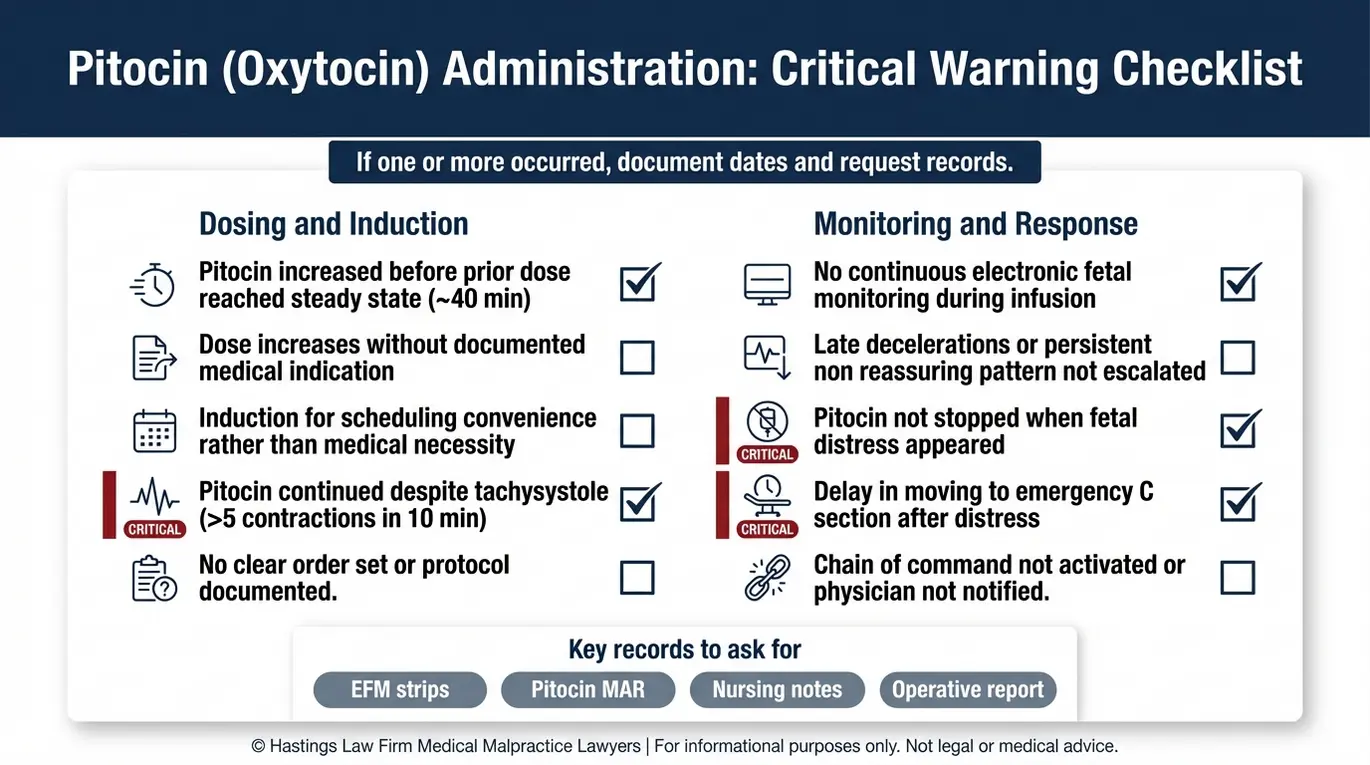
Medical negligence occurs when medical staff fail to discontinue Pitocin despite signs of fetal distress on the monitor, fail to follow dosing protocols, or induce labor for non-medical reasons such as scheduling convenience.
Inadequate Monitoring. During any Pitocin-augmented labor, the standard of care requires continuous electronic fetal monitoring (EFM), a system that tracks the baby’s heart rate in relation to the mother’s contractions in real time. The clinical guidelines published by the Washington University in St. Louis Department of Obstetrics and Gynecology on Intrapartum Fetal Heart Rate Monitoring outline how providers should interpret these tracings. One of the most critical patterns to watch for is late decelerations, a drop in the fetal heart rate that occurs after a contraction peaks. Late decelerations suggest the baby is not receiving enough oxygen and the placenta is under stress.
Failure to Stop Pitocin. The duty of care requires that Pitocin be discontinued immediately when signs of fetal distress or tachysystole appear on the monitor. Continuing the infusion after the strip shows non-reassuring patterns is a clear departure from accepted medical practice. A Texas Pitocin overuse malpractice lawyer will examine whether the nursing staff escalated concerns to the attending physician and whether the physician responded appropriately.
Induction Without Medical Necessity. Labor induction carries inherent risks, and those risks are only justified when there is a medical reason to proceed. When labor is induced for non-clinical reasons or scheduling convenience, the risk-benefit calculation shifts dramatically. If Pitocin was contraindicated, meaning the patient had a clinical condition that made its use unsafe, the decision to induce may itself constitute negligence.
An attorney for labor induction errors will look for these red flags in the medical records:
- Pitocin continued despite late decelerations or prolonged fetal heart rate drops
- Dose increases made more frequently than every 30-40 minutes
- No documented medical indication for induction
- Gaps in fetal monitoring strips or missing documentation
- Nursing notes that show concerns were raised but not addressed by the physician
- Failure to call for an emergency C-section when distress was apparent
If any of these patterns appear in your records, a Pitocin negligence lawyer can help determine whether they support a malpractice claim.
Proving Liability with Forensic Evidence
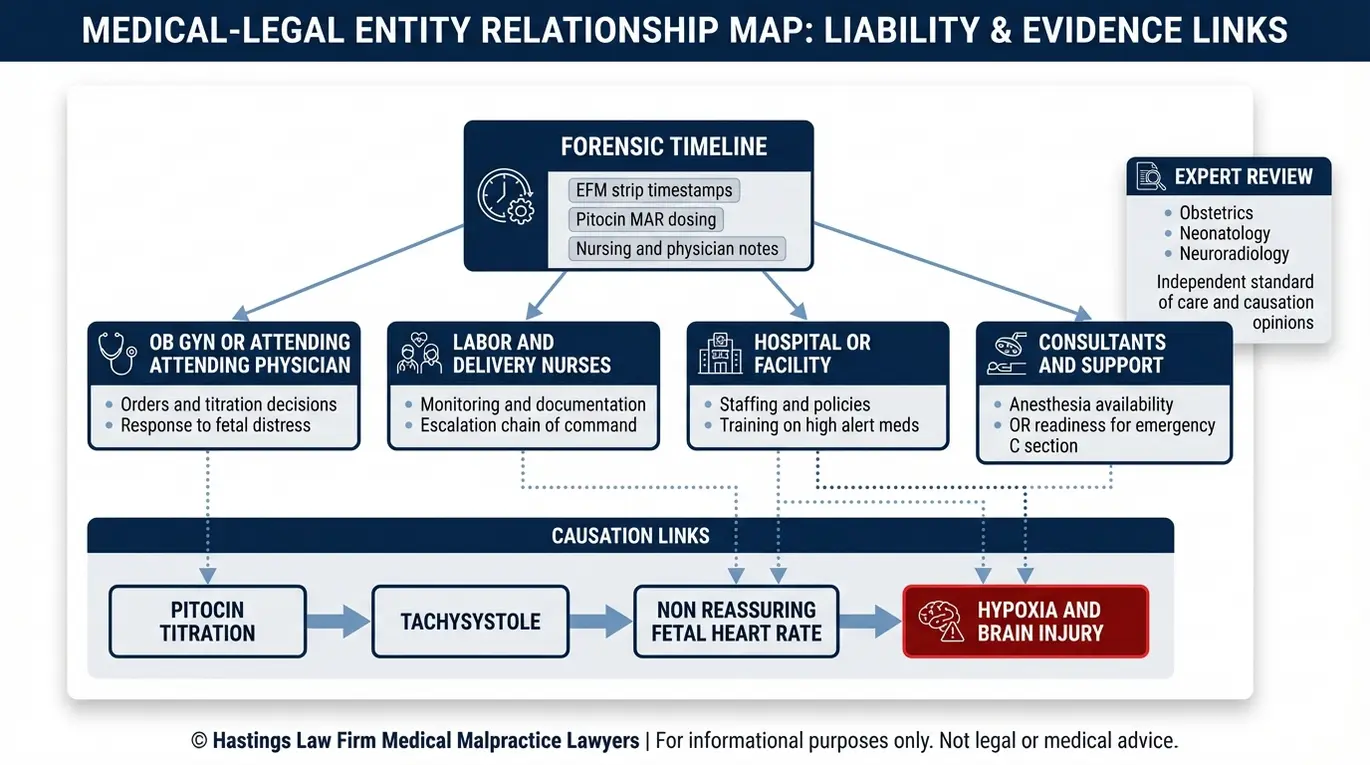
Proving liability requires a forensic analysis of the Electronic Fetal Monitoring (EFM) strips to demonstrate a clear timeline of distress that was ignored by the nursing staff or attending physician. These fetal monitoring records serve as an objective history of the birth process.
The EFM Strip as Evidence. The fetal monitoring strip functions much like a flight recorder. It captures a continuous, minute-by-minute record of the baby’s heart rate alongside the frequency and duration of the mother’s contractions. When properly preserved, this strip provides objective evidence of what the medical team knew, or should have known, and when they knew it. A Pitocin lawsuit attorney will work with medical experts to reconstruct the timeline and identify the point at which intervention should have occurred.
Chain of Command and Shared Liability. Liability in these cases rarely falls on one person alone. Labor and delivery nurses are often the first to observe concerning patterns on the monitor. When a nurse identifies signs of distress, the standard of care requires them to notify the attending physician.
If the physician does not respond, the nurse has a duty to escalate through the chain of command. We examine nursing logs and staffing records to identify nursing staff liability, especially where communication failures contributed to the injury. Hospital administration may also bear responsibility if understaffing contributed to delayed responses or gaps in monitoring.
Expert Testimony. Establishing causation, the direct link between the Pitocin mismanagement and the child’s injury, requires qualified expert witnesses. We work with board-certified neonatologists, maternal-fetal medicine specialists, and OB/GYN experts who can review the records and testify about what the standard of care required. Families also have the right to obtain their own medical records; the UAB Medicine Patient Request for Medical Records form is one example of how hospitals process these requests.
Calculating Damages and Future Care Costs
Damages in Pitocin cases cover past medical bills, pain and suffering, and most importantly, the lifetime cost of care for a disabled child, which is calculated using a comprehensive Life Care Plan.
Life Care Plans. A life care plan estimates every foreseeable expense associated with the child’s injury over the course of their lifetime. This may include future medical costs, physical, occupational, and speech therapy; specialized medical equipment such as wheelchairs and adaptive devices; 24-hour attendant care; medications; surgical interventions; and educational support. For a child with severe HIE or cerebral palsy, these costs can extend over 50 or more years and reach into the millions of dollars.
Non-Economic Damages. Beyond the financial costs, Texas law allows recovery for pain, suffering, mental anguish, physical impairment, and loss of enjoyment of life. We also evaluate lost earning capacity if the child’s disability will prevent them from working in the future. These damages recognize that the harm extends far beyond hospital bills.
Why Full Compensation Matters. A Texas Pitocin overuse malpractice lawyer understands that a settlement or verdict is not about a number on paper. It is about ensuring that your child has the resources to receive proper care for the rest of their life. Securing a multi-million dollar verdict or settlement is often necessary to provide the quality and continuity of care your child deserves without placing that financial burden on your family.
Contact the Texas Birth Injury Attorneys at Hastings Law Firm Today for Help
You do not have to face the hospital’s legal team on your own. Hastings Law Firm was built to stand with families in exactly this situation. Our legal team includes in-house medical professionals and former defense attorneys who understand how hospitals and insurers approach these cases, and we use that knowledge to protect your family’s interests.
Board-certified trial lawyer Tommy Hastings founded our firm to provide a voice for patients silenced by medical error. We handle every case on a contingency fee basis, which means you pay no attorney fees or costs unless we recover compensation for you. If your child suffered a birth injury that you believe was connected to Pitocin use during labor, we encourage you to reach out to our Texas office for a free, confidential case evaluation.
Call Hastings Law Firm today. Let us review what happened and help you understand your options.
Frequently Asked Questions About Pitocin Overuse Malpractice in Texas


This content was researched and written by the Hastings Law Firm editorial team, which includes attorneys, medical professionals, and experienced researchers. Our writing is informed by internal knowledge and practical experience, and we cross-check critical details against authoritative sources cited throughout. Every piece undergoes human-led fact-checking and legal review. Because legal and medical information can change, if you spot an error, please contact us. Learn more about our content standards and review process on our editorial policy page.

Tommy Hastings, founder of Hastings Law Firm, is a board-certified personal injury trial lawyer dedicated exclusively to healthcare injury cases. Since 2001, he has represented injured patients and families in litigation against major hospital systems, pharmaceutical companies, and negligent healthcare providers nationwide. He has handled numerous high-profile cases that have drawn national media attention and resulted in multi-million dollar recoveries. He draws on that experience in his writing, helping readers understand how these cases work and what options may be available to them.
