


Texas External Cephalic Version Complication Lawyer
Written by: Hastings Law Firm | Reviewed by: Tommy Hastings | Updated: July 27, 2026
External cephalic version is a manual fetal turning procedure intended to reduce the need for a cesarean delivery, but it can carry serious risks when safety protocols are not followed. The text describes concerns such as excessive force, missed contraindications, inadequate fetal heart rate monitoring, and delayed emergency response when distress appears. It also highlights how oxygen deprivation during complications can lead to permanent harm and long term care needs for a child. If you or a loved one were harmed or worse due to external cephalic version complications in Texas, contact Hastings Law Firm for a free, confidential case review.
Leading Texas Attorneys for Injuries Caused by Failed Fetal Turning Procedures
What You Should Know About Fetal Turning Injury Claims in Texas:
- Permanent newborn harm can follow an external cephalic version when complications interrupt oxygen supply.
- Severe maternal injury can occur when excessive force during the turning maneuver leads to uterine rupture and hemorrhaging.
- Options for accountability can narrow when an external cephalic version is attempted despite contraindications identified through prenatal testing and ultrasound.
- Preventable injury risk can rise when continuous fetal heart rate monitoring is not used before during and after the attempt.
- Outcomes can worsen when emergency intervention is delayed after severely abnormal fetal heart rate activity is detected.
- Disputes often focus on whether informed consent was obtained with clear warnings about major risks and the possibility of emergency surgery.
- Financial strain can be substantial when a child needs long term therapy assistive equipment home modifications or nursing care.
- Case clarity can depend on objective records such as fetal heart rate monitoring strips ultrasound reports nursing notes and consent forms.

A Healthcare Focused Law Firm
When a procedure meant to safely reposition your baby leads to harm instead, the confusion and fear that follow can be overwhelming. You trusted your medical team to protect both you and your child, and now you may be left with more questions than answers. If you or a loved one is dealing with injuries tied to an external cephalic version, you are not alone, and what happened deserves a thorough, honest review.
As a Texas External Cephalic Version complication lawyer, Hastings Law Firm focuses exclusively on medical malpractice. Led by board-certified trial lawyer Tommy Hastings, our team of trial attorneys and nurse consultants understands both the medicine and the law behind these cases. We can review what happened during your care, explain your legal options, and help you understand whether negligence may have played a role. Contact us for a free, confidential case evaluation.
Understanding External Cephalic Version and Its Risks
External Cephalic Version (ECV) is a manual procedure where a physician attempts to turn a breech fetus into a head-down position, but it carries serious risks including placental abruption and fetal distress if not performed with strict adherence to safety protocols. During the process, a physician applies pressure to the mother’s abdomen to move the baby from a feet-first or bottom-first position into one suitable for vaginal delivery. The goal is to avoid a planned cesarean section, but ECV carries real risks that require careful patient selection and strict safety protocols.
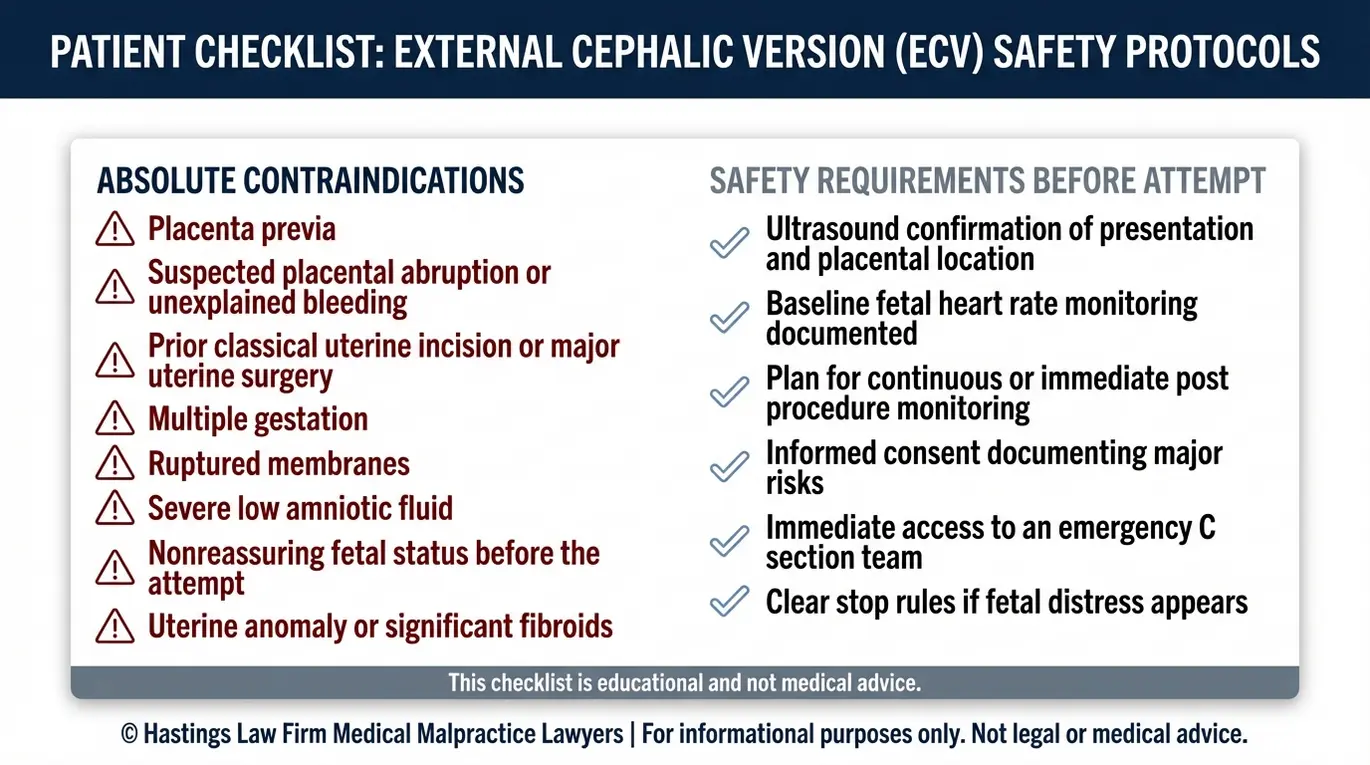
According to the clinical guidelines published by Prisma Health Academics, the standard of care for performing an ECV includes several essential steps. Before the procedure, the physician should conduct comprehensive prenatal testing, including an ultrasound examination to confirm the baby’s position, assess amniotic fluid levels, and check placental location. Continuous fetal heart rate monitoring must be in place before, during, and after the attempt. The procedure should also be performed in a setting where an emergency C-section can be carried out immediately if complications arise.
As outlined by the NCBI Bookshelf’s clinical resource on ECV, fetal malpresentation (or fetal malposition), meaning any position other than head-down, affects a small but significant percentage of pregnancies near term. When a physician evaluates a patient for ECV, certain conditions, called contraindications, make the procedure too dangerous to attempt. Ignoring these contraindications can constitute a breach of the accepted medical standard.
Absolute Contraindications for ECV (When the Procedure Should Not Be Attempted):
- Placenta previa (placenta covering or near the cervix)
- Severely low amniotic fluid (oligohydramnios)
- Abnormal fetal heart rate tracing before the procedure
- Prior classical (vertical) uterine incision or significant uterine surgery
- Active vaginal bleeding
- Ruptured membranes
- Multiple gestation requiring vaginal delivery of a non-vertex first twin
- Known fetal anomalies affecting the procedure’s safety
Under Texas Civil Practice & Remedies Code Chapter 74, a health care liability claim requires showing that a provider deviated from the accepted standard of care and that the deviation caused injury. As discussed in PubMed Central’s analysis of Texas health care liability claims, this framework applies directly to cases where a breech position lawyer in Texas must demonstrate that ECV was attempted inappropriately or performed without adequate precautions. If your doctor proceeded despite one or more of these contraindications, an ECV injury attorney can investigate whether that decision fell below the standard of care.
Common Injuries Caused by Negligent ECV Procedures
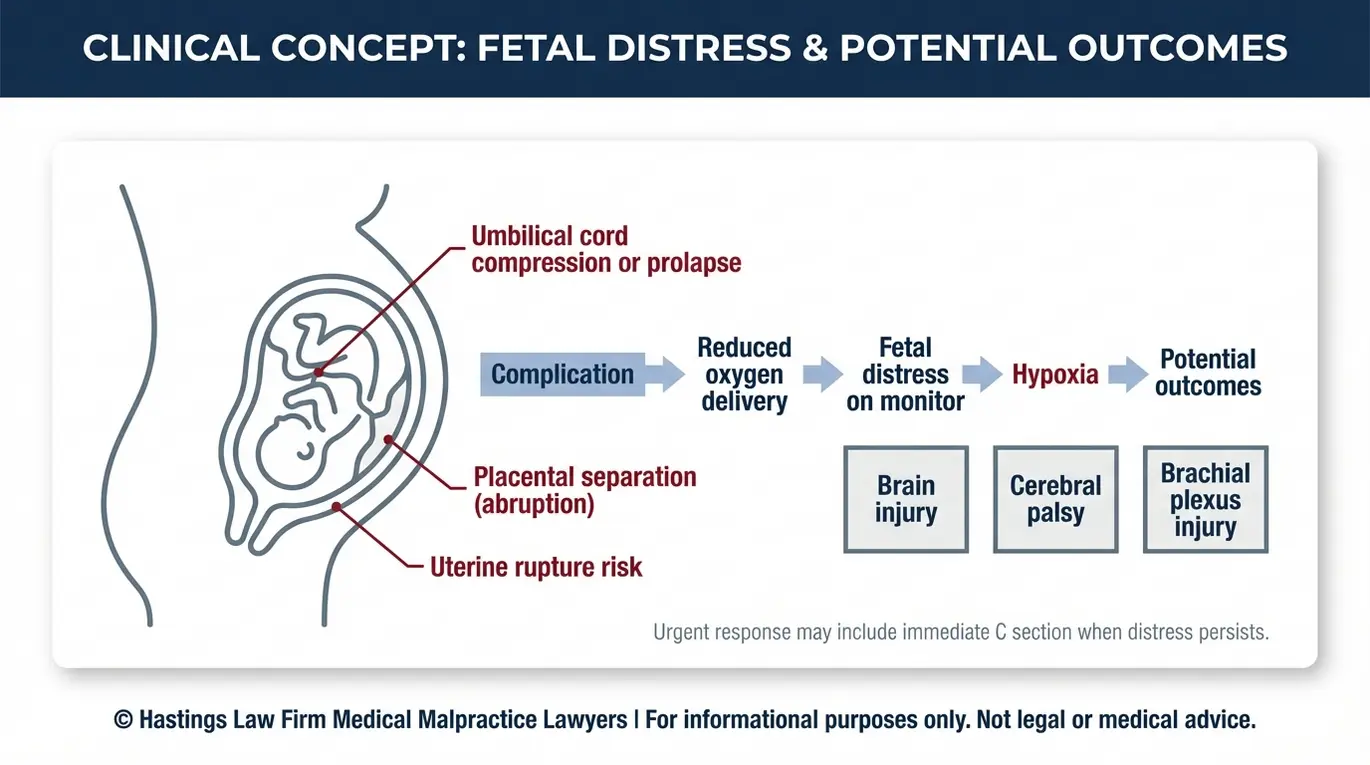
Negligent performance of an ECV can cause life-altering injuries such as placental abruption, uterine rupture, or umbilical cord prolapse, each of which can lead to oxygen deprivation (hypoxia) and permanent brain damage in the newborn.
Force and Trauma
Excessive force during the turning maneuver can cause direct physical harm. Uterine rupture, a tear in the wall of the uterus, is one of the most dangerous outcomes. It can cause severe hemorrhaging for the mother and an immediate loss of oxygen supply to the baby. Forceful manipulation may also cause direct trauma to the baby, potentially resulting in serious injury.
Placental abruption, the premature separation of the placenta from the uterine wall, is another serious risk. When the placenta detaches, the baby’s oxygen and nutrient supply can be partially or completely cut off. According to research published in PubMed Central reviewing the revival of external cephalic version, this complication may occur when the procedure is performed too aggressively or without appropriate patient screening.
Oxygen Deprivation and Brain Injury
When complications like cord compression or placental separation interrupt blood flow, the baby can experience hypoxia. Even a few minutes without adequate oxygen can cause permanent brain damage. Cerebral palsy is one of the most common long-term diagnoses associated with oxygen deprivation during birth. A Texas birth injury lawyer evaluating these cases will examine the timing of the injury relative to the ECV attempt to determine whether negligence caused the harm.
Emergency Response Failures
Fetal distress during an ECV typically shows up on the heart rate monitor as sudden decelerations or abnormal patterns. The University of Alabama’s review of Category I, II, and III fetal heart rate tracings provides the clinical framework doctors use to classify these patterns and guide emergency decisions. When a Category III tracing appears, indicating severely abnormal heart rate activity, the standard of care generally requires immediate emergency intervention, often an emergency C-section. Failing to order that intervention promptly is one of the most common grounds for a fetal turning complication attorney to pursue a claim.
| Complication | Mechanism of Harm | Potential Injury to Baby |
|---|---|---|
| Placental abruption | Premature separation of placenta from uterine wall | Hypoxia, brain damage, cerebral palsy |
| Uterine rupture | Tear in the uterus from excessive force | Hemorrhage (mother), oxygen loss (baby) |
| Umbilical cord prolapse | Cord slips ahead of the baby, compressing blood flow | Hypoxia, brain damage, cerebral palsy |
| Cord compression | Direct trauma or compression of umbilical cord | Reduced oxygen flow, potential brain injury |
| Premature labor | ECV triggers early contractions | Prematurity-related complications |
Complications Involving the Umbilical Cord During ECV
The umbilical cord is especially vulnerable during an ECV attempt. A nuchal cord, where the cord becomes wrapped around the baby’s neck, can tighten during repositioning and restrict blood flow. If the cord is not identified on ultrasound before the procedure, the turning motion may worsen the entanglement.
Umbilical cord prolapse, a condition where the cord drops through the cervix ahead of the baby, is a medical emergency. It can compress the cord between the baby and the birth canal, cutting off oxygen rapidly. Continuous fetal heart rate monitoring is essential to detect these cord-related complications in real time. When monitoring is absent or the response is delayed, the consequences for the baby can be severe and permanent.
The Hastings Law Firm Difference
Results matter, but what truly sets us apart is how we achieve them. Every verdict, every settlement, and every Texas courtroom victory comes from one guiding promise: To treat each client’s fight for justice as if it were our own.
This balance of skill, experience, and empathy reflects our core philosophy that justice should not only compensate the injured, but also make healthcare safer nationwide.

Proving Malpractice: When Does a Failed ECV Become Negligence?
A failed ECV becomes medical malpractice when the physician proceeds despite contraindications, uses excessive force, fails to monitor fetal heart rates continuously, or delays an emergency C-section when distress is detected. Not every unsuccessful procedure is negligent. The legal question is whether the doctor deviated from what a reasonably competent physician would have done under similar circumstances.
To prove an ECV malpractice case in Texas, the following elements must be established:
- Breach of duty: Evidence that the physician failed to follow accepted medical standards, such as attempting the procedure despite known contraindications or without proper monitoring equipment in place.
- Causation: A direct link between the physician’s actions and the injury. For example, fetal heart rate monitoring strips may show that the baby’s heart rate dropped during the maneuver and did not recover, indicating distress caused by the procedure itself.
- Informed consent: Documentation showing whether the physician explained the risks and you agreed to the treatment. This includes warnings about specific risks like placental abruption, cord complications, and the potential need for emergency surgery. If the doctor did not explain these risks and obtain agreement, that omission can be an independent basis for a birth injury lawsuit.
Continuous fetal heart rate monitoring (FHR monitoring), the ongoing electronic tracking of the baby’s heart rate throughout the procedure, generates tracings classified as Category I (normal), Category II (indeterminate), or Category III (abnormal). These tracings are among the most important pieces of evidence a Texas medical malpractice lawyer will review. They provide a minute-by-minute record of how the baby responded to the procedure and whether the care team acted appropriately on warning signs.
Our team examines medical records, monitoring strips, nursing notes, ultrasound reports, and consent forms to build a detailed timeline of what happened. We then work with qualified medical experts to determine whether the care provided fell below the standard and caused the injury.
Compensation for Birth Injuries Resulting from ECV Errors
Compensation in ECV malpractice cases covers past and future medical expenses, life care planning costs, pain and suffering, and loss of earning capacity for the child, often totaling millions in lifetime care needs. For families facing conditions like cerebral palsy, the cost of care can be staggering.
Economic damages in these cases typically include the cost of ongoing therapy (physical, occupational, and speech), assistive equipment such as wheelchairs or braces, home modifications for accessibility, and around-the-clock nursing care when ongoing care needs require it. Research published by PubMed Central on the economic costs of childhood disability confirms that these expenses accumulate significantly over a child’s lifetime, far exceeding what most families can absorb on their own.
Non-economic damages account for the child’s pain, suffering, and physical impairment. These cases are not about a payout. They are about making sure your child has the resources and support they need for the rest of their life. To secure fair birth injury compensation, a birth injury attorney can work with life care planners and economists to build an accurate picture of what your family will need going forward.
Why Choose Hastings Law Firm for Your ECV Malpractice Claim
We are a specialized medical malpractice firm with a track record of holding negligent providers accountable, utilizing a team of nurse consultants and trial lawyers to ensure no detail of your prenatal care is overlooked.
Hastings Law Firm handles medical malpractice cases exclusively. We do not split our attention across unrelated practice areas. That singular focus means our attorneys and in-house medical staff understand the clinical details of ECV complications at a level most general practice firms cannot match. As your ECV complication lawyer, we prepare every case from day one as if it will go to a jury. This trial-ready advocacy gives us a stronger position when negotiating with hospitals and their insurers.
Our team also includes Board Certified Patient Advocates who assist in interpreting clinical data to support your case. Our firm also includes former defense attorneys who previously represented hospitals. That background helps us anticipate the arguments the other side will raise and counter them early. You pay nothing unless we recover compensation for your family. That is our promise as a Texas medical malpractice firm operating on a contingency fee basis.
Contact the Texas Birth Injury Attorneys at Hastings Law Firm Today for Help
If your child was injured during an external cephalic version, your family deserves honest answers about what happened and whether the care you received met the standard. These are painful questions, but you do not have to face them alone.
At Hastings Law Firm, we understand how difficult this time is. Our team is here to listen, review your medical records, and give you a clear assessment of whether negligence may have caused your child’s injury. The consultation is free, confidential, and comes with no obligation.
Contact us today for a free case evaluation. There is no fee unless we win.
Frequently Asked Questions About External Cephalic Version Complications in Texas


This content was researched and written by the Hastings Law Firm editorial team, which includes attorneys, medical professionals, and experienced researchers. Our writing is informed by internal knowledge and practical experience, and we cross-check critical details against authoritative sources cited throughout. Every piece undergoes human-led fact-checking and legal review. Because legal and medical information can change, if you spot an error, please contact us. Learn more about our content standards and review process on our editorial policy page.

Tommy Hastings, founder of Hastings Law Firm, is a board-certified personal injury trial lawyer dedicated exclusively to healthcare injury cases. Since 2001, he has represented injured patients and families in litigation against major hospital systems, pharmaceutical companies, and negligent healthcare providers nationwide. He has handled numerous high-profile cases that have drawn national media attention and resulted in multi-million dollar recoveries. He draws on that experience in his writing, helping readers understand how these cases work and what options may be available to them.
