


Texas Abnormal Doppler Ultrasound Malpractice Lawyer
Written by: Hastings Law Firm | Reviewed by: Tommy Hastings | Updated: July 27, 2026
Abnormal fetal Doppler findings can signal that a fetus is not getting enough oxygen or nutrients, and missed or misread warning signs can lead to permanent injury. The discussion focuses on how Doppler studies are used to monitor high risk pregnancies, where interpretation and communication failures can occur, and why delays in responding to abnormal results matter. It also addresses how responsibility may be shared among sonographers, interpreting physicians, and hospitals, and how damages and time limits can affect recovery. If you or a loved one were harmed or worse due to abnormal Doppler ultrasound malpractice in Texas, contact Hastings Law Firm for a free, confidential case review.

Top Rated Legal Representation for Missed Fetal Distress Signals
What You Should Know About Fetal Doppler Negligence Claims in Texas:
- Permanent neurological injury can result when abnormal fetal Doppler warning signs are missed, misread, or not acted on promptly.
- Delayed intervention can follow when abnormal blood flow findings are dismissed as artifact or treated with watchful waiting despite signs of worsening oxygen deprivation.
- Disputes over responsibility can arise because sonographers, interpreting physicians, and hospitals may each contribute to communication failures tied to missed fetal distress.
- Recovery options can be shaped by Texas limits on non economic damages even when lifelong medical needs create substantial financial losses.
- Full compensation for long term care can depend on expert support that links the Doppler error directly to the child injury.
- Available economic damages can be significant because they can cover ongoing care needs such as therapy and in home support.
- Options can narrow if action is delayed because evidence can degrade and memories can fade over time.
- Medical records can be central to evaluating what happened because imaging reports, monitoring strips, and clinical notes may show whether abnormal findings were escalated.

A Healthcare Focused Law Firm
When a prenatal Doppler study reveals warning signs of fetal distress, the medical team has a responsibility to act quickly and appropriately. If those signs were missed, misread, or ignored, the consequences for a child can be permanent.
Conditions like intrauterine growth restriction (IUGR), a condition where the baby is not growing at a normal rate, and placental insufficiency, where the placenta cannot deliver enough oxygen and nutrients to the fetus, require careful monitoring. Doppler ultrasound is one of the most important tools physicians have to detect these problems early. When that tool is used improperly, or its findings are not acted upon, families deserve to know why.
If you believe your child was harmed because of a missed or misinterpreted Doppler finding, a Texas abnormal Doppler ultrasound malpractice lawyer at Hastings Law Firm can review what happened and explain your legal options. Contact us for a free, confidential case evaluation.
Common Errors Committed by Doctors Interpreting Fetal Doppler Studies
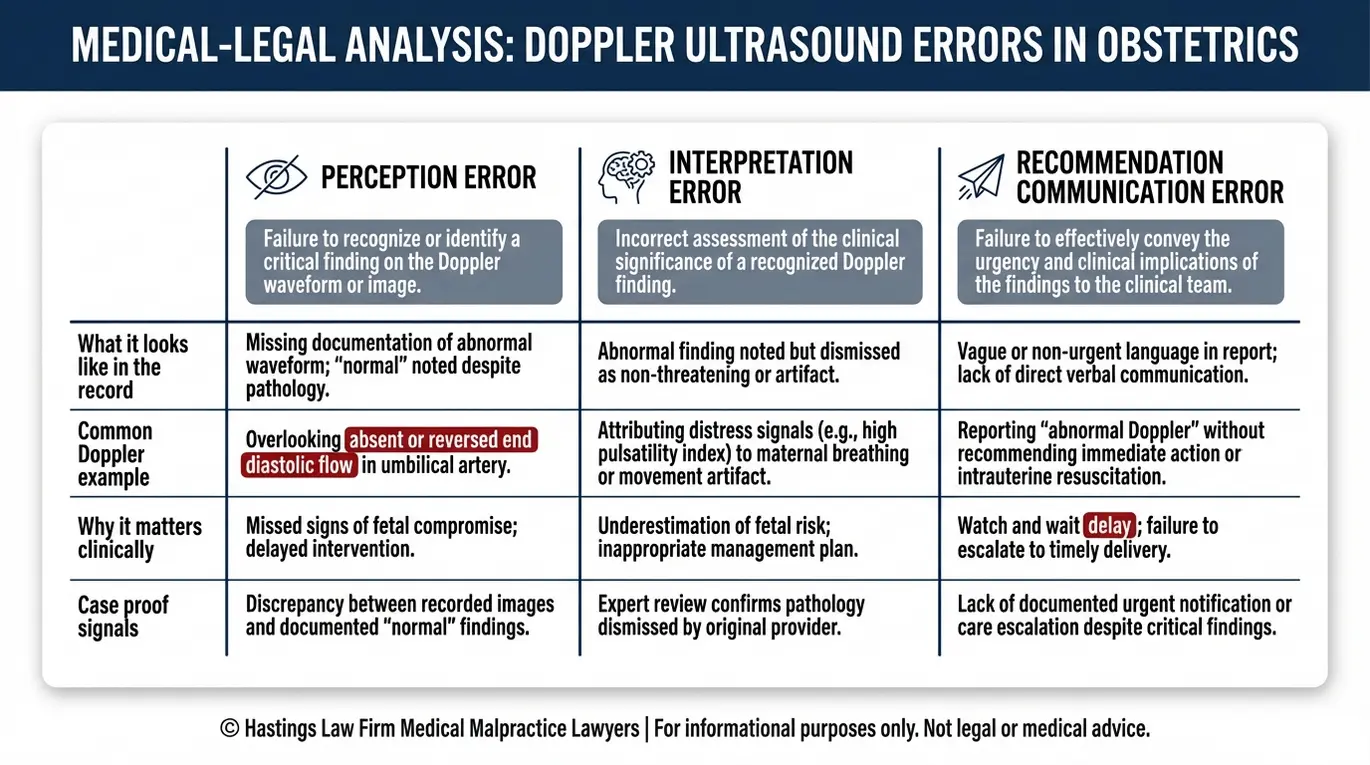
Doppler ultrasound errors often occur when physicians fail to recognize absent or reversed end-diastolic flow, misinterpret velocity ratios, or attribute clear signs of fetal hypoxia to equipment artifact rather than physiological distress. Fetal hypoxia refers to a lack of oxygen to the baby’s tissues. These errors can fall into distinct categories, and understanding them helps identify where the breakdown in care occurred.
Understanding the Taxonomy of Radiology Errors
In diagnostic imaging for fetal health, not all mistakes are the same. A perception error happens when the person reviewing the study simply does not see the abnormality on the screen. The finding may be present and visible, but the reviewer overlooks it entirely. An interpretation error, by contrast, occurs when the reviewer sees the abnormality but fails to understand what it means or how urgent it is.
The umbilical artery is the vessel that carries blood from the fetus to the placenta. According to sonography fetal assessment protocols published in the NCBI Bookshelf, Doppler studies of the umbilical artery are a primary surveillance tool for identifying compromised blood flow. When those studies are misread, critical interventions can be delayed.
Here are the most common types of Doppler errors we evaluate when working as a Doppler ultrasound malpractice attorney for injured families:
- Perception errors: The sonographer or physician does not identify absent or reversed end-diastolic flow (AEDF or REDF), a finding where blood flow in the umbilical artery stops or reverses during diastole, indicating severe placental dysfunction.
- Interpretation errors: The clinician sees abnormal waveforms but underestimates their severity, choosing serial monitoring over intervention even when findings suggest the fetus is already redistributing blood flow to protect the brain.
- The “watch and wait” mistake: When Doppler results suggest brain-sparing effect, a phenomenon where the fetus diverts blood away from other organs to prioritize the brain, further delay in delivery can lead to irreversible hypoxia and oxygen deprivation.
- Technical failures: Improper gain settings, incorrect Doppler angle correction, or failure to confirm findings with repeat imaging can produce false readings that mask a deteriorating condition.
- Recommendation failures: The physician correctly identifies the finding but fails to recommend or order the appropriate next step, such as an emergency cesarean delivery.
Each of these errors leaves a trail in the medical records. As a lawyer for Doppler interpretation errors, our team examines fetal monitoring strips, sonogram reports, and clinical notes to determine whether the standard of care was met. Under Texas Civil Practice and Remedies Code Chapter 74, a qualified medical expert must confirm that a breach occurred and directly caused the injury before a case can proceed.
Standard of Care for High-Risk Prenatal Doppler Monitoring
The standard of care mandates that physicians order and correctly interpret umbilical artery Doppler (UAD) velocimetry, a test that measures blood flow speed and direction in the umbilical cord, for pregnancies complicated by IUGR or preeclampsia to assess placental function and fetal well-being.
When a pregnancy is classified as high risk due to lagging fetal growth, maternal hypertension, or other factors, the treating physician is expected to order serial Doppler studies. These studies provide real-time data about how well the placenta is supporting the baby. Research published through PubMed Central on umbilical artery Doppler clinical application confirms that umbilical artery Doppler velocimetry is a well-established tool for predicting adverse outcomes and guiding delivery timing. Vascular resistance is the pressure blood must overcome to flow through a vessel.
Regular assessment allows physicians to track the progression of vascular resistance. This provides an important window of opportunity to intervene before the fetus suffers irreversible injury.
The standard of care also requires a clear chain of response when results are abnormal. If Doppler findings show diminished, absent, or reversed end-diastolic flow, the clinical team should initiate intrauterine resuscitation, a set of interventions designed to improve oxygen delivery to the fetus, which may include maternal repositioning, IV fluids, and supplemental oxygen. When these measures do not improve the fetal heart rate tracing, the standard typically calls for an emergency cesarean delivery.
A failure to follow this chain of response can lead to preventable injuries. A delay in acting on abnormal Doppler findings can result in prolonged oxygen deprivation and hypoxic-ischemic brain injury. As a Texas fetal Doppler error lawyer, our firm works with maternal-fetal medicine specialists to evaluate whether the care team escalated appropriately.
The Hastings Law Firm Difference
Results matter, but what truly sets us apart is how we achieve them. Every verdict, every settlement, and every Texas courtroom victory comes from one guiding promise: To treat each client’s fight for justice as if it were our own.
This balance of skill, experience, and empathy reflects our core philosophy that justice should not only compensate the injured, but also make healthcare safer nationwide.

Assigning Liability Between Sonographers and Interpreting Physicians
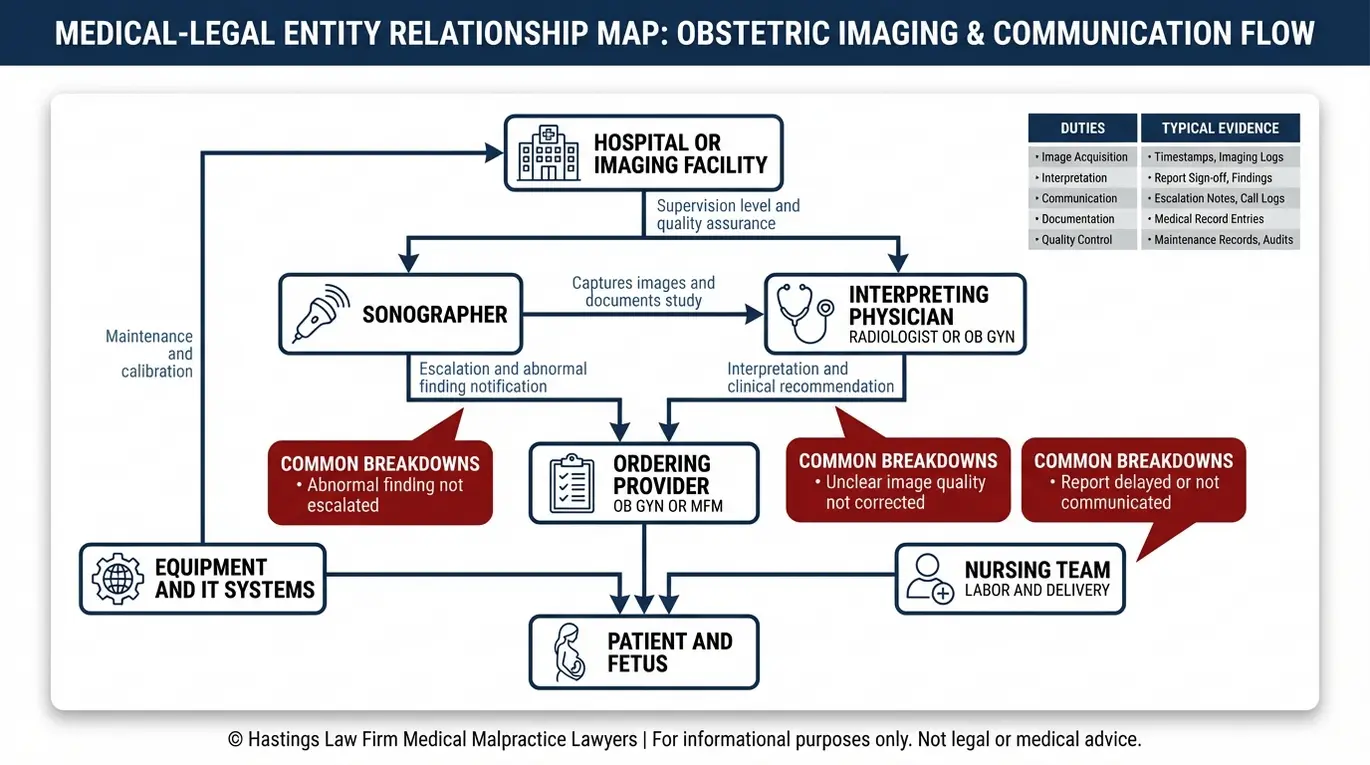
Liability often involves a “blame game” where the hospital claims the sonographer failed to capture the image, while the radiologist or OB/GYN claims the image was insufficient, yet both may be held liable under Texas law for communication failures.
The sonographer performs the hands-on imaging and is responsible for obtaining clear, diagnostic-quality studies. This includes using proper Doppler angle correction, the adjustment of the ultrasound beam’s angle relative to blood flow to ensure accurate velocity measurements. If a sonographer notices findings that appear abnormal, they have a professional duty to flag those findings immediately to the interpreting physician, not simply log them in a report queue.
The interpreting physician, such as a radiologist or obstetrician, holds the ultimate responsibility for reviewing the images, confirming their quality, and rendering a clinical interpretation. If the images contain a Doppler artifact, a false signal produced by equipment settings or patient movement, the physician must recognize it as such and request repeat imaging rather than dismissing an abnormal finding.
| Responsibility | Sonographer | Interpreting Physician |
|---|---|---|
| Image acquisition and quality | Capture diagnostic-quality images using correct settings and technique | Verify that submitted images meet quality standards for interpretation |
| Identifying abnormalities | Flag potentially abnormal findings to the physician immediately | Independently review all images and render a clinical diagnosis |
| Communication | Report concerns verbally and in writing per hospital protocol | Communicate findings and recommendations to the treating OB team |
| Equipment and settings | Use proper gain, angle correction, and Doppler mode | Recognize when technical limitations may affect accuracy |
| Follow-up | Document and escalate when images suggest urgent findings | Order additional studies or intervention based on clinical judgment |
Systemic breakdowns in hospital protocols, such as delayed result reporting, inadequate equipment maintenance, or understaffing, can also contribute to a missed diagnosis. Under the Texas Occupations Code Chapter 157, the delegation of medical acts and supervision requirements create a framework for evaluating whether oversight was adequate. When we serve as malpractice counsel for ultrasound errors, we examine each link in this chain to identify every responsible party.
Securing Compensation for Birth Injuries Caused by Doppler Errors
Families may recover substantial economic damages for lifelong medical care and non-economic damages for physical impairment and mental anguish, particularly when expert testimony links the Doppler error directly to the child’s neurological injury.
A child who suffers a brain injury due to prolonged oxygen deprivation may require a lifetime of specialized support. The calculation of damages in these cases often begins with a life care plan, a detailed projection of every medical and adaptive need the child will have. This complete document is the roadmap for the child’s financial recovery, itemizing costs such as:
- Ongoing physical, occupational, and speech therapy
- In-home nursing care or assisted living support
- Specialized medical equipment, wheelchair modifications, and adaptive technology
- Future surgeries or medical procedures
- Lost earning capacity over the child’s lifetime
- Past and future medical expenses already incurred by the family
These economic damages are not subject to a cap under Texas law. Economic damages include the quantifiable financial losses resulting from a birth injury. Since birth injuries often require lifetime support, maximizing this recovery is important for the child’s future security.
Non-economic damages, which cover pain and suffering, are subject to caps under Texas Civil Practice and Remedies Code § 74.301. These are generally limited to $250,000 per provider and up to $500,000 for institutional defendants.
In cases involving gross negligence, punitive damages may also be available. These apply in limited situations where the evidence shows a conscious disregard for patient safety. Our team works with economists, life care planners, and medical experts to build a complete picture of the harm.
Texas Statute of Limitations for Prenatal Imaging Malpractice
While Texas generally imposes a two-year statute of limitations for medical negligence, cases involving minors under 12 years old allow for tolling until the child reaches age 14, though parents should file sooner to preserve evidence.
Under Texas Civil Practice and Remedies Code § 74.251, the deadline for a claim is two years from the negligent act. This window typically runs from the date the act occurred or was discovered through the discovery rule.
For a child’s own claim, if the child was under 12 years old at the time of the incident, the statute of limitations may be tolled, or paused, until the minor’s 14th birthday. Evidence degrades and memories fade over time, so having the case evaluated early helps preserve the facts. If you need a Texas abnormal Doppler ultrasound malpractice lawyer, do not wait to explore your options.
Contact the Texas Birth Injury Attorneys at Hastings Law Firm Today for Help
A missed red flag on a fetal Doppler study is not simply an oversight. It represents a failure to protect your child at a moment when accurate interpretation could have changed everything. You have every right to ask what happened, and we can help you find those answers.
Hastings Law Firm focuses exclusively on medical malpractice. Our team includes in-house nurse consultants and former defense attorneys who understand how hospitals build their cases. As a Texas abnormal Doppler ultrasound malpractice lawyer, Tommy Hastings and his team prepare every case as if it is going to trial.
There is no cost for your initial consultation, and we never charge a fee unless we recover compensation for your family. If you believe a Doppler error led to your child’s injury, contact Hastings Law Firm today for a free, confidential evaluation.
Frequently Asked Questions About Abnormal Doppler Ultrasound Malpractice in Texas


This content was researched and written by the Hastings Law Firm editorial team, which includes attorneys, medical professionals, and experienced researchers. Our writing is informed by internal knowledge and practical experience, and we cross-check critical details against authoritative sources cited throughout. Every piece undergoes human-led fact-checking and legal review. Because legal and medical information can change, if you spot an error, please contact us. Learn more about our content standards and review process on our editorial policy page.

Tommy Hastings, founder of Hastings Law Firm, is a board-certified personal injury trial lawyer dedicated exclusively to healthcare injury cases. Since 2001, he has represented injured patients and families in litigation against major hospital systems, pharmaceutical companies, and negligent healthcare providers nationwide. He has handled numerous high-profile cases that have drawn national media attention and resulted in multi-million dollar recoveries. He draws on that experience in his writing, helping readers understand how these cases work and what options may be available to them.
