


Texas Infant Leptomeningeal Cyst Lawyer
Written by: Hastings Law Firm | Reviewed by: Tommy Hastings | Updated: July 27, 2026
An infant leptomeningeal cyst, also called a growing skull fracture, is a rare but serious complication that can follow skull trauma during labor and delivery. The fracture can widen over time after a dural tear, leading to progressive erosion and brain tissue herniation. Symptoms may appear gradually, and missed warning signs can delay imaging, surgery, and meaningful treatment. Because outcomes can involve permanent brain damage and lasting developmental effects, early recognition and appropriate care matter. If your child suffered harm due to an infant leptomeningeal cyst in Texas, contact Hastings Law Firm for a free, confidential case review.

Compassionate Texas Medical Attorneys for Infant Leptomeningeal Cyst Claims
What You Should Know About Leptomeningeal Cyst Birth Injury Claims in Texas:
- Long term outcomes can worsen when a growing skull fracture is not recognized and treated early.
- Permanent brain damage can occur when diagnosis or neurosurgical treatment is delayed.
- Liability can turn on whether delivery related trauma was preventable with proper medical care.
- Recovery options can be limited by Texas caps on non economic damages.
- Misdiagnosis risk can increase when a persistent scalp mass is dismissed as a cephalohematoma without imaging.
- Treatment needs can be extensive because surgery is required to repair the dura and reconstruct the skull.
- Compensation can be driven by the cost of ongoing care such as therapy and special education services.
- Disputes can depend on what labor and delivery records show about risk factors such as instrument assisted delivery or obstructed labor.
- Future needs can shape damages when long term monitoring is required to confirm the repair holds and the cyst does not recur.

A Healthcare Focused Law Firm
When your child is diagnosed with a leptomeningeal cyst, also known as a growing skull fracture, the news can be overwhelming. You may be grappling with questions about how this happened, what treatment your child will need, and whether someone should have prevented it. These are valid concerns, and you deserve clear answers.
A growing skull fracture in an infant is almost always the result of trauma, frequently during labor and delivery. If that trauma could have been avoided with proper medical care, you and your child may have a legal claim for compensation. As a Texas infant leptomeningeal cyst lawyer team, Hastings Law Firm focuses exclusively on medical malpractice cases. Our team is led by Tommy Hastings, a board-certified trial lawyer who has focused on medical negligence since 2005 to help families seek the truth.
If your infant has been diagnosed with a growing skull fracture, we are here to review what happened and explain your options at no cost to you.
What Is a Leptomeningeal Cyst or Growing Skull Fracture?
A leptomeningeal cyst, often called a growing skull fracture, is a rare complication of a skull fracture where the dura mater, the tough protective membrane covering the brain, tears, allowing cerebrospinal fluid and brain tissue to become trapped between the fracture edges. Rather than healing normally, the fracture progressively widens over time. This condition occurs when a tear in the brain’s protective lining prevents the skull bones from fusing.
This condition occurs almost exclusively in children under three years old. According to a clinical review published in PubMed on leptomeningeal cysts, infants are uniquely vulnerable to this complication following traumatic skull fractures sustained during birth.
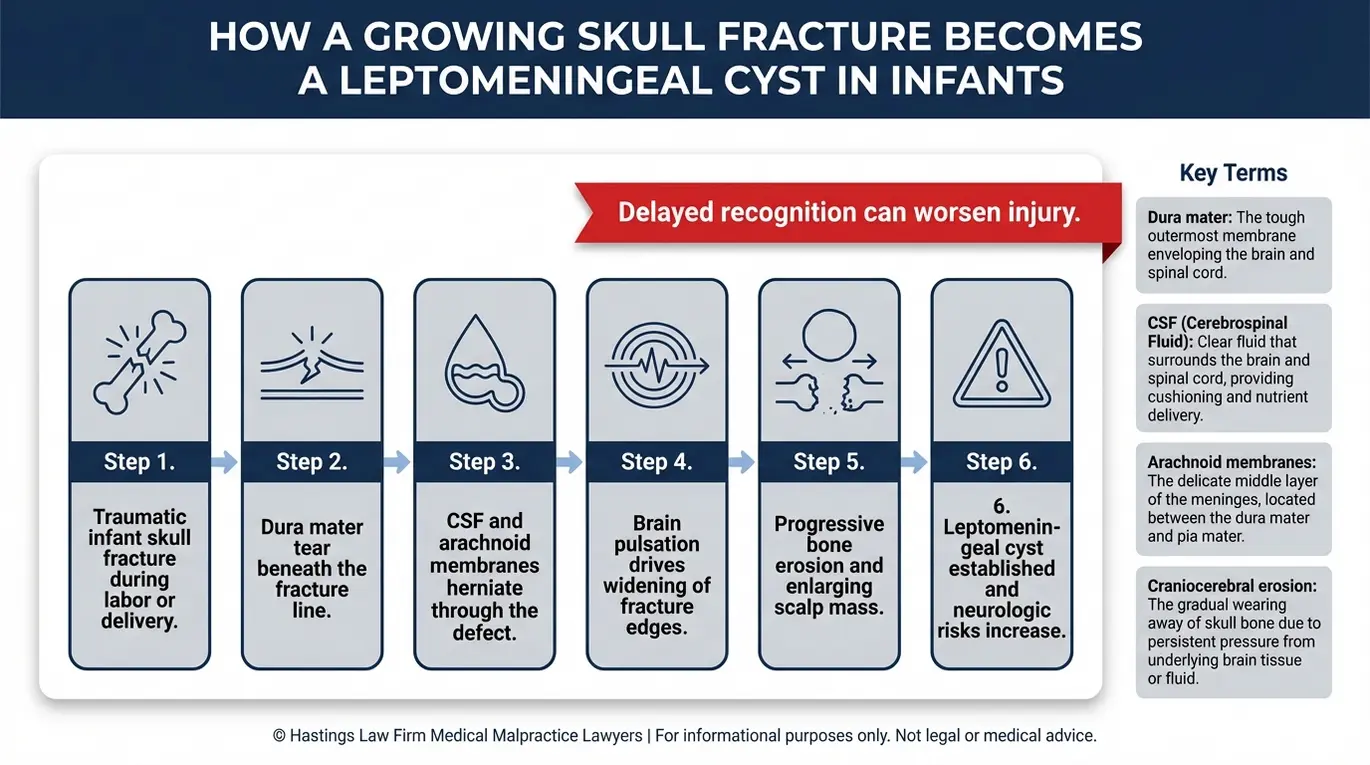
Here is how the condition progresses:
- A skull fracture occurs: Trauma during delivery creates a crack in the infant’s thin skull bone.
- The dura mater tears: The protective membrane beneath the bone is damaged at the fracture site.
- Brain pulsation widens the gap: Blood flow and cerebrospinal fluid (CSF) pressure push against the fracture edges.
- The fracture “grows”: Over time, this constant pulsation causes craniocerebral erosion, where the bone edges wear away.
- A cystic mass forms: Brain tissue and arachnoid membranes herniate through the defect.
A Texas infant leptomeningeal cyst attorney can help determine whether the original fracture resulted from preventable medical error. If the injury was avoidable, a lawyer for growing skull fracture cases can investigate whether the standard of care was breached.
How Brain Pulsation Drives Progressive Bone Erosion
The mechanism behind a growing skull fracture is unique. Once the dura is torn, the brain loses its sealed protective barrier. Normal cerebrospinal fluid pressure and the rhythmic pulsation of blood flow create outward force against the exposed fracture edges.
In a healthy skull, intact dura absorbs these forces. But when the dura is torn, this repeated pressure erodes the surrounding bone, a process known as craniocerebral erosion, causing the fracture to widen and tissue to herniate. This progression explains why the initial fracture is referred to as “growing.”
Common Causes and Risk Factors for Infant Skull Fractures
Most infant leptomeningeal cysts result from traumatic skull fractures sustained during difficult deliveries, particularly those involving instrumental assistance or undiagnosed cephalopelvic disproportion. The initial fracture is the prerequisite for every growing skull fracture. If the fracture was preventable, the cyst was preventable. Skull trauma in newborns can happen when the birth process is mismanaged.
Instrument-assisted delivery, meaning the use of forceps or a vacuum extractor to help guide the baby through the birth canal, carries inherent risks to the infant’s skull. When these tools are applied with excessive force, at improper angles, or for too long, they can cause linear skull fractures in a newborn whose bones are thin and pliable. These devices have a role in obstetric care, but their misuse is a well-documented source of birth injury.
Failure to identify risk factors before delivery is another common issue. Cephalopelvic disproportion (CPD), a condition where the baby’s head is too large to pass safely through the mother’s pelvis, can make vaginal delivery dangerous. Similarly, macrosomia, or an abnormally large baby, increases the risk of a traumatic birth. When medical providers fail to recognize these conditions through proper assessment, imaging, or labor monitoring, the result can be prolonged labor, dystocia (obstructed labor), and ultimately, a delivery that causes preventable skull trauma.
Risk factors a Texas birth injury lawyer may investigate include:
- Use of forceps or vacuum extractors during delivery
- Prolonged or obstructed labor (dystocia)
- Undiagnosed cephalopelvic disproportion
- Macrosomia not identified on prenatal ultrasound
- Breech presentation managed without timely cesarean section (C-section)
- Failure to convert to C-section when vaginal delivery stalled
An infant skull fracture attorney examines delivery records, fetal monitoring strips, and nursing notes to determine whether any of these risk factors were present and whether the care team responded appropriately.
The Hastings Law Firm Difference
Results matter, but what truly sets us apart is how we achieve them. Every verdict, every settlement, and every Texas courtroom victory comes from one guiding promise: To treat each client’s fight for justice as if it were our own.
This balance of skill, experience, and empathy reflects our core philosophy that justice should not only compensate the injured, but also make healthcare safer nationwide.

Recognizing Symptoms and Diagnosing Growing Skull Fractures
Symptoms often include a soft, pulsating mass on the scalp that grows over time, potentially accompanied by seizures, focal neurological deficits, or signs of hydrocephalus, a dangerous buildup of fluid in the brain. Identifying these symptoms early is necessary to prevent permanent brain damage. Our in-house medical staff includes hospital nurses who provide insider insight into how these injuries are documented and identified.
Growing skull fractures may not be obvious at birth. The initial fracture might go unnoticed, and the cyst develops gradually as the fracture widens. Parents may not notice anything unusual until a soft lump appears on the baby’s head or the child shows developmental delays.
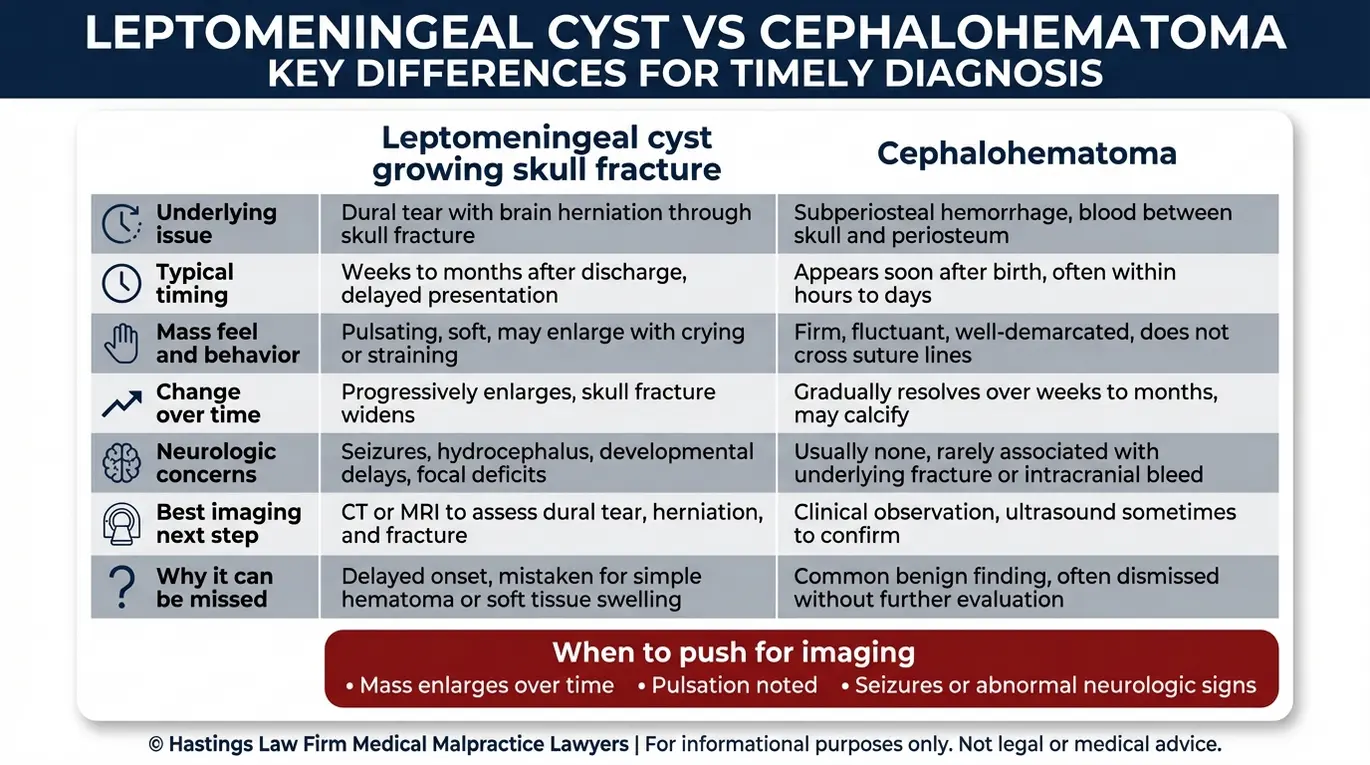
Providers must distinguish a leptomeningeal cyst from a cephalohematoma, a common, harmless collection of blood beneath the scalp. A clinical overview of cephalohematoma by the National Center for Biotechnology Information notes that this condition usually resolves on its own. A leptomeningeal cyst does not.
If a provider dismisses a persistent scalp mass as a simple cephalohematoma without ordering imaging, the growing fracture beneath it can go undetected. Parents should watch for a pulsating mass that does not shrink as the child grows.
| Feature | Cephalohematoma | Leptomeningeal Cyst |
|---|---|---|
| Cause | Blood collection under the periosteum | Skull fracture with dural tear |
| Behavior over time | Shrinks and reabsorbs within weeks | Grows larger over weeks to months |
| Pulsation | Typically non-pulsatile | Often soft and pulsatile |
| Brain involvement | None; confined to the scalp | Brain herniation, or protrusion of brain tissue, may be present |
| Imaging | Normal skull on X-ray | X-ray shows widening fracture; MRI/CT reveals defect |
When a growing skull fracture is suspected, imaging is essential. X-rays can reveal the widening fracture line, while CT scans and MRI provide detailed views of the dural tear, helping doctors assess the full extent of brain involvement. A leptomeningeal cyst malpractice lawyer focuses on whether these diagnostic steps were taken, or whether a Texas medical malpractice attorney needs to investigate a failure to diagnose.
Surgical Treatment and Long-Term Prognosis
Treatment invariably requires neurosurgery to repair the torn dura mater, remove the cyst, and perform a cranioplasty. The surgeon must complete a dural repair, or patching of the torn membrane, and a cranioplasty, a surgical reconstruction of the eroded skull bone using grafts. There is no conservative or “wait and see” alternative because surgery is the only way to stop the fracture from growing.
This is a complex operation on an infant’s brain. Research published in PubMed Central on early treatment of growing skull fractures highlights that early intervention correlates with better neurological outcomes. When diagnosis or treatment is delayed, children face a higher risk of permanent brain damage, chronic seizure disorders, hemiparesis, and lasting developmental delays.
Because timing is so important, failure to diagnose the condition before extensive erosion occurs is an important concept in malpractice litigation. A Texas infant brain injury lawyer evaluates the timeline of care to determine whether delays in diagnosis worsened the child’s outcome.
The difference between early and late intervention can shape a child’s future, affecting their ability to learn, communicate, and live independently. Recovery often involves long-term monitoring to ensure the graft holds and the cyst does not recur.
Establishing Liability and Recovering Damages in Texas
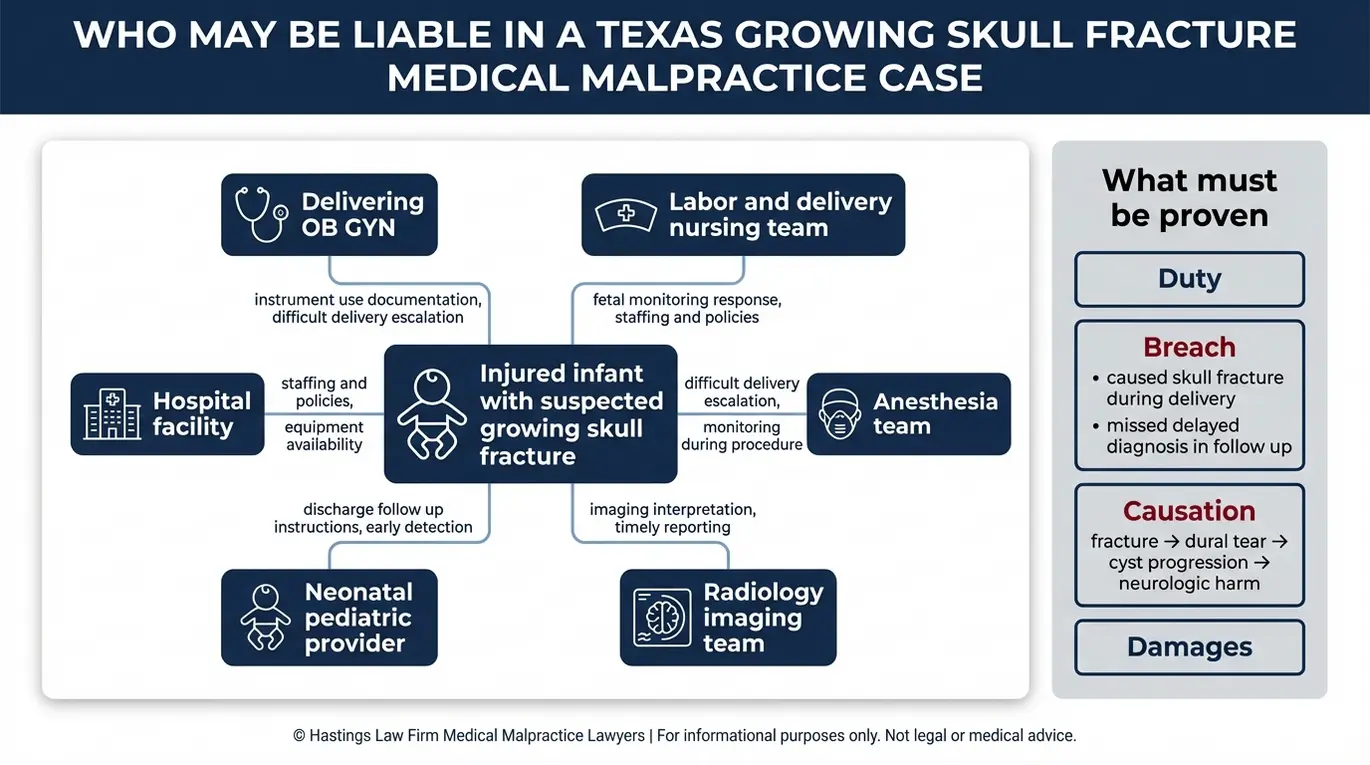
To secure compensation, plaintiffs must prove that a medical provider breached the standard of care by causing the initial fracture or failing to diagnose the cyst, resulting in significant damages. Proving negligence requires showing that the medical team failed to act as a reasonably competent provider would have under similar circumstances. A Texas infant leptomeningeal cyst lawyer works with qualified medical experts to establish exactly where medical negligence occurred.
Texas medical malpractice claims are governed by specific procedural requirements. Under Texas Civil Practice and Remedies Code Section 74.301, there are caps on non-economic damages, making it critical to build the strongest possible case. Liability may arise from the delivery itself, or from a failure to identify warning signs in the nursery or during follow-up care. To prevail, your legal team must prove a breach of the standard of care occurred during or after birth.
Damages that may be recoverable in these cases include:
- Past and future medical expenses, including neurosurgery and hospitalization
- Physical therapy, occupational therapy, and speech therapy
- Special education and adaptive learning services
- Pain and suffering experienced by the child
- Loss of future earning capacity
- Life care planning costs for long-term deficits
Life care planning is especially important in infant brain injury cases. A qualified life care planner projects the full cost of medical care, therapies, and support services your child may need over their lifetime. This analysis helps ensure that birth injury compensation reflects the true scope of your child’s needs.
Contact the Texas Birth Injury Attorneys at Hastings Law Firm Today for Help
A growing skull fracture is a serious, life-altering condition, and in many cases, one that should never have occurred. If your child has been diagnosed with a leptomeningeal cyst following a difficult delivery, you have the right to find out whether medical negligence played a role.
Hastings Law Firm focuses entirely on medical malpractice. Our team includes in-house nurses, former defense attorneys, and board-certified trial lawyers who understand both the medicine and the law behind these cases. As a Texas infant leptomeningeal cyst lawyer, we prepare every case as if it is going to trial, because that preparation is what drives fair results.
There is no fee unless we recover compensation for your family. Contact us today for a free, confidential case evaluation. Let us review your child’s medical records and help you understand what happened and what options you may have.
Frequently Asked Questions About Infant Leptomeningeal Cyst in Texas


This content was researched and written by the Hastings Law Firm editorial team, which includes attorneys, medical professionals, and experienced researchers. Our writing is informed by internal knowledge and practical experience, and we cross-check critical details against authoritative sources cited throughout. Every piece undergoes human-led fact-checking and legal review. Because legal and medical information can change, if you spot an error, please contact us. Learn more about our content standards and review process on our editorial policy page.

Tommy Hastings, founder of Hastings Law Firm, is a board-certified personal injury trial lawyer dedicated exclusively to healthcare injury cases. Since 2001, he has represented injured patients and families in litigation against major hospital systems, pharmaceutical companies, and negligent healthcare providers nationwide. He has handled numerous high-profile cases that have drawn national media attention and resulted in multi-million dollar recoveries. He draws on that experience in his writing, helping readers understand how these cases work and what options may be available to them.
