


Texas Intraventricular Hemorrhage Malpractice Lawyer
Written by: Hastings Law Firm | Reviewed by: Tommy Hastings | Updated: July 27, 2026
A severe intraventricular hemorrhage in the NICU can leave families facing uncertainty about whether a fragile prematurity related complication was unavoidable or whether preventable errors played a role. This topic involves how IVH is graded, why timely imaging and monitoring matter, and how missed warning signs or unmanaged instability can worsen outcomes and lead to lifelong needs. It also addresses how Texas law can affect responsibility, compensation, and the practical risks of waiting to act. If you or a loved one were harmed or worse due to intraventricular hemorrhage malpractice in Texas, contact Hastings Law Firm for a free, confidential case review.

Specialized Legal Representation for Preventable NICU Injuries
What You Should Know About Premature Infant Brain Bleed Claims in Texas:
- Long term disability risk can increase when a higher grade intraventricular hemorrhage develops, including complications such as hydrocephalus and cerebral palsy.
- Accountability can be disputed because defense arguments often claim the bleed was an inevitable result of prematurity rather than a preventable error.
- Options can narrow when preventable triggers are not identified, such as unmanaged blood pressure swings or oxygen deprivation during labor or NICU care.
- Permanent harm can follow when routine cranial ultrasound screening is delayed, skipped, or misinterpreted.
- Outcomes can worsen when warning signs are not escalated, such as apnea and bradycardia patterns or seizure activity documented in nursing notes.
- Recovery can be limited by Texas caps on non economic damages even when the child has severe pain, suffering, or physical impairment.
- The ability to pursue a claim can be lost if Texas timing rules are missed, including an absolute cutoff that can apply even when negligence is discovered later.
- Evidence can weaken with delay because records may be lost, electronic fetal monitoring data may be purged, and witness memories can fade.
- Financial strain can be lifelong when severe IVH leads to ongoing therapy, specialized equipment, and long term support needs.
- Causation disputes can turn on detailed records because experts may analyze imaging timelines, ventilator settings, medication logs, and vital sign documentation.

A Healthcare Focused Law Firm
When a premature baby suffers a serious brain bleed in the neonatal intensive care unit (NICU), families are often left searching for answers. If your child, born extremely preterm (before 28 weeks gestation, sometimes called a micro-preemie), was diagnosed with a severe intraventricular hemorrhage, you may be wondering whether the care your baby received met the standard that was required.
At Hastings Law Firm, we focus exclusively on medical malpractice, and our team includes in-house nurses and board-certified patient advocates who understand the clinical details of NICU care. The firm was founded by Tommy Hastings, a board-certified trial lawyer, to give a voice to families affected by medical errors. As a Texas intraventricular hemorrhage malpractice lawyer team, we can review your child’s medical records and help you understand what happened and what your legal options may be.
Understanding Intraventricular Hemorrhage and Grading Severity
Intraventricular hemorrhage (IVH) is bleeding into the fluid-filled spaces, called ventricles, inside the brain. It most commonly affects premature babies born before 32 weeks gestation because their blood vessels are extremely fragile and underdeveloped.
The bleeding originates in an area called the germinal matrix, a highly vascular region of the developing brain that is especially vulnerable to changes in blood flow and pressure. Vascular means the area is full of delicate blood vessels. According to the NCBI Bookshelf overview of Periventricular and Intraventricular Hemorrhage, this fragility is the primary reason premature infants face elevated risk for brain hemorrhage.
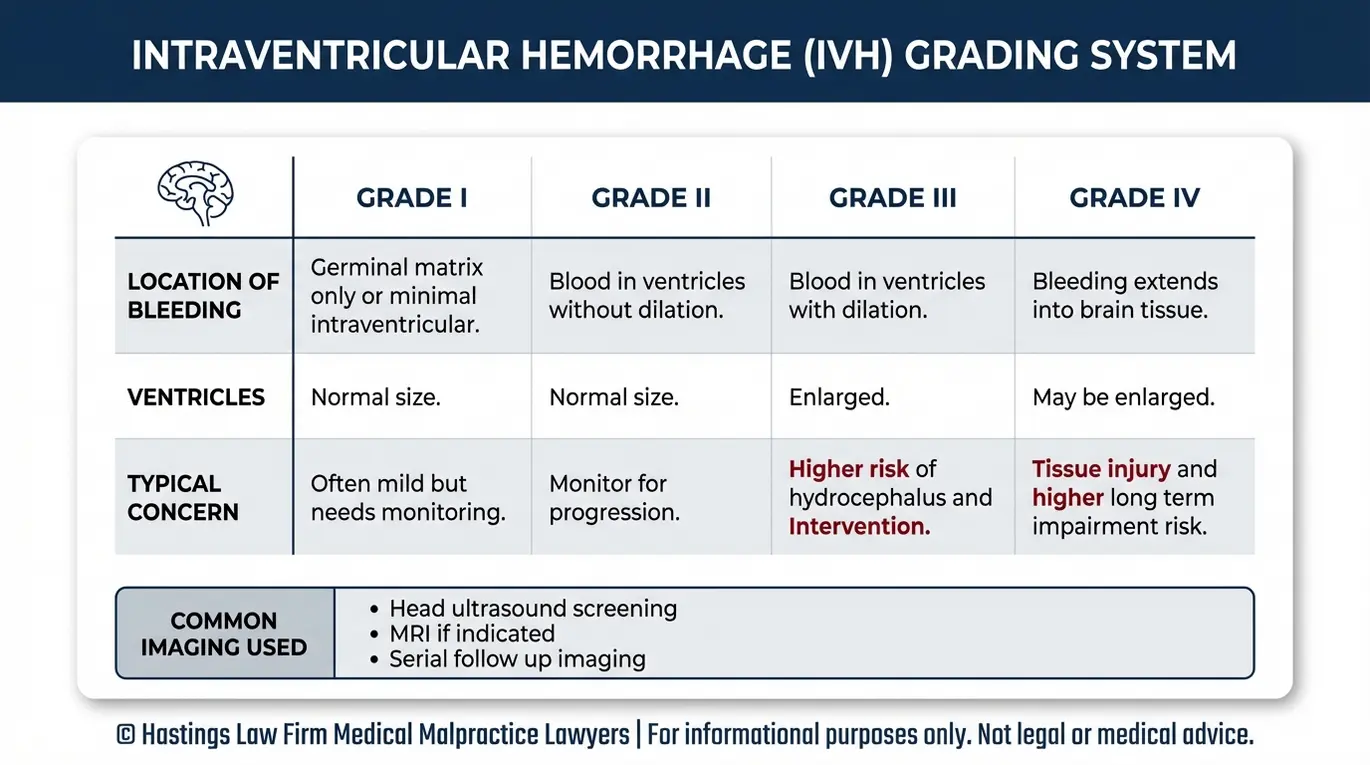
Doctors classify IVH severity using the Papile grading system, a four-level scale based on the extent and location of bleeding seen on imaging. This grading helps determine the severity of the brain injury and the potential for long-term complications.
| Grade | Description | Typical Outlook |
|---|---|---|
| Grade I | Bleeding confined to the germinal matrix | Often resolves without lasting effects |
| Grade II | Blood extends into the ventricles but does not enlarge them | Generally manageable with monitoring |
| Grade III | Ventricles are enlarged (dilated) due to blood accumulation | Higher risk of developmental delays and hydrocephalus |
| Grade IV | Bleeding extends into surrounding brain tissue (parenchyma) | Significant risk of permanent injury, including cerebral palsy |
As noted in research published in PubMed Central on cranial ultrasonography standards for diagnosing IVH, accurate and timely imaging is essential to grading and managing these bleeds. Grade III and IV hemorrhages carry the greatest risk of long-term consequences, including hydrocephalus and cerebral palsy. Hydrocephalus is a condition where fluid builds up and causes dangerous pressure in the brain.
When an intraventricular hemorrhage lawyer or brain bleed attorney evaluates a potential case, understanding the grade of injury helps determine whether clinical decisions contributed to a worse outcome than necessary.
Distinguishing Unavoidable Prematurity Risks from Medical Errors
While prematurity itself is a primary risk factor for IVH, medical malpractice occurs when healthcare providers fail to manage preventable triggers, such as blood pressure swings, respiratory distress, or rough handling of the infant. Not every brain bleed in a premature baby is the result of negligence, but some are clearly tied to errors that could have been avoided. Distinguishing between a natural complication of extreme prematurity and a preventable injury requires a meticulous review of the medical facts.
The germinal matrix, the fragile network of blood vessels in a developing baby’s brain, is highly sensitive to hemodynamic instability, which refers to sudden, dangerous fluctuations in blood pressure or blood flow. When NICU staff fail to manage these fluctuations, the resulting stress on those delicate vessels can cause them to rupture.
Some IVH cases begin before the baby is even born. During labor, conditions like uterine tachysystole (excessive contractions caused by mismanaged labor-inducing medications like Pitocin) can restrict oxygen flow to the fetus. When contractions occur too frequently, the placenta cannot replenish its oxygen supply between waves, leading to cumulative hypoxia.
Prolonged hypoxia, or oxygen deprivation, during labor can weaken those already fragile blood vessels and set the stage for a hemorrhage after delivery. According to a study published in JAMA Network Open on IVH, survival, and neurodevelopment, the interplay between labor complications and postnatal care directly affects outcomes. These factors help determine if the standard of care was met during delivery and the NICU stay.
Here is how we distinguish between the two:
Factors often associated with spontaneous, unavoidable IVH:
- Extreme prematurity (born before 28 weeks)
- Very low birth weight
- Naturally fragile vascular development
Factors that may indicate preventable, negligence-related IVH:
- Failure to monitor or control blood pressure fluctuations in the NICU
- Delayed or improper response to fetal distress during labor
- Failure to perform a timely emergency C-section when electronic fetal monitoring indicated distress
- Traumatic delivery involving excessive force or improper use of instruments
- Mismanagement of ventilation causing oxygen deprivation after birth
A Texas intraventricular hemorrhage malpractice lawyer must be able to separate what was unavoidable from what was not. Under Chapter 74 of the Texas Civil Practice and Remedies Code, proving malpractice for infant brain bleed requires demonstrating that a specific breach of the standard of care caused or worsened the injury. As a Texas birth injury attorney team, we work with neonatal and obstetric experts to evaluate whether the medical team’s actions fell below what was required.
The Hastings Law Firm Difference
Results matter, but what truly sets us apart is how we achieve them. Every verdict, every settlement, and every Texas courtroom victory comes from one guiding promise: To treat each client’s fight for justice as if it were our own.
This balance of skill, experience, and empathy reflects our core philosophy that justice should not only compensate the injured, but also make healthcare safer nationwide.

Critical Failures in Diagnosis and NICU Monitoring
Negligence often involves the failure to perform routine head ultrasound screenings on infants born before 32 weeks, or the failure to promptly diagnose and treat complications like post-hemorrhagic hydrocephalus, a condition where blood from the hemorrhage blocks normal fluid drainage and causes dangerous pressure buildup in the brain. Screening refers to regular testing used to find medical problems before symptoms become severe.
Bedside cranial ultrasound screening is the primary tool for detecting IVH in premature infants. According to the Frontiers in Pediatrics consensus on standardized screening and classification of preterm brain injury, standardized ultrasound protocols are recommended for all high-risk neonates. When these screenings are delayed, skipped, or misinterpreted, a treatable bleed can progress to a grade that causes permanent harm.
Beyond imaging, physical symptoms often signal that something is wrong. Seizures, lethargy, a bulging fontanelle, abnormal muscle tone, and episodes of apnea or bradycardia can all indicate worsening hemorrhage. Apnea is a pause in breathing and bradycardia is an abnormally slow heart rate. NICU nurses chart these events, often documented as “A&Bs,” and patterns in that charting can reveal periods of unmonitored or undertreated distress.
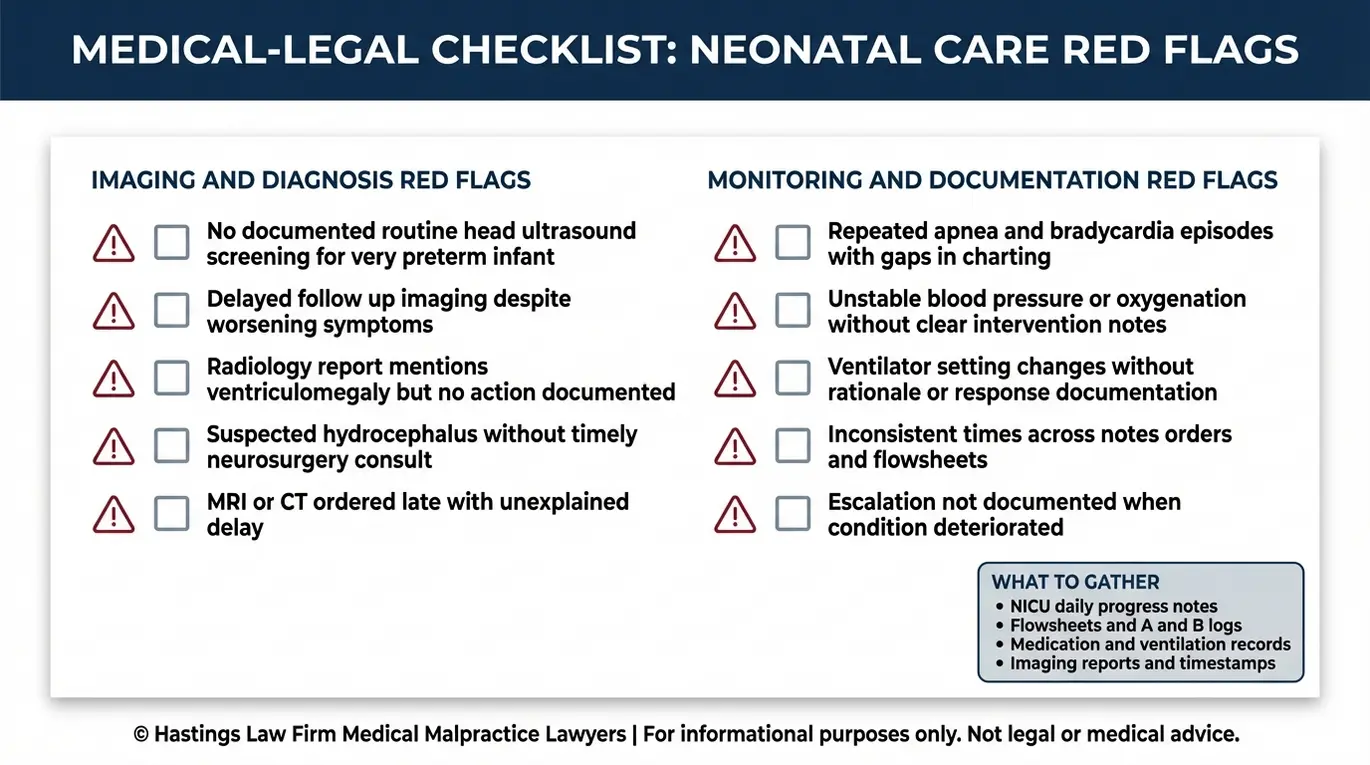
As a Texas intraventricular hemorrhage malpractice lawyer team with in-house nursing staff who previously worked in hospital settings, we know what to look for in these records. A failure to diagnose IVH often leaves a trail in the documentation. Here are red flags our NICU negligence lawyer team examines:
- No cranial ultrasound performed within the first 7 days of life for an infant born before 32 weeks
- Delayed follow-up imaging after an initial bleed was identified
- Apnea and bradycardia episodes documented but not escalated to the treating physician
- Seizure activity noted in nursing charts but absent from physician progress notes
- Head circumference measurements showing rapid increase without corresponding imaging or intervention
- MRI or CT scans ordered only after symptoms became severe, suggesting a delayed response
- Gaps in vital sign documentation during critical windows
Each of these failures can represent a point where earlier action may have changed the outcome for your child.
Proving Liability and Navigating Texas Malpractice Laws
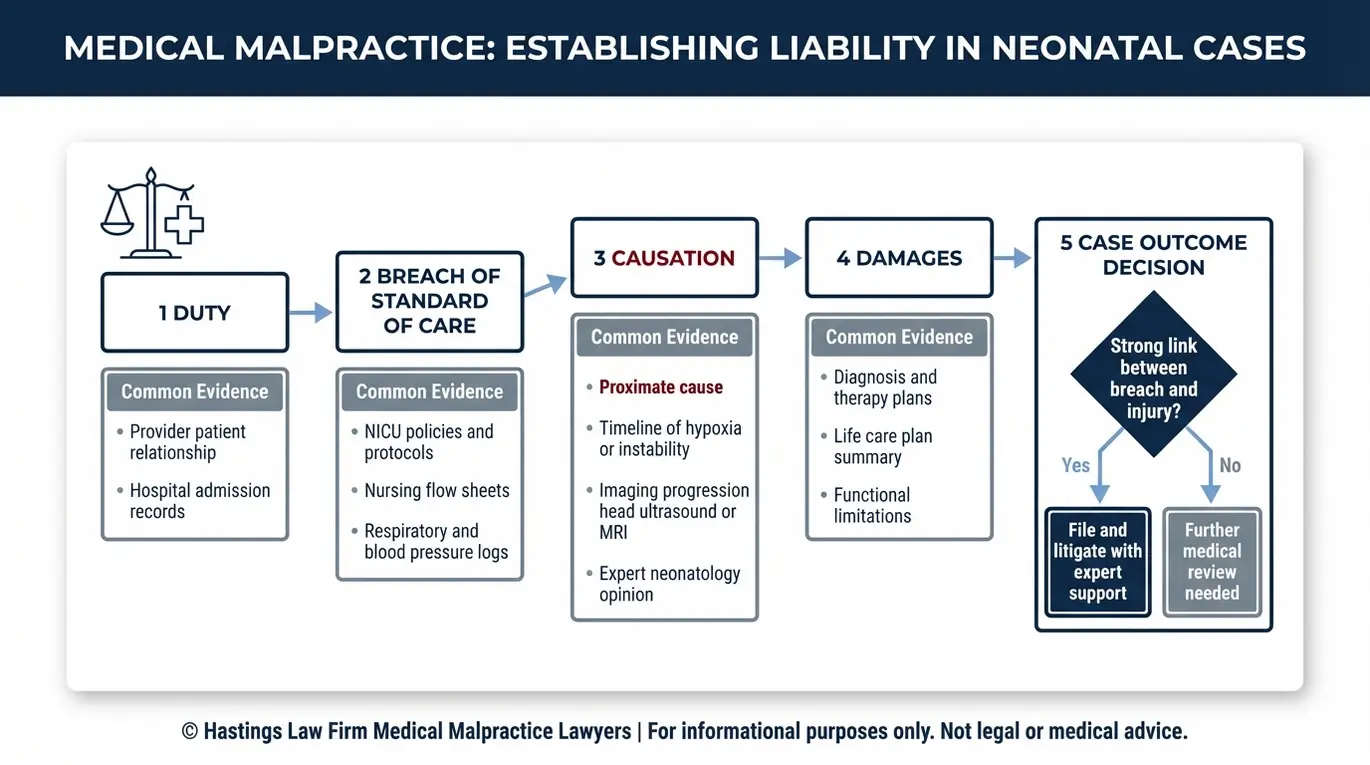
Proving liability in Texas requires establishing that the medical provider breached the accepted standard of care and that this breach was the proximate cause of the infant’s worsening condition or injury. Liability is the legal responsibility one party has for the harm caused to another.
Texas medical malpractice claims are built on four elements: duty, breach, causation, and damages. The medical team owed your baby a duty of care. If they failed to meet the standard expected of a reasonably competent provider in the same specialty, that failure is a breach. But proving medical negligence in Texas also requires showing that the breach, not just the prematurity itself, caused or worsened the hemorrhage and its consequences.
Causation is the most contested element in IVH cases. Defense teams will almost always argue that the bleed was an inevitable result of prematurity. Establishing this link between the error and the injury is essential for a successful legal claim.
Qualified neonatologists and neuroradiologists serve as experts to analyze imaging timelines, ventilator settings, medication logs, and vital sign records. These experts establish whether the injury followed a pattern consistent with negligence rather than natural disease progression.
Our legal team includes former defense attorneys who previously represented hospitals in cases like these. That experience gives us direct insight into the arguments the defense will raise and allows us to prepare for them from the start. Our in-house nurses review charting line by line, identifying inconsistencies between nursing notes, physician orders, and electronic monitoring data.
These discrepancies, such as a gap between when a symptom appeared and when a doctor was notified, can be critical evidence in establishing a breach. Every case we accept as a Texas medical malpractice lawyer team is prepared from day one as if it will go before a jury. We focus on uncovering the proximate cause of the injury through detailed record reconstruction. Proximate cause is the legal link showing that a provider’s specific action directly led to the harm.
Calculating Damages for Lifelong Care and Therapy
Compensation in severe IVH cases covers past medical bills, future life care costs, therapy, specialized equipment, and non-economic damages for the child’s pain and physical impairment. In legal terms, damages refers to the money awarded to cover medical costs and suffering. Because Grade III and IV hemorrhages can result in permanent disabilities, including cerebral palsy, the financial impact on a family can be enormous and lifelong. Families typically cannot bear these substantial costs without a fair settlement that addresses every aspect of the injury.
According to the CDC’s data on cerebral palsy, children with this condition often require ongoing therapy, adaptive equipment, and specialized education services well into adulthood. These needs evolve as the child grows, necessitating periodic surgeries, mobility aids, and vocational training.
Calculating what a child will need over the course of a lifetime requires a detailed life care plan developed by medical and economic experts. This detailed analysis projects expenses adjusted for inflation. A life care plan estimates the total cost of medical needs and daily support throughout the patient’s life. To ensure funds remain available for forty, fifty, or even sixty years of care, these projections must be accurate and thorough.
Recoverable damages in IVH birth injury cases may include:
- Past and future medical expenses, including NICU hospitalization, surgeries, and medications
- Physical, occupational, and speech therapy costs
- Specialized equipment such as wheelchairs, communication devices, and home modifications
- Future lost earning capacity if the child is unable to work independently as an adult
- In-home nursing care or assisted living costs
- Non-economic damages for pain, suffering, and physical impairment
- Parents’ claims for emotional distress and loss of companionship
Life care planning is one of the most important parts of securing full compensation for birth injury. IVH lawsuit settlements must account not just for current needs but for decades of future care. Our team works with life care planners and economists to build a complete picture of what your child’s care will cost, so that any recovery reflects the real, long-term financial burden your family faces.
Texas Statute of Limitations for Infant Brain Injury Claims
In Texas, the statute of limitations for medical malpractice is generally two years from the date of the alleged negligence. A statute of limitations is the legal deadline for starting a lawsuit. However, for birth injuries involving minors under the age of 12, the deadline may be tolled, or paused, until the child reaches age 14. This means parents can potentially file a claim on the child’s behalf until the child’s fourteenth birthday. Claims for the parents’ own medical expenses and damages, though, must generally be filed within the standard two-year window.
Even with extended deadlines, waiting carries real risks. Medical records can be lost or altered. Electronic fetal monitoring strips may be stored on systems that are eventually purged. Nurses and doctors change jobs, and memories fade.
The earlier an investigation begins, the stronger the evidence will be. Securing witness statements while events are fresh often provides the critical details needed to prove a breach in the standard of care.
Texas also imposes a 10-year statute of repose, which sets an absolute outer boundary on when a claim can be filed regardless of when the injury was discovered. This strict deadline means that even if a family is unaware of the negligence until years later, the right to sue is extinguished after a decade. This makes it essential to consult a Texas intraventricular hemorrhage malpractice lawyer as soon as you suspect something went wrong, even if your child is still young.
Starting the legal process early does not mean rushing to court. It means preserving the records, imaging, and testimony that your case depends on.
Contact the Texas Birth Injury Attorneys at Hastings Law Firm Today for Help
If your child suffered a severe intraventricular hemorrhage and you believe NICU negligence may have played a role, our team is here to listen and help you find answers. Our medical-legal firm focuses exclusively on medical malpractice cases to ensure families get the specialized attention they need. Hastings Law Firm includes in-house nurses and board-certified patient advocates who can review your child’s records and explain whether you may have a case.
We understand how overwhelming this time is for your family. You deserve to know what happened and what options are available to protect your child’s future.
Contact us today for a confidential, no-obligation consultation. There is no fee unless we recover compensation on your behalf.
Frequently Asked Questions About Intraventricular Hemorrhage Malpractice in Texas


This content was researched and written by the Hastings Law Firm editorial team, which includes attorneys, medical professionals, and experienced researchers. Our writing is informed by internal knowledge and practical experience, and we cross-check critical details against authoritative sources cited throughout. Every piece undergoes human-led fact-checking and legal review. Because legal and medical information can change, if you spot an error, please contact us. Learn more about our content standards and review process on our editorial policy page.

Tommy Hastings, founder of Hastings Law Firm, is a board-certified personal injury trial lawyer dedicated exclusively to healthcare injury cases. Since 2001, he has represented injured patients and families in litigation against major hospital systems, pharmaceutical companies, and negligent healthcare providers nationwide. He has handled numerous high-profile cases that have drawn national media attention and resulted in multi-million dollar recoveries. He draws on that experience in his writing, helping readers understand how these cases work and what options may be available to them.
