


Texas Maternal Anesthesia Complications Lawyer
Written by: Hastings Law Firm | Reviewed by: Tommy Hastings | Updated: July 27, 2026
Maternal anesthesia mistakes during labor and delivery can cause sudden harm to a mother and baby, especially when dosing, catheter placement, or monitoring falls short. Families may face severe pain, lasting neurological injury, paralysis, cardiac arrest, or serious infant brain injury tied to oxygen deprivation, with the most severe cases resulting in fatal outcomes. Responsibility may involve an anesthesiologist, a CRNA, or a hospital depending on supervision and staffing. If you or a loved one were harmed or worse due to maternal anesthesia complications in Texas, contact Hastings Law Firm for a free, confidential case review.

Compassionate Texas Medical Attorneys for Epidural Malpractice Claims
What You Should Know About Epidural Malpractice During Delivery Claims in Texas:
- Long term disability can follow anesthesia mistakes during childbirth, including permanent nerve damage, paralysis, or cardiac arrest in mothers.
- Lifelong infant care needs can result when maternal blood pressure drops after anesthesia and oxygen delivery to the baby is reduced.
- Fatal outcomes are described as possible in the most severe cases.
- Liability can extend beyond the individual provider when supervision, staffing, or hospital responsibility is disputed.
- Recovery for non economic harm can be limited in Texas even when the injury is severe.
- Compensation for financial losses can remain available for extensive medical care and long term support needs.
- Disputes can focus on whether complications were unavoidable due to abnormal neuraxial anatomy.
- Case outcomes can depend on what anesthesia logs and fetal monitoring strips show about warning signs and response timing.
- Options can be affected when key records are not preserved, including labor and delivery documentation and medication administration records.

A Healthcare Focused Law Firm
When something goes wrong with anesthesia during labor and delivery, the consequences can be sudden and severe. You may be dealing with unexplained pain, neurological symptoms, or a child who needs care you never anticipated. These situations leave families searching for answers, often unsure whether what happened was preventable.
At Hastings Law Firm, we focus exclusively on medical malpractice as a nationally recognized plaintiff trial firm. Our team includes in-house nurse consultants and former defense attorneys who understand how hospitals document anesthesia care and how errors get overlooked. Our founder, Tommy Hastings, is board-certified in personal injury trial law and has handled medical liability cases for more than 20 years. If you or your child were harmed by an anesthesia mistake during childbirth, a Texas maternal anesthesia complications lawyer at our firm can review your records and help you understand your options.
Consultations are free and confidential, and we charge no fees unless we recover compensation for you.
Common Types of Maternal Anesthesia Errors During Labor and Delivery
Maternal anesthesia errors often involve improper dosing, incorrect catheter placement, failure to monitor vital signs, or failure to recognize maternal hypotension, leading to severe injury for both mother and child. Most pain relief during childbirth involves neuraxial anesthesia, a category that includes epidurals and spinal blocks delivered near the spinal cord. When performed correctly, these procedures are generally safe. But errors during placement or monitoring can turn a routine delivery into a medical emergency.
The types of anesthesia mistakes we commonly evaluate include:
- Improper catheter placement: The epidural catheter may be advanced too far, puncturing the dura mater, a complication known as a dural puncture where the needle pierces the protective membrane surrounding the spinal cord. Research published by the National Library of Medicine on post-dural puncture headache trends confirms it remains a persistent complication of labor neuraxial analgesia. In other cases, the catheter may be placed into a blood vessel, which can cause a toxic reaction to the anesthetic medication.
- Medication errors: Administering too high a dose can lead to a high spinal block, where the numbing effect rises dangerously above the intended level, potentially affecting breathing and heart function. Syringe swaps and labeling errors are frequent causes of medication mishaps in the delivery room. In the high-pressure environment of a labor unit, ampules looking similar can lead to providers inadvertently swapping safe drugs for toxic ones or administering vasopressors, which are medications used to raise blood pressure, incorrectly.
- Monitoring failures: After an epidural or spinal block is administered, the standard of care requires close monitoring of the mother’s blood pressure and the baby’s heart rate. When this monitoring lapses, warning signs of distress can go undetected. Staff shortages often contribute to these lapses, as one provider may be overseeing too many patients simultaneously to maintain the required observation frequency.
- Emergency versus scheduled cesarean sections: Anesthesia errors carry heightened risk during emergency C-sections. When a baby needs to be delivered immediately, the pace of the procedure can lead to shortcuts in dosing, placement, or monitoring that would not occur during a planned cesarean section.
Emergency C-Section Anesthesia Risks
The standard of care for anesthesia during an emergency or “crash” C-section differs from a routine delivery. In a scheduled procedure, the anesthesia team has time to carefully position the patient, confirm catheter placement, and titrate medication gradually. During an emergency, that window shrinks dramatically.
In a labor and delivery setting, a “crash” C-section is an unplanned surgical delivery performed during a medical crisis. Emergency C-section anesthesia risks vary depending on the delivery method. If an epidural catheter is already in place, the team may deliver a rapid bolus dose through it. If not, general anesthesia may be required. A rapid bolus through an existing epidural catheter, a thin tube placed in the epidural space to deliver medication, can cause a high spinal block if the catheter has migrated.
A lawyer for anesthesia errors will examine whether the anesthesia team followed the protocols that apply to the specific clinical scenario, whether it was a calm, scheduled delivery or a crisis requiring immediate surgical intervention. As a Texas maternal anesthesia complications lawyer, our role is to determine whether the care provided matched the urgency and risk of the situation.
Severe Injuries Caused by Epidural and Spinal Block Negligence
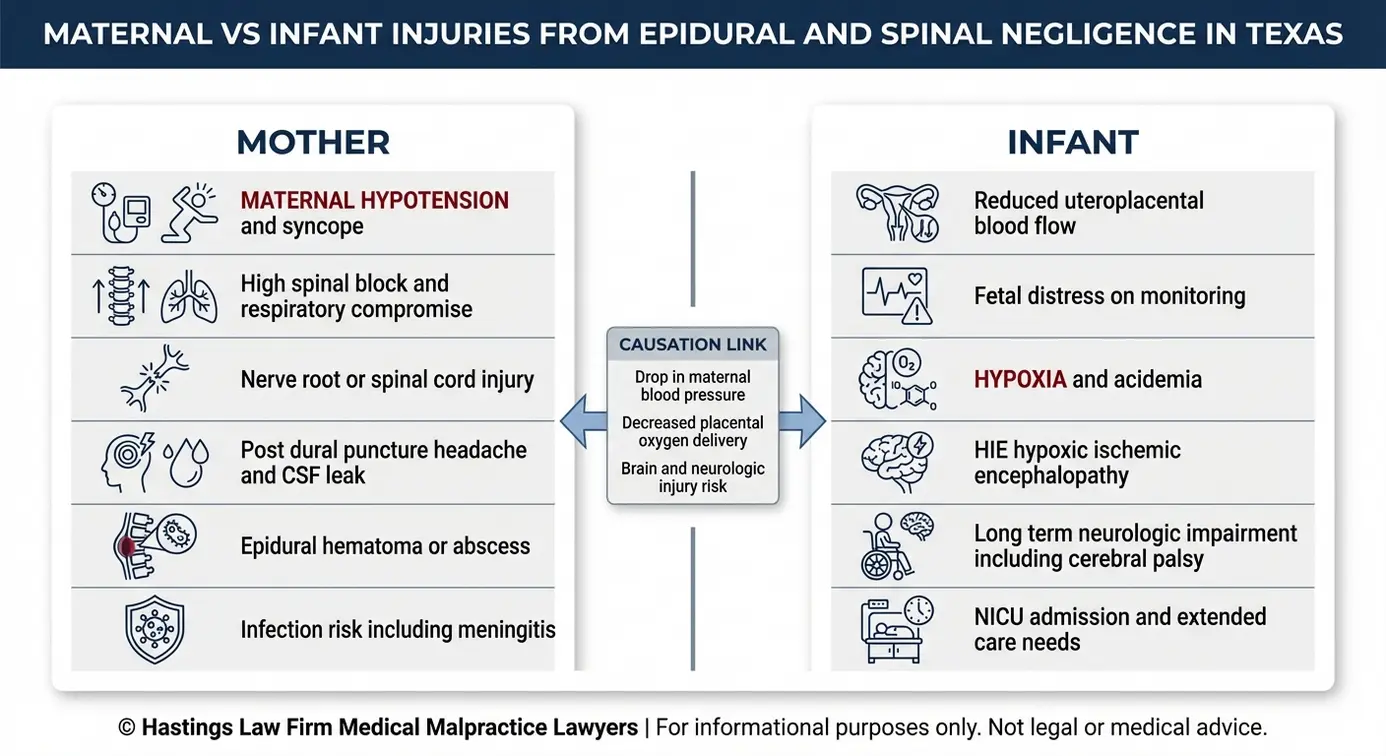
Negligent administration of neuraxial anesthesia can cause permanent nerve damage, paralysis, and cardiac arrest in mothers, while resulting in hypoxic-ischemic encephalopathy (HIE) or cerebral palsy in infants due to prolonged hypotension.
One of the most dangerous complications is maternal hypotension, a sudden, significant drop in the mother’s blood pressure after anesthesia is administered. When blood pressure falls too low, the pressure gradient driving oxygen to the baby collapses. This can starve the baby of oxygen, triggering fetal distress. If the hypotension is not corrected quickly, the oxygen deprivation can lead to hypoxic-ischemic encephalopathy (HIE), a type of brain injury caused by reduced blood flow and oxygen to the brain. This lack of oxygen, known as hypoxia, rapidly damages fetal brain tissue and can result in cerebral palsy, developmental delays, or death.
Direct trauma to the spinal cord or nerve roots during needle or catheter placement can cause lasting neurological damage. In rare but serious cases, an epidural hematoma or abscess may form in the spinal canal, compressing the nerves and potentially leading to paralysis if not surgically treated in time.
Severe post-dural puncture headaches caused by a cerebrospinal fluid leak may require a procedure called a blood patch. Infections such as meningitis or spinal abscesses can develop when sterile technique is not maintained during placement. Symptoms of infection, like high fever or localized tenderness at the injection site, must be addressed immediately to prevent systemic spread.
These injuries are recognized under Texas Civil Practice and Remedies Code Chapter 74, which governs medical liability claims in Texas. A maternal anesthesia negligence attorney evaluates whether the provider’s actions fell below accepted medical standards and directly caused the harm.
| Maternal Injuries | Infant Injuries |
|---|---|
| Nerve damage or paralysis from needle/catheter trauma | Hypoxic-ischemic encephalopathy (HIE) from prolonged maternal hypotension |
| Epidural hematoma or abscess compressing the spinal cord | Cerebral palsy resulting from oxygen deprivation |
| Post-dural puncture headache requiring blood patch | Fetal distress leading to emergency intervention |
| Meningitis or infection from unsterile technique | Brain damage from delayed delivery during anesthesia crisis |
| Cardiac arrest from high spinal block | Wrongful death in the most severe cases |
As a Texas maternal anesthesia complications lawyer, we work to connect each documented injury to a specific failure in the anesthesia care provided.
The Hastings Law Firm Difference
Results matter, but what truly sets us apart is how we achieve them. Every verdict, every settlement, and every Texas courtroom victory comes from one guiding promise: To treat each client’s fight for justice as if it were our own.
This balance of skill, experience, and empathy reflects our core philosophy that justice should not only compensate the injured, but also make healthcare safer nationwide.

Liability for Anesthesia Errors Involving Anesthesiologists and CRNAs
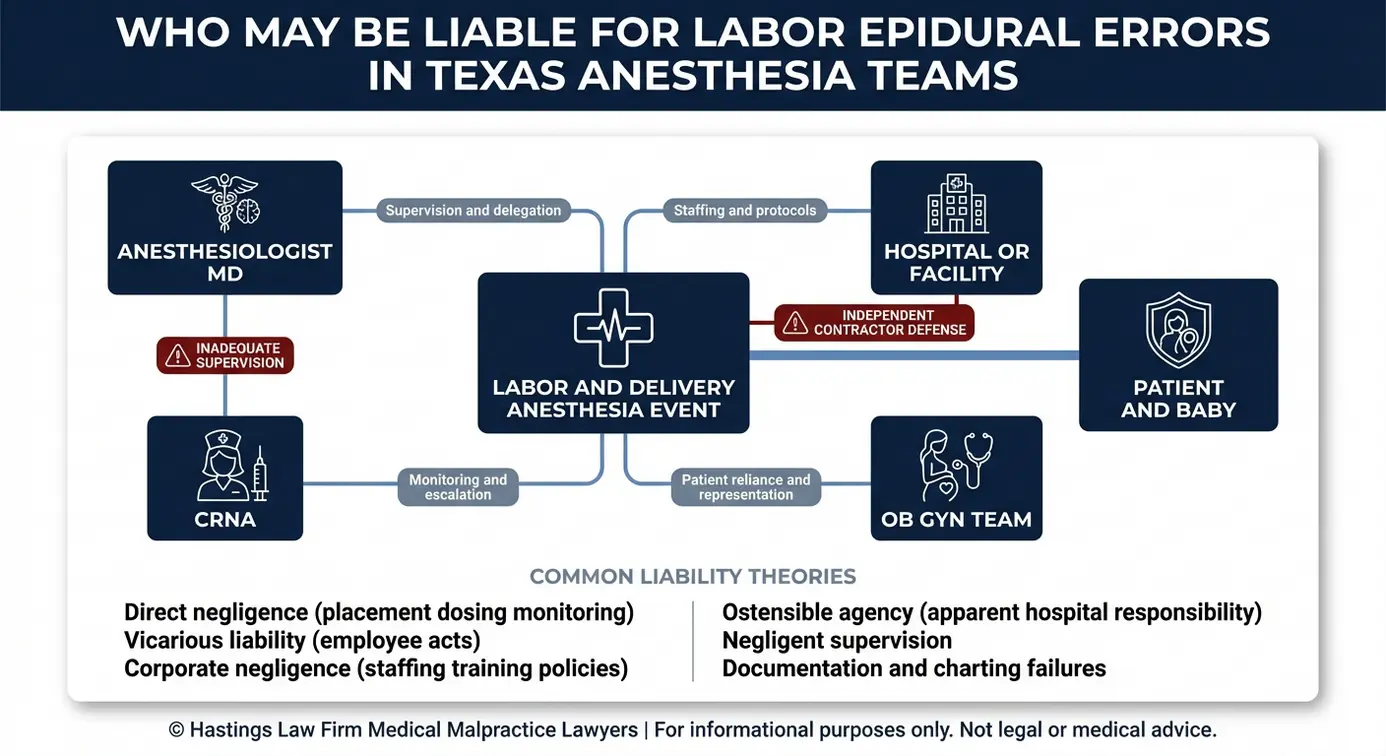
Liability in Texas may extend to the attending anesthesiologist, the Certified Registered Nurse Anesthetist (CRNA), or the hospital itself, depending on employment status and the level of supervision provided during the procedure.
An anesthesiologist, a physician who has completed medical school and specialized residency training in anesthesia, typically leads the care team. A Certified Registered Nurse Anesthetist (CRNA), an advanced practice nurse who is licensed to administer anesthesia, often works under the supervision of an anesthesiologist. In many labor and delivery units, these two providers work together as part of an “anesthesia care team,” where the CRNA handles direct patient care while the anesthesiologist oversees multiple cases.
When something goes wrong, the question of who is legally responsible depends on the facts. If the CRNA made an error during placement or dosing, both the CRNA and the supervising anesthesiologist may share liability. The anesthesiologist has a duty to provide adequate oversight, and a failure to do so can be independent negligence.
Hospital liability is also a factor. Even when the anesthesiologist is technically an independent contractor, Texas courts recognize a legal theory called ostensible agency. If the patient reasonably believed the anesthesiologist was a hospital employee, the hospital may still be held responsible.
Hospitals often use independent contractor agreements and disclosures in admission paperwork to limit their direct liability. However, if the hospital holds the doctor out as its agent, such as by assigning them to you without your input, ostensible agency may apply. Hospitals can also face claims of corporate negligence for failing to maintain adequate anesthesia staffing, especially during high-volume shifts or emergency situations.
Defense teams in these cases often argue that the patient had abnormal neuraxial anatomy, suggesting the complication was unavoidable regardless of technique. Our team, which includes former defense attorneys and in-house medical staff, knows how to evaluate these claims through independent expert testimony and detailed record analysis. A lawyer for maternal anesthesia malpractice will identify every responsible party and build the evidence needed to hold them accountable.
Investigating the Case and Proving Medical Negligence
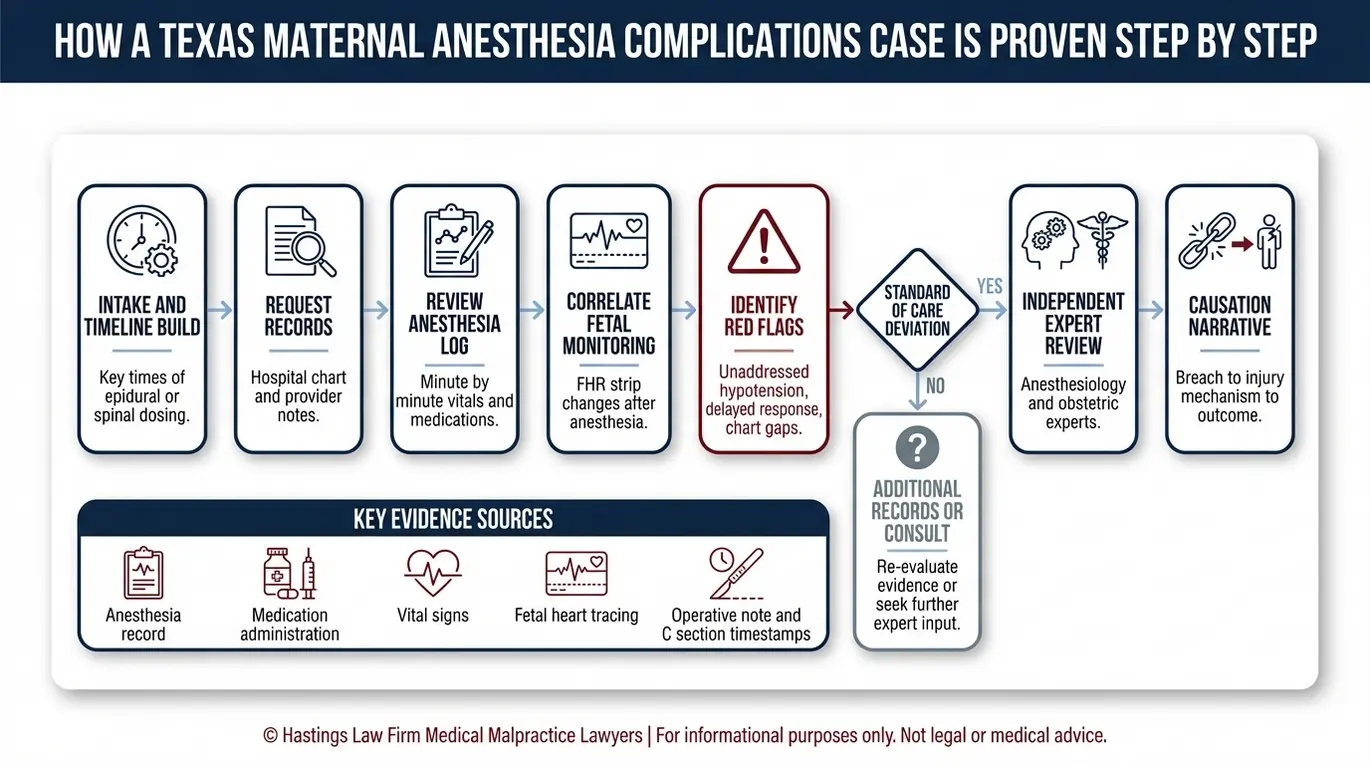
Proving negligence requires a thorough analysis of anesthesia logs, fetal monitoring strips, and medical records to demonstrate that the provider deviated from the accepted standard of care and directly caused the injury.
We closely examine the anesthesia log, which is a minute-by-minute record of the patient’s vital signs and medication during a procedure. A thorough analysis of anesthesia logs can reveal if the care team failed to act on warning signs. Gaps, inconsistencies, or delayed responses documented in this log are critical pieces of evidence. A gap of even five minutes in recording blood pressure during a critical phase can indicate that the provider was negligent in their monitoring duties.
We also review fetal monitoring strips, records that capture the baby’s heart rate patterns throughout labor and delivery. By correlating the timing of anesthesia administration with any changes in the fetal heart rate, we can determine whether a drop in maternal blood pressure led to fetal distress and how quickly the team responded.
Our investigation also examines whether assisted delivery tools such as forceps or a vacuum extractor were used, and whether those decisions were connected to complications from the anesthesia itself. In wrongful death cases, the timeline becomes even more critical.
Every case we accept is reviewed by independent medical experts, typically board-certified anesthesiologists, who assess whether the care met the standard expected of a competent provider. These experts apply the objective standard of care to the specific facts, determining if the deviation was a breach of duty. Texas law requires this level of expert review.
You have the right to obtain your own medical records. The Texas Medical Board outlines how to request copies of your medical records, and doing so early can be an important first step. As a Texas maternal anesthesia complications lawyer, we handle the full investigation, but preserving your records promptly helps protect the evidence.
Evidence we gather and review:
- Complete labor and delivery records, including nursing notes
- The anesthesia log with minute-by-minute vital sign data
- Fetal monitoring strips (EFM) from before, during, and after anesthesia
- Medication administration records and pharmacy logs
- Operative reports for any cesarean section or emergency procedure
- Hospital staffing records and anesthesia team assignments
- Independent expert analysis from qualified anesthesiologists
Recoverable Damages in Texas Maternal Anesthesia Cases
Victims of maternal anesthesia malpractice can recover compensation for past and future medical expenses, lost wages, pain and suffering, and the lifetime costs of care for a child with birth injuries.
Texas medical malpractice law divides recoverable damages, which are the financial awards meant to compensate for losses, into two main categories: economic and non-economic.
Economic damages cover the measurable financial losses caused by the injury. These include:
- Past and future medical bills, including surgeries, hospital stays, and rehabilitation
- Physical therapy, occupational therapy, and specialized care
- Lost wages and diminished earning capacity for the injured mother
- Lifetime care costs for a child diagnosed with cerebral palsy or HIE, often documented through a formal life care plan
- Future medical care required to manage long-term complications or disabilities
There is no cap on economic damages in Texas. For families raising a child with a permanent brain injury, these costs can extend across an entire lifetime and reach into the millions. A life care plan is a complete, dynamic document used to project these needs. It accounts for wheelchair replacements, home modifications, 24-hour attendant care, and specialized therapies over the child’s entire life expectancy.
Non-economic damages address the human toll: pain, suffering, physical impairment, disfigurement, and the loss of normal life experiences. Under Texas Civil Practice and Remedies Code § 74.301, non-economic damages are capped at $250,000 against all physicians and individual health care providers combined and $250,000 per health care institution, with a maximum aggregate of $750,000. While these caps limit non-economic recovery, the uncapped economic damages often represent the larger portion of a settlement or verdict.
An anesthesia injury attorney can work with medical economists and life care planners to document the full scope of what your family will need going forward, ensuring that a settlement or jury award accounts for every foreseeable cost.
Contact the Texas Birth Injury Attorneys at Hastings Law Firm Today for Help
If you or your child suffered harm because of an epidural or anesthesia error during labor and delivery, you deserve a legal team that understands both the medicine and the law. At Hastings Law Firm, our attorneys, nurse consultants, and medical experts work together to determine what happened, who is responsible, and what your family needs to move forward.
We handle these cases on a contingency fee basis, which means you pay no attorney fees or costs unless we recover compensation for you. Every consultation is free and confidential.
You are not alone in this process, and asking questions does not mean making a commitment. It means getting the answers you need to make an informed decision.
Call Hastings Law Firm or contact us online to schedule your free case evaluation today.
Frequently Asked Questions About Maternal Anesthesia Complications in Texas


This content was researched and written by the Hastings Law Firm editorial team, which includes attorneys, medical professionals, and experienced researchers. Our writing is informed by internal knowledge and practical experience, and we cross-check critical details against authoritative sources cited throughout. Every piece undergoes human-led fact-checking and legal review. Because legal and medical information can change, if you spot an error, please contact us. Learn more about our content standards and review process on our editorial policy page.

Tommy Hastings, founder of Hastings Law Firm, is a board-certified personal injury trial lawyer dedicated exclusively to healthcare injury cases. Since 2001, he has represented injured patients and families in litigation against major hospital systems, pharmaceutical companies, and negligent healthcare providers nationwide. He has handled numerous high-profile cases that have drawn national media attention and resulted in multi-million dollar recoveries. He draws on that experience in his writing, helping readers understand how these cases work and what options may be available to them.
