


Texas NICU Medication Error Lawyer
Written by: Hastings Law Firm | Reviewed by: Tommy Hastings | Updated: July 27, 2026
NICU medication errors can be especially devastating because newborns often need precise weight based dosing and close monitoring while their bodies process drugs differently than older patients. A small miscalculation, a wrong route administration, or a breakdown in safety protocols can lead to serious injury, long term care needs, or worse. Understanding how these errors happen and how responsibility may extend across the care team can help families make informed decisions after a frightening event. If you or a loved one were harmed or worse due to a NICU medication error in Texas, contact Hastings Law Firm for a free, confidential case review.
Top-Rated Representation for Infant Drug Administration Negligence
What You Should Know About Infant Drug Administration Negligence Claims in Texas:
- Life altering harm can follow a NICU medication error because premature infants have limited ability to metabolize and clear drugs.
- Severe outcomes can occur from small dosing mistakes because weight based calculations leave little margin for error.
- Responsibility can extend beyond one clinician because prescribing, pharmacy compounding, and bedside administration can each be a failure point.
- Disputes over causation can shape outcomes because injuries are often attributed to prematurity rather than a drug error.
- Options for recovery can be limited because Texas law places caps on non economic damages in medical malpractice cases.
- The ability to pursue a claim can be lost because Texas law imposes strict time limits that can apply even when the injury is discovered later.
- Claims involving public hospitals can be harder to pursue because sovereign immunity can restrict lawsuits and limit liability.
- Key proof can depend on documentation because medication records, pump programming, scan logs, and pharmacy logs may show where the breakdown occurred.
- Future care needs can drive damages because life care planning is used to project long term medical and support costs for an injured infant.

A Healthcare Focused Law Firm
When your newborn is in the Neonatal Intensive Care Unit (NICU), a specialized hospital unit for critically ill or premature infants, you trust that every medication, every dosage, and every IV line is managed with the highest level of precision. Learning that a preventable drug error may have harmed your baby can leave you feeling shocked, angry, and unsure of what to do next. You are not alone, and what you are feeling is a normal response to an extraordinary betrayal of that trust.
At Hastings Law Firm, we focus exclusively on medical malpractice. Our founder, Tommy Hastings, is an invited member of the American Board of Trial Advocates (ABOTA), and our team includes in-house nurse consultants and former defense attorneys. As a Texas NICU medication error lawyer, Tommy Hastings and our medical-legal team have the experience and resources to investigate what happened and pursue the compensation your child needs for their future.
If you believe your infant was harmed by a medication error in the NICU, we welcome the opportunity to review what happened and explain your options during a free, confidential case evaluation.
Why NICU Patients Are Uniquely Vulnerable to Medication Errors
Premature infants are uniquely vulnerable because they require complex, weight-based dosing calculations where a simple decimal point error can be fatal, combined with immature organs that cannot metabolize drugs efficiently. Their developing organs, particularly the liver and kidneys, cannot metabolize or eliminate drugs the way an adult body can. These biological factors increase the risk of harm in the Neonatal Intensive Care Unit (NICU).
This physical development is known as neonatal pharmacokinetics (PK). It describes how a newborn’s body absorbs, distributes, and clears medication, meaning even a small miscalculation can cause serious harm. Drugs that are safe for older children can accumulate to toxic levels in a premature infant because of these metabolic limitations.
One of the most dangerous aspects of NICU medication management is weight-based dosing, which is the practice of calculating drug amounts in milligrams per kilogram (mg/kg) of body weight. Because these infants may weigh as little as 500 grams, the margin for error is razor-thin. A misplaced decimal point can result in what clinicians call a tenfold error, where a baby receives ten times the intended dose. Research published through a PubMed study on medication administration errors in the NICU confirms that these errors remain alarmingly common in neonatal settings.
Several factors make NICU patients especially vulnerable to drug errors:
- Immature organ systems that process medications far more slowly than in older children or adults
- Extremely small body weight requiring precise calculations where fractions of a milliliter matter
- Tenfold (decimal point) errors caused by manual dose calculations under time pressure
- Polypharmacy risks from multiple potent drugs administered simultaneously through tiny IV lines, increasing the chance of dangerous drug interactions or chemical incompatibilities that can render treatments ineffective
- Limited ability to signal distress, since neonates cannot verbalize symptoms of an adverse drug reaction
These risks are well-documented, and the standard of practice in neonatology accounts for them. When NICU staff fail to follow established safety protocols, we can help determine whether that failure constitutes medical negligence.
Types of Preventable Drug Errors in Texas Neonatal Units
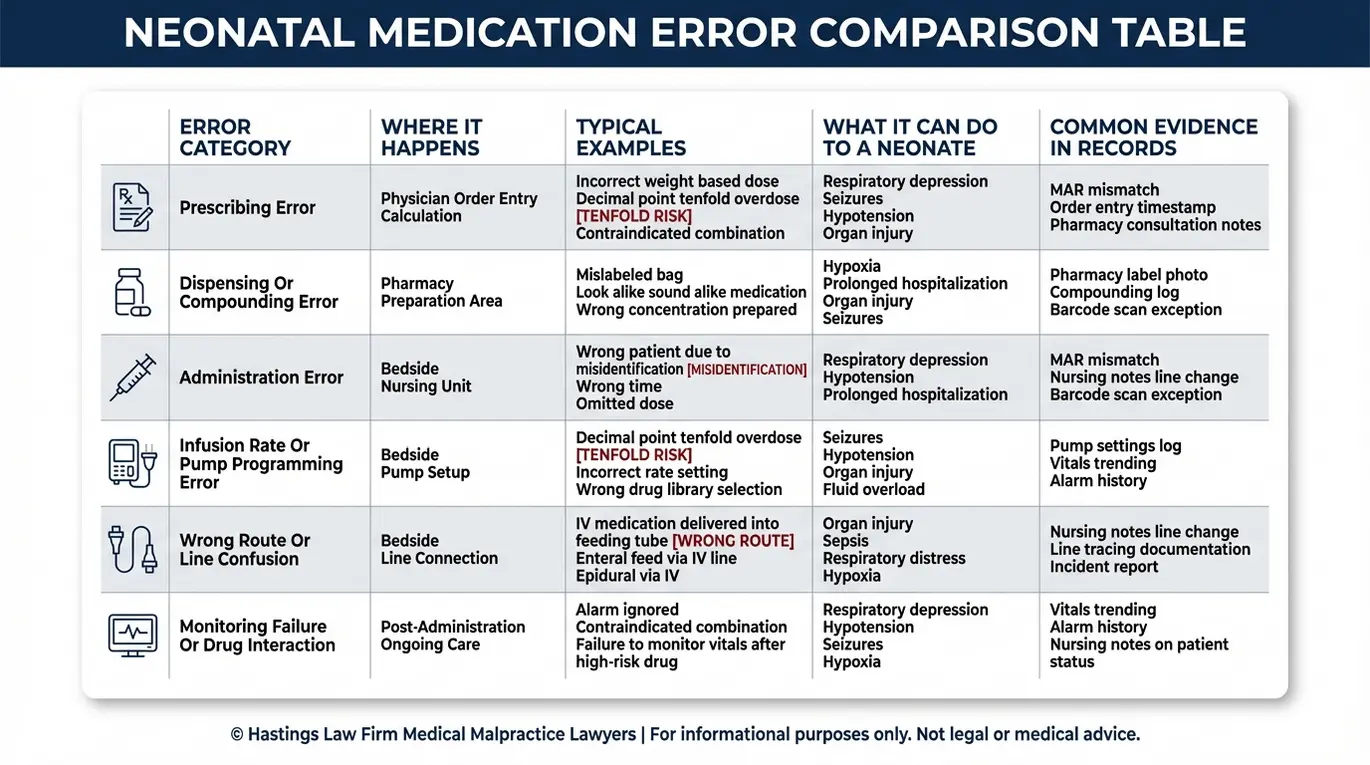
Common preventable errors in Texas NICUs include incorrect dosage calculations based on weight, confusion between IV and feeding tube lines, administering the wrong medication due to look-alike labels, and failure to monitor infusion rates. Understanding the specific type of error that occurred is essential to building a strong legal claim, because different failures may point to different responsible parties.
Prescribing errors occur at the physician level, when a doctor orders the wrong drug, the wrong dose, or fails to account for a known drug interaction or allergy. This often involves complex calculations that must be verified against the infant’s current weight, which changes daily. Dispensing errors happen in the pharmacy, where a medication may be compounded at the wrong concentration or placed in a mislabeled bag. Administration errors take place at the bedside when a nurse delivers the medication incorrectly, whether through the wrong route, at the wrong infusion rate, or to the wrong patient entirely.
One risk unique to the NICU is wrong-route administration, sometimes called line confusion. Neonates often have both IV lines and feeding tubes in place, and these lines can look similar. If a nurse administers an IV medication through a feeding tube, or vice versa, the consequences can be serious.
The U.S. Food and Drug Administration’s guidance on proprietary drug naming addresses the broader problem of look-alike/sound-alike (LASA) medications, where drug names or packaging are so similar that fatigued or understaffed nurses may grab the wrong vial. A tenfold dosing error, where a misplaced decimal point results in ten times the intended dose, remains one of the most frequent and dangerous mistakes in neonatal pharmacology.
As a medication error attorney for NICU patients, we examine the full medication-use process to identify exactly where the breakdown occurred. A NICU drug negligence lawyer must trace the chain from prescription to administration to pinpoint liability.
| Error Type | Where It Occurs | Example | Potential Impact on Infant |
|---|---|---|---|
| Prescribing Error | Physician/Provider | Wrong dose ordered for weight | Organ toxicity, overdose |
| Dispensing Error | Pharmacy | Mislabeled IV bag or wrong concentration | Systemic poisoning, cardiac arrest |
| Administration Error | Bedside (Nurse) | Wrong infusion rate or wrong patient | Brain injury, respiratory failure |
| Wrong-Route Error | Bedside (Nurse) | IV drug given through feeding tube | GI perforation, chemical burns |
| Monitoring Failure | Bedside/Unit | Failure to track drug levels or vitals post-dose | Undetected toxicity, organ damage |
The Hastings Law Firm Difference
Results matter, but what truly sets us apart is how we achieve them. Every verdict, every settlement, and every Texas courtroom victory comes from one guiding promise: To treat each client’s fight for justice as if it were our own.
This balance of skill, experience, and empathy reflects our core philosophy that justice should not only compensate the injured, but also make healthcare safer nationwide.

Establishing Liability for Infant Pharmaceutical Negligence
Liability often extends beyond the individual nurse to include the hospital for inadequate staffing or protocols, the attending physician for prescribing errors, or the pharmacy for dispensing mistakes. In cases of pharmaceutical negligence, liability refers to who is legally responsible for the error. The hospital, the pharmacy, and the broader care team may all share responsibility depending on how the error occurred and what systemic failures allowed it to happen.
Hospital systems liability is one of the most important areas we investigate. Hospitals are expected to implement safety technology and protocols that reduce medication errors, including barcode medication administration (BCMA). This is a system that uses barcode scanning to verify the right drug, dose, and patient before a medication is given.
The Indian Health Service’s BCMA End User Training Guide outlines how these systems are designed to function. When a facility fails to implement BCMA or allows staff to bypass it, that institutional decision can form the basis of a negligence claim. Facility negligence may also involve maintaining inadequate nurse-to-patient ratios, forcing staff to rush critical safety checks.
Pharmacy liability arises when the hospital’s compounding pharmacy prepares medications at the wrong concentration or mislabels an IV bag. Sterile compounding, the process of preparing injectable medications (IV admixture preparation) in a controlled environment, demands exact measurements. A compounding error can deliver a toxic dose even when the prescribing physician and bedside nurse both follow correct procedures.
The chain of command also matters. Attending physicians, residents, pharmacists, and nurses each have distinct responsibilities in the medication-use process. In many cases, we see these parties attempt to shift blame to one another. As a Texas NICU medication error lawyer, our job is to reconstruct the full timeline and identify every point where the standard of practice was violated. Our team’s in-house nursing staff and former defense attorneys know how hospital charting works and where documentation gaps tend to appear.

Proving Breach of Standard of Care in NICU Cases
Proving a breach requires demonstrating that a reasonably prudent NICU specialist, whether a neonatologist, nurse, or pharmacist, would have acted differently under similar circumstances, confirmed through expert testimony and rigorous analysis of medical records. The standard of care acts as the legal benchmark for safe medical practice.
In Texas medical malpractice cases, the standard of care refers to the level of treatment a competent healthcare provider in the same specialty would deliver under comparable conditions. For NICU cases, this standard is particularly demanding because of the fragility of neonates and the known risks of medication errors in this setting.
To build a case as a Texas NICU medication error lawyer, we rely on qualified neonatologists and pharmacologists who can review the records and provide expert opinions. Tommy Hastings is board-certified in Personal Injury Trial Law by the Texas Board of Legal Specialization, a credential held by less than 2% of attorneys in the state. Our experts specifically investigate complex factors such as polypharmacy, which is the concurrent use of multiple medications. They also examine whether the facility implemented safeguards against look-alike/sound-alike (LASA) medications.
One of the most significant challenges in these cases is causation, which is the link between the medical error and the resulting injury. Defense attorneys frequently argue that an infant’s injuries resulted from prematurity itself, not from a drug error. Separating the effects of a medication overdose from the complications of being born premature requires sophisticated medical analysis. Tools like the neonatal adverse events trigger tool studied on PubMed help identify patterns of drug-related harm in neonatal records that might otherwise be attributed to underlying conditions.
Here is what our investigation typically examines:
- Medication administration records (MARs) and electronic health records for dosing accuracy
- Pharmacy compounding logs and labeling documentation
- Infusion pump settings and programming records
- Nursing shift notes and handoff communications
- BCMA scan logs or evidence that scanning was bypassed
- Blood levels and lab results indicating drug toxicity
- Staffing records to evaluate whether the unit was adequately resourced
This evidence allows our experts to determine whether the standard of care was met and, if not, whether that failure directly caused your child’s injuries.
Calculating Damages and Life Care Planning for Injured Infants
Damages in NICU medication cases cover immediate medical bills, long-term costs for life care planning (therapy, equipment, nursing), and non-economic damages for the child’s pain and suffering and the parents’ mental anguish. Because many of these injuries affect infants who will need care for decades, accurately projecting future costs is one of the most important parts of the case.
Economic damages account for the measurable financial costs of the injury. For a child who suffers brain damage, such as cerebral palsy caused by drug-induced hypoxia, organ failure, or developmental disabilities from a drug error, these costs can be staggering. They include past and future hospitalizations, surgeries, rehabilitation, specialized therapies, adaptive equipment, home modifications, and around-the-clock nursing care. A life care plan, a detailed projection of a disabled child’s medical and non-medical needs over their lifetime, is the foundation of this calculation.
The American Academy of Nurse Life Care Planners’ Standards of Practice provides the framework our experts follow when developing these plans. This document accounts for medical inflation and the increasing complexity of care as the child ages, ensuring that funds remain available for their lifetime needs.
Non-economic damages address the losses that do not come with a receipt: physical pain, mental anguish, physical impairment, disfigurement, and loss of enjoyment of life. For parents, this category also includes the emotional suffering of watching their child endure preventable harm.
Wrongful death claims arise when a medication error proves fatal. Texas law allows parents to seek compensation for the loss of their child, including funeral expenses, loss of companionship, and the grief that follows. As a lawyer for NICU medication errors in Texas, we treat these cases with the gravity and sensitivity they deserve, working closely with life care planners and economists to ensure no future need goes unaccounted for.
Understanding the Statute of Limitations for Texas Infant Claims
While Texas generally has a two-year statute of limitations for medical malpractice, cases involving minors may have extended deadlines, though a strict 10-year Statute of Repose applies regardless of when the injury was discovered.
Under Texas Civil Practice and Remedies Code Chapter 74, the standard filing deadline begins on the date the negligent act occurred. For minors, the statute of limitations is tolled, meaning the clock is paused, and the child generally has until their 14th birthday to file suit. But the parents’ own claims for mental anguish and related damages may have different, shorter deadlines that are not subject to the same tolling.
⚠️ The 10-Year Statute of Repose: Texas law sets an absolute 10-year deadline from the date of the negligent act. This deadline cannot be extended for any reason, including minority status or delayed discovery of the injury. Once 10 years pass, the legal right to file is permanently lost.
Even though the extended timeline for minors may seem to provide breathing room, waiting can be costly. Medical records may be altered or destroyed. Witnesses relocate or forget critical details. Equipment logs and pharmacy records may not be retained indefinitely. As a Texas NICU medication error lawyer, we strongly encourage parents to consult with an attorney as early as possible to preserve the evidence needed to build a strong case.

Contact the Texas Birth Injury Attorneys at Hastings Law Firm Today for Help
No amount of money can undo the harm your child has suffered. But financial compensation is the only tool the legal system offers to provide the medical care, therapy, and support your child will need for the years ahead. That is why pursuing accountability matters, not just for your family, but to help prevent the same error from harming another infant.
Hastings Law Firm has the medical knowledge, legal experience, and resources to investigate NICU medication errors and hold the responsible parties accountable. Our team includes in-house nurses, board-certified patient advocates, and former defense attorneys who know how hospitals respond to these claims. As your Texas NICU medication error lawyer, we prepare every case as if it is going to trial, which puts us in the strongest possible position to secure a fair result.
We work on a contingency fee basis, which means you pay no attorney fees or costs unless we recover compensation for your family. Contact Hastings Law Firm today for a free, confidential case evaluation. Let us review what happened and help you understand your options.
Frequently Asked Questions About NICU Medication Error in Texas


This content was researched and written by the Hastings Law Firm editorial team, which includes attorneys, medical professionals, and experienced researchers. Our writing is informed by internal knowledge and practical experience, and we cross-check critical details against authoritative sources cited throughout. Every piece undergoes human-led fact-checking and legal review. Because legal and medical information can change, if you spot an error, please contact us. Learn more about our content standards and review process on our editorial policy page.

Tommy Hastings, founder of Hastings Law Firm, is a board-certified personal injury trial lawyer dedicated exclusively to healthcare injury cases. Since 2001, he has represented injured patients and families in litigation against major hospital systems, pharmaceutical companies, and negligent healthcare providers nationwide. He has handled numerous high-profile cases that have drawn national media attention and resulted in multi-million dollar recoveries. He draws on that experience in his writing, helping readers understand how these cases work and what options may be available to them.
