


Texas Intrauterine Growth Restriction Lawyer
Written by: Hastings Law Firm | Reviewed by: Tommy Hastings | Updated: July 27, 2026
Intrauterine growth restriction linked to placental insufficiency can leave a baby without enough oxygen and nutrients to grow safely. When warning signs are missed or care is delayed, the result can be lasting harm that affects a child and family for years. Understanding how growth restriction is identified, monitored, and managed can clarify whether care fell short of accepted standards and why timing decisions matter. If you or a loved one were harmed or worse due to missed or mismanaged intrauterine growth restriction in Texas, contact Hastings Law Firm for a free, confidential case review.

Top Rated Medical Malpractice Attorneys for Placental Insufficiency Birth Injuries
What You Should Know About Placental Insufficiency Birth Injury Claims in Texas:
- Lasting neurologic harm can occur when placental insufficiency is not managed with timely delivery because prolonged low oxygen can injure the brain.
- A stillbirth can occur when delivery is delayed in the face of complete placental failure.
- Preventable injury is more often alleged with asymmetrical intrauterine growth restriction because it develops later when routine screening and timely intervention can change outcomes.
- Liability disputes often turn on whether growth restriction was missed during routine screening or recognized but not managed with appropriate escalation.
- Options in Texas can be limited by filing time limits for medical malpractice claims, including special rules for minors and an absolute cutoff.
- Recovery for non economic harms can be limited in Texas because state law caps certain damages even when injuries are severe.
- Economic losses can remain recoverable in Texas because the article states that future medical care and related costs are not capped.
- Missed fundal height trends can be central because routine measurements are described as a basic screening tool for poor fetal growth.
- Delayed response to abnormal ultrasound or Doppler findings can be central because absent or reversed umbilical artery flow paired with inaction is described as a key negligence indicator.
- Placental pathology findings can be important because reports may confirm vascular insufficiency patterns that serve as objective medical proof.

A Healthcare Focused Law Firm
When a baby doesn’t grow as expected during pregnancy, it can be a sign of a serious condition that required closer attention from the medical team. If your child suffered harm because intrauterine growth restriction was missed or mismanaged, you may be asking whether your doctor did everything they should have. That feeling deserves to be taken seriously.
As a Texas Intrauterine Growth Restriction Lawyer, Hastings Law Firm focuses exclusively on medical malpractice. Our team, led by board-certified trial attorney Tommy Hastings, includes in-house nurses and former defense attorneys who know how to examine prenatal records, identify where the standard of care may have been breached, and build a case around the medical evidence. We work on a contingency fee basis, which means you pay no attorney fees unless we recover compensation for your family.
If you believe your child’s birth injury could have been prevented, we can review what happened and explain your options.
Understanding Intrauterine Growth Restriction and Placental Insufficiency
Intrauterine Growth Restriction (IUGR) is a medical condition where a fetus fails to reach its genetic growth potential, often caused by placental insufficiency where the placenta acts as a failing life-support system that cannot deliver adequate oxygen and nutrients.
The placenta functions as the baby’s lifeline. It acts as the lungs, kidneys, and digestive system for the developing fetus. When placental dysfunction occurs, the baby is essentially starved of what it needs to grow. According to the National Center for Biotechnology Information (NCBI), fetal growth restriction affects a significant number of pregnancies and is a leading contributor to low birth weight and adverse outcomes.
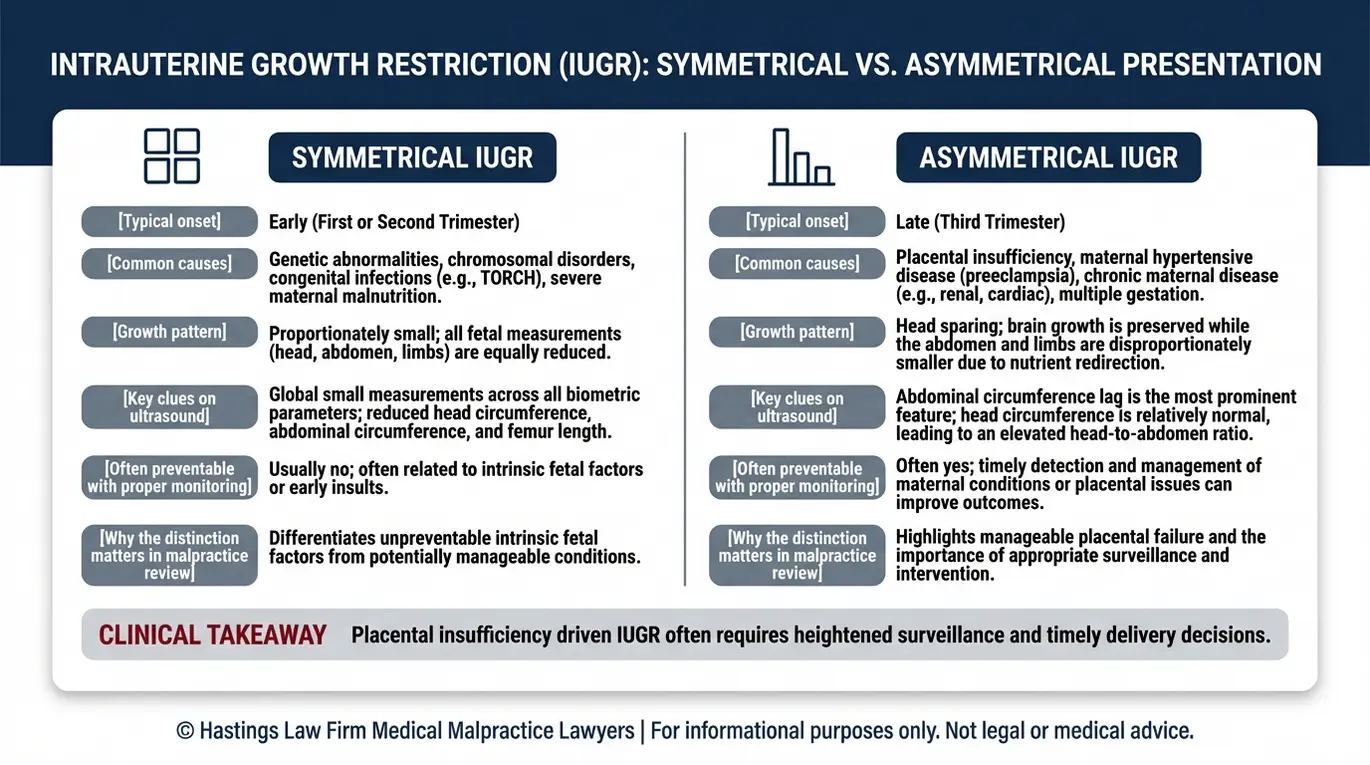
Doctors typically classify IUGR into two types, and the distinction matters for both treatment and legal accountability. Attorneys for intrauterine growth restriction cases evaluate which type was present because it affects what the medical team should have done and when based on the gestational age.
| Feature | Symmetrical IUGR | Asymmetrical IUGR |
|---|---|---|
| Onset | Early in pregnancy | Later in pregnancy (second or third trimester) |
| Common Causes | Genetic conditions, chromosomal abnormalities, infections | Placental insufficiency, preeclampsia |
| Growth Pattern | Head and body are proportionally small | Head size is normal; body and abdomen are smaller |
| Relation to Negligence | Less commonly tied to provider error | More frequently linked to failures in monitoring and delivery timing |
Asymmetrical IUGR is the type most often connected to preventable harm because it develops later in pregnancy, when routine screening and timely intervention can make a measurable difference in outcomes.
How Negligent Management of IUGR Leads to Birth Injuries
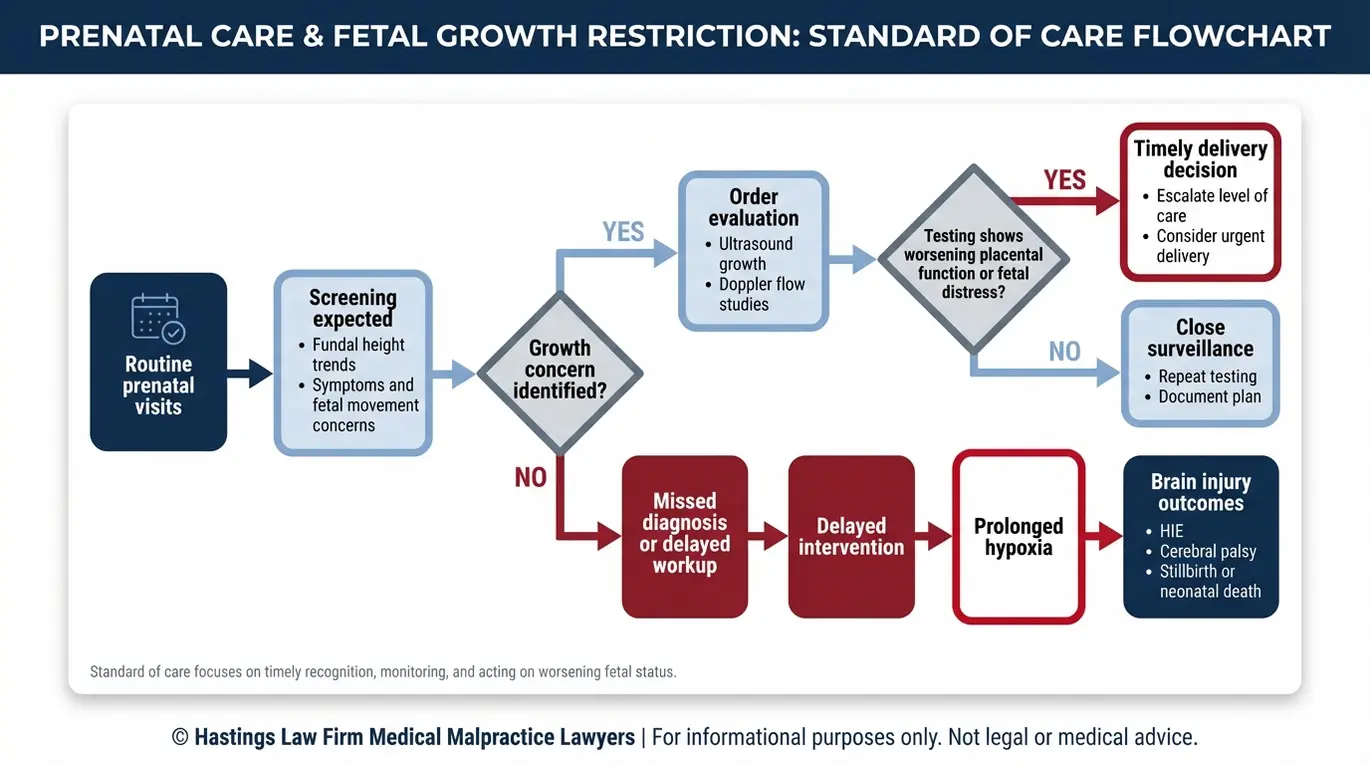
Medical malpractice occurs when healthcare providers fail to diagnose growth restriction through routine screening or fail to intervene with an emergency C-section once fetal distress is detected. The standard of care generally requires that providers track fetal growth at each prenatal visit and escalate testing when something looks abnormal. An IUGR malpractice lawyer in Texas can examine the medical timeline to determine if these standards were upheld.
Common acts of negligence in these cases include:
- Failure to diagnose: Not measuring fundal height, the distance from the pubic bone to the top of the uterus, at routine visits, or missing measurements that fall below expected ranges. According to the Cleveland Clinic, fundal height is a basic screening tool that can signal when a baby is not growing properly.
- Failure to monitor: Not performing adequate fetal monitoring, such as follow-up ultrasounds or umbilical artery Doppler flow studies, when screening suggests the fetus may be growth-restricted. These tests measure blood flow between the placenta and baby to ensure the standard of care is being met.
- Failure to act: Delaying an emergency C-section or induction when testing reveals the baby is experiencing hypoxia. Hypoxia is a dangerous reduction in oxygen that can cause permanent brain injury.
Liability in Diagnosing vs. Managing Fetal Growth Restriction
The first category of liability involves failing to catch intrauterine growth restriction early enough. If a provider missed abnormal fundal height readings or skipped routine ultrasounds, the diagnosis itself may have been delayed past the point where monitoring could protect the baby.
The second involves diagnosing IUGR correctly but failing to deliver the baby before permanent damage occurred. A malpractice attorney will examine both the diagnostic timeline and the management decisions to determine where the breakdown happened. A provider who identified asymmetrical IUGR but did not order Doppler studies or escalate to delivery may still be liable for resulting harm.
The Hastings Law Firm Difference
Results matter, but what truly sets us apart is how we achieve them. Every verdict, every settlement, and every Texas courtroom victory comes from one guiding promise: To treat each client’s fight for justice as if it were our own.
This balance of skill, experience, and empathy reflects our core philosophy that justice should not only compensate the injured, but also make healthcare safer nationwide.

Common Complications and Long-Term Effects of Placental Failure
If placental insufficiency is not managed with timely delivery, the fetus may suffer from chronic fetal hypoxia, a prolonged reduction in oxygen supply that can cause permanent brain damage, cerebral palsy, or stillbirth.
The medical challenge is one of timing. Delivering too early exposes the baby to the risks of premature birth, including underdeveloped lungs and other organ systems. But waiting too long in the face of a failing placenta can lead to hypoxic-ischemic injury, a type of brain injury caused by oxygen deprivation and restricted blood flow, or even neonatal death.
Research published by the National Library of Medicine (PubMed) confirms that infants with late-onset fetal growth restriction face elevated risks of neurodevelopmental impairment. Potential long-term complications include:
- Cerebral palsy (CP): Permanent motor disability caused by brain injury before, during, or shortly after birth.
- Hypoxic-ischemic injury: Brain damage from oxygen deprivation that can range from mild to severe.
- Developmental delays: Cognitive, speech, and behavioral challenges that may not become apparent until early childhood.
- Stillbirth: Fetal death resulting from complete placental failure when delivery is delayed.
Proving Malpractice with Medical Evidence and Expert Testimony
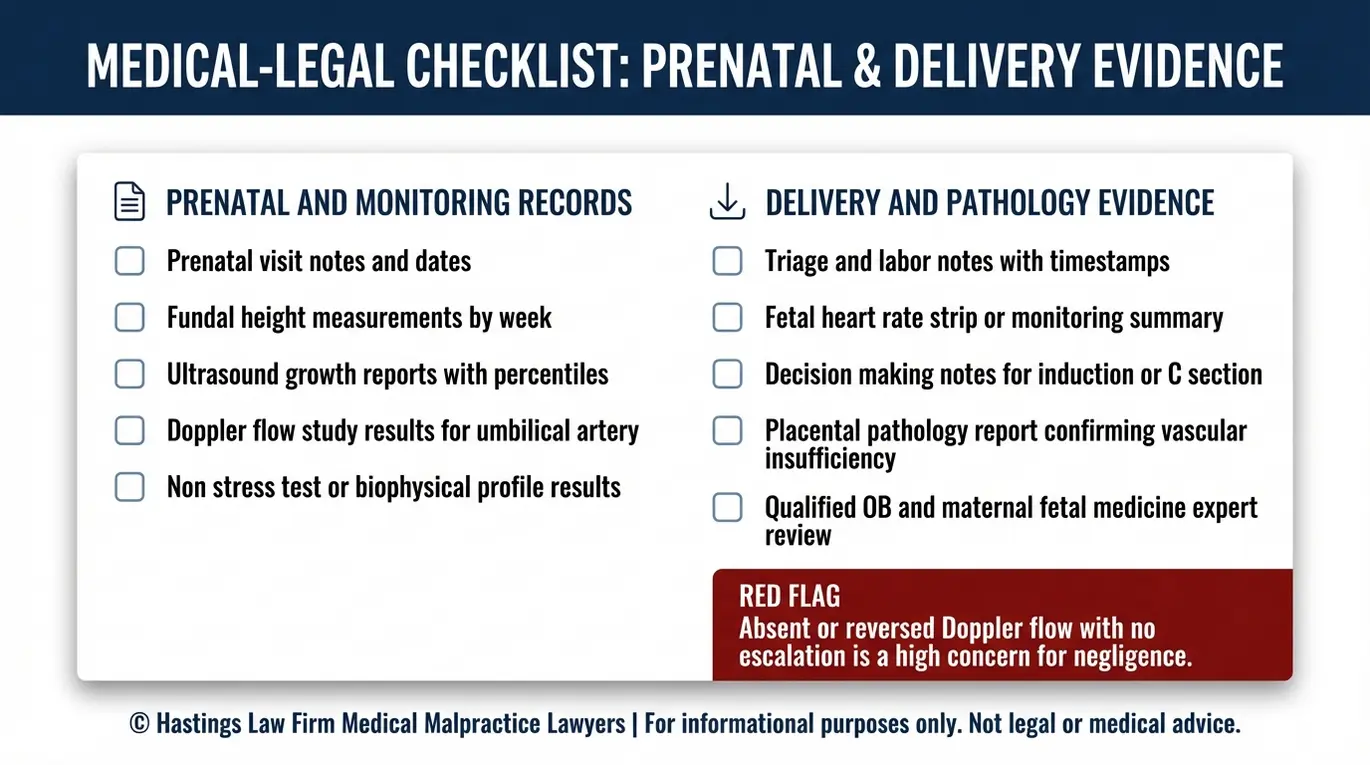
Successfully proving a claim requires specific evidence such as prenatal charts showing missed growth trends and placental pathology reports that confirm vascular insufficiency. Our legal and medical team works together to reconstruct the prenatal timeline and identify where the standard of care was not met.
A placental pathology report, a document completed after delivery by examining the placenta under a microscope, is one of the most important pieces of evidence in these cases. It can confirm whether maternal vascular malperfusion (MVM), a pattern of inadequate blood flow from the mother to the placenta, was present. Research from PubMed Central connects MVM findings to maternal cardiovascular and thrombotic risk profiles, reinforcing its value as objective medical proof.
Doppler flow study results are often the strongest evidence in an IUGR case. If blood flow in the umbilical artery was absent or reversed and the provider did not act, that gap between the clinical finding and the response can establish negligence.
Key evidence our team examines from the medical records includes:
- Fundal height measurements across all prenatal visits
- Serial ultrasound reports showing growth percentile trends
- Doppler flow study results for the umbilical artery
- Fetal non-stress test strips and biophysical profile scores
- The placental pathology report
- Delivery room records and nursing notes documenting timing of decisions
- Expert witness analysis from maternal-fetal medicine specialists
Contact the Texas Birth Injury Attorneys at Hastings Law Firm Today for Help
A diagnosis of intrauterine growth restriction should have triggered heightened monitoring, not complacency. If your child suffered a preventable injury because warning signs were missed or delivery was delayed, you deserve to know what happened and why.
At Hastings Law Firm, our team of attorneys, nurse consultants, and medical experts has the experience to examine your prenatal records, identify breakdowns in the standard of care, and build a case supported by medical evidence. As a Texas Intrauterine Growth Restriction Lawyer, we handle these cases exclusively, and we do so on a contingency fee basis. You pay nothing unless we secure a recovery for your family.
Contact us for a free, confidential case evaluation. Let us help you find the answers you deserve.
Frequently Asked Questions About Intrauterine Growth Restriction in Texas


This content was researched and written by the Hastings Law Firm editorial team, which includes attorneys, medical professionals, and experienced researchers. Our writing is informed by internal knowledge and practical experience, and we cross-check critical details against authoritative sources cited throughout. Every piece undergoes human-led fact-checking and legal review. Because legal and medical information can change, if you spot an error, please contact us. Learn more about our content standards and review process on our editorial policy page.

Tommy Hastings, founder of Hastings Law Firm, is a board-certified personal injury trial lawyer dedicated exclusively to healthcare injury cases. Since 2001, he has represented injured patients and families in litigation against major hospital systems, pharmaceutical companies, and negligent healthcare providers nationwide. He has handled numerous high-profile cases that have drawn national media attention and resulted in multi-million dollar recoveries. He draws on that experience in his writing, helping readers understand how these cases work and what options may be available to them.
