


Texas Hypernatremic Dehydration Lawyer
Written by: Hastings Law Firm | Reviewed by: Tommy Hastings | Updated: July 27, 2026
Hypernatremic dehydration in newborns is a preventable medical emergency that can cause severe brain injury when early warning signs are missed. Families may feel overwhelmed when feeding problems are not taken seriously and a baby becomes dangerously ill under medical supervision. This topic often turns on whether providers monitored feeding adequacy, weight changes, and blood sodium levels and whether timely testing and intervention occurred. Accountability may involve both individual clinicians and hospital systems when discharge and follow up are unsafe. If you or a loved one were harmed or worse due to hypernatremic dehydration in Texas, contact Hastings Law Firm for a free, confidential case review.
Top Rated Birth Injury Attorneys Helping Families Across Texas
What You Should Know About Infant Hypernatremia Misdiagnosis Claims in Texas:
- Life altering brain injury can result when hypernatremic dehydration is not recognized and treated promptly.
- Accountability can extend beyond a pediatrician when hospital staff and systems fail to detect inadequate feeding and fluid imbalance.
- Disputes often arise when providers shift blame to breastfeeding rather than addressing missed clinical warning signs.
- Long term harm can be tied to intracranial hemorrhage, seizures, or permanent structural damage when sodium levels rise too high.
- Additional neurological injury can occur when sodium is corrected too rapidly during treatment.
- Recovery options in Texas can be limited for non economic damages because state caps apply in medical malpractice cases.
- Financial recovery can be driven by lifetime care needs because economic damages for measurable costs are not capped in Texas.
- A case can be lost entirely if required expert support is not provided in time because dismissal can be with prejudice.
- Options can be cut off by strict time limits for filing because Texas applies both limitations rules for minors and an absolute repose deadline.
- Clarity about what happened can depend on hospital records because weight trends, nursing logs, and lab testing decisions may show missed warning signs.

A Healthcare Focused Law Firm
When a newborn suffers a preventable brain injury, the emotional weight on a family is immense. You trusted your medical team to monitor your baby’s health, and learning that something may have gone wrong can leave you feeling overwhelmed and unsure of what to do next. Hypernatremic dehydration, a dangerous condition where an infant’s blood sodium levels rise to harmful concentrations because of insufficient fluid intake, is a recognized and preventable medical emergency. When healthcare providers fail to identify the warning signs early, the consequences can be life-altering.
Founded by board-certified trial lawyer Tommy Hastings, our firm focuses exclusively on medical malpractice cases. Tommy is board-certified in Personal Injury Trial Law by the Texas Board of Legal Specialization, a distinction held by less than 2% of attorneys in the state. Our team includes in-house nurses and former defense attorneys who understand how hospitals work from the inside. Tommy is also an invite-only member of the American Board of Trial Advocates (ABOTA), an organization reserved for elite trial lawyers with significant experience.
If your child was harmed by undiagnosed or mismanaged dehydration, a Texas hypernatremic dehydration lawyer at our firm can review what happened and explain your legal options at no cost to you.
Proving Medical Negligence in Hypernatremic Dehydration Cases
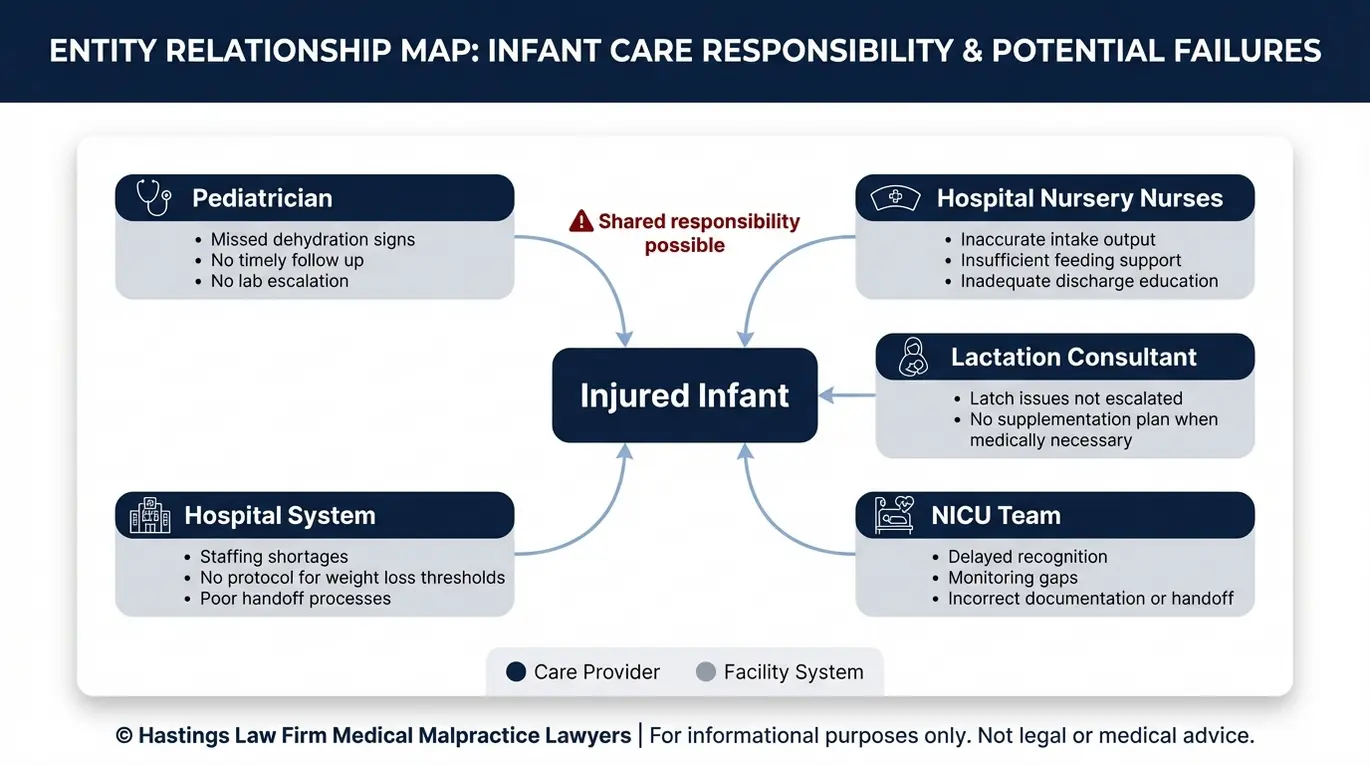
Proving negligence requires showing that a pediatrician, nurse, or other provider failed to monitor newborn weight loss or serum sodium levels, the concentration of sodium (Na+) measured in the blood, according to the accepted standard of care, and that this failure directly caused the infant’s injury.
Medical malpractice claims in these cases rest on four connected elements: duty, breach, causation, and damages. The healthcare provider owed your baby a duty of care. If they fell below the standard that a reasonably competent provider would have met under the same circumstances, that is a breach. We then must connect that breach to the harm your child suffered.
What the Standard of Care Requires
For newborns, the standard of care generally requires close monitoring of feeding adequacy and weight. Excessive newborn weight loss, typically defined as losing more than 10% of birth weight, is a well-established red flag. According to clinical guidance from Stanford Medicine’s Newborn Nursery, an infant who crosses this threshold requires prompt evaluation and intervention.
Research published in PubMed on the clinical presentation of hypernatremic dehydration in exclusively breastfed neonates confirms that warning signs are often present well before the condition becomes critical. When those signs are missed or dismissed, and a simple blood test could have revealed dangerously elevated sodium, the failure to act can constitute medical negligence. A hypernatremic dehydration attorney examines the medical records to determine whether providers ordered appropriate tests, responded to clinical warning signs, and intervened in time.
Warning Signs We Look for in the Medical Records
- Documented weight loss exceeding 7 to 10% of birth weight without intervention
- Fewer than expected wet or soiled diapers recorded in nursing logs
- Notes describing infant lethargy, poor feeding, or weak latch without follow-up orders
- Absence of serum sodium or electrolyte testing despite clinical indicators
- Discharge from the hospital before feeding adequacy was confirmed
- Parental concerns about feeding difficulties documented but not acted upon
One of the most common defense strategies in these cases is to shift blame onto the mother, framing the injury as a breastfeeding problem rather than a diagnostic failure. But a provider’s duty does not stop at encouraging breastfeeding. If the infant is not getting adequate nutrition, the medical team is responsible for identifying the problem and taking corrective action. A Texas malpractice lawyer experienced in these cases can counter that defense by focusing on what the clinical evidence actually shows.
Mechanism of Injury and Long-Term Consequences
Understanding how hypernatremic dehydration injures the brain is central to proving causation. When sodium levels in the blood rise too high, the body attempts to balance the concentration through osmotic fluid shifts, the natural movement of water from areas of lower solute concentration to areas of higher concentration. In a newborn’s brain, this process pulls fluid out of brain cells, causing the brain tissue to shrink.
That shrinkage can tear delicate blood vessels, leading to intracranial hemorrhage, seizures, or permanent structural damage. If sodium is corrected too rapidly during treatment, the infant also faces the risk of osmotic demyelination syndrome (ODS), a condition where the protective coating around nerve fibers breaks down, potentially causing additional neurological harm.
The long-term consequences can include cerebral palsy, developmental delays, learning disabilities, epilepsy, and in the most severe cases, death. Establishing the mechanism of injury for high sodium levels requires the work of qualified experts who can connect a healthcare provider‘s failure to the child’s long-term health.
Liability of Pediatricians and Hospitals for Infant Dehydration
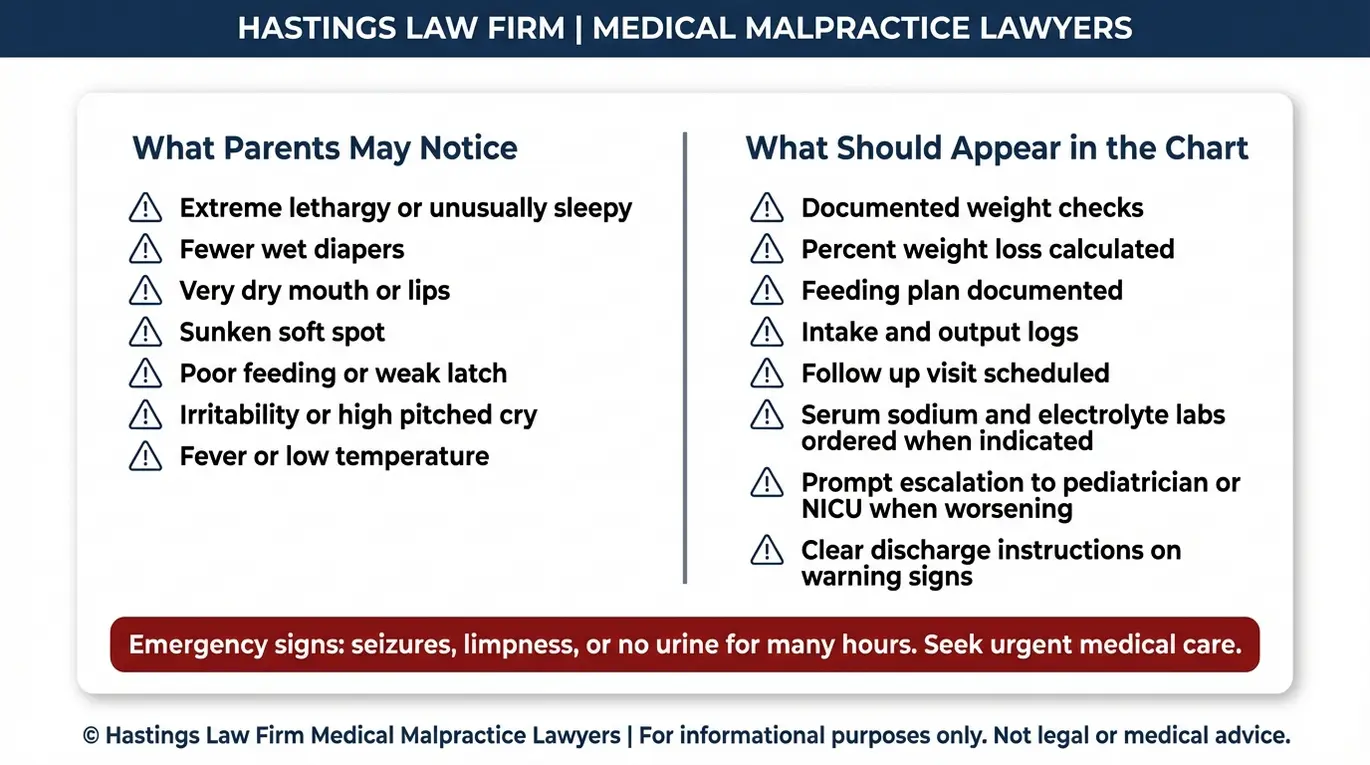
Liability often extends well beyond the pediatrician to include hospital nurses, lactation consultants, and NICU staff who failed to recognize critical signs of inadequate feeding or fluid imbalance in a newborn. Identifying who is responsible for a newborn’s high sodium levels requires a look at hospital-wide care.
Medical malpractice cases involving infant dehydration frequently involve multiple parties, each with distinct duties. When investigating a potential claim to identify misdiagnosis or delayed diagnosis, we examine the role of every healthcare provider who had contact with the mother and baby, from delivery through discharge and follow-up.
| Responsible Party | Common Failures |
|---|---|
| Pediatrician | Failing to schedule timely follow-up visits; dismissing parental concerns about poor feeding; not ordering electrolyte panels when weight loss is documented |
| Hospital Nurses | Inaccurate intake and output (I&O) monitoring, which tracks how much an infant eats and eliminates; failing to escalate concerns about feeding adequacy to the attending physician |
| Lactation Consultants | Not recognizing signs of insufficient milk transfer, a situation where the infant does not receive enough breast milk volume despite attempted feedings; failing to recommend supplemental feeding, the provision of formula or expressed breast milk, when the baby is losing weight |
| Hospital Administration | Inadequate staffing levels; lack of standardized breastfeeding support protocols; premature discharge without confirmed feeding adequacy |
Research published by PubMed Central on safe discharge of the late preterm infant highlights that discharge planning must include verified feeding competence and a clear follow-up plan. When hospitals release newborns without these safeguards, the institution itself may bear liability.
A lawyer for dehydration malpractice will review hospital policies, staffing records, and nursing documentation to identify where the system broke down. In many cases, suing a hospital for dehydration involves demonstrating not just individual errors, but institutional failures that allowed those errors to happen. Our team, which includes nurses who formerly worked in hospital settings, understands exactly where to look. If your baby was injured, an infant injury attorney at our firm can help determine which parties may be held accountable.
Common NICU and Nursery Errors
In the NICU or newborn nursery, system-level errors can compound individual mistakes. Inaccurate intake and output (I&O) monitoring, the systematic tracking of an infant’s fluid consumption and elimination, is one of the most common monitoring failures we encounter. When nurses record feeding volumes inaccurately or fail to log output consistently, dangerous trends go unnoticed.
Other errors include failure to order a timely electrolyte panel, sometimes called a basic metabolic panel (BMP), which measures sodium, potassium, and other critical blood chemistry markers. Medication mix-ups, staffing shortages during shift changes, and gaps in communication between providers can also delay diagnosis. These are the types of system failures our medical-legal team investigates thoroughly in every case we accept.
The Hastings Law Firm Difference
Results matter, but what truly sets us apart is how we achieve them. Every verdict, every settlement, and every Texas courtroom victory comes from one guiding promise: To treat each client’s fight for justice as if it were our own.
This balance of skill, experience, and empathy reflects our core philosophy that justice should not only compensate the injured, but also make healthcare safer nationwide.

Understanding Damages for Brain Injuries Caused by Sodium Imbalance
Texas law allows families to recover both economic damages for the lifetime cost of medical care and non-economic damages for pain, suffering, and physical impairment, though state caps apply to certain categories. When a child suffers a brain injury from hypernatremic dehydration, the financial and emotional toll on a family can last decades.
Texas medical malpractice law recognizes this by allowing recovery across several categories of harm. Economic damages are not capped in Texas. These cover the actual, measurable costs of the injury, including:
- Past and future medical bills, including hospitalizations, surgeries, and specialist visits
- Rehabilitative therapies such as physical, occupational, and speech therapy
- Specialized educational services and adaptive equipment
- In-home nursing or attendant care for children with severe impairments
- Lost future earning capacity if the brain injury limits the child’s ability to work as an adult
A detailed life care plan, prepared by qualified medical and economic experts, is often essential to documenting these costs accurately. Compensation for a dehydration injury must account for the full scope of a child’s projected needs.
Non-economic damages compensate for the child’s physical pain, loss of enjoyment of life, and the parents’ mental anguish. However, under Texas Civil Practice and Remedies Code Chapter 74, Texas applies damage caps to non-economic damages in medical malpractice cases. The cap applies per defendant category: roughly $250,000 against a physician and an additional amount against a hospital, with the total non-economic recovery reaching up to approximately $750,000 depending on how many defendants are involved. In cases involving a child’s death, wrongful death claims carry their own damage structure.
A Texas hypernatremic dehydration lawyer can evaluate the full value of your claim and identify every potential source of recovery. At Hastings Law Firm, we work with life care planners and economists to build damage models that reflect the true cost of your child’s injury.
Chapter 74 Expert Reports and the Burden of Proof
Texas law requires plaintiffs to file a qualified expert medical report within 120 days after the defendant files their answer, a strict procedural requirement that demands specialized legal resources from the start. These expert reports are necessary to explain how a baby developed dangerous sodium levels while under medical supervision.
This requirement comes from the Texas Medical Liability Act, codified in Texas Civil Practice and Remedies Code Section 74.351. The expert report must be authored by a qualified healthcare professional and must address three specific points: the applicable standard of care, how the defendant breached that standard, and how the breach caused the patient’s injury.
For hypernatremic dehydration cases, this typically means retaining a board-certified pediatrician or neonatologist who can speak with authority about newborn feeding protocols, weight monitoring standards, and the clinical significance of elevated sodium levels. Meeting the burden of proof and filing a dehydration lawsuit without the right expert from the beginning puts the entire case at risk.
If the report is not filed within the 120-day window, or if the court finds it insufficient, the case faces automatic dismissal with prejudice, meaning it cannot be refiled. This is one of the most important medical malpractice requirements in Texas and a primary reason families need an attorney experienced in these claims. Our firm maintains a national network of pediatric and neonatal experts who serve as expert witnesses for dehydration and related birth injury cases, and we begin building the expert foundation from the day we accept a case.
Texas Statute of Limitations and Deadlines for Minors
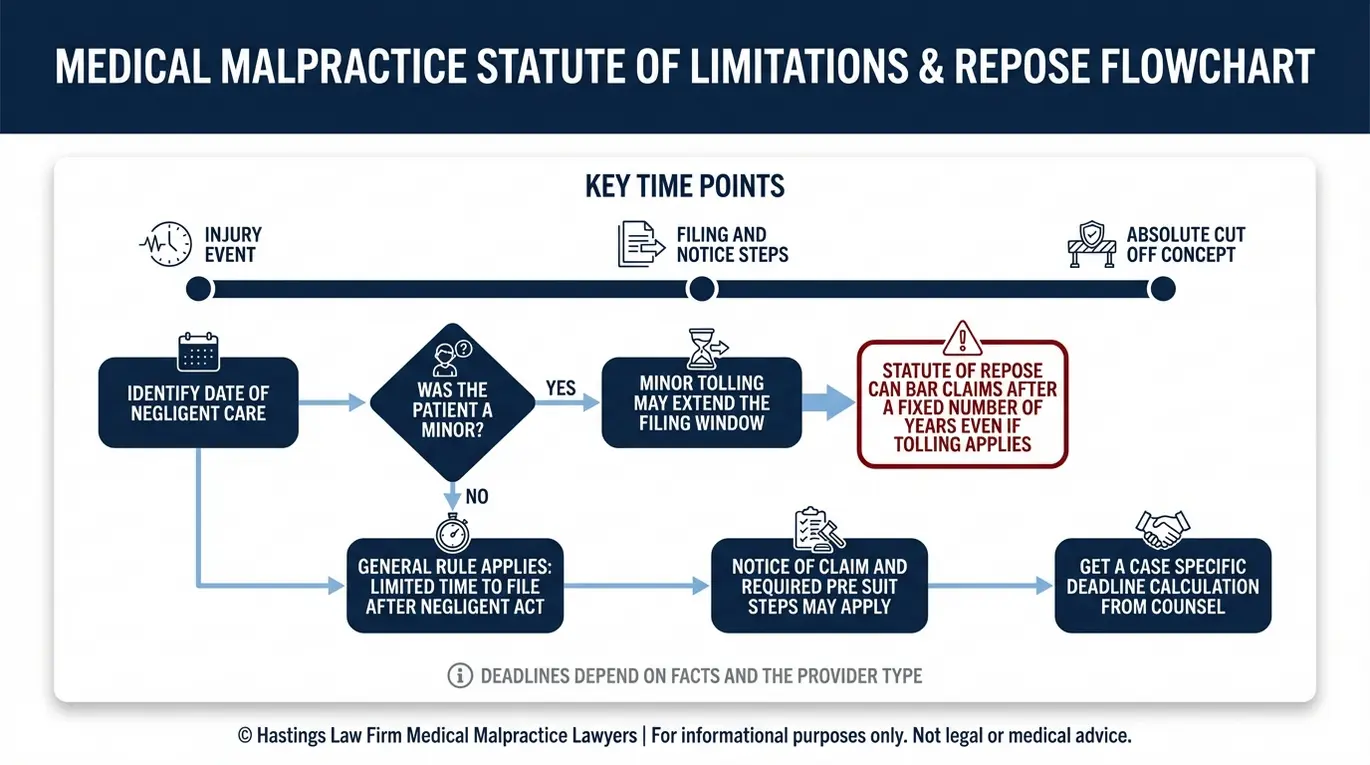
While the standard statute of limitations for medical malpractice in Texas is two years from the date of the injury, cases involving minors have tolled deadlines that may extend the filing window. In these cases, it is vital to track the timeline from the moment the dehydration occurred.
Under Texas law, the two-year clock generally begins on the date the negligent act occurred. However, for children, the statute of limitations is tolled, or paused, until the minor turns 18. This means a child injured as a newborn may have until their 20th birthday to file a claim.
There is an important exception. Texas also imposes a statute of repose, an absolute 10-year deadline that cannot be extended regardless of the patient’s age or when the injury was discovered. Under Texas Civil Practice and Remedies Code Section 74.051, no medical malpractice claim can be filed more than 10 years after the date of the alleged negligence, even for a minor.
The discovery rule may apply in limited situations where the injury was not immediately apparent, but Texas courts interpret this exception narrowly. Waiting to consult a legal professional about your deadline to sue is risky. Strict rules, including the notice of claim requirement, mean that delay can be fatal to your case. If you believe your child was harmed, speaking with an attorney about legal time limits sooner rather than later protects your family’s ability to seek accountability.
Contact the Texas Birth Injury Attorneys at Hastings Law Firm Today for Help
If your child suffered a brain injury from hypernatremic dehydration, you deserve answers about what happened and whether it could have been prevented. These cases are medically and legally complex, but you do not have to work through them alone.
Hastings Law Firm was founded on a commitment to restoring trust for families who have been failed by the healthcare system. Our team of attorneys, nurse consultants, and medical experts focuses exclusively on medical malpractice, and we prepare every case as though it will go to trial. We operate on a contingency fee basis, which means you pay no attorney fees or costs unless we secure a recovery for your family.
Contact us today to discuss your case with a dedicated Texas hypernatremic dehydration lawyer. Your consultation is free, confidential, and carries no obligation.
Frequently Asked Questions About Hypernatremic Dehydration in Texas


This content was researched and written by the Hastings Law Firm editorial team, which includes attorneys, medical professionals, and experienced researchers. Our writing is informed by internal knowledge and practical experience, and we cross-check critical details against authoritative sources cited throughout. Every piece undergoes human-led fact-checking and legal review. Because legal and medical information can change, if you spot an error, please contact us. Learn more about our content standards and review process on our editorial policy page.

Tommy Hastings, founder of Hastings Law Firm, is a board-certified personal injury trial lawyer dedicated exclusively to healthcare injury cases. Since 2001, he has represented injured patients and families in litigation against major hospital systems, pharmaceutical companies, and negligent healthcare providers nationwide. He has handled numerous high-profile cases that have drawn national media attention and resulted in multi-million dollar recoveries. He draws on that experience in his writing, helping readers understand how these cases work and what options may be available to them.
