


Texas Discordant Twin Growth Negligence Lawyer
Written by: Hastings Law Firm | Reviewed by: Tommy Hastings | Updated: July 27, 2026
Discordant twin growth can signal a high risk pregnancy where one baby is not getting enough blood flow or nutrients. When warning signs are missed or monitoring is delayed, families may face premature birth, intensive care, long term neurological injury, or worse. Understanding expected surveillance, timely referral to maternal fetal medicine, and careful interpretation of ultrasound and Doppler findings can clarify whether care met acceptable standards. If you or a loved one were harmed or worse due to discordant twin growth negligence in Texas, contact Hastings Law Firm for a free, confidential case review.
Top Rated Birth Injury Attorneys Helping Families Across Texas
What You Should Know About Unequal Fetal Growth Malpractice Claims in Texas:
- Severe and lasting harm can follow when discordant twin growth is not recognized and managed as a high risk pregnancy.
- Uncertainty about whether care met acceptable standards often turns on whether the growth gap was identified and acted on.
- Lost opportunities for safer outcomes can occur when referral to a maternal fetal medicine specialist is delayed.
- Limited recovery for non financial losses can affect overall compensation in Texas because non economic damages are capped while economic damages are not.
- Disputes over whether an injury was unavoidable are common because defenses may blame genetics or maternal conditions instead of provider failures.
- Stronger clarity on causation can come from placental pathology because it can show abnormal vascular connections and uneven blood supply.
- Clearer insight into missed warning signs can come from prenatal records such as ultrasound findings and Doppler studies.
- Access to medical records can shape decision making because families have a right to obtain their health information under HIPAA.

A Healthcare Focused Law Firm
When a twin pregnancy results in a preventable injury, the emotional toll can be overwhelming. You may feel confused about what went wrong, unsure whether the care your babies received met acceptable standards, and uncertain about where to turn for answers. Those feelings are valid, and you are not alone.
At Hastings Law Firm, we focus exclusively on medical malpractice, including cases involving discordant growth in twin pregnancies. When you need a Texas discordant twin growth negligence lawyer, our team combines legal knowledge with in-house medical staff to help families understand what happened and whether a provider’s failure to act caused harm. If your twins suffered injuries that you believe were preventable, we can review the medical records and explain your options during a free, confidential consultation.
Understanding Discordant Twin Growth and Medical Negligence
Discordant twin growth occurs when there is a significant size difference—typically greater than 20%—between twin fetuses, often signaling conditions like Twin-to-Twin Transfusion Syndrome (TTTS) or Selective Intrauterine Growth Restriction (sIUGR). Selective Intrauterine Growth Restriction (sIUGR) involves one twin failing to grow at a normal rate due to placental issues. A retrospective analysis of 2,348 twin pregnancies published in PubMed Central confirmed that increasing levels of birthweight discordance are associated with higher rates of adverse neonatal outcomes.
Any multiple pregnancy carrying twins and multiples is classified as high-risk. When discordant growth is present, that risk level increases substantially because the smaller twin may not be receiving adequate blood flow or nutrients. Providers are expected to recognize this disparity early and respond with a clear management plan.
In medical malpractice involving twins, the central question is whether the care team identified the growth gap and acted on it. Red flags that should prompt immediate investigation include:
- A weight difference of 20% or more between twins on ultrasound
- Abnormal umbilical artery Doppler findings in the smaller twin
- Decreasing amniotic fluid around one twin (oligohydramnios)
- Absent or reversed end-diastolic flow on Doppler studies
- Failure to refer the mother to a maternal-fetal medicine specialist
If medical teams ignore these warning signs, the condition can cause severe consequences for one or both babies. A qualified twin birth injury attorney or Texas discordant twin growth negligence lawyer examines the prenatal record to determine whether providers recognized indicators of fetal growth restriction and whether the response met the standard expected in a high-risk pregnancy.
The Standard of Care: Monitoring High-Risk Twin Pregnancies
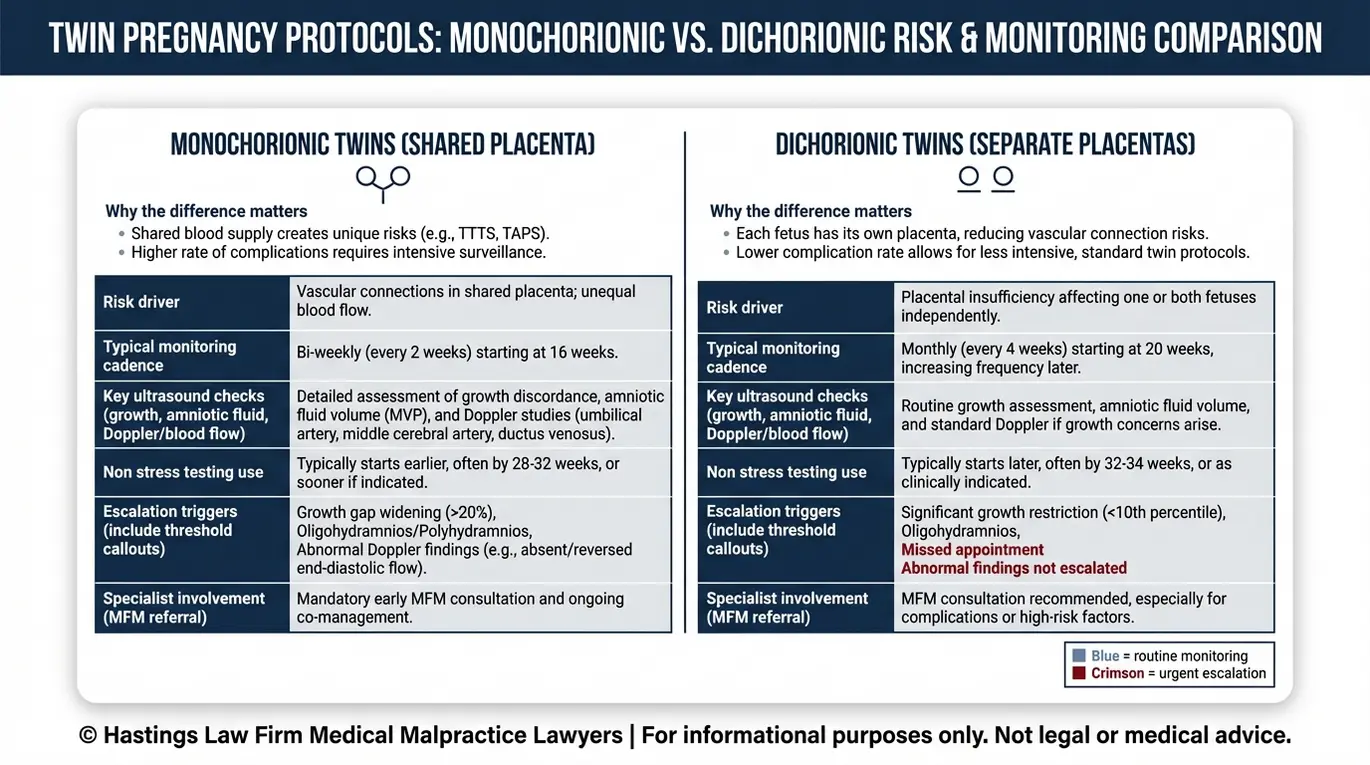
The standard of care for discordant twins requires frequent monitoring, including bi-weekly ultrasounds and non-stress testing, to track fluid levels, blood flow (Doppler), and fetal growth rates. Chorionicity, the study of how twins share a placenta, determines the monitoring frequency required to protect both babies. According to clinical guidance on antenatal care for twin pregnancies published in PubMed Central, the type and frequency of surveillance depend heavily on chorionicity, which refers to whether the twins share a placenta (monochorionic) or each have their own (dichorionic).
Maternal-fetal medicine (MFM) specialists are essential in managing these pregnancies. When a general OB fails to involve an MFM specialist or delays the referral, critical time can be lost.
The monitoring protocols differ significantly based on placental structure:
| Factor | Monochorionic Twins (Shared Placenta) | Dichorionic Twins (Separate Placentas) |
|---|---|---|
| Ultrasound Frequency | Every 2 weeks starting at 16 weeks | Every 4 weeks starting at 20 weeks |
| Doppler Assessment | Every scan; umbilical artery + middle cerebral artery | As indicated by growth trends |
| Primary Risk | TTTS, sIUGR, unequal placental sharing | Growth restriction from individual placental issues |
| Escalation Trigger | Any sign of discordance, fluid imbalance, or abnormal Doppler | Weight discordance exceeding 20% |
A failure to monitor twins, missing a scheduled scan, misinterpreting ultrasound screenings or sonograms and non-stress testing data, or failing to escalate care when findings are abnormal can each form the basis of an actionable malpractice claim. As a Texas discordant twin growth negligence lawyer, we review the timing and interpretation of every prenatal care study to identify where the standard of care may have been breached.
The Hastings Law Firm Difference
Results matter, but what truly sets us apart is how we achieve them. Every verdict, every settlement, and every Texas courtroom victory comes from one guiding promise: To treat each client’s fight for justice as if it were our own.
This balance of skill, experience, and empathy reflects our core philosophy that justice should not only compensate the injured, but also make healthcare safer nationwide.

Complications: TTTS and Selective Intrauterine Growth Restriction
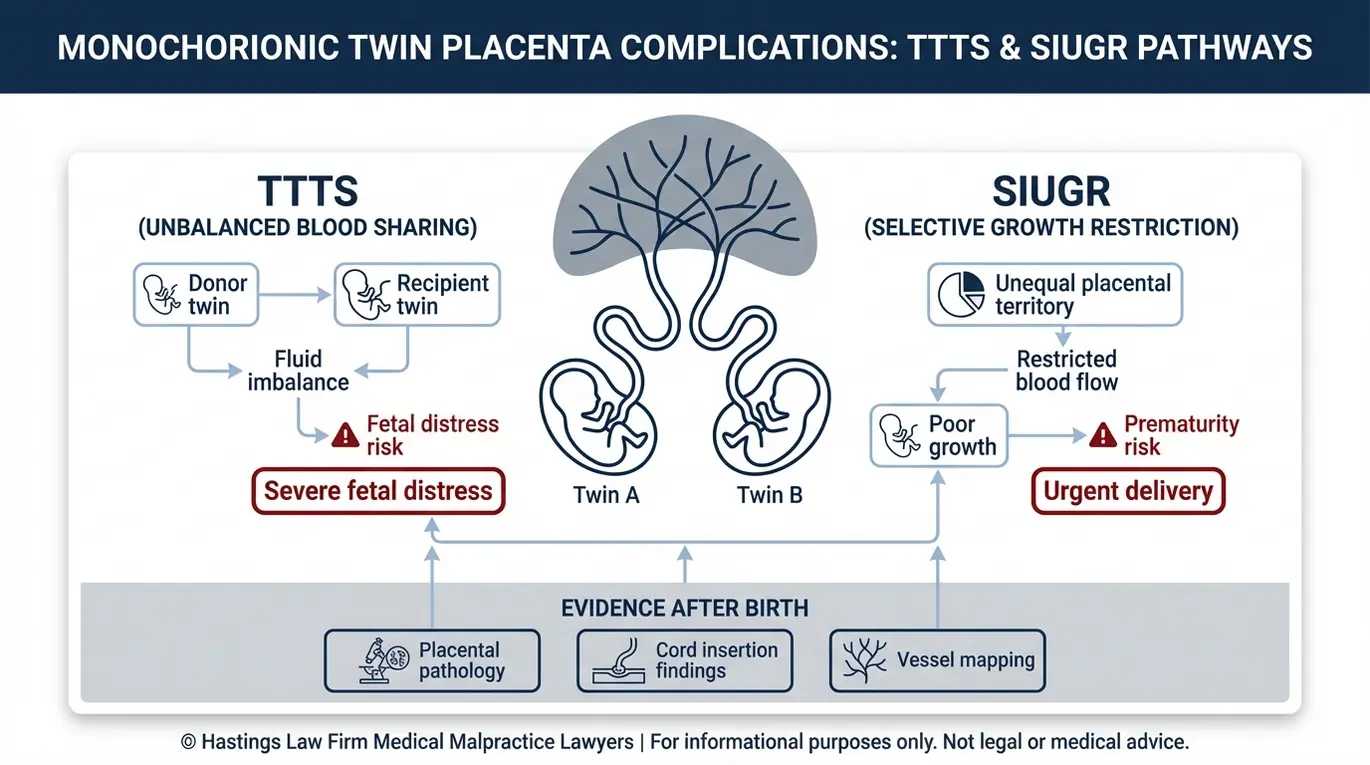
Unmanaged discordant growth can escalate into Twin-to-Twin Transfusion Syndrome (TTTS), where one twin receives too much blood while the other receives too little, often requiring emergency interventions like laser ablation or early delivery. Laser ablation is a surgical procedure used to seal abnormal blood vessel connections in the placenta. According to a systematic review and meta-analysis on survival rates in TTTS pregnancies published in PubMed, fetoscopic laser photocoagulation has become the primary intervention, but outcomes depend heavily on early detection and timely referral.
TTTS and sIUGR are related but distinct conditions, and understanding the difference matters in building a negligence claim:
- TTTS involves unequal blood flow between twins through shared placental vessels, leading to fluid overload in one twin and depletion in the other. It can progress rapidly through stages and may require emergency delivery or laser ablation.
- sIUGR involves unequal placental territory, meaning one twin simply has access to less of the placenta’s surface area. Growth restriction in the affected twin can be chronic and progressive.
Both conditions can cause fetal distress, premature birth requiring neonatal intensive care, and long-term neurological injury. When providers fail to recognize worsening discordance or delay C-section decisions in the face of deteriorating fetal status, the results can be severe.
One piece of evidence that is often overlooked is placental pathology, the examination of the placenta after delivery. This analysis can reveal whether blood supply was shared unevenly, confirm the presence of abnormal vascular connections, and establish that the condition existed before delivery. For a TTTS malpractice lawyer or Texas discordant twin growth negligence lawyer building a case around twin pregnancy complications, placental pathology is physical evidence supporting causation.
Damages Recoverable in Texas Twin Birth Injury Cases
Families may recover compensation for past and future medical expenses, life care planning, pain and suffering, and loss of earning capacity for the injured child. Economic damages include measurable financial losses like past and future medical bills. In discordant growth cases, the injuries can range from conditions like cerebral palsy caused by oxygen deprivation to the devastating loss of one or both twins. Establishing causation and damages is critical to securing a full recovery.
The lifetime cost of caring for a child with cerebral palsy or other severe neurological injury from premature birth can reach into the millions. Birth injury compensation in these cases typically includes:
- Past and future medical expenses, including surgeries, therapies, and assistive devices
- Life care plan costs covering daily care needs across the child’s lifetime
- Pain and suffering experienced by the child
- Loss of future earning capacity
- Parents’ emotional distress and loss of companionship
- Wrongful death damages if one or both twins did not survive
Texas does impose statutory caps on non-economic damages under Chapter 74 of the Texas Civil Practice and Remedies Code, but economic damages are not capped. Statutory caps are legal limits on how much compensation a jury can award for non-financial losses like pain and suffering. A Texas discordant twin growth negligence lawyer can explain how these caps apply to your specific situation and ensure that all categories of medical malpractice damages are fully documented.
Common Defenses in Growth Discordance Cases and How We Counter Them
Defense attorneys often argue that discordant growth was genetic or unavoidable; however, experienced lawyers use electronic fetal monitoring strips and growth charts to prove that timely intervention would have altered the outcome. When challenging medical malpractice defenses, we rely on hard evidence to uncover the truth.
| Defense Argument | Our Counter-Strategy |
|---|---|
| “The growth discordance was genetic and unavoidable.” | We retain maternal-fetal medicine experts and use placental pathology, the post-delivery examination of placental tissue, to show the discordance was related to vascular abnormalities, not genetics. |
| “The monitoring schedule was appropriate.” | We compare the actual scan frequency against published guidelines and use Doppler velocimetry records, which measure blood flow through the umbilical artery, to show that abnormal findings were missed or ignored. |
| “Maternal conditions like gestational diabetes or preeclampsia caused the outcome.” | We work with specialists to distinguish between maternal risk factors and provider failures, demonstrating that even with these conditions, the standard of care required specific interventions that were not performed. |
| “The injury would have occurred regardless of timing.” | Our experts analyze the medical records to reconstruct a timeline showing when intervention could have prevented the harm. |
Texas law requires an expert report within 120 days after the defendant files their answer. This expert report is a legal document where a qualified medical expert provides a fair summary of opinions regarding the applicable standard of care, the defendant’s breach, and causation. Through a medical records review, we identify where the duty of care and breach occurred. At Hastings Law Firm, our in-house medical staff and national expert network allow us to complete this step efficiently, validating the claim and strengthening it before litigation begins. As a Texas discordant twin growth negligence lawyer, we understand both the decision-making failures by individual providers and the logistical breakdowns at the hospital level that can contribute to these injuries.
Contact the Texas Birth Injury Attorneys at Hastings Law Firm Today for Help
Discordant twin growth injuries are often preventable when providers follow established monitoring protocols and act on warning signs. When they do not, families deserve to know what happened and why.
Hastings Law Firm represents families across Texas who have been affected by medical negligence during twin and multiple pregnancies. Our team includes nurse consultants and former defense attorneys who understand how hospitals build their cases. Tommy Hastings is Board Certified in Personal Injury Trial Law by the Texas Board of Legal Specialization and has dedicated his career to holding negligent providers accountable.
We work on a contingency fee basis, meaning you pay no attorney fees or costs unless we secure a recovery for your family. If your twins were harmed by a failure to properly monitor or treat discordant growth, contact us for a free case evaluation. We can review your medical records, consult with qualified experts, and help you understand your legal options.
Frequently Asked Questions About Discordant Twin Growth Negligence in Texas


This content was researched and written by the Hastings Law Firm editorial team, which includes attorneys, medical professionals, and experienced researchers. Our writing is informed by internal knowledge and practical experience, and we cross-check critical details against authoritative sources cited throughout. Every piece undergoes human-led fact-checking and legal review. Because legal and medical information can change, if you spot an error, please contact us. Learn more about our content standards and review process on our editorial policy page.

Tommy Hastings, founder of Hastings Law Firm, is a board-certified personal injury trial lawyer dedicated exclusively to healthcare injury cases. Since 2001, he has represented injured patients and families in litigation against major hospital systems, pharmaceutical companies, and negligent healthcare providers nationwide. He has handled numerous high-profile cases that have drawn national media attention and resulted in multi-million dollar recoveries. He draws on that experience in his writing, helping readers understand how these cases work and what options may be available to them.
