


Texas Birth Paralysis Lawyer
Written by: Hastings Law Firm | Reviewed by: Tommy Hastings | Updated: July 27, 2026
Birth paralysis can leave families facing fear, confusion, and lasting uncertainty after a delivery that should have been safe. Nerve injuries during labor can affect a newborn’s face or arm function and may be linked to excessive force, missed warning signs, or failures to follow accepted safety protocols. Understanding how these injuries happen and what records can show helps families make informed decisions while seeking clarity and support. If you or a loved one were harmed or worse due to birth paralysis in Texas, contact Hastings Law Firm for a free, confidential case review.

Advocating for Families After Preventable Newborn Nerve Injuries
What You Should Know About Newborn Paralysis Claims in Texas:
- Long term impairment can follow a newborn nerve injury, especially when severe damage leads to permanent paralysis and ongoing care needs.
- Accountability can extend beyond an individual clinician when hospital level failures such as understaffing or inadequate training contribute to preventable harm.
- Disputes often focus on whether paralysis was preventable, since hospitals may claim the injury resulted from natural forces rather than medical error.
- Recovery options can be limited by Texas rules that restrict non economic damages even when the impact on quality of life is substantial.
- Financial strain can be significant, since families may face intensive early treatment costs and later expenses for therapy, surgeries, and specialized support.
- Liability questions often turn on delivery decisions involving forceps or vacuum extraction and the management of shoulder dystocia.
- Options can narrow quickly if required malpractice filings are not supported early by qualified medical experts.
- Key evidence can be lost or disputed when documentation does not match what occurred in the delivery room.
- Medical records such as fetal monitoring strips, delivery notes, and nursing assessments can be central to evaluating whether warning signs were missed.
- Diagnostic testing such as EMG, nerve conduction studies, MRI, or CT imaging can clarify the extent of nerve damage and whether it is likely to be permanent.

A Healthcare Focused Law Firm
When a baby is born with paralysis, which is the loss of muscle movement caused by nerve damage during delivery, the shock and confusion parents feel can be overwhelming. You may be watching your child struggle to move an arm or noticing one side of their face doesn’t respond the way it should, and no one has given you a clear explanation of what went wrong. These feelings of frustration and helplessness are valid.
Birth paralysis cases involve a difficult intersection of medicine and law, and getting real answers often requires more than what a hospital is willing to share on its own. A Texas birth paralysis lawyer with specific experience in medical malpractice can review your child’s delivery records, spot what may have caused the injury, and explain whether you have a legal claim. If your family is going through this, we welcome you to contact Hastings Law Firm for a free, confidential case evaluation to discuss what happened and explore your options.
The Role of a Specialized Attorney in Birth Injury Cases
A specialized attorney investigates the cause of infant nerve damage by analyzing labor and delivery records for evidence of excessive force or improper technique. They work alongside medical experts to determine whether the injury resulted from a violation of the standard of care, the level of treatment a reasonably competent provider would have delivered under similar circumstances, rather than from unavoidable natural causes.
Our firm focuses exclusively on medical malpractice litigation, providing specialized resources for these challenging investigations. Tommy Hastings, a board-certified trial lawyer and 2025 inductee into the American Board of Trial Advocates (ABOTA), leads our team with over two decades of experience in handling birth injury cases. At Hastings Law Firm, our team includes former defense attorneys who previously represented hospitals and experienced nurses who once worked inside the systems we now hold accountable. This insider perspective helps us find charting inconsistencies and spot gaps in the medical record that might otherwise go unnoticed, often revealing systemic issues that point toward hospital liability.
When a hospital’s documentation doesn’t match what actually happened in the delivery room, those discrepancies can become central to proving medical malpractice and establishing liability. We specifically look for evidence of negligence in operative vaginal delivery (OVD), which is a procedure involving the use of forceps or vacuum extraction, to determine if protocols were followed. We also rely on a national network of qualified expert witnesses who provide objective reviews of fetal monitoring strips, delivery notes, and nursing assessments.
Fetal heart rate monitoring, or FHR monitoring, which is the continuous electronic tracking of a baby’s heart rate during labor, is one of the most important pieces of evidence in these cases. The ACOG Clinical Practice Guideline on Intrapartum Fetal Heart Rate Monitoring provides clinical guidance on interpreting these tracings. Our experts use those same principles to evaluate whether warning signs were missed or ignored.
Beyond the medical investigation, a Texas birth paralysis lawyer also protects the family from insurance adjusters whose goal is to minimize the severity of the paralysis or deny that the injury was preventable. Our role is to build the case from day one as though it is going to trial, because that level of preparation is what positions families to recover fair compensation. Whether the case resolves through firm negotiation or a jury verdict, the preparation is the same. We use our background as a trial-ready firm to build the evidence early and provide a thorough investigation into the cause of your child’s injury.
Distinguishing Facial Paralysis and Brachial Plexus Injuries
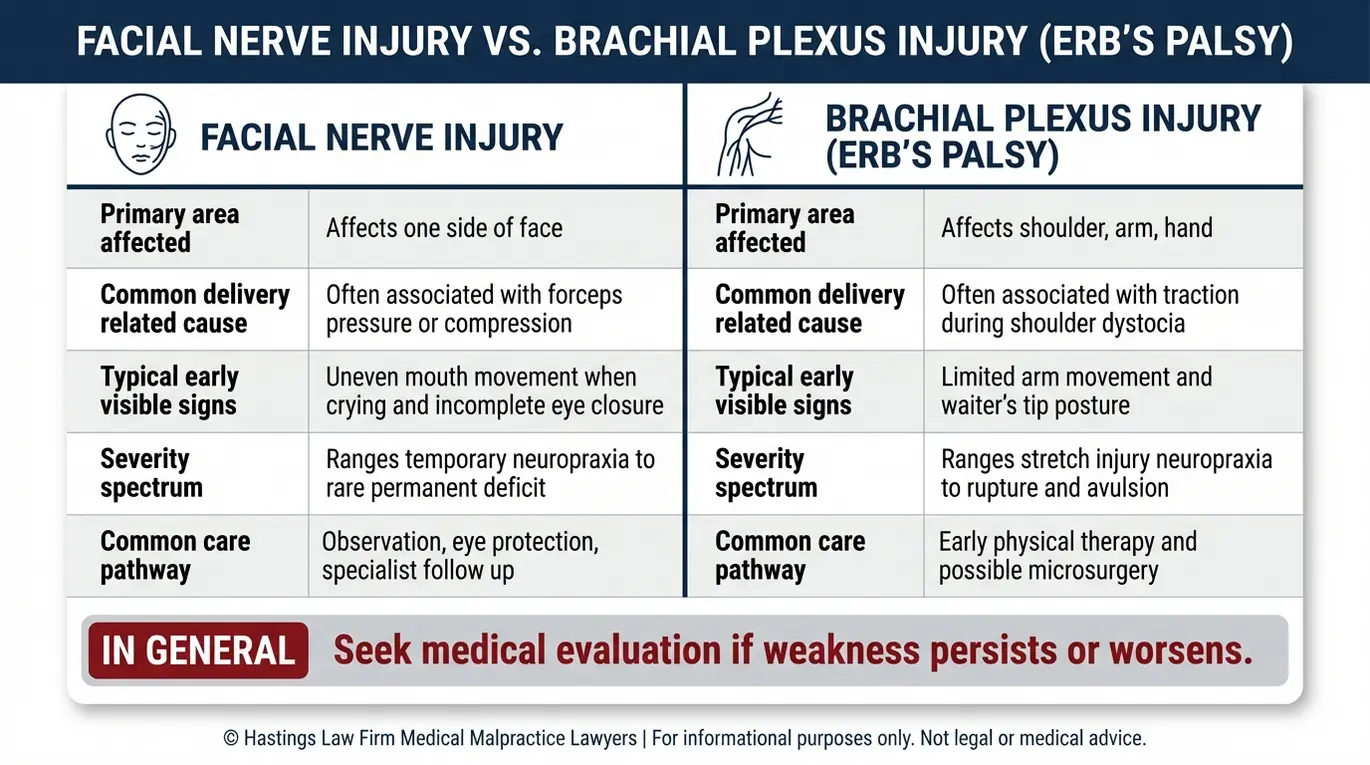
Birth paralysis typically presents as either a facial nerve injury or a brachial plexus palsy. Facial paralysis affects the movement of the face, often becoming most visible when the baby cries, while brachial plexus injuries like Erb’s palsy affect the movement and sensation of the arm and shoulder.
Distinguishing these conditions matters because their causes, treatments, and outlooks differ. Facial nerve injury involves damage to cranial nerve VII, the nerve that controls the muscles responsible for facial expression. This injury often results from pressure applied to the side of the baby’s face during delivery, such as from the use of forceps. Parents may notice that one side of the baby’s face doesn’t move when crying, or that the eye on the affected side doesn’t close fully.
Brachial plexus injury involves damage to the brachial plexus, the network of nerves running from the spinal cord through the neck and into the arm. Erb’s palsy, the most common form, results from excessive traction on the baby’s neck during delivery. It typically affects the upper arm and shoulder, limiting the child’s ability to move or rotate the affected limb. Brachial plexus birth injuries are classified under ICD-10 codes P14.0 through P14.9, which are used by hospitals nationwide for diagnostic coding and medical billing.
The severity of nerve damage falls along a spectrum. Neuropraxia, the mildest form, involves stretching of the nerve and often resolves on its own within weeks or months. On the other end, an avulsion occurs when the nerve root is torn completely from the spinal cord, which can result in permanent paralysis and may require surgical intervention. A Texas birth paralysis lawyer can review these diagnostic details to assess the viability of a claim.
| Type of Injury | Common Cause | Primary Symptoms | Typical Prognosis |
|---|---|---|---|
| Facial Nerve Palsy | Pressure from forceps or positioning | Asymmetric facial movement, inability to close eye on affected side | Often resolves within weeks; some cases require treatment |
| Erb’s Palsy (Upper Brachial Plexus) | Excessive lateral traction on the neck | Limited arm/shoulder movement, “waiter’s tip” posture | Many improve with therapy; severe cases may need surgery |
| Total Brachial Plexus Palsy | Significant traction or traumatic delivery | Complete loss of arm function and sensation | Higher risk of permanent impairment |
| Spinal Cord Injury | Extreme force or improper technique | Paralysis below injury site, potential respiratory issues | Often permanent; requires lifelong care |
Recognizing Physical Signs of Nerve Damage
Parents are often the first to notice something is wrong. With Erb’s palsy, one of the most recognizable signs is the “waiter’s tip” posture, where the affected arm hangs limp at the baby’s side with the wrist bent inward and fingers curled, as though the child is waiting for a tip to be placed in their hand. Understanding these symptoms is important for parents when evaluating the care their child received.
The baby may not move that arm during normal activity or startle reflexes. With facial nerve damage, the signs are typically most apparent during crying. One side of the face may appear drooped or motionless while the other moves normally.
The physiological vulnerability of a newborn’s delicate nerve structures makes newborn paralysis a risk during a difficult delivery. If you noticed any of these signs shortly after birth, legal counsel can help determine whether the injury was preventable.
The Hastings Law Firm Difference
Results matter, but what truly sets us apart is how we achieve them. Every verdict, every settlement, and every Texas courtroom victory comes from one guiding promise: To treat each client’s fight for justice as if it were our own.
This balance of skill, experience, and empathy reflects our core philosophy that justice should not only compensate the injured, but also make healthcare safer nationwide.

Common Medical Errors Leading to Infant Paralysis
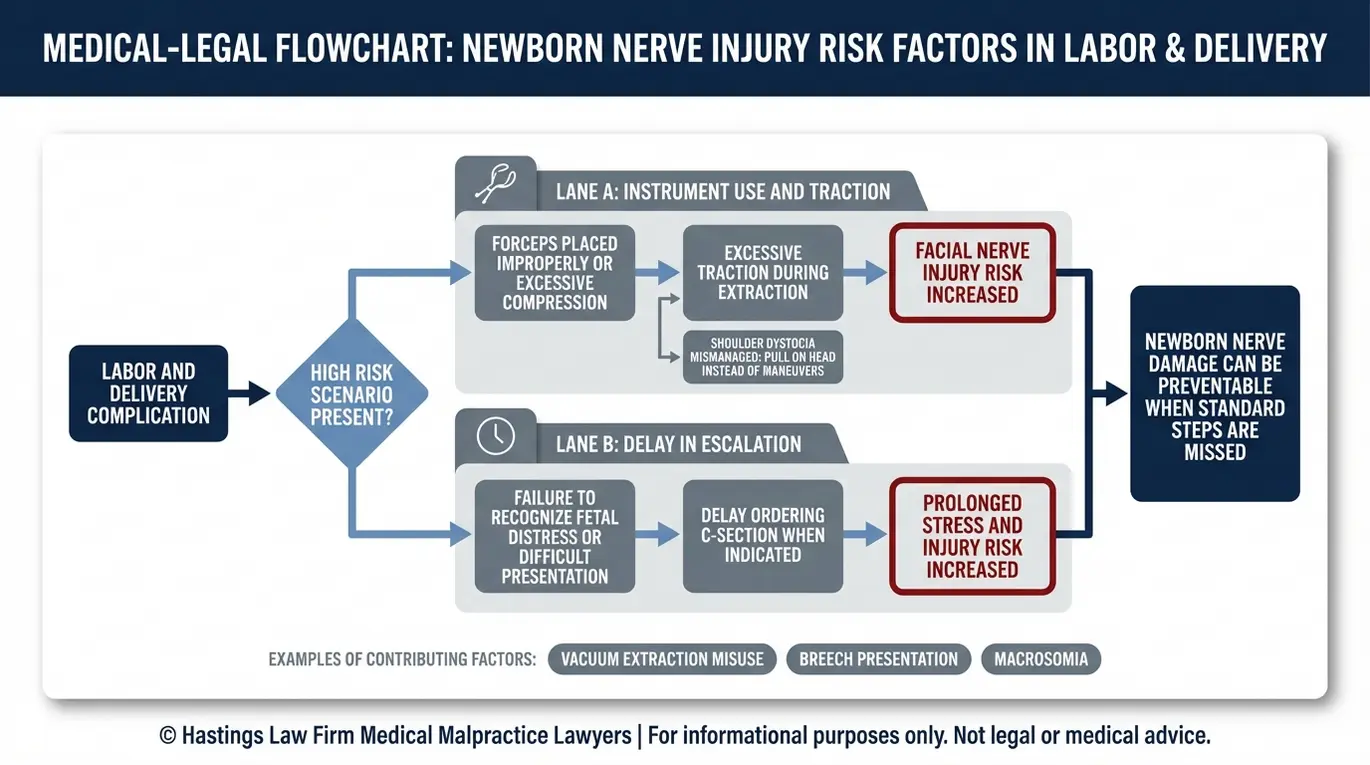
Most preventable cases of birth paralysis stem from the improper use of assistive delivery tools or the failure to manage complications like shoulder dystocia. Medical negligence often occurs when healthcare providers fail to follow recognized safety protocols during labor. Excessive force applied during extraction can stretch or tear the delicate nerve structures in a baby’s neck and face, leaving permanent impairments.
Shoulder dystocia, which is a delivery emergency where the baby’s shoulder becomes lodged behind the mother’s pelvic bone after the head has been delivered, requires immediate, specific action. When this happens, the standard of care typically calls for specific repositioning techniques, such as the McRoberts maneuver, where the thighs are flexed toward the abdomen to widen the pelvic opening. Pulling on the baby’s head before or instead of using these recognized maneuvers can place dangerous traction on the brachial plexus.
A qualified Texas birth paralysis lawyer examines the sequence of decisions made during delivery to determine whether the medical team followed accepted protocols. The most common errors we investigate include:
- Incorrect forceps placement or excessive force during operative vaginal delivery. Forceps applied improperly can compress the facial nerve against the baby’s skull, causing partial or complete facial paralysis. Aggressive vacuum extraction can also contribute to nerve and soft tissue damage.
- Failure to perform a timely C-section. When prenatal assessments suggest a large baby, a condition known as macrosomia, or when the baby is in a breech presentation, a Cesarean delivery may be the safer option. Delaying or failing to order a C-section in the face of fetal distress, abnormal fetal heart rate patterns, or known risk factors can lead to oxygen deprivation (hypoxia) and traumatic vaginal delivery.
- Improper management of shoulder dystocia. Applying downward traction on the baby’s head rather than performing approved maneuvers is one of the most well-documented causes of permanent brachial plexus injury. There are established, evidence-based steps for resolving dystocia safely, and failure to follow them can constitute a breach of the standard of care.
- Failure to recognize and respond to signs of fetal distress. Continuous monitoring should alert the care team to patterns that indicate the baby is not tolerating labor. Delayed intervention when these warning signs appear can result in prolonged compression, metabolic acidosis, and severe nerve damage.
Each of these situations represents a point where a different decision may have prevented the injury. That is exactly what a Texas birth paralysis lawyer evaluates: whether the medical team’s choices fell below the standard that a competent provider would have met.
Proving Negligence and Liability in Court
Proving medical negligence requires demonstrating that the medical provider’s actions deviated from the accepted standard of care and that this deviation directly caused the paralysis. Medical malpractice laws govern how these cases are proven in court. This involves collecting and analyzing a range of evidence, including prenatal records, delivery room logs, nursing notes, and witness statements.
The first step is establishing what a prudent provider would have done under the same circumstances. Our team works with qualified expert witnesses, physicians who practice in the same specialty as the defendant, to define the standard of care and explain how the delivery team’s conduct fell short. Under the Texas Civil Practice and Remedies Code, Section 74.351, a person filing a medical malpractice claim must serve a written expert report on each defendant within 120 days after that defendant files their original answer. This requirement makes early access to credible medical experts important.
Causation is often the most contested element. The defense in birth paralysis cases may argue that the injury resulted from natural forces during labor, such as macrosomia, an excessively large birth weight, rather than from any specific action by the medical team. To counter this, we build a detailed, minute-by-minute timeline of the delivery using the medical records and fetal monitoring data. Our medical staff, which includes nurse practitioners and board-certified patient advocates, reviews the clinical documentation to find where the timeline doesn’t add up.
We also look beyond the individual provider to examine systemic hospital liability. Understaffing, inadequate training on emergency delivery procedures, and failure to enforce safety protocols can all contribute to preventable injuries. When a hospital’s institutional failures played a role, additional claims may apply.
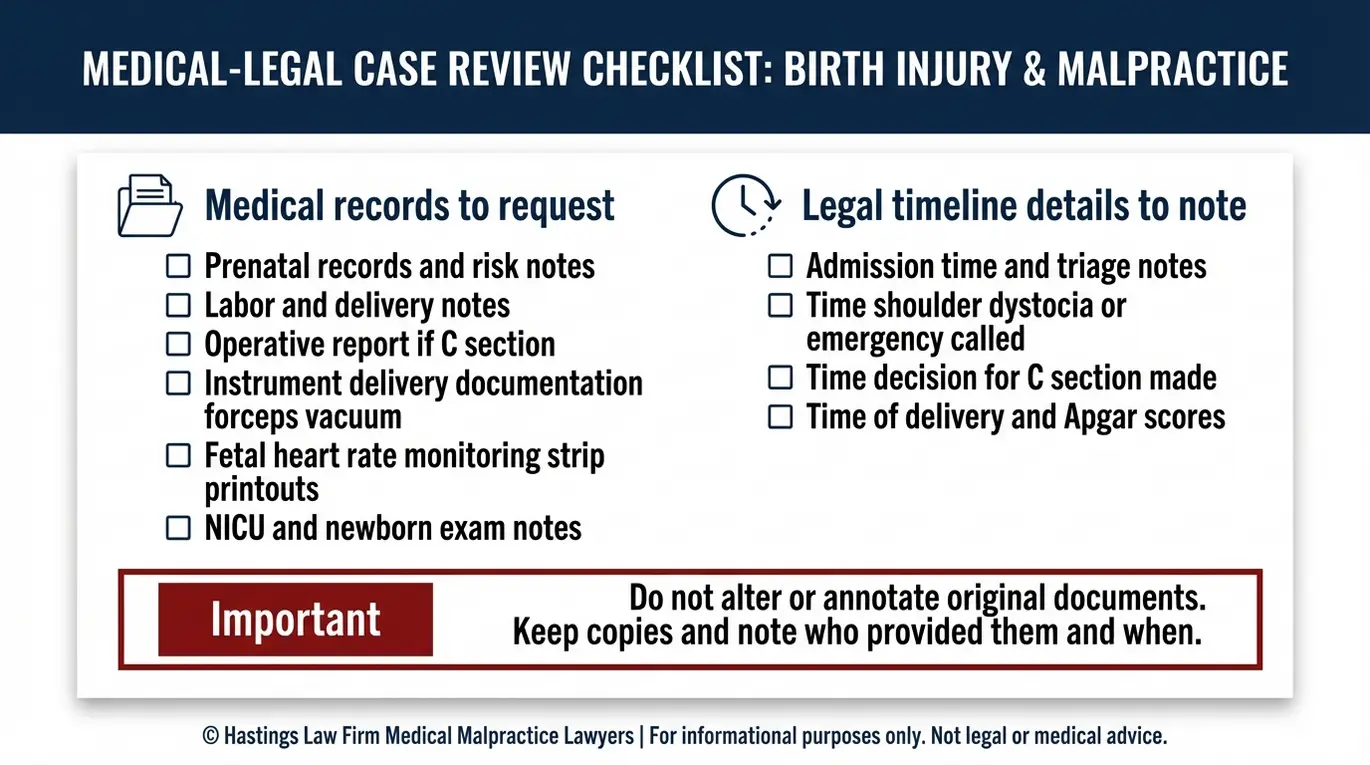
Document preservation is critical. If you believe your child’s injury may have been preventable, take these steps:
- Request a complete copy of your medical records, including labor and delivery notes, fetal monitoring strips, and operative reports
- Save all discharge paperwork, follow-up visit records, and diagnostic test results
- Document your child’s physical condition and any limitations with dated photographs
- Keep a written log of conversations with medical providers about the injury
- Avoid signing any settlement documents or recorded statements from insurance representatives before speaking with a Texas birth paralysis lawyer
Recovering Compensation for Lifetime Care and Rehabilitation
Compensation in birth paralysis cases covers both economic damages, such as past and future medical expenses, and non-economic damages like pain and suffering. A successful claim is designed to provide financial security for the child’s ongoing physical therapy, surgeries, and specialized care needs. Legal action helps ensure the child has resources for long-term support.
The immediate costs of a birth nerve injury can be significant. Families often face NICU bills, diagnostic imaging, and in some cases, surgical procedures like nerve grafts or tendon transfers shortly after the injury is discovered. These early expenses are only the beginning. Parents often deplete their savings covering co-pays and deductibles while missing work to attend frequent medical appointments, adding financial strain to emotional trauma.
Long-term care needs are where a thorough damage assessment becomes important. Many children with permanent or severe brachial plexus injuries require years of physical therapy and occupational therapy to maximize function. Adaptive equipment, home modifications, and specialized educational support may also be necessary as the child grows. Life care planning involves collaborating with medical and rehabilitation specialists to project the future care costs associated with these needs.
A resulting plan becomes a key piece of evidence in establishing the value of the claim. Non-economic damages account for the effects that don’t come with a receipt. Physical disfigurement, chronic pain, emotional distress, and the impact on the child’s quality of life are all recognized categories of harm. For a child who may grow up unable to fully use an arm or who carries visible facial asymmetry, these losses are real and lasting.
At Hastings Law Firm, we prepare every case with the understanding that fair compensation must account for the full scope of the injury. A Texas birth paralysis lawyer on our team works with life care planners, economists, and medical specialists to present a damages picture that reflects both what your family has already endured and what lies ahead. We do not accept undervalued offers, and our trial-ready approach ensures the defense understands we are prepared to present the case to a jury if necessary.
Contact the Texas Birth Injury Attorneys at Hastings Law Firm Today for Help
If your child suffered a paralyzed face or arm during birth, you deserve answers before accepting anyone’s assurance that the injury was unavoidable. Our team provides legal guidance to families across Texas dealing with birth-related nerve injuries. Hastings Law Firm is dedicated to restoring trust for families who feel the healthcare system let them down and to securing the resources your child needs for the future.
Our team of attorneys, nurse consultants, and patient advocates will review your child’s medical records, consult with independent experts, and give you an honest assessment of your case. We operate on a contingency fee basis, which means you pay no attorney fees or costs unless we recover compensation for you.
Contact us today for a free and confidential case evaluation. Call our office or reach out online to speak with a patient advocate who can help you take the first step.
Frequently Asked Questions About Birth Paralysis in Texas


This content was researched and written by the Hastings Law Firm editorial team, which includes attorneys, medical professionals, and experienced researchers. Our writing is informed by internal knowledge and practical experience, and we cross-check critical details against authoritative sources cited throughout. Every piece undergoes human-led fact-checking and legal review. Because legal and medical information can change, if you spot an error, please contact us. Learn more about our content standards and review process on our editorial policy page.

Tommy Hastings, founder of Hastings Law Firm, is a board-certified personal injury trial lawyer dedicated exclusively to healthcare injury cases. Since 2001, he has represented injured patients and families in litigation against major hospital systems, pharmaceutical companies, and negligent healthcare providers nationwide. He has handled numerous high-profile cases that have drawn national media attention and resulted in multi-million dollar recoveries. He draws on that experience in his writing, helping readers understand how these cases work and what options may be available to them.
