


Texas Infant Hip Dysplasia Diagnosis Failure Lawyer
Written by: Hastings Law Firm | Reviewed by: Tommy Hastings | Updated: July 27, 2026
A missed or delayed diagnosis of infant hip dysplasia can turn a treatable early condition into years of invasive care and lasting limitations. Routine newborn and infant screenings are meant to detect hip instability early, and errors in exams, follow up, or imaging can leave families facing avoidable surgery, prolonged recovery, chronic pain, and mobility problems. Understanding how screening should be performed and where breakdowns occur can clarify why outcomes sometimes worsen over time. If you or a loved one were harmed or worse due to a missed hip dysplasia diagnosis in Texas, contact Hastings Law Firm for a free, confidential case review.

Advocating for Children Harmed by Missed Hip Dysplasia Diagnoses in Texas
What You Should Know About Pediatric Hip Exam Negligence Claims in Texas:
- Long term disability can result when infant hip dysplasia is not identified and treated early.
- More invasive treatment and longer recovery can follow a delayed diagnosis compared with early non invasive care.
- Disputes over responsibility can arise because missed screening can involve hospital staff, pediatricians, or radiologists.
- Options for financial recovery can be limited if Texas medical malpractice timing rules are missed.
- Proving fault can be difficult when the defense claims the condition developed later or the signs were too subtle to detect.
- A missed diagnosis may be tied to misinterpreting a hip clunk as a benign hip click.
- A failure to act on high risk factors such as breech presentation or family history may indicate a deviation from expected screening.
- Medical records and clinical documentation can be central when evaluating whether routine screening findings were missed or not recorded.
- Expert medical testimony can be decisive in linking a missed diagnosis to the need for surgery or permanent injury.

A Healthcare Focused Law Firm
When a child’s developmental dysplasia of the hip (DDH), a condition where the hip joint’s ball and socket do not form properly, goes undetected, the consequences can follow them for years. The acetabulum, the cup-shaped socket of the hip, may fail to develop normally, leaving the joint unstable and prone to damage that worsens over time. Early detection through routine infant screenings can lead to simple, non-invasive treatment. If a doctor misses the signs, families are often left facing surgeries and long recoveries that could have been avoided.
If your child was harmed by a missed or delayed hip dysplasia diagnosis, you deserve to know what went wrong and what options are available. As a Texas missed hip dysplasia lawyer team focused exclusively on medical malpractice, Hastings Law Firm can review your child’s medical records and help you understand whether negligence occurred. Contact us for a free, confidential case evaluation.
Understanding the Standard of Care for Infant Hip Screening
The medical standard of care requires pediatricians to perform specific physical exams, such as the Barlow and Ortolani maneuvers, during routine newborn and infant examinations to detect hip instability early. Infant hip screening is a routine part of newborn care designed to identify joints that are unstable or improperly formed. These exams are not optional extras; they are a baseline expectation for competent newborn and infant care.
Two maneuvers form the foundation of newborn hip screening. The Barlow maneuver, a test where the doctor gently pushes the infant’s hip backward to see if it can be dislocated, checks for instability. The Ortolani maneuver, performed by gently lifting and rotating the hip forward, checks whether a dislocated hip can be guided back into position. Research published by Stanford Medicine’s Newborn Nursery program outlines these as standard clinical techniques taught to all practitioners who examine newborns.
A study on developmental dysplasia of hip screening using Ortolani and Barlow testing on breech delivered neonates (PubMed Central) reinforces how critical these exams are, particularly for infants born in the breech position.
The window for early diagnosis matters enormously, a reality well known to any Texas missed hip dysplasia lawyer. When DDH is caught in the first few weeks of life, treatment may involve nothing more than a simple harness worn for several weeks. The longer the condition goes undetected, the more likely a child will need surgery.
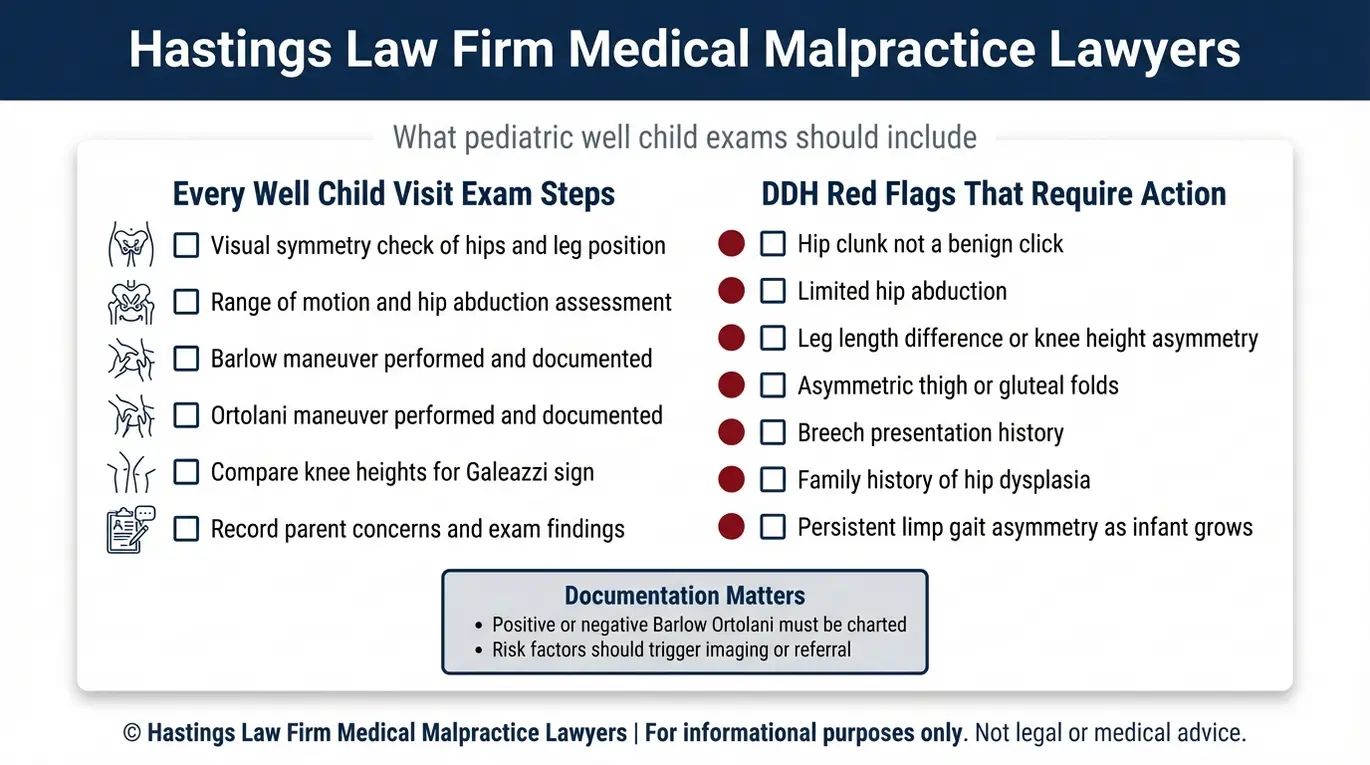
One common area of error involves the difference between harmless “hip clicks” and pathologic “hip clunks.” A click is a soft sound caused by ligaments or tendons and is generally benign. A clunk, by contrast, is a palpable sensation indicating the femoral head is actually moving in or out of the acetabulum. Misinterpreting a clunk as a harmless click, and failing to order follow-up imaging or refer the patient to a pediatric orthopedist, represents a clear deviation from the standard of care.
Red flags doctors are trained to identify during hip screening:
- A positive Barlow or Ortolani sign (felt as a distinct “clunk”)
- Asymmetric skin folds on the thighs or buttocks
- Uneven leg lengths (Galeazzi sign)
- Limited hip abduction on one or both sides
- Known risk factors such as breech presentation, family history of DDH, or female sex
How Medical Negligence Leads to Missed DDH Diagnoses
Negligence occurs when a healthcare provider deviates from accepted protocols, such as failing to order an ultrasound for a breech baby or dismissing parental concerns about uneven leg lengths. Diagnostic errors in these cases often stem from a failure to follow established imaging and physical exam protocols. These are not judgment calls in gray areas. They are failures to follow well-established screening guidelines.
A hip ultrasound, a non-invasive imaging study that visualizes the soft cartilage of an infant’s hip joint, is the primary diagnostic tool for DDH in babies under six months old. After six months, x-rays become more useful as the hip bones begin to ossify, or harden into bone. The Galeazzi sign, a visible difference in knee height when both hips are flexed, is another clinical indicator that should prompt immediate further evaluation. Research on known risk factors of developmental dysplasia of the hip (PubMed Central) identifies breech presentation, family history, and female sex as factors that should trigger heightened screening and referral to a pediatric orthopedist.
Understanding where the failure originated is an important part of any missed hip dysplasia lawyer’s investigation into a missed diagnosis or delayed diagnosis. Liability does not always rest with a single provider.
Common errors that may lead to a missed DDH diagnosis:
- Failing to perform Barlow and Ortolani maneuvers at birth or during early well-child visits
- Dismissing a parent’s concern about a child’s limp, uneven crawling, or leg-length discrepancy
- Not referring high-risk infants (breech birth, positive family history) for hip ultrasound
- Misreading or failing to act on abnormal ultrasound or x-ray findings
- Inadequate documentation of physical exam results
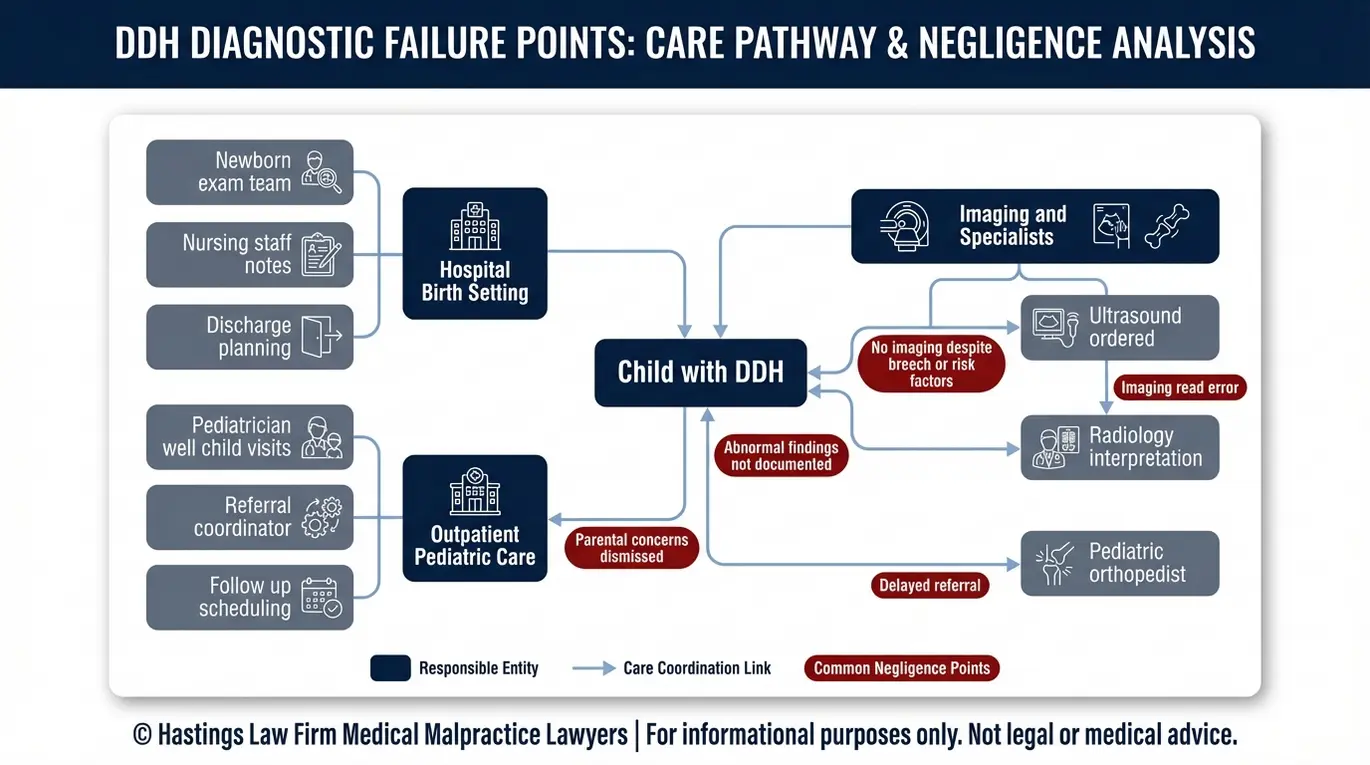
Hospital birth screening errors and pediatrician well-check failures create different forms of liability. A hospital may be responsible if its staff failed to screen a breech newborn before discharge. A pediatrician may bear responsibility if signs of hip instability were present at routine visits but not addressed. In some cases, a radiologist who misinterpreted imaging may also be liable.
The Hastings Law Firm Difference
Results matter, but what truly sets us apart is how we achieve them. Every verdict, every settlement, and every Texas courtroom victory comes from one guiding promise: To treat each client’s fight for justice as if it were our own.
This balance of skill, experience, and empathy reflects our core philosophy that justice should not only compensate the injured, but also make healthcare safer nationwide.

Long-Term Consequences of Untreated Hip Dysplasia
Failure to treat DDH in infancy often results in the need for invasive surgeries like open reduction or osteotomy, and can lead to early-onset arthritis and lifelong mobility issues. These long-term issues arise because the hip joint needs proper alignment during early growth to function correctly in adulthood. What starts as a treatable condition in a newborn can become a permanent disability.
The contrast between early and late treatment is stark. When caught early, an infant may only need a Pavlik harness, a soft brace that holds the hips in a flexed and abducted position to encourage normal socket development. When the diagnosis is delayed, treatment escalates significantly, sometimes requiring a Spica cast, a rigid body cast that immobilizes the hips and legs for weeks or months after a surgical procedure.
| Early Detection (0–6 months) | Late-Stage Intervention (6+ months) | |
|---|---|---|
| Primary Treatment | Pavlik harness or hip abduction brace | Closed reduction, open reduction, or osteotomy |
| Anesthesia Required | No | Yes |
| Recovery Period | Weeks in a harness | Months in a Spica cast; potential repeat surgeries |
| Long-Term Outlook | Normal hip development expected | Risk of early-onset arthritis, chronic pain, limping, hip replacement in adulthood |
As children grow, the window of opportunity for non-invasive treatment closes rapidly. The femoral head and acetabulum remodel most effectively in the first months of life. Beyond that period, the joint may not develop properly even with treatment.
This can leave children with hip pain, limited range of motion, and permanent hip dislocation or an altered gait that affects them well into adulthood. Early-onset arthritis is a significant risk for children who do not receive timely care. For families of children who needed lawyers for missed hip dysplasia in Texas, the damages often extend across a lifetime of medical care and physical limitation.
Establishing Liability and Damages in DDH Cases
To secure compensation, a plaintiff must prove that the doctor owed a duty of care, breached that duty by missing obvious signs, and that this breach directly caused the need for more invasive treatment or permanent injury. Medical malpractice litigation in Texas follows strict rules to prove a provider’s failure caused a patient’s injury. These are the four elements of liability in every medical malpractice claim filed under Texas Civil Practice and Remedies Code Chapter 74.
Duty is established by the doctor-patient relationship. When a pediatrician accepts a child as a patient, they take on the obligation to provide care consistent with accepted medical standards.
Breach means the provider failed to meet that standard. In DDH cases, this could involve skipping the Barlow and Ortolani exams, ignoring risk factors, or failing to refer for imaging.
Causation is often the most contested element. The defense will argue the outcome would have been the same regardless of when the diagnosis was made. Your legal team must demonstrate that earlier detection would have allowed non-invasive treatment. This prevents the need for procedures like open reduction, where the femoral head is manually repositioned, or osteotomy, which involves reshaping the bone to improve joint alignment.
Damages include past and future medical expenses, pain and suffering, and potential loss of earning capacity if the injury results in lasting physical limitations.
Expert medical testimony is essential to proving each element. A qualified pediatric orthopedist can review the medical records and explain to a jury exactly what a competent physician should have found, and when. A study on medical malpractice against pediatric orthopaedic surgeons (PubMed Central) highlights how clinical documentation and expert analysis shape the outcome of these cases. A Texas missed hip dysplasia lawyer with experience in birth injury and pediatric malpractice will know how to build this evidence effectively.
Why Choose Hastings Law Firm for Your Family
Hastings Law Firm offers a “trial-ready” approach, utilizing a national network of medical experts and a team of former defense attorneys to ensure families receive full compensation for preventable medical errors. We maintain a staff of in-house nurse practitioners who assist in case evaluation and record analysis to identify breaches in the standard of care.
Our founder, Tommy Hastings, is board-certified in Personal Injury Trial Law, a distinction held by less than two percent of Texas attorneys. He is also a 2025 inductee into the American Board of Trial Advocates (ABOTA), an invitation-only organization for elite trial lawyers. With over two decades of experience, our firm works to provide a voice for patients harmed by medical error.
We focus exclusively on medical malpractice. We do not handle car accidents, slip-and-fall cases, or general personal injury. Every member of our team, from our board-certified trial attorneys to our in-house nurse consultants, dedicates their work to one thing: holding negligent healthcare providers accountable.
The Hastings Difference:
- Trial-ready from day one: Every case is prepared as if it will go before a jury, which strengthens our position whether the case settles or goes to trial.
- In-house medical staff: Nurse practitioners and patient advocates review your child’s records and help identify exactly where the standard of care was broken.
- Former defense attorneys on our team: We know the strategies hospitals and their insurers rely on because our attorneys used to execute them.
- No fee unless we win: We work on a contingency basis, meaning you pay nothing unless we recover compensation for your family.
- Exclusive medical malpractice focus: Our entire firm is built around one area of law, giving your family the depth of knowledge these cases require.
As a Texas missed hip dysplasia lawyer team, we understand the medical details and the legal framework needed to prove what happened to your child.
Contact the Texas Birth Injury Attorneys at Hastings Law Firm Today for Help
Texas law limits the time you have to file a medical malpractice claim, and the timeline can vary depending on your child’s age. Acting sooner gives our team more time to investigate, preserve records, and build the strongest case possible.
We handle the medical review, the legal filings, and the preparation so you can focus on what matters most: your child’s care and recovery.
If you believe your child’s hip dysplasia was missed or diagnosed too late, we are here to help you find answers. Contact Hastings Law Firm for a free, risk-free case evaluation. There is no fee unless we recover compensation for your family. Call us today or request your evaluation online.
Frequently Asked Questions About Infant Hip Dysplasia Diagnosis Failure in Texas


This content was researched and written by the Hastings Law Firm editorial team, which includes attorneys, medical professionals, and experienced researchers. Our writing is informed by internal knowledge and practical experience, and we cross-check critical details against authoritative sources cited throughout. Every piece undergoes human-led fact-checking and legal review. Because legal and medical information can change, if you spot an error, please contact us. Learn more about our content standards and review process on our editorial policy page.

Tommy Hastings, founder of Hastings Law Firm, is a board-certified personal injury trial lawyer dedicated exclusively to healthcare injury cases. Since 2001, he has represented injured patients and families in litigation against major hospital systems, pharmaceutical companies, and negligent healthcare providers nationwide. He has handled numerous high-profile cases that have drawn national media attention and resulted in multi-million dollar recoveries. He draws on that experience in his writing, helping readers understand how these cases work and what options may be available to them.
