


Texas Low Amniotic Fluid Birth Injury Lawyer
Written by: Hastings Law Firm | Reviewed by: Tommy Hastings | Updated: July 27, 2026
Low amniotic fluid during pregnancy can become dangerous when warning signs are missed or dismissed, especially when monitoring and timely intervention do not match accepted standards of care. The article describes how ultrasound measurement errors, delayed responses to fetal heart rate changes, and failures to escalate care can contribute to oxygen deprivation and lasting neurological harm. It also explains how long term care needs and non economic damages are addressed under Texas law. If you or a loved one were harmed or worse due to low amniotic fluid mismanagement in Texas, contact Hastings Law Firm for a free, confidential case review.

Top Rated Malpractice Attorneys for Birth Injuries in Texas
What You Should Know About Oligohydramnios Misdiagnosis Claims in Texas:
- Permanent neurological injury can result when low amniotic fluid is not managed with heightened monitoring and timely intervention.
- A missed or delayed recognition of fetal distress can worsen outcomes, especially when variable decelerations signal possible umbilical cord compression.
- Options for recovery can be limited by Texas caps on non economic damages, even when long term care needs are extensive.
- Financial losses can be substantial in severe birth injury cases, since long term medical and supportive services may extend into adulthood.
- Disputes often turn on whether the care team acted on documented warning signs, including declining fluid levels and abnormal fetal heart rate patterns.
- Diagnostic mistakes can shape the course of care, since ultrasound measurement errors or misinterpretation can delay recognition of oligohydramnios.
- Treatment delays can be central when escalation to operative delivery is not timely after persistent non reassuring fetal heart rate patterns.
- The underlying cause of low fluid can affect what providers should have been watching for, including membrane rupture or placental insufficiency.
- Conservative measures can matter early, since the article notes research suggesting oral hydration may increase fluid levels in some mild cases.
- Medical records can be decisive, since fetal monitoring strips, nursing notes, and documented timelines are used to evaluate what was recognized and when.

A Healthcare Focused Law Firm
When your child has been harmed during delivery, and you suspect that low amniotic fluid was mismanaged, the weight of that experience can feel impossible to carry alone. You may have questions about what went wrong, whether it could have been prevented, and what options exist to protect your child’s future.
As a Texas low amniotic fluid birth injury lawyer, Hastings Law Firm focuses exclusively on medical malpractice cases, including birth injuries linked to oligohydramnios. Our team of attorneys, nurse consultants, and medical staff can review your records, explain what the evidence shows, and help you understand your legal options. If you believe your child’s injury was preventable, we welcome a confidential conversation about what happened.
When Mismanagement of Low Amniotic Fluid Becomes Malpractice
Medical malpractice occurs when a healthcare provider fails to meet the accepted standard of care, the level of treatment a reasonably competent provider would deliver under similar circumstances, and that failure causes preventable harm. Not every poor outcome is malpractice. But when a provider overlooks, misreads, or ignores the warning signs of oligohydramnios (abnormally low amniotic fluid surrounding the baby during pregnancy), and the baby suffers injury as a result, the line between complication and negligence may have been crossed.
Low amniotic fluid is a well-documented risk factor during pregnancy, particularly in the third trimester. The medical community recognizes that oligohydramnios demands heightened monitoring and, in many cases, prompt intervention. A “wait and see” approach in the face of declining fluid levels can expose the baby to serious and preventable danger.
While some fluctuations in fluid volume are normal, a persistent downward trend requires proactive investigation rather than passive observation. By the time fluid levels drop critically low, the window for safe intervention may have already closed, turning a manageable situation into a medical crisis.
The distinction between an unavoidable complication and medical negligence often comes down to what the provider knew, when they knew it, and what they did (or failed to do) in response. If warning signs were present in the medical records and the care team did not act in accordance with accepted protocols, that gap between what should have happened and what actually happened may form the basis of a malpractice claim.
Texas low amniotic fluid birth injury attorneys evaluate these cases by reconstructing the timeline of care and comparing provider actions against the standard that obstetric professionals are expected to follow. We look for specific patterns that suggest the standard of care was not met.
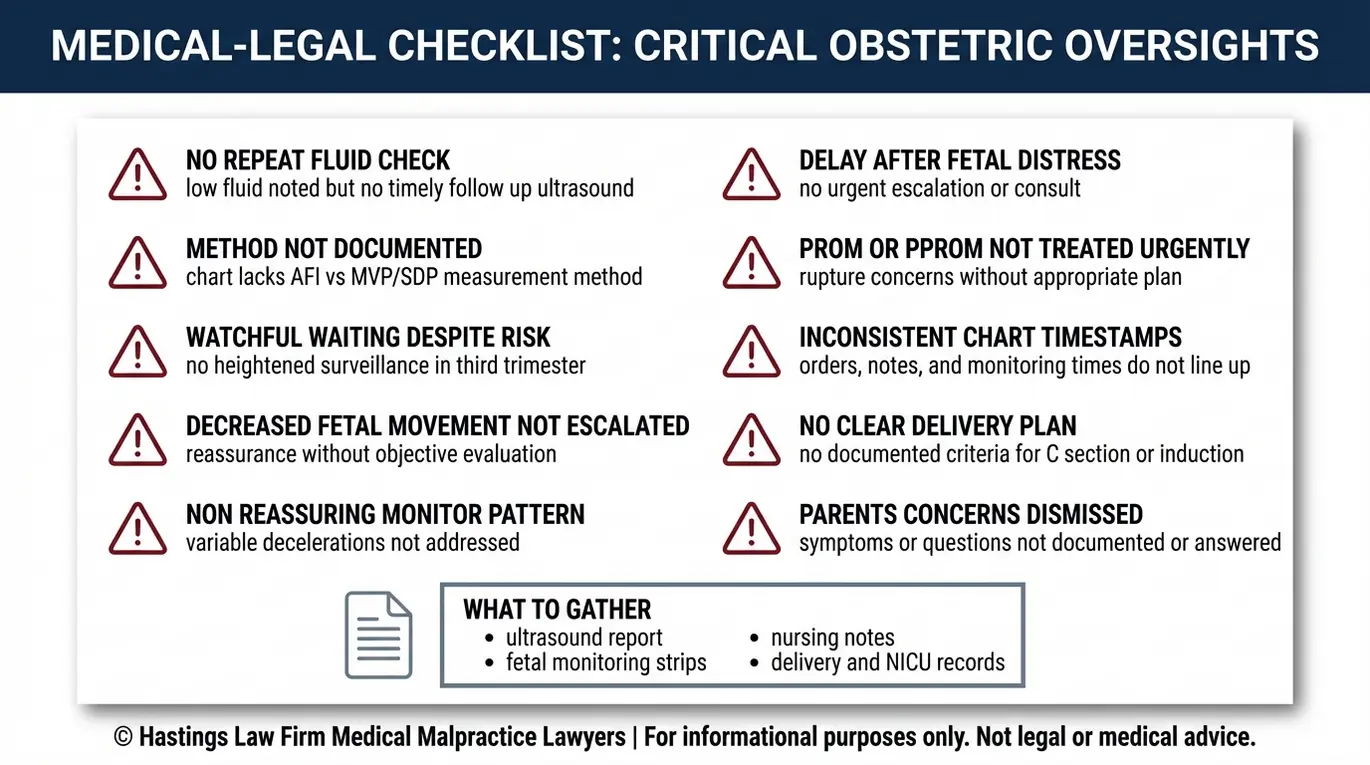
Red flags that may indicate a breach in the standard of care:
- Declining fluid measurements on serial ultrasounds with no change in the care plan
- Lack of increased fetal surveillance after an oligohydramnios diagnosis
- No documented discussion of risks or delivery planning with the patient
- Failure to refer to a maternal-fetal medicine specialist when indicated
- Delayed response to abnormal fetal heart rate patterns
- Absence of a clear plan for timing of delivery despite persistently low fluid
If any of these patterns appear in your records, they deserve a closer look from a legal and medical team experienced in birth injury cases.
Diagnostic Errors Involving Ultrasound and Fluid Measurement
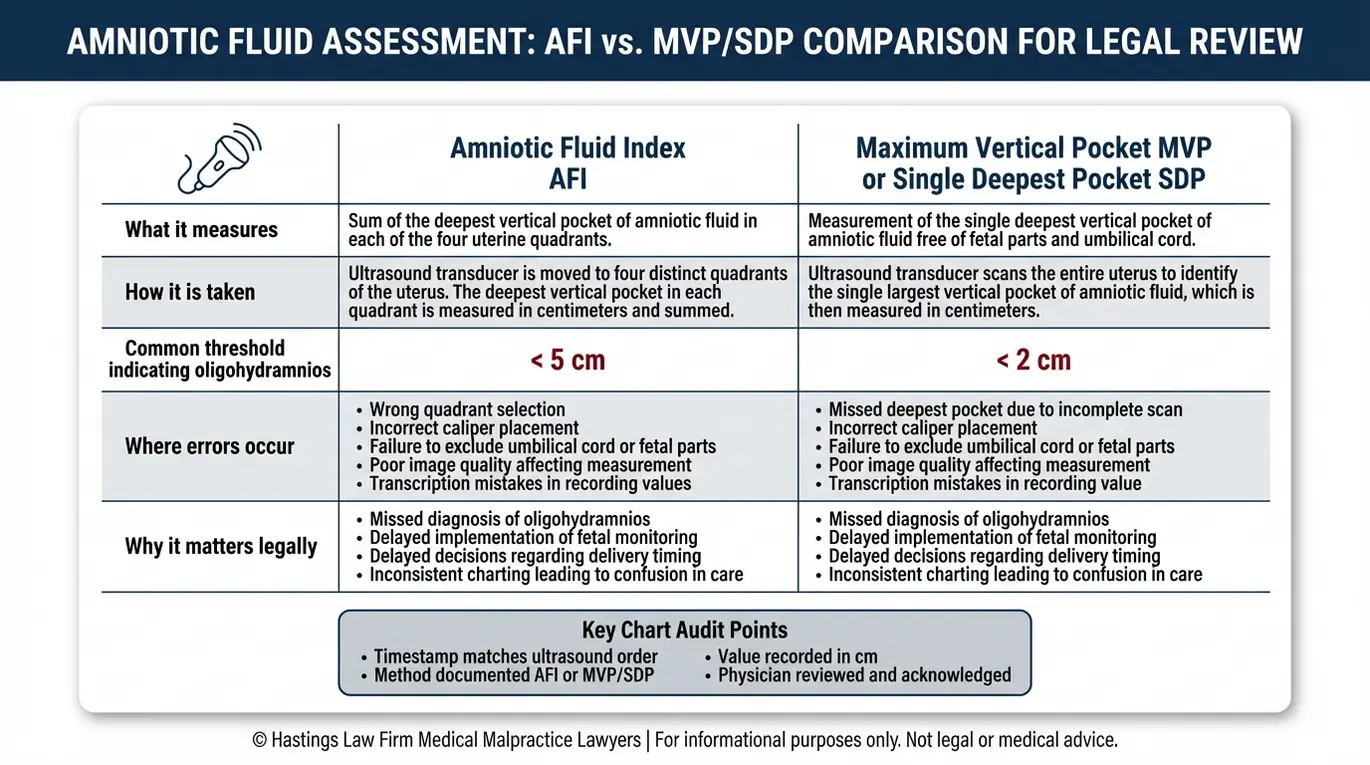
Doctors measure amniotic fluid levels using ultrasound, relying on two primary methods: the Amniotic Fluid Index (AFI), which is the sum of fluid depth measured in four quadrants of the uterus, and the Maximum Vertical Pocket (MVP), also called the Single Deepest Pocket (SDP), which measures the deepest single pocket of fluid. Errors in either measurement can lead to a missed or delayed diagnosis of dangerously low fluid levels.
An AFI below 5 cm or an MVP below 2 cm generally indicates oligohydramnios. These thresholds are not arbitrary. They reflect the point at which the baby loses protective cushioning and faces elevated risk for complications like cord compression.
| Measurement Method | What It Measures | Oligohydramnios Threshold |
|---|---|---|
| Amniotic Fluid Index (AFI) | Sum of fluid depth in four uterine quadrants | Less than 5 cm |
| Maximum Vertical Pocket (MVP/SDP) | Deepest single pocket of amniotic fluid | Less than 2 cm |
Accurate measurement depends on both the ultrasound technician’s skill and the reviewing physician’s interpretation. A technician who measures incorrectly, or a physician who fails to act on borderline or abnormal results, can set the stage for harm. Even a correct measurement can be useless if the physician fails to appreciate its significance in the context of the entire pregnancy. According to research published on Amniotic Fluid Disorders From Prenatal Management to Neonatal Outcomes, proper assessment and timely clinical response are essential to reducing adverse outcomes.
ACOG Guidance Favoring Maximum Vertical Pocket Measurement
The American College of Obstetricians and Gynecologists (ACOG) has noted that the Single Deepest Pocket (SDP), the measurement of the single largest vertical pocket of fluid, may be preferable to the AFI in certain clinical contexts. Research suggests that AFI can overdiagnose oligohydramnios, leading to unnecessary interventions. But misapplying this guidance creates its own risk.
The preference for SDP is intended to prevent unnecessary labor inductions for borderline cases, which carry their own risks. However, if a provider relies solely on one method without clinical context, or uses the preference for SDP as a reason to dismiss genuinely low readings from an AFI, that decision may fall below the standard of care. A thorough assessment should consider the full clinical picture, including fetal movement and heart rate, not just a single measurement value.
Lawyers for low amniotic fluid birth injuries examine which measurement method was used, whether it was applied correctly, and whether the results prompted appropriate follow-up.
The Hastings Law Firm Difference
Results matter, but what truly sets us apart is how we achieve them. Every verdict, every settlement, and every Texas courtroom victory comes from one guiding promise: To treat each client’s fight for justice as if it were our own.
This balance of skill, experience, and empathy reflects our core philosophy that justice should not only compensate the injured, but also make healthcare safer nationwide.

Critical Risks Include Umbilical Cord Compression and HIE
Without sufficient amniotic fluid to cushion the fetus, the umbilical cord compression can become compressed between the baby’s body and the uterine wall, restricting the flow of oxygenated blood. This is one of the most dangerous consequences of oligohydramnios.
Amniotic fluid acts as a protective buffer. When fluid levels drop too low, the cord loses that protection. During contractions, the cord may be squeezed or pinched, which often appears on the electronic fetal monitor as variable decelerations, sudden drops in the baby’s heart rate.
Isolated variable decelerations, which often appear as sharp “V” or “W” shapes on the monitor, may resolve on their own if the baby changes position. However, recurrent or prolonged episodes signal that the baby is losing oxygen with every contraction. Unlike late decelerations, which indicate placental issues, variable decelerations specifically point to cord compression. If the cord remains compressed for too long, the fetus cannot recover between contractions, leading to a dangerous buildup of acid in the blood (acidosis).
If oxygen deprivation continues without intervention, the baby can develop hypoxia, a state of insufficient oxygen reaching the brain and organs. Prolonged hypoxia during labor can lead to hypoxic-ischemic encephalopathy (HIE), a specific type of brain injury caused by reduced blood flow and oxygen delivery to the brain tissue. Research published on Predictors of Outcome Following Neonatal Encephalopathy confirms that the severity and duration of oxygen deprivation are closely linked to long-term neurological outcomes.
The consequences of untreated or poorly managed oxygen deprivation can be permanent. These injuries often stem from prolonged oxygen deprivation during delivery and include:
- Hypoxic-ischemic encephalopathy (HIE)
- Cerebral palsy
- Seizure disorders
- Cognitive and developmental delays
- Motor impairment affecting mobility and coordination
- Vision or hearing deficits
For families facing these diagnoses, the critical question is whether the care team recognized the signs of fetal distress on the monitor and responded quickly enough. As a birth injury lawyer in Texas, we examine the fetal monitoring strips, the nursing notes, and the timeline of response to determine whether the care followed the standard during those critical moments.
Common Causes and Risk Factors for Low Fluid Levels
Oligohydramnios can arise from maternal conditions such as hypertension or preeclampsia, fetal issues like kidney abnormalities or intrauterine growth restriction (IUGR), or the premature rupture of membranes. Identifying the underlying cause matters both medically and legally, because it shapes what the care team should have been watching for.
Maternal causes include preeclampsia (dangerously high blood pressure during pregnancy), chronic hypertension, maternal dehydration, and certain medications that affect kidney function or blood flow to the placenta.
Fetal and placental causes include placental insufficiency, a condition where the placenta cannot deliver adequate blood and nutrients to the baby, as well as congenital kidney abnormalities and fetal growth restriction. Post-term pregnancies, those extending beyond 42 weeks, are also associated with declining fluid levels because the placenta naturally begins to age and function less efficiently, producing less urine for the fetus to recycle into amniotic fluid.
| Category | Common Risk Factors |
|---|---|
| Maternal | Preeclampsia, chronic hypertension, dehydration, medication effects |
| Fetal/Placental | Placental insufficiency, kidney abnormalities, IUGR, congenital defects |
| Membrane-Related | PROM, PPROM |
| Gestational | Post-term pregnancy (beyond 42 weeks) |
One of the most common causes is premature rupture of membranes (PROM), which occurs when the amniotic sac breaks before labor begins. When this happens before 37 weeks, it is classified as preterm premature rupture of membranes (PPROM), carrying additional risks for both mother and baby.
The Role of Maternal Hydration in Managing Levels
Research suggests that simple oral hydration can increase amniotic fluid levels in some cases of mild oligohydramnios. Maintaining adequate fluid levels is essential for supporting the baby’s kidney function and overall circulation. We may investigate whether the care team recommended conservative measures like increased fluid intake before the situation became critical. If a provider failed to suggest basic, low-risk interventions when the condition was first identified, that omission can become part of the broader negligence analysis.
Failure to Perform Timely C-Section and Other Treatments
When fetal distress is detected in the setting of low amniotic fluid, the standard of care often calls for immediate intervention, which may include amnioinfusion or an emergency Cesarean delivery. The failure to act on clear signs of fetal distress visible on the electronic fetal monitor is one of the most common breakdowns we investigate in these cases.
Amnioinfusion is a procedure in which sterile fluid is infused into the uterus through a catheter to replace lost amniotic fluid and relieve pressure on the umbilical cord. According to Lecturio’s clinical resource on amnioinfusion, the procedure is often used when recurrent variable decelerations, repeated sudden drops in the fetal heart rate, indicate cord compression during labor. It can provide temporary relief by creating a fluid cushion around the cord, potentially resolving variable decelerations. However, it is not a definitive solution for every case, and its effectiveness must be constantly evaluated.
There comes a point in many of these situations during pregnancy or delivery where a C-section becomes the only safe option. If the baby’s heart rate tracing shows persistent late decelerations, prolonged bradycardia, or a pattern of worsening distress that does not respond to conservative measures, continued labor puts the baby at increasing risk for permanent oxygen deprivation.
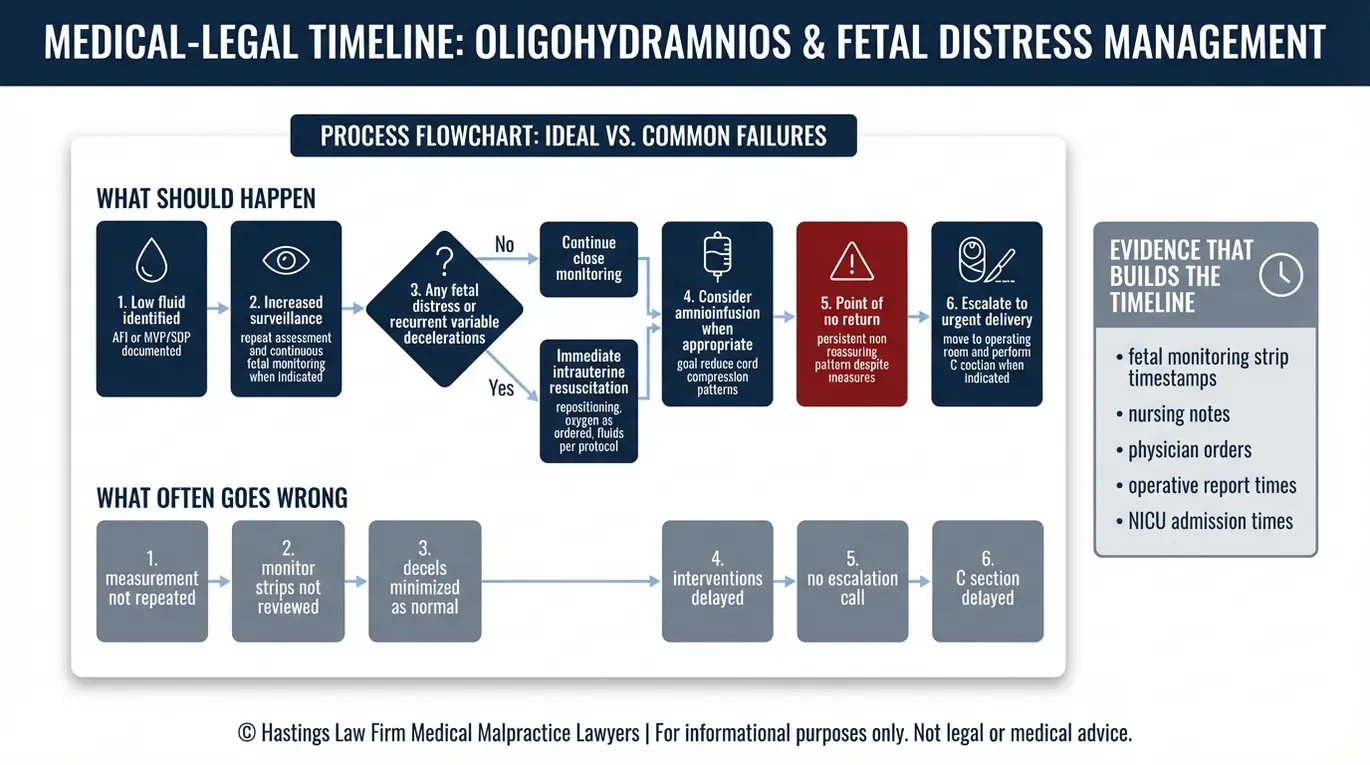
A typical timeline of expected care when low fluid and fetal distress are present:
- Identification: Oligohydramnios diagnosed on ultrasound; fetal monitoring initiated or increased
- Early intervention: Maternal repositioning, IV fluids, oxygen; amnioinfusion considered for recurrent variable decelerations
- Escalation: Persistent or worsening fetal heart rate abnormalities trigger preparation for operative delivery
- Decision point: If the fetal heart rate pattern does not improve, the standard of care typically requires proceeding with emergency C-section without unnecessary delay
A medical malpractice lawyer for birth injuries examines each of these decision points. We review the fetal monitoring strips, nursing and provider notes, and the documented timeline to identify where delays or inaction may have allowed preventable harm to occur. Every minute matters when the fetal brain is deprived of oxygen. A delay of even ten or fifteen minutes in ordering or executing a C-section when the heart rate tracing is non-reassuring can mean the difference between a healthy recovery and a lifetime of disability.
Recovering Compensation for Long Term Care Needs
Texas law allows families to recover both economic damages for quantifiable financial losses and non-economic damages for the pain, suffering, and impairment their child has endured. In birth injury cases involving conditions like HIE or cerebral palsy, the financial burden of long-term care can be extraordinary.
The lifetime cost of caring for a child with cerebral palsy or a related neurological condition can reach into the millions. According to a study published in The Economic Costs of Childhood Disability, families face substantially higher healthcare expenditures, lost household income, and ongoing therapeutic costs that extend well into adulthood.
A life care plan is a detailed projection of the medical, therapeutic, and supportive services a child will need over their lifetime. These plans are developed by qualified experts, such as certified life care planners and rehabilitation specialists, who account for inflation and the rising cost of healthcare.
They typically account for:
- Ongoing medical treatment and specialist visits
- Physical, occupational, and speech therapy
- Assistive devices, adaptive equipment, and home modifications
- In-home nursing care or attendant services
- Special education and vocational support
- Prescription medications
- Lost future earning capacity
Non-economic damages, including compensation for physical pain, mental anguish, and loss of enjoyment of life, are also recoverable. As a Texas low amniotic fluid lawyer, we work with life care planners and medical experts to build a complete picture of your child’s needs. We ensure any recovery reflects the true cost of their care, not just the bills received so far.
Why Choose Hastings Law Firm for Your Case
Hastings Law Firm brings together board-certified legal skill and in-house medical knowledge in a way that is specifically designed for complex birth injury litigation. Founded by Tommy Hastings, who is Board Certified in Personal Injury Trial Law by the Texas Board of Legal Specialization, a distinction held by fewer than 2% of Texas attorneys, the firm has built its reputation on thorough preparation and a commitment to accountability.
Tommy’s 2025 induction into the American Board of Trial Advocates (ABOTA), an invitation-only organization for experienced trial lawyers, reflects the firm’s standing in the legal community. But credentials alone do not define our approach. Every case is prepared from day one as though it will go before a jury. That level of preparation, supported by our national network of medical experts and our in-house team of nurse consultants and patient advocates, allows us to build the kind of evidence-driven cases that defense attorneys and insurance carriers take seriously.
Our team includes former defense counsel who previously represented hospitals, giving us direct insight into how the other side prepares its arguments. We also employ experienced nurses who understand charting practices, clinical protocols, and the standard of care from the inside.
As a Texas low amniotic fluid birth injury lawyer, our mission goes beyond compensation. Our unique combination of trial experience and medical insight ensures that no detail in the medical records is overlooked. We believe that holding negligent providers accountable helps prevent the same failures from harming another family. That mission drives every case we take.
Contact the Texas Birth Injury Attorneys at Hastings Law Firm Today for Help
You do not have to face the hospital’s legal team alone. If you or a loved one had a child who was harmed and you believe low amniotic fluid was mismanaged during pregnancy or delivery, the first step is understanding what happened and whether the care your family received fell below the standard.
At Hastings Law Firm, our team of attorneys, nurses, and medical professionals can review your records, explain what the evidence shows, and help you understand your legal options. Finding the truth is the starting point for both accountability and your child’s future security.
Consultations are free and confidential. We work on a contingency fee basis, meaning you pay no attorney fees or costs unless we recover compensation for your family. If you are looking for a Texas low amniotic fluid birth injury lawyer, contact Hastings Law Firm to discuss your case.
Frequently Asked Questions About Low Amniotic Fluid in Texas


This content was researched and written by the Hastings Law Firm editorial team, which includes attorneys, medical professionals, and experienced researchers. Our writing is informed by internal knowledge and practical experience, and we cross-check critical details against authoritative sources cited throughout. Every piece undergoes human-led fact-checking and legal review. Because legal and medical information can change, if you spot an error, please contact us. Learn more about our content standards and review process on our editorial policy page.

Tommy Hastings, founder of Hastings Law Firm, is a board-certified personal injury trial lawyer dedicated exclusively to healthcare injury cases. Since 2001, he has represented injured patients and families in litigation against major hospital systems, pharmaceutical companies, and negligent healthcare providers nationwide. He has handled numerous high-profile cases that have drawn national media attention and resulted in multi-million dollar recoveries. He draws on that experience in his writing, helping readers understand how these cases work and what options may be available to them.
