


Texas Erb’s Palsy Injury Lawyer
Written by: Hastings Law Firm | Reviewed by: Tommy Hastings | Updated: July 27, 2026
Erb palsy and other brachial plexus birth injuries can leave a newborn with weakness or loss of movement in an arm, and families often struggle to understand whether the injury was preventable. These injuries are often linked to shoulder dystocia and the amount or direction of traction used during delivery, and outcomes can range from temporary nerve stretching to permanent impairment. Treatment may involve therapy, surgery, and long term planning for care costs and quality of life. If you or a loved one were harmed or worse due to Erb palsy birth injury in Texas, contact Hastings Law Firm for a free, confidential case review.

Top Rated Erb’s Palsy Injury Lawyer for Texas Birth Trauma Cases
What You Should Know About Neonatal Shoulder Nerve Injury Claims in Texas:
- Long term arm weakness or permanent impairment can follow a brachial plexus birth injury, depending on whether nerves were stretched, compressed, or torn.
- Preventability can be a central dispute because shoulder dystocia requires careful maneuvers and excessive or misdirected traction can injure delicate nerves.
- Options for financial recovery can be shaped by damage limits on non economic harms while medical and care related losses may be treated differently.
- Future care needs can drive the value of a claim because treatment may involve therapy, surgery, adaptive equipment, and home or daily living modifications.
- The severity label can change both medical expectations and damages because neuropraxia may resolve while rupture or avulsion is linked to lasting loss.
- Missed or delayed recognition can affect outcomes because early evaluation and early therapy are emphasized for newborn brachial plexus injuries.
- Liability may be disputed based on delivery decisions such as whether a cesarean section was recommended when risk factors were present.
- Objective documentation can be pivotal because labor and delivery records and fetal monitoring strips may show what occurred during the emergency.
- Diagnostic testing can influence the picture of injury severity because MRI, EMG, and nerve conduction studies may identify rupture or avulsion.

A Healthcare Focused Law Firm
When your child is born with an arm that doesn’t move the way it should, the worry can be overwhelming. If your baby was diagnosed with Erb’s palsy or a brachial plexus injury after a difficult delivery, you may be wondering whether something went wrong in the delivery room and what you can do about it.
You are not alone in asking these questions, and you are not wrong for asking them. Many families feel uncertain about whether their child’s injury was preventable. That instinct deserves a clear, honest answer from someone who understands both the medicine and the law.
At Hastings Law Firm, medical malpractice is all we do. Our team includes in-house nurses, former defense attorneys, and board-certified Texas Erb’s Palsy injury lawyer Tommy Hastings, who has spent over two decades holding healthcare providers accountable for preventable injuries. We know how to examine what happened during delivery and determine whether your child’s injury resulted from a departure from accepted medical standards.
If your family is dealing with this, we invite you to contact us for a free, confidential case evaluation. We can review what happened and explain your options.
Understanding Erb’s Palsy and Brachial Plexus Injuries
Erb’s palsy is a form of obstetric brachial plexus injury caused by damage to the network of nerves controlling the arm and hand, typically occurring when an infant’s shoulder becomes stuck during delivery. Understanding this injury is the first step toward knowing whether your child may have a legal claim.
The brachial plexus is a bundle of nerves running from the spinal cord in the neck down through the shoulder. It is formed by the nerve roots C5, C6, C7, C8, and T1, and controls movement and sensation in the arm and hand. When these nerves are stretched, compressed, or torn during birth, the result can range from temporary weakness to permanent paralysis of the affected arm.
The injury most often happens during shoulder dystocia, a complication occurring when the baby’s head has been delivered but one or both shoulders become lodged behind the mother’s pelvic bone. When this happens, the delivering physician may need to apply traction, or pulling force, to free the baby. This emergency requires calm, precise maneuvers to release the shoulder without harming the baby. If that force is excessive or improperly directed, it can damage the delicate nerves of the brachial plexus.
Not every case of shoulder dystocia leads to nerve damage, and not every brachial plexus injury is permanent. Some infants experience only neuropraxia, a mild stretching of the nerve that often heals on its own within a few months. Others suffer more severe injuries that cause lasting loss of movement, sensation, or both.
A Texas Erb’s palsy injury lawyer can help determine whether the delivery team’s actions fell below the accepted standard of care. If your child’s birth trauma could have been avoided with proper technique or timely intervention, your family may have grounds for a medical malpractice claim. Working through these medical challenges requires legal expertise, and experienced lawyers for Erb’s palsy in Texas can help families uncover the truth.
Recognizing the Symptoms of Infant Shoulder Nerve Avulsion
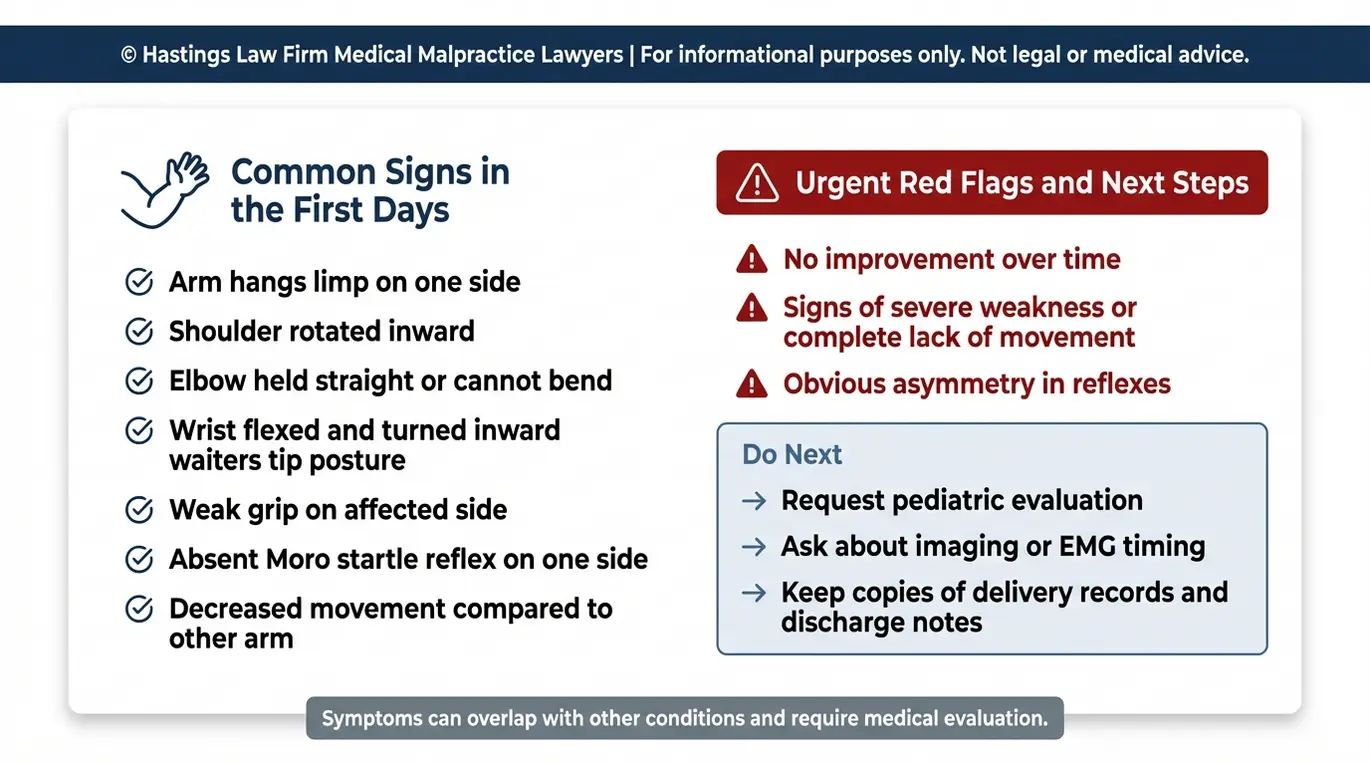
Common signs of Erb’s palsy include a limp arm held close to the body, a lack of Moro reflex (the involuntary startle response newborns display when they feel unsupported) on the affected side, and the “waiter’s tip” posture, where the arm hangs with the wrist flexed backward as though the child is waiting for a tip to be placed in their hand.
These symptoms, often indicative of an infant shoulder nerve avulsion, may be noticeable immediately after birth or become more apparent in the days that follow. Parents and medical staff should watch for the following signs:
Symptoms to watch for in your newborn:
- The arm on one side hangs limp or rotates inward toward the body
- The baby does not move the affected arm when startled (absent Moro reflex)
- The hand or fingers on the affected side curl inward or appear weak
- The baby does not respond to touch or gentle pressure on the affected arm (loss of sensation)
- The “waiter’s tip” posture is visible when the arm is at rest, resulting in limited mobility
- Difficulty gripping or grasping with the affected hand
If you notice any of these signs, prompt medical evaluation is essential. Doctors can assess nerve function and determine the severity of the injury. According to MedlinePlus, brachial plexus injuries in newborns require early identification so that appropriate treatment can begin quickly.
Understanding your legal rights is also important. Under the Texas Civil Practice and Remedies Code, Chapter 74, families have the right to pursue a claim if a healthcare provider’s negligence caused or contributed to the injury. An Erb’s palsy attorney can help you connect the clinical signs to what happened during delivery.
The Hastings Law Firm Difference
Results matter, but what truly sets us apart is how we achieve them. Every verdict, every settlement, and every Texas courtroom victory comes from one guiding promise: To treat each client’s fight for justice as if it were our own.
This balance of skill, experience, and empathy reflects our core philosophy that justice should not only compensate the injured, but also make healthcare safer nationwide.

Types and Severity of Brachial Plexus Nerve Damage
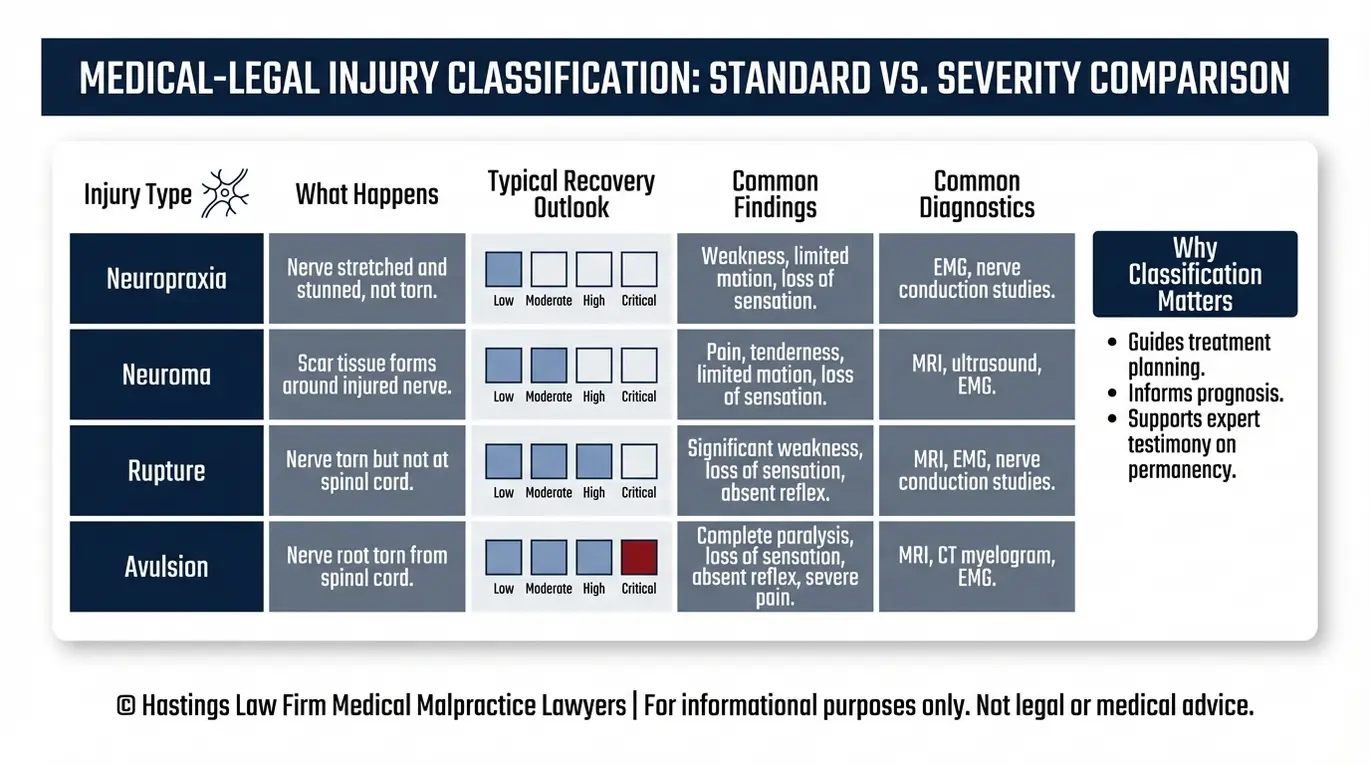
Brachial plexus injuries range from mild neuropraxia, a temporary stretching of the nerve, to severe avulsion, where the nerve root is torn directly from the spinal cord, with significantly different recovery outlooks depending on severity.
Understanding the type of brachial plexus injury your child sustained is important for both treatment decisions and any potential legal claim. Medical experts and a Texas Erb’s palsy injury lawyer will classify the nerve damage into one of four categories:
| Injury Type | What Happens | Typical Prognosis |
|---|---|---|
| Neuropraxia | The nerve is stretched but not torn | Often resolves within 3–6 months without surgery |
| Neuroma | Scar tissue forms around a partially damaged nerve, creating pressure | May improve partially; can require therapy or surgery |
| Rupture | The nerve is torn but not at the spinal cord | Will not heal on its own; surgery is typically required |
| Avulsion | The nerve root is torn from the spinal cord | Most severe; permanent damage likely even with surgery |
Neuropraxia is the most common and least severe form. Many infants with this type of injury recover full or near-full function with physical therapy alone. Neuroma injuries are more unpredictable because the buildup of scar tissue can continue to interfere with nerve signals over time.
Rupture and avulsion injuries carry the most serious long-term consequences. According to a clinical review published in PubMed Central on the evaluation and management of neonatal brachial plexus palsy, these severe injuries often require surgery. Even with nerve grafting, a full recovery is not always possible. In cases of severe avulsion, a tearing of the nerve root from the spinal cord, the damage is typically permanent.
The severity classification matters in a legal claim because it directly affects the scope of damages. A birth injury legal team will work with medical experts to document the type and extent of the nerve damage as part of building your case.
Diagnosing the Injury with Advanced Imaging
Confirming the type and extent of a brachial plexus injury typically involves specialized diagnostic testing. These diagnostic tests help identify the specific type and severity of nerve damage. An MRI can reveal structural damage to the nerves and surrounding tissue, helping doctors determine whether a rupture or avulsion has occurred.
Electromyography (EMG), a test that measures the electrical activity in muscles, can show whether the nerves are sending proper signals to the affected arm. Nerve conduction studies (NCS), tests that measure how quickly electrical impulses travel through the nerves, are also used. Together, these tools give physicians and legal experts a detailed picture of the injury’s severity, which becomes essential evidence in supporting a medical malpractice claim.
Proving Medical Negligence in Delivery Room Errors
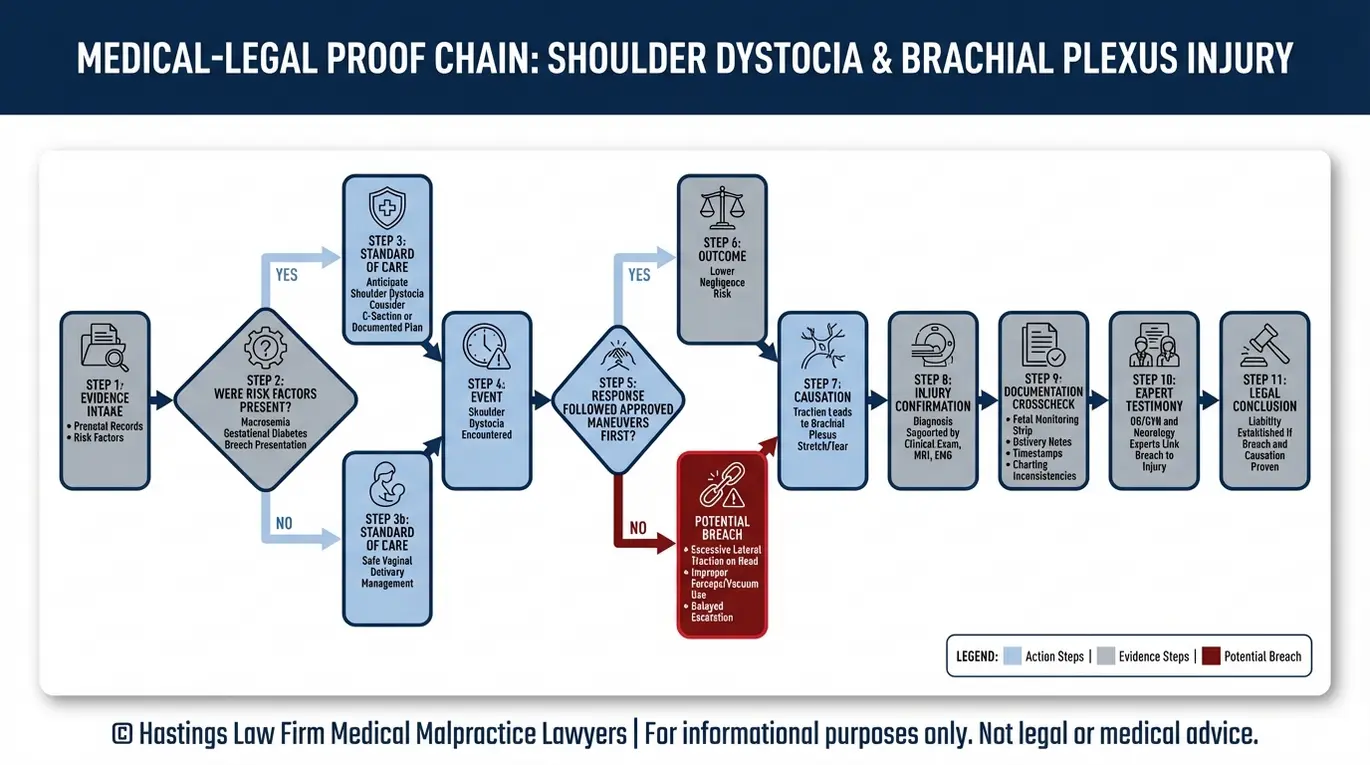
Medical negligence is proven by showing that the obstetrician failed to follow the standard of care, such as applying excessive force during a shoulder dystocia emergency or failing to recommend a necessary cesarean section. Building a strong claim requires connecting the provider’s actions (or inactions) to the child’s injury.
A Texas Erb’s palsy injury lawyer will examine the full timeline of prenatal care and delivery to identify where the standard of care may have been breached.
Common risk factors and delivery decisions we evaluate include:
- Macrosomia (large baby): Macrosomia, or a condition where the baby is significantly larger than average, requires the physician to discuss delivery alternatives, including a scheduled C-section. Failing to account for a baby’s size can set the stage for shoulder dystocia.
- Ignored maternal risk factors: Conditions like gestational diabetes or a history of difficult deliveries can increase the likelihood of complications. We review whether these risks were properly documented and addressed.
- Improper use of forceps or vacuum extraction: These instruments can be appropriate in certain situations, but their misuse, or use when contraindicated, can apply dangerous pressure to the baby’s head and neck.
- Excessive lateral traction: Lateral traction, the act of pulling the baby’s head sideways to free the shoulders, can damage the brachial plexus when too much force is applied or when recognized maneuvers to relieve shoulder dystocia are not attempted first.
- Failure to perform a timely cesarean section: In some cases, the safest course of action is surgical delivery. We look at whether the medical team had information that should have prompted this decision earlier.
Our medical malpractice attorneys work alongside in-house nursing staff and qualified medical experts to reconstruct what happened during delivery. We review fetal monitoring strips, labor and delivery records, nursing notes, and physician orders to determine whether the care provided fell below accepted standards. Expert testimony from a qualified OB-GYN is then used to establish the connection between the provider’s decisions and your child’s injury. We recommend retaining experienced Erb’s palsy counsel to examine these critical details.
Treatment Options and Life Care Planning Costs
Treatment for Erb’s palsy involves physical therapy, occupational therapy, and potentially nerve graft surgery, often requiring a lifetime of care that necessitates a comprehensive Life Care Plan for legal damages. When pursuing a legal claim, a detailed Life Care Plan helps calculate the full scope of future expenses.
Early intervention is one of the most important factors in recovery. Physical therapy and occupational therapy can begin in the first weeks of life to help prevent muscle atrophy, improve range of motion, and strengthen the affected arm. For infants with milder injuries, consistent therapy may be sufficient to restore significant function.
For children with more severe injuries, such as ruptures or avulsions, surgical options may include nerve grafts, nerve transfers, or tendon transfers. According to a clinical review published in PubMed Central on brachial plexus birth injury treatment and interventions, early surgical evaluation is recommended when there is no improvement within the first few months of life. The costs of these interventions can be staggering, often reaching into the millions over a child’s lifetime.
A birth injury lawyer in Texas will work with life care planning experts to project the total cost of your child’s treatment over their lifetime. This includes therapy, future surgeries, adaptive equipment such as splints and braces, and potential modifications to daily living. This Life Care Plan becomes a central piece of evidence when seeking fair compensation.
Recovering Compensation for Birth Injuries in Texas
Recoverable damages in Texas birth injury cases include past and future medical expenses, pain and suffering, physical impairment, and lost future earning capacity for the child. Understanding what your family may be entitled to is an important part of the legal process.
Texas law divides birth injury damages into two main categories. Economic damages cover the measurable financial costs of the injury: medical bills, rehabilitation, therapy, assistive devices, and the income your child may lose over a lifetime because of their physical limitations. There is no cap on economic damages in Texas, which means these claims can account for the full cost of your child’s care.
Non-economic damages compensate for pain, suffering, disfigurement, and physical impairment. Texas does place caps on these damages under the Texas Medical Liability Act. The cap is $250,000 per physician and up to $500,000 total against hospital defendants.
While capped, these damages acknowledge the profound impact of the injury on the child’s quality of life, including physical disfigurement and the emotional toll of living with a permanent disability. However, the uncapped economic damages often represent the largest portion of a birth injury case, particularly when a child will need decades of medical care.
Types of damages your family may recover include:
- Past and future medical expenses (surgery, therapy, medications, adaptive equipment)
- Lost future earning capacity for your child
- Pain and suffering endured by the child
- Physical impairment and disfigurement
- Costs of ongoing rehabilitation and life care needs
A Texas Erb’s palsy injury lawyer will evaluate the full scope of your child’s injury to pursue financial recovery that reflects both current needs and long-term costs. Securing full financial recovery for Erb’s palsy is critical for your child’s independence. It ensures they have access to the best specialists and adaptive technologies available. Holding the hospital, physicians, and nursing staff accountable through the legal system is about making sure your child has the resources they need going forward.
How Our Firm Investigates Your Brachial Plexus Case
We begin with a free medical record review by our in-house nursing staff to identify potential deviations from the standard of care, followed by expert witness validation to build a trial-ready case. Here is how the process works:
- Step 1: Intake with a Patient Advocate. Your first call is answered by a trained patient advocate, not a call center. We listen to what happened, answer your initial questions, and gather the information needed to begin a review.
- Step 2: Medical Record Analysis and Expert Review. Our thorough case investigation begins with our in-house nurses and board-certified patient advocates examining your delivery records, fetal monitoring strips, and nursing notes. We then engage qualified medical experts to conduct a formal standard of care analysis.
- Step 3: Filing the Lawsuit. Texas law requires compliance with Chapter 74 of the Civil Practice and Remedies Code, including filing a qualified expert report within 120 days of the defendant filing their answer. Our team handles every procedural requirement from the start.
- Step 4: Litigation and Resolution. We rely on validation by expert testimony to build a strong claim. Because we prepare every case as if it will go to trial, we negotiate from a position of strength. Our former defense attorneys know how the other side thinks, and we use that knowledge to your advantage.
As your Texas Erb’s palsy injury lawyer, we work on a contingency fee basis. You pay no attorney fees or costs unless we recover compensation for your family. Contact a birth injury attorney at our firm to get started.
Contact the Texas Birth Injury Attorneys at Hastings Law Firm Today for Help
Your child’s future matters, and so does the truth about what happened during their delivery. If your baby was diagnosed with Erb’s palsy or a brachial plexus injury, you deserve answers from a team that understands these cases at the deepest medical and legal level.
Hastings Law Firm focuses exclusively on medical malpractice. Our team of attorneys, nurses, and patient advocates is built to investigate birth injuries with the precision and dedication your family’s case requires. We are committed to restoring trust for families who feel the healthcare system let them down, and to securing the resources your child needs for the road ahead.
Your consultation is free and confidential, and you pay nothing unless we win. Reach out to a Texas Erb’s Palsy Injury Lawyer at Hastings Law Firm today to request your risk-free case evaluation. Let us help you find the answers you deserve.
Frequently Asked Questions About Erb’s Palsy Birth Injury in Texas


This content was researched and written by the Hastings Law Firm editorial team, which includes attorneys, medical professionals, and experienced researchers. Our writing is informed by internal knowledge and practical experience, and we cross-check critical details against authoritative sources cited throughout. Every piece undergoes human-led fact-checking and legal review. Because legal and medical information can change, if you spot an error, please contact us. Learn more about our content standards and review process on our editorial policy page.

Tommy Hastings, founder of Hastings Law Firm, is a board-certified personal injury trial lawyer dedicated exclusively to healthcare injury cases. Since 2001, he has represented injured patients and families in litigation against major hospital systems, pharmaceutical companies, and negligent healthcare providers nationwide. He has handled numerous high-profile cases that have drawn national media attention and resulted in multi-million dollar recoveries. He draws on that experience in his writing, helping readers understand how these cases work and what options may be available to them.
