


Texas Forceps Eye Birth Injury Lawyer
Written by: Hastings Law Firm | Reviewed by: Tommy Hastings | Updated: July 27, 2026
Forceps deliveries can be appropriate in limited situations, but misuse can cause serious and lasting eye damage in a newborn. Excessive pressure, poor placement, or repeated traction can injure the eye socket, optic pathway, or facial nerves, sometimes leading to permanent vision impairment and long term developmental impacts. The difference between temporary marks and preventable structural injury often depends on whether accepted safety criteria and technique were followed and whether a safer delivery method should have been chosen. If you or a loved one were harmed or worse due to forceps eye birth injuries in Texas, contact Hastings Law Firm for a free, confidential case review.

Fighting for Infants Who Suffered Preventable Vision Loss in Texas Hospitals
What You Should Know About Infant Traumatic Eye Damage Claims in Texas:
- Lifelong vision impairment can follow a forceps delivery when excessive pressure or improper placement injures the eye, orbit, or nearby nerves.
- Permanent harm can be disputed when providers characterize injuries as expected bruising rather than preventable structural damage.
- Severe outcomes can become more likely when forceps are used despite missing safety criteria or when a timely C section is not chosen.
- The risk of serious intracranial and ocular trauma can increase when a vacuum attempt is followed by forceps during the same delivery.
- Long term complications can extend beyond the eye when brain based visual processing is affected by intracranial bleeding or oxygen deprivation.
- Recovery options in Texas can be limited for pain and suffering while lifetime care costs and other economic losses are treated differently.
- Case viability can be lost if a required expert report is not served on time in Texas medical malpractice claims.
- Causation disputes can turn on whether imaging findings and injury patterns match forceps compression rather than congenital or developmental causes.
- Key records can be central when delivery notes, fetal monitoring, and postnatal imaging show how the instrument was used and when symptoms appeared.

A Healthcare Focused Law Firm
When your baby is born with an eye injury after a forceps delivery, the fear and confusion can feel overwhelming. You expected your medical team to protect your child, and now you are searching for answers about what went wrong and what it means for your baby’s future.
You deserve to know the truth. A Texas forceps eye birth injury lawyer can help you understand whether the injuries your child sustained were the result of medical negligence, and what legal options may be available to your family.
At Hastings Law Firm, our medical-legal team focuses exclusively on medical malpractice cases, including birth injuries involving instrument-assisted deliveries. Founded by board-certified trial lawyer Tommy Hastings, we use a trial-ready approach to handle complex birth trauma cases. The consultation is free, and you pay nothing unless we recover compensation for your family.
Understanding How Forceps Misuse Causes Traumatic Eye Damage
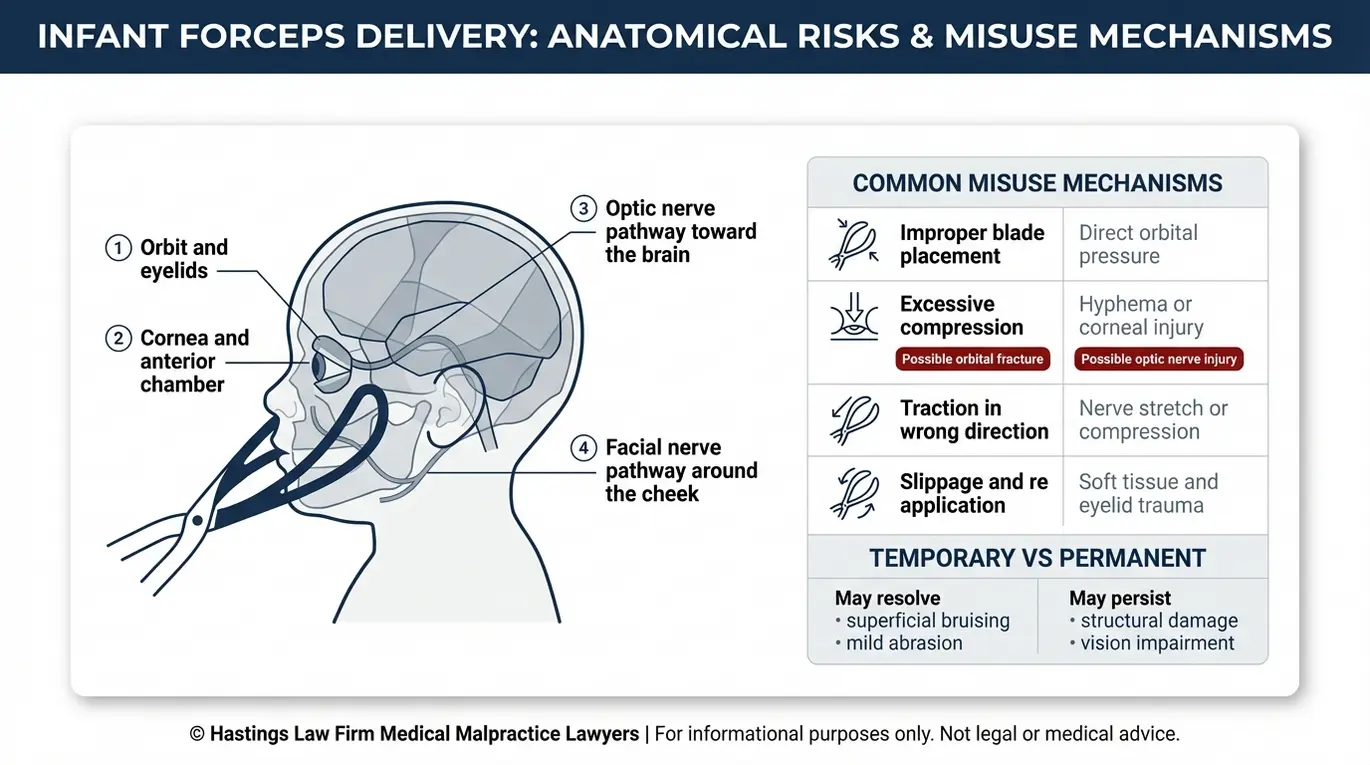
Forceps eye injuries occur when a physician applies excessive pressure, uses improper placement, or applies incorrect traction during an assisted delivery, directly compressing the infant’s orbit, or eye socket, and surrounding facial nerves. Understanding the mechanics of how these injuries happen is the first step toward knowing whether your child’s condition could have been prevented.
A forceps delivery is a type of operative vaginal delivery, sometimes called an assisted vaginal delivery, in which a doctor uses a pair of curved metal instruments shaped like large spoons to gently guide the baby’s head through the birth canal. When used correctly and under the right conditions, forceps can be an appropriate tool. The problem arises when the instrument is misapplied. If this leads to injury, a Texas medical malpractice lawyer can investigate whether the standard of care was breached.
Misuse can take several forms. The blades may slip from their intended position on either side of the baby’s head, shifting toward the face and compressing the delicate orbital structures. A physician may select the wrong size instrument for the baby’s head.
Excessive force, whether from repeated traction attempts or prolonged compression, can cause direct trauma to the soft tissue, bone, and nerves surrounding the eyes. An infant’s skull and facial bones are not fully developed at birth. The orbit is particularly fragile, and the nerves that control eye movement and eyelid function run close to the surface. Small errors in forceps placement can result in serious ocular trauma.
We distinguish between temporary marks and permanent structural damage. Superficial bruising or redness on a newborn’s face after a forceps delivery may resolve within days. But deeper injuries, such as fractures to the orbital bone, compression of the optic nerve, or damage to the facial nerve controlling the eyelid, can cause lasting harm to the child’s vision.
A Texas forceps eye birth injury lawyer focuses on identifying whether an injury crossed that line from expected minor bruising into preventable, permanent damage caused by medical negligence. The standard of care requires that any physician performing an assisted vaginal delivery be trained in proper forceps technique. This includes correct blade placement, appropriate force application, and recognizing when the procedure should be abandoned.
When those standards are not followed, and a child is injured as a result, the physician and the facility may be held accountable. If your infant suffered eye damage during delivery, a forceps birth injury attorney in Texas can evaluate the medical records to determine whether the care your child received fell below accepted standards. You may need a lawyer for infant eye damage to guide you through the legal process and fight for your child’s rights.
Types of Eye Injuries and Vision Loss Caused by Forceps
Common forceps-related eye injuries include corneal abrasions, retinal hemorrhages, optic nerve damage, orbital fractures, and lagophthalmos caused by facial nerve palsy. These injuries range from conditions that may heal with treatment to permanent vision loss that will affect a child for life.
Direct Trauma to the Eye
The most immediate injuries happen when the forceps blades physically contact or compress the structures of the eye and face. Corneal abrasions, or scratches to the surface of the eye, are among the more common injuries and can cause significant pain and light sensitivity. If not properly treated, they may lead to scarring that impairs vision.
More serious direct injuries include hyphema, a condition where blood collects in the anterior chamber of the eye between the cornea and the iris. Hyphema can increase pressure inside the eye and, if left untreated, may lead to permanent vision damage. In rare but severe cases, the force from a misapplied instrument can cause globe rupture, a catastrophic break in the wall of the eyeball that often results in permanent vision loss in the affected eye. A Texas forceps eye birth injury lawyer can help families understand whether these injuries were caused by instrument misuse during delivery.
Orbital fractures occur when the thin bones surrounding the eye socket are cracked or broken by the pressure of the forceps blades. These fractures can affect eye alignment, restrict eye movement, and lead to long-term conditions like strabismus, where the eyes do not point in the same direction, or amblyopia, sometimes called “lazy eye,” where one eye develops weaker vision because the brain begins to favor the other. A forceps injury lawyer can review the diagnostic records to confirm these findings.
Nerve Damage and Secondary Vision Loss
Facial nerve injury during a forceps delivery can cause facial nerve palsy, in which the muscles on one side of the face become temporarily or permanently paralyzed. When this paralysis affects the eyelid, the infant may be unable to fully close the eye. Facial nerve injury can lead to lagophthalmos, which leaves the cornea exposed to drying, infection, and progressive damage.
What starts as a nerve injury can lead to secondary vision loss that could have been prevented with a different delivery approach. Lagophthalmos is the medical term for the inability to fully close the eyes, often resulting from nerve damage. These conditions can cause the eye to dry out or become infected if not managed. An infant vision loss attorney in Texas can investigate whether the nerve damage was a foreseeable result of instrument misuse.
Neurological Vision Loss
Not all forceps-related vision problems originate in the eye itself. Cerebral visual impairment, sometimes called cortical visual impairment or CVI, is a condition where the eyes may be structurally intact but the brain’s visual processing centers are damaged. This can happen when forceps cause intracranial hemorrhage, bleeding inside the skull, or when excessive compression leads to oxygen deprivation during a prolonged delivery. CVI is one of the leading causes of vision impairment in children.
Other conditions, such as retinopathy, may also manifest alongside these injuries. Parents should be aware of the warning signs of vision problems in infants and children, including lack of eye contact, failure to track objects, and unusual head positioning.
If your child has been diagnosed with any of these conditions following a forceps delivery, a birth injury lawyer in Texas can work with medical experts to determine whether the injury was preventable. A medical malpractice attorney for eye injury cases will examine the full clinical picture, from delivery room records to postnatal imaging, to build an accurate understanding of what happened. If your child suffered eye damage from forceps, we are here to help.
| Injury Type | Mechanism of Forceps Trauma | Potential Long-Term Outcome |
|---|---|---|
| Corneal Abrasion | Blade contact or pressure on the eye surface | Scarring, light sensitivity, impaired vision |
| Hyphema | Blunt force causing blood to pool in the eye | Elevated eye pressure, glaucoma, vision loss |
| Globe Rupture | Severe compression fracturing the eyeball wall | Permanent blindness in the affected eye |
| Orbital Fracture | Forceps pressure cracking thin eye socket bones | Strabismus, restricted movement, amblyopia |
| Facial Nerve Palsy | Compression of cranial nerve VII | Lagophthalmos, corneal exposure, secondary vision loss |
| Cortical Visual Impairment | Intracranial hemorrhage or oxygen deprivation from prolonged delivery | Impaired brain-based visual processing |
The Hastings Law Firm Difference
Results matter, but what truly sets us apart is how we achieve them. Every verdict, every settlement, and every Texas courtroom victory comes from one guiding promise: To treat each client’s fight for justice as if it were our own.
This balance of skill, experience, and empathy reflects our core philosophy that justice should not only compensate the injured, but also make healthcare safer nationwide.

Medical Criteria for Forceps Use Versus C-Section
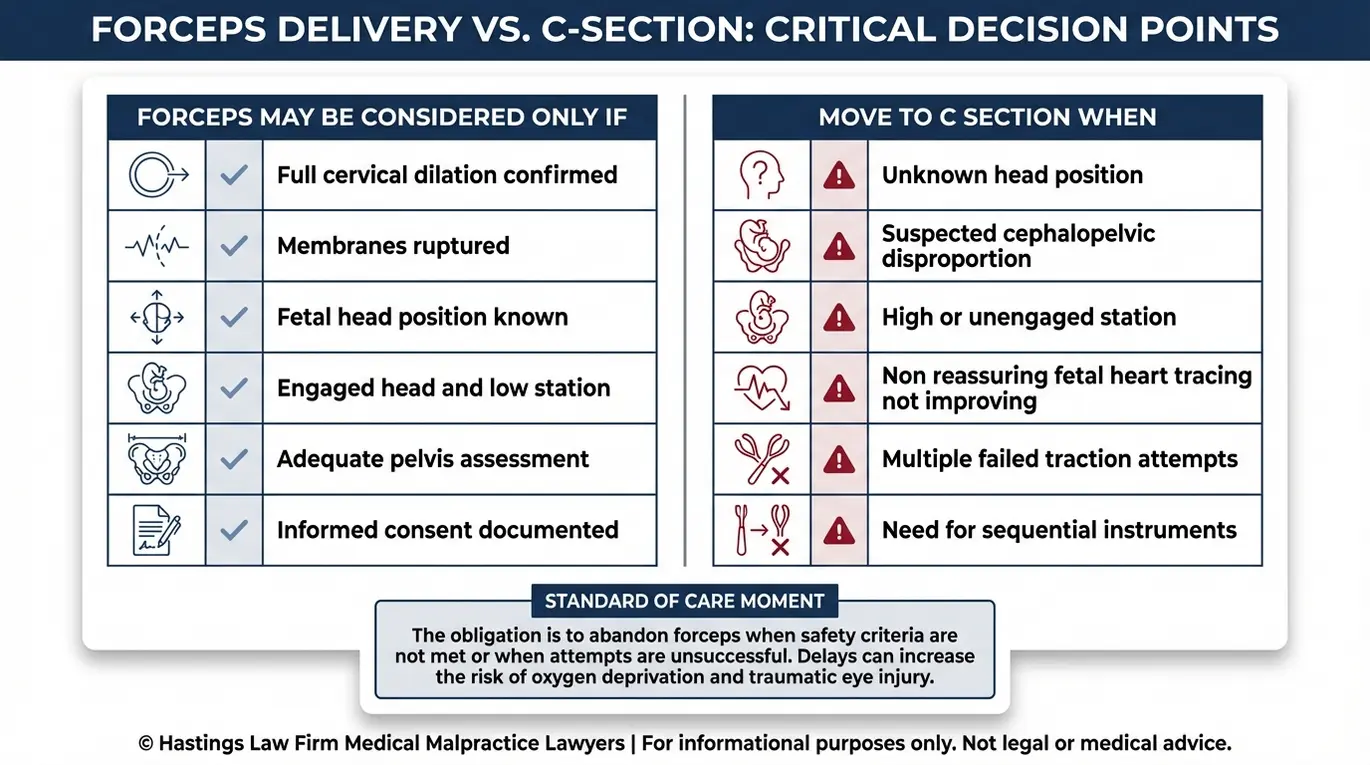
Doctors must only use forceps when specific safety criteria are met, including full cervical dilation, ruptured membranes, and a known fetal head position. When these conditions are absent or the delivery is not progressing safely, failure to abandon forceps in favor of a C-section can violate the medical standard of care.
When Forceps May Be Appropriate
There are recognized clinical situations where a forceps delivery can be a reasonable choice. These include cases where the mother has been pushing for an extended period and is physically exhausted, where the baby is showing signs of fetal distress on the fetal heart monitor and delivery needs to happen quickly, or where a maternal medical condition makes prolonged pushing unsafe.
Even when these indications are present, the decision to proceed with forceps requires that a strict set of preconditions be confirmed:
- The cervix must be fully dilated
- The membranes must be ruptured
- The fetal head position, meaning the direction the baby is facing in the birth canal, must be definitively identified
- The baby’s head must be engaged at an appropriate station in the pelvis
- The mother’s bladder should be emptied
- Adequate anesthesia must be in place
- The physician must have obtained informed consent by explaining the risks
- The team must be prepared for an emergency C-section if the forceps attempt fails
When any of these conditions is not met, the standard of care generally requires that the physician choose a different delivery method. A Texas forceps eye birth injury lawyer examines whether these preconditions were satisfied before a doctor proceeded with instrument-assisted delivery.
When Forceps Should Not Be Used
Certain conditions make forceps delivery dangerous and, in many cases, a clear deviation from accepted medical practice. A known or suspected cephalopelvic disproportion, or CPD, a condition where the baby’s head is too large or the mother’s pelvis is too narrow, is one of the most significant contraindications. Attempting forceps in this situation can result in severe trauma to the infant’s head, face, and eyes.
Other contraindications include an unengaged fetal head, an unknown head position, and prematurity. If the baby is showing signs of a condition that would make skull compression particularly dangerous, such as a bleeding disorder, forceps delivery is generally contraindicated.
The critical decision point in these cases is the moment when the physician chooses an operative vaginal delivery over a C-section. When fetal distress is present and forceps criteria are not clearly met, the safer option is typically a cesarean delivery.
If a doctor proceeded with forceps despite warning signs, or failed to transition to a C-section after an unsuccessful attempt, that decision may be the basis for a malpractice claim. Prolonged labor under these conditions can lead to oxygen deprivation and birth asphyxia. An improper forceps use attorney can review the delivery records to determine whether the physician’s choice fell below the standard of care. A failure to perform C-section lawyer can investigate whether a timely surgical delivery would have prevented the injury. Seek advice from Texas birth injury counsel to evaluate your claim.
The One Mechanical Instrument Rule and Sequential Instrument Risks
The “One Mechanical Instrument” rule advises against switching from a vacuum extractor to forceps, or vice versa, because this sequential use significantly increases the risk of severe intracranial and ocular trauma to the infant. The One Mechanical Instrument rule serves as a safety guideline to prevent doctors from using multiple types of delivery tools on one infant.
Why Sequential Instruments Are Dangerous
When a vacuum extractor fails to deliver the baby, switching to forceps compounds the mechanical stress already placed on the infant’s head. The vacuum applies suction and traction to the top of the skull. Forceps then apply lateral compression to the sides. These are two fundamentally different types of force acting on different parts of the head, and using both in the same delivery multiplies the risk of injury.
Sequential instrument delivery, the practice of switching from one device to another during the same delivery, is widely recognized as a significant risk factor for serious birth injuries, including skull fracture, brain injury, and severe ocular trauma. Research on long-term neurodevelopmental outcomes after forceps, vacuum, and second-stage cesarean delivery has examined the increased harm associated with these delivery methods, particularly when instruments are used in combination. A Texas forceps eye birth injury lawyer will specifically look for evidence that more than one instrument was used during your child’s delivery. A vacuum to forceps switch attorney can help you hold the medical team accountable.
Understanding Station and Forceps Classification
The level of risk associated with forceps also depends on where the baby’s head is positioned in the birth canal, measured by a system called “station.” Station refers to the position of the fetal head in relation to the mother’s pelvis. This classification matters because the higher the baby’s head when forceps are applied, the greater the distance and force required to deliver, and the greater the risk of injury.
Outlet forceps are applied when the baby’s head is visible at the vaginal opening and requires only minimal rotation and traction. Low forceps are applied when the head is at a slightly higher station but still well-descended. Mid forceps involve application when the head is higher in the pelvis and require more force and rotation. High forceps, the application of forceps when the baby’s head has not descended into the pelvis, are considered so dangerous that they are effectively abandoned in modern obstetric practice. Any physician who applies high forceps, or forceps at a level above the baby’s head, would almost certainly be found to have violated the standard of care.
An instrument delivery negligence lawyer evaluates the operative notes and nursing records to determine what station the baby was at when forceps were applied, whether a vacuum was attempted first, and whether the combined force from sequential instruments caused the infant’s eye or neurological injuries.
Proving Medical Negligence in Texas Eye Injury Cases
Proving negligence in Texas requires demonstrating that a physician breached the accepted standard of care during delivery and that this specific breach was the proximate cause of the infant’s ocular injury. The proximate cause is the direct link showing that a specific medical error led to the child’s injury. Tommy Hastings is board-certified in Personal Injury Trial Law by the Texas Board of Legal Specialization, a credential held by fewer than 2% of Texas attorneys.
The Four Elements of a Medical Malpractice Claim
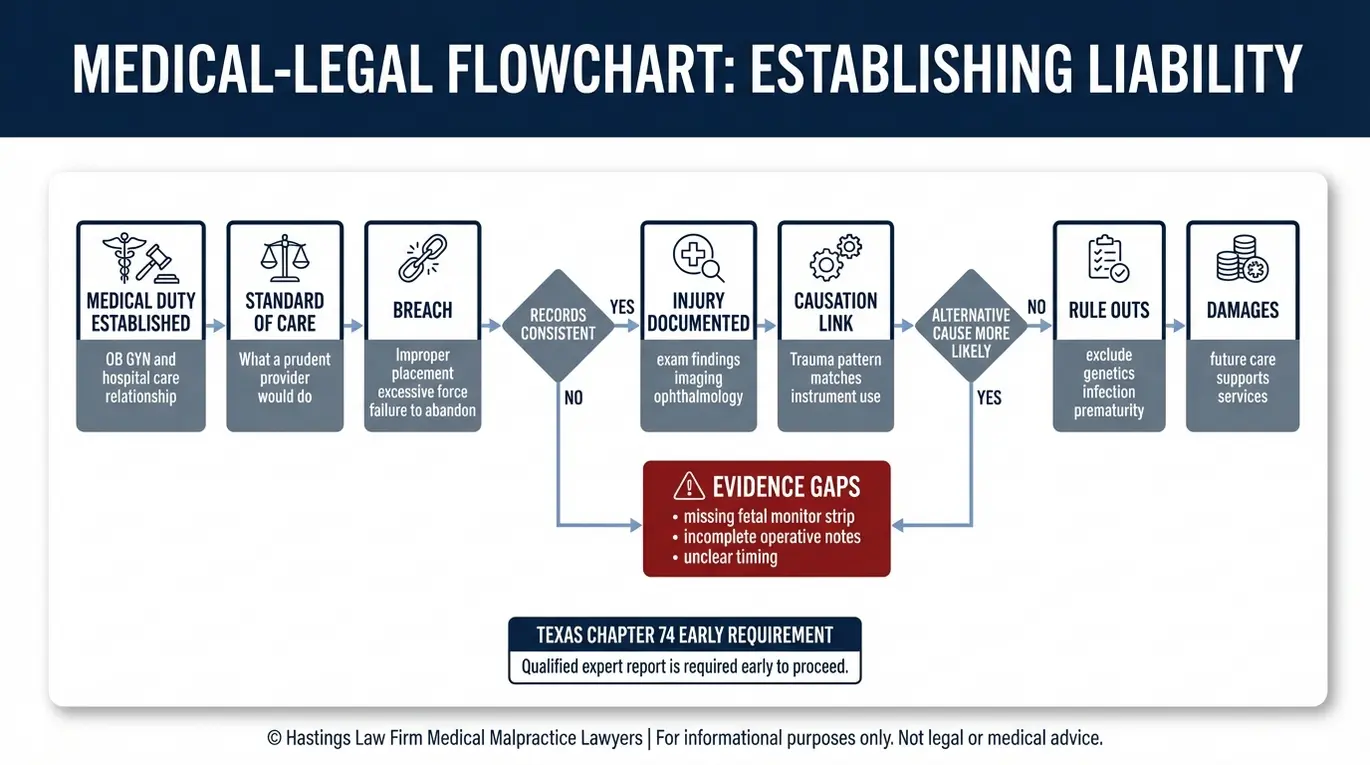
Every medical malpractice case in Texas requires proof of four elements. Your legal team must establish each one to hold the responsible parties accountable:
- Duty: The physician had a doctor-patient relationship and owed a duty of care to both the mother and the infant during delivery.
- Breach: The physician failed to meet the accepted standard of care. In a forceps delivery case, this could mean using improper technique, applying excessive force, choosing forceps when a C-section was indicated, or failing to abandon the procedure when it was not progressing safely.
- Causation: The breach directly caused the infant’s eye injury. This requires establishing a clear connection between the forceps misuse and the specific damage, whether that is an orbital fracture, nerve compression, or intracranial hemorrhage leading to cortical visual impairment.
- Damages: The injury resulted in measurable harm, including medical expenses, future care costs, pain and suffering, and the impact on the child’s quality of life.
A Texas forceps eye birth injury lawyer must build each of these elements through medical evidence and expert testimony. Proving medical negligence in Texas birth injury cases is not simply about showing that an injury occurred. It requires demonstrating that the injury would not have happened if the physician had made different, clinically appropriate decisions.
Establishing Causation
One of the most contested aspects of any forceps injury case is causation. The defense will often argue that the eye damage was congenital, related to prematurity, or caused by something other than the delivery. To counter this, your legal team works with pediatric ophthalmologists and neuroradiologists who can analyze imaging, exam findings, and the physical pattern of injury to determine whether the trauma is consistent with forceps compression rather than a genetic or developmental condition.
Specifics of the medical records are critical to building the causation chain. The placement of bruising, the location of fractures relative to where the forceps blades were positioned, and the timing of when symptoms appeared all contribute to building this connection. A malpractice lawsuit for eye injury requires this level of medical detail to succeed.
The Texas Chapter 74 Expert Report Requirement
Texas law imposes an additional procedural requirement on medical malpractice cases that does not apply to other types of personal injury claims. Under Chapter 74 of the Texas Civil Practice and Remedies Code, a plaintiff must serve a qualified expert report within 120 days of the defendant’s original answer. This report must identify the applicable standard of care, explain how the defendant breached that standard, and describe how the breach caused the injury.
Failure to file a compliant expert report within the deadline can result in the case being dismissed. Working with an experienced Texas birth injury attorney who understands Texas birth injury laws and the procedural demands of Chapter 74 is important. A standard of care breach must be clearly articulated by a qualified medical expert early in the process. Suing a doctor in Texas for a birth injury requires a team that can move quickly and precisely to meet these legal deadlines.
Investigating Your Case with Our Medical-Legal Team
We conduct a forensic investigation of fetal heart monitor strips, delivery room notes, and imaging results to reconstruct the delivery and identify charting inconsistencies that hide malpractice. At Hastings Law Firm, this investigation is led by a team that includes attorneys, in-house nurse consultants, and board-certified patient advocates who know exactly what to look for in these records. Our medical-legal team includes former defense attorneys and experienced hospital nurses who previously worked for the healthcare systems we now challenge.
How We Approach Forceps Eye Injury Cases
When we accept a birth injury case, our birth injury investigation team begins by pulling and reviewing the complete medical records from the labor, delivery, and neonatal period. We examine the fetal heart monitor tracings to determine whether there were signs of fetal distress that should have prompted an earlier decision. We review the operative delivery notes for details about forceps placement, the number of traction attempts, and whether a vacuum extractor was used before the forceps.
Our team knows how to challenge hospital arguments because we have seen them built from the inside. We often depose hospital risk managers and clinical staff during the deposition phase to uncover the truth. We anticipate the defensive strategy and prepare our case to address it head-on.
Showing the Jury What Happened
Medical malpractice cases involving infant eye injuries require the jury to understand anatomy and mechanisms of injury that are not intuitive. We work with medical illustration experts who create detailed visual reconstructions showing how the forceps were positioned, how force was applied, and how that force caused specific damage to the orbital bone, facial nerve, or optic pathway.
Facial nerve palsy, the paralysis or weakness of facial muscles caused by compression or stretching of the seventh cranial nerve, can be difficult for a jury to understand without visual aids. Similarly, cortical visual impairment (CVI), where the brain’s ability to process visual information is damaged even though the eyes themselves may appear normal, requires clear explanation. These visual tools help translate complex medical concepts into evidence a jury can see and understand.
Calculating the True Cost of Your Child’s Injury
A Texas forceps eye birth injury lawyer must also establish the full scope of damages your child will face over a lifetime. Vision loss or impairment in an infant affects every stage of development. This includes early learning, education, social interaction, independence, and future earning capacity.
We work with life care planners and economists to calculate the cost of ongoing ophthalmology care, corrective surgeries, assistive technology, special education services, occupational therapy, and adaptive living support. These are economic damages, and unlike non-economic damages in Texas, they are not subject to a statutory cap. Our goal at Hastings Law Firm is to make sure the full picture of your child’s needs is documented and presented so that any recovery reflects the real, lifelong impact of the injury. Experienced medical malpractice lawyers Texas families trust can make a difference in your result.
Contact the Texas Birth Injury Attorneys at Hastings Law Firm Today for Help
No amount of money can undo the vision loss your child has suffered. But compensation is the only tool available to provide the specialized medical care, adaptive technology, and support your child will need as they grow.
At Hastings Law Firm, we focus exclusively on medical malpractice, and birth injury cases involving forceps delivery are a core part of our practice. Our team of attorneys, nurses, and patient advocates is ready to review your child’s medical records and give you honest answers about what happened and whether you have a case.
There are no upfront costs. We work on a contingency fee basis, which means you pay no attorney fees or expenses unless we recover compensation for your family. Contact our Texas forceps eye birth injury lawyer today to request a free, confidential case evaluation. Call us or fill out our online form to get started.
Frequently Asked Questions About Forceps Eye Birth Injury in Texas


This content was researched and written by the Hastings Law Firm editorial team, which includes attorneys, medical professionals, and experienced researchers. Our writing is informed by internal knowledge and practical experience, and we cross-check critical details against authoritative sources cited throughout. Every piece undergoes human-led fact-checking and legal review. Because legal and medical information can change, if you spot an error, please contact us. Learn more about our content standards and review process on our editorial policy page.

Tommy Hastings, founder of Hastings Law Firm, is a board-certified personal injury trial lawyer dedicated exclusively to healthcare injury cases. Since 2001, he has represented injured patients and families in litigation against major hospital systems, pharmaceutical companies, and negligent healthcare providers nationwide. He has handled numerous high-profile cases that have drawn national media attention and resulted in multi-million dollar recoveries. He draws on that experience in his writing, helping readers understand how these cases work and what options may be available to them.
