


Texas Misoprostol Induction Error Lawyer
Written by: Hastings Law Firm | Reviewed by: Tommy Hastings | Updated: July 27, 2026
Misoprostol also known as Cytotec is widely used off label to induce labor, and errors in dosing, monitoring, or emergency response can lead to severe and permanent harm to a mother or baby. The text highlights concerns about limited control once the medication is given, the need for clear informed consent, and the role of fetal monitoring in detecting early distress. It also describes how complications can escalate quickly when contractions become too frequent. If you or a loved one were harmed or worse due to a Misoprostol or Cytotec induction error in Texas, contact Hastings Law Firm for a free, confidential case review.

Experienced Texas Attorneys for Misoprostol and Cytotec Birth Injuries
What You Should Know About Cytotec Drug Injury Claims in Texas:
- Permanent injury can result when Misoprostol triggers excessive contractions that reduce oxygen delivery to the baby.
- Catastrophic maternal harm can occur with complications such as uterine rupture or severe postpartum bleeding linked to Cytotec administration.
- Options for accountability can narrow if Texas medical malpractice time limits are missed, even when the underlying injury is severe.
- Recovery for non economic harm can be limited in Texas, while economic losses such as long term medical care may remain available.
- Disputes often focus on whether informed consent addressed off label use and whether safer FDA approved alternatives were discussed.
- Liability questions often turn on whether fetal monitoring showed early warning signs and whether the response was timely.
- Responsibility may extend beyond a single clinician when hospital protocols are bypassed or nursing concerns are not escalated.
- Claims involving military or government hospitals can face additional procedural barriers that affect how compensation can be pursued.
- Key records can be central in evaluating what happened, including fetal monitoring strips, nursing notes, and medication dosing documentation.

A Healthcare Focused Law Firm
When a labor induction goes wrong, the aftermath can be devastating. If your child suffered a brain injury, oxygen deprivation, or other serious harm after receiving Misoprostol during labor, you deserve answers about what happened and why.
Misoprostol, commonly known by the brand name Cytotec, is a medication that was never designed for labor induction. Yet it is widely used in labor and delivery units across Texas. When it is administered improperly, without appropriate monitoring, or to patients with known risk factors, the consequences can be catastrophic and permanent.
At Hastings Law Firm, our team of medical malpractice attorneys, in-house nurse consultants, and former defense lawyers focuses exclusively on cases like these. As a Texas Misoprostol induction error lawyer team, we investigate the medical records, reconstruct the clinical timeline, and identify where the standard of care broke down. If you believe your family was harmed by a Cytotec induction error, contact us for a free, confidential case evaluation. There are no fees unless we recover compensation for your family.
Understanding Misoprostol and the Risks of Off-Label Use
Misoprostol (brand name Cytotec) is a synthetic prostaglandin medication originally approved for preventing and treating NSAID-induced gastric ulcers but frequently used off-label to ripen the cervix and induce labor. It was not designed for obstetric use. Despite this, many hospitals and providers across Texas use Misoprostol off-label, meaning for a purpose the FDA has not specifically approved, to soften and thin the cervix before labor. This process, known as cervical ripening, prepares the body for delivery. A Misoprostol induction error attorney can investigate if this process was managed correctly.
The gap between FDA approval and actual clinical practice matters. Off-label use is legal, but it places a higher burden on the prescribing physician to explain the risks, available alternatives, and the reasons for choosing this particular drug. That explanation is part of informed consent. If your doctor did not clearly describe the specific dangers associated with Cytotec or discuss FDA-approved alternatives, that silence may represent a breach of the standard of care. Consulting a lawyer for Misoprostol errors is often the only way parents can determine if their rights were violated during this conversation.
A Texas Misoprostol induction error lawyer evaluates whether this informed consent process was followed and whether the decision to use Cytotec was medically appropriate given the patient’s history and risk factors. Families facing these challenges need a Misoprostol malpractice lawyer who understands the nuanced regulations regarding off-label usage.
FDA Approval vs. Obstetric Reality:
- Cytotec is FDA-approved only for the prevention and treatment of NSAID-induced gastric ulcers
- No FDA approval exists for cervical ripening or labor induction
- Off-label use for labor induction is common but carries unique risks
- Informed consent should specifically address off-label status and associated dangers
- FDA-approved labor-inducing medications with more predictable safety profiles do exist
Physicians have access to other FDA-approved labor-inducing medications, such as Dinoprostone (Cervidil), which are specifically designed for cervical ripening. Unlike Misoprostol, these alternatives often have safety mechanisms like retrievable inserts. When a doctor bypasses safer, approved options in favor of Cytotec without a compelling medical reason, a Misoprostol birth injury attorney can argue that the provider unnecessarily endangered the patient. Our attorney for induction errors frequently sees cases where cost or convenience drove the decision to use Misoprostol rather than patient safety.
Differences Between Pitocin and Misoprostol Induction
Pitocin (synthetic oxytocin) and Misoprostol are both used to stimulate uterine contractions, but they work differently at a fundamental level. Pitocin is delivered through an IV drip, which means the dosage can be precisely controlled. If contractions become too strong or too frequent, a provider can reduce or stop the infusion immediately.
Misoprostol, a prostaglandin medication used for cervical ripening and contraction stimulation, does not offer that same control. Once a Misoprostol tablet is placed vaginally or taken orally, the drug cannot be retrieved or “turned off.” If the uterus begins contracting too rapidly or too intensely, the medical team cannot simply reverse the medication’s effects.
This difference in how the drugs work is a central concern in many induction error cases. The inability to control the drug’s effect can quickly escalate into fetal distress, uterine hyperstimulation, or worse. A lawyer for Misoprostol errors will examine whether the provider accounted for this critical distinction when choosing which medication to administer.
Severe Complications Associated with Cytotec Administration
The use of Cytotec for labor induction can lead to dangerous complications such as uterine hyperstimulation, uterine rupture, amniotic fluid embolism, and severe fetal distress caused by oxygen deprivation. When these events occur, the harm to both mother and baby can be permanent.
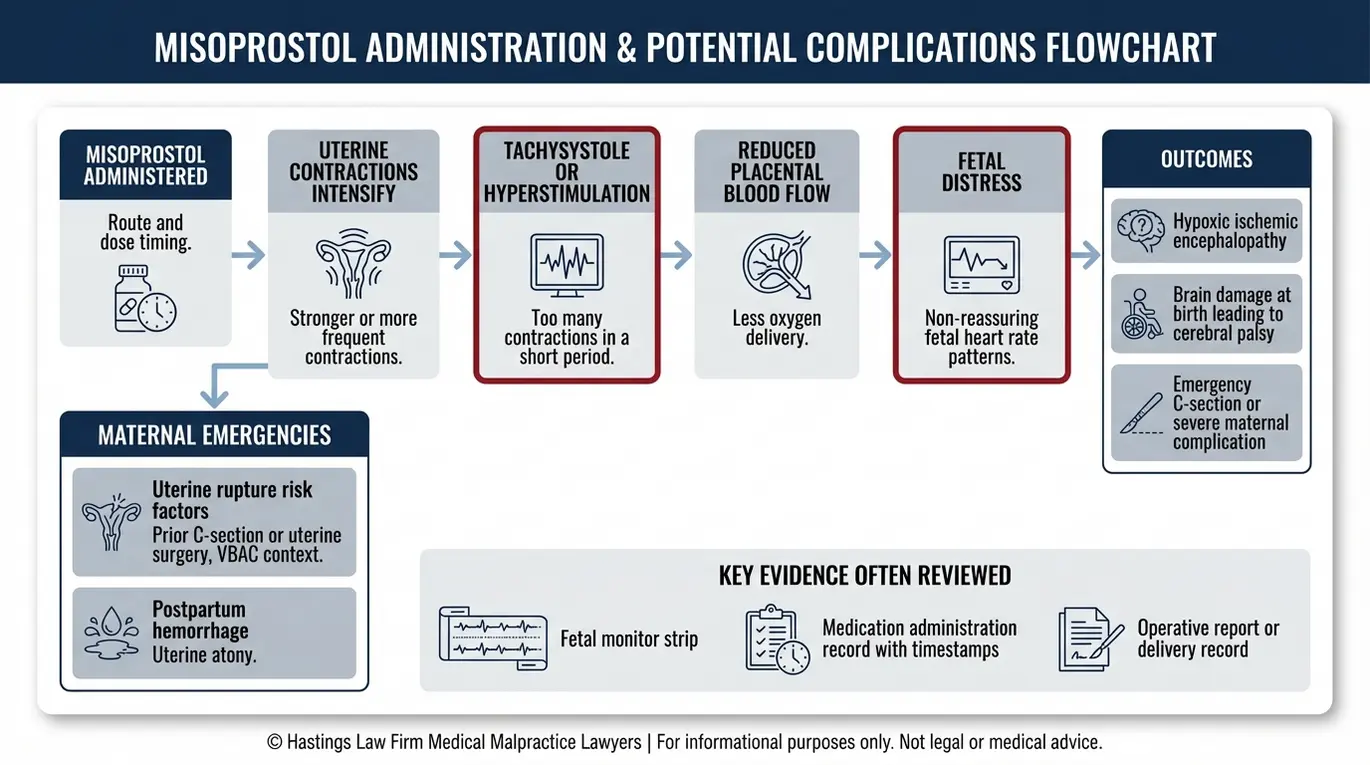
The injury pattern in many of these cases follows a recognizable sequence. Misoprostol overstimulates the uterus, causing contractions that are too strong or too frequent. Those excessive contractions reduce or cut off the flow of oxygen-rich blood through the placenta. When the baby’s brain is deprived of oxygen for even a short period, the result can be birth asphyxia, a condition that may lead to Hypoxic Ischemic Encephalopathy (HIE), a specific type of brain damage at birth caused by oxygen deprivation. An experienced Misoprostol birth injury lawyer understands how critical this timing is. HIE can result in lifelong disabilities, including Cerebral Palsy.
A Texas Misoprostol induction error lawyer investigates this chain of events to determine where and how the standard of care was violated. A lawyer for uterine rupture cases can pinpoint if surgical intervention was delayed.
The risks associated with Cytotec administration include:
- Uterine hyperstimulation: Contractions become too frequent or prolonged, depriving the fetus of oxygen
- Uterine rupture: A catastrophic tearing of the uterine wall, which is the muscular wall of the uterus splitting open during labor. This risk is significantly elevated in women attempting a vaginal birth after a prior C-section
- Fetal distress and brain injury: Oxygen deprivation leading to HIE, Cerebral Palsy, or death
- Birth asphyxia: The baby fails to receive adequate oxygen before, during, or immediately after delivery
- Postpartum hemorrhaging: Excessive blood loss in the mother following delivery
- Uterine atony: A condition where the uterus fails to contract properly after delivery, which can cause life-threatening hemorrhage in the mother
While uterine rupture is a well-known risk, uterine atony is another critical danger. This occurs when the uterine muscles lose their tone and fail to clamp down after birth to stop bleeding. Misoprostol’s powerful effect on the uterus can sometimes fatigue the muscle, leading to this condition.
A Texas Cytotec malpractice lawyer often reviews cases where unmonitored dosing led to atony and massive postpartum hemorrhage. Prompt identification and treatment are essential to save the mother’s life. Research published in Frontiers in Medicine comparing misoprostol with dinoprostone for labor induction has documented the elevated risk profile associated with Misoprostol, particularly regarding uterine hyperstimulation. A Misoprostol error lawyer in Texas uses this type of clinical evidence to build a case connecting the medication decision to the resulting injury.
Each of these complications may give rise to a medical malpractice claim if the provider failed to properly assess the patient’s risk factors, used an inappropriate dosage, or delayed emergency intervention such as a C-section when warning signs appeared. A Cytotec injury attorney can review the records to determine whether the care team’s actions met the accepted standard. If you need legal help for Cytotec induction errors, our firm is ready. A attorney for Misoprostol complications can review the records to determine whether the care team’s actions met the accepted standard.
The Hastings Law Firm Difference
Results matter, but what truly sets us apart is how we achieve them. Every verdict, every settlement, and every Texas courtroom victory comes from one guiding promise: To treat each client’s fight for justice as if it were our own.
This balance of skill, experience, and empathy reflects our core philosophy that justice should not only compensate the injured, but also make healthcare safer nationwide.

Uterine Hyperstimulation and Tachysystole Dangers
Uterine hyperstimulation occurs when Misoprostol causes contractions that are too frequent or too strong, preventing the placenta from refilling with oxygen-rich blood and leading to fetal asphyxia. This is one of the most common mechanisms of injury in Cytotec induction cases.
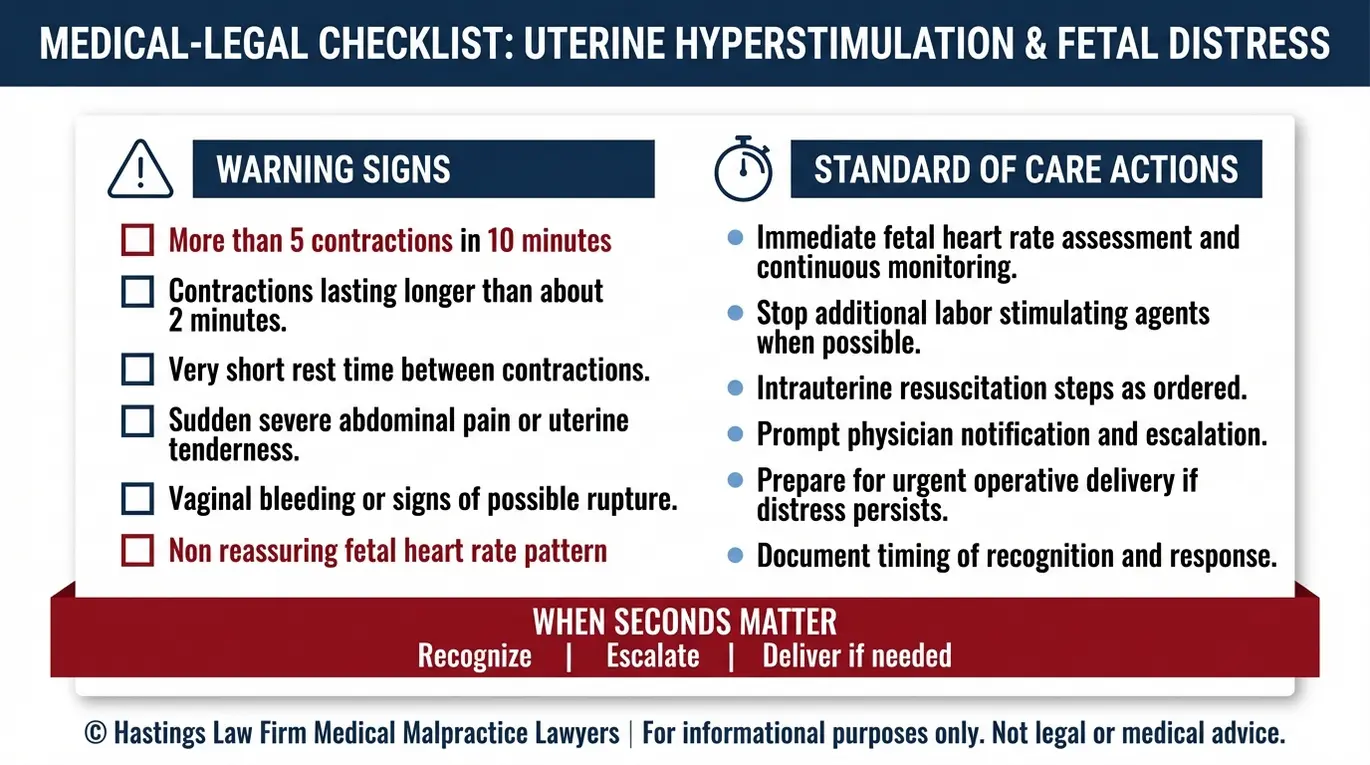
The clinical term for this dangerous contraction pattern is tachysystole, defined as more than five contractions within a 10-minute window, averaged over a 30-minute period. According to educational materials from the UCSF Continuing Medical Education program on tachysystole, this pattern is a recognized obstetric emergency that demands immediate clinical response. A Misoprostol malpractice lawyer uses these clinical guidelines to prove that the medical team should have known danger was imminent.
Here is how the harm develops. During a normal contraction, blood flow through the placenta temporarily slows. Between contractions, the placenta refills with oxygenated blood for the baby. The physiology is simple but critical: the uterus is a muscle.
Like any muscle, it constricts blood vessels when it contracts. If it never relaxes, the baby is essentially holding their breath indefinitely. This is why fetal heart rates must be watched so closely. When contractions come too fast or last too long, the placenta never fully recovers.
The baby’s oxygen supply drops, and the fetal heart rate begins to show signs of distress. A non-reassuring fetal heart rate tracing, which is an abnormal pattern on the electronic fetal monitor suggesting the baby is not tolerating labor, is often the first measurable warning sign.
When a Texas birth injury attorney for hyperstimulation reviews your case, identifying these early warnings is the first step. Delays of even minutes in responding to tachysystole can mean the difference between a healthy delivery and a permanent brain injury.
A lawyer for tachysystole injuries looks for these warning signs:
- Tachysystole: more than 5 contractions in 10 minutes, averaged over 30 minutes
- Late decelerations on the fetal heart rate monitor
- Prolonged decelerations or sustained bradycardia
- Decreased fetal heart rate variability
- Meconium-stained amniotic fluid
The standard of care requires continuous monitoring of fetal heart rates during any Misoprostol induction. When these warning signs appear, medical negligence may occur if the care team fails to act quickly. This may include administering medications to slow contractions, repositioning the mother, or proceeding to an emergency C-section. Failure to perform a timely section is a common finding for a Cytotec negligence lawyer.
A Texas Misoprostol induction error lawyer examines the fetal monitoring strips, nursing notes, and provider response times to determine whether the standard of care was met. An attorney for induction errors will work with qualified medical experts to reconstruct this timeline and identify where breakdowns occurred. Our team, which includes experienced nurses who understand how to read these tracings and interpret charting patterns, investigates every detail of the clinical record.
Proving Medical Negligence in Misoprostol Injury Cases
Proving negligence requires demonstrating that the healthcare provider deviated from the accepted standard of care by administering an improper dose, failing to monitor the fetus, or delaying a C-section despite signs of distress. These cases are medically complex, and building a strong claim depends on detailed evidence and qualified expert analysis. A Texas Cytotec induction lawyer can help simplify these legal hurdles.
In Texas medical malpractice cases involving Misoprostol, we evaluate several key areas of potential negligence:
- Improper dosage: Was the initial dose too high, or were subsequent doses given too frequently? The standard of care generally requires starting at low doses (such as 25 mcg) with adequate intervals between administrations. Vaginal versus oral routes carry different absorption rates and risk profiles, which the provider must account for. A lawyer for Cytotec overdose checks if protocols were followed.
- Failure to monitor: Did the nursing staff and attending physician continuously observe fetal heart tracings throughout the induction? Ignoring non-reassuring patterns or failing to escalate concerns to the attending physician can constitute medical negligence. This is a common form of nursing negligence.
- Contraindicated use: Was Misoprostol given to a patient with a prior cesarean scar? Using Cytotec on a patient attempting a vaginal birth after cesarean (VBAC), which is a vaginal delivery in a woman who previously delivered by C-section, is widely considered contraindicated due to the heightened risk of uterine rupture. A Texas Misoprostol lawsuit attorney flags this immediately.
- Delayed emergency response: When signs of fetal distress appeared, did the team act with appropriate urgency to perform an emergency C-section?
Obstetrics teams must follow strict hospital protocols. When a hospital allows providers to bypass safety checks for convenience, it creates a culture of doctor malpractice. We often identify nursing negligence when staff fail to alert the chain of command.
Doctor malpractice cases also frequently involve medical staff ignoring nursing concerns. An attorney for birth injury negligence scrutinizes these systemic failures. Violating established protocols regarding oxytocin and prostaglandin use is a clear deviation.
A Texas Misoprostol induction error lawyer works with independent medical experts to establish what the standard of care required and how the provider’s actions fell short. At Hastings Law Firm, our in-house medical staff, including nurse practitioners and board-certified patient advocates, conduct a detailed review of hospital records, fetal monitoring strips, and nursing charting. Our former defense attorneys know the strategies hospitals use to deflect responsibility, which allows us to anticipate and counter those arguments early in the case.
The Texas Department of State Health Services Open Records Policy can also provide access to relevant facility data that supports the investigation. A Misoprostol injury attorney Texas uses these records alongside expert testimony to build a clear picture of what went wrong.
Claims Against Military or Government Hospitals
When a Misoprostol induction error occurs at a military base hospital resulting in a military birth injury or government-funded facility, leading to government hospital negligence, the legal process is different. These claims fall under the Federal Tort Claims Act (FTCA), which requires the injured party to file an administrative claim with the responsible federal agency before a lawsuit can proceed. There are strict deadlines and procedural requirements that differ from standard Texas malpractice filings. A Cytotec lawsuit lawyer experienced with FTCA claims can help families manage these additional hurdles and protect their right to pursue compensation.
Texas Statute of Limitations for Birth Injury Lawsuits
In Texas, the statute of limitations for medical malpractice is generally two years from the date of the injury, but specific exceptions apply to minors under the age of 12, allowing claims to be filed until the child reaches age 14. Understanding these deadlines is essential because missing them can permanently bar your family from pursuing a claim, regardless of how strong the evidence may be.
Here is how the filing deadlines break down under Texas law:
| Category | Deadline | Details |
|---|---|---|
| Parents’ claims (medical bills, expenses, loss of consortium) | 2 years from the date of injury | Applies to the parents’ own damages |
| Minor child’s claims (pain and suffering, future care) | Before the child turns 14 | Texas tolling rules extend the deadline for minors under 12 at the time of injury |
| Absolute statute of repose | 10 years from the date of the act | This is the outer boundary; no claims can be filed after 10 years regardless of when the injury was discovered |
The statute of repose is a rigid barrier. Even if you did not know the injury was caused by negligence until age 11, if the injury occurred at birth, the 10-year repose period may bar the claim. This is why consulting a lawyer for birth injury time limits immediately is crucial. Waiting can be fatal to your case.
These deadlines are established under the Texas Civil Practice and Remedies Code Chapter 74, which governs medical liability claims throughout the state. The distinction between the parents’ two-year window and the child’s extended timeline is critical. Parents who wait too long may lose their own claims even while their child’s claims remain viable.
Navigating these distinct timelines requires a Misoprostol statute of limitations lawyer who understands the interaction between the parent’s claim and the child’s claim. While the child has more time, the parents’ claim for medical bills, which is often the largest expense, can expire quickly. A Texas Misoprostol induction error lawyer can evaluate your family’s specific situation and identify which deadlines apply.
How Our Trial-Ready Methodology Secures Maximum Compensation
Hastings Law Firm works to secure maximum compensation by calculating current and future economic damages, including lifetime medical care, lost earning capacity, and pain and suffering caused by the induction error. Every case we accept is prepared from day one as though it will go to trial, because that level of preparation is what produces fair results, whether the case resolves through settlement or jury verdict. Hiring a Misoprostol error lawyer is the first step toward securing this future.
For families affected by a Misoprostol induction error, the financial impact often extends across a lifetime. A child diagnosed with Cerebral Palsy or HIE may require decades of specialized medical care, adaptive equipment, therapy, and educational support. The best induction error attorney Texas can offer will ensure these long-term needs are met.
A life care plan is a document that accounts for inflation, medical advancements, and changing needs. Our Texas birth injury litigation team employs top experts to create these plans. Our lawyer for birth trauma damages and attorney for HIE compensation focus on accurate calculation for these long-term costs. We work with life care planners and economists to develop detailed projections so that nothing is overlooked.
The top Cytotec injury law firm will pursue:
- Past and future medical expenses: Surgeries, hospitalizations, medications, rehabilitation, and ongoing specialist care
- Life care plan costs: Long-term projections for therapy, assistive devices, home modifications, and in-home care
- Lost earning capacity: The income the child would have been expected to earn over a lifetime, now diminished or eliminated by the injury
- Pain and suffering: Compensation for physical pain, mental anguish, and loss of quality of life (subject to Texas non-economic damage caps)
- Wrongful death damages: In the most tragic cases, funeral expenses and loss of companionship for the family
As a Texas Misoprostol induction error lawyer team, we understand how insurance carriers and defense firms evaluate these cases. Our attorneys include former defense counsel who know the tactics used to minimize payouts, and that knowledge shapes our litigation strategy from the start. Hiring a Misoprostol error lawyer at Hastings Law Firm carries no financial risk. We handle these cases on a contingency fee basis, which means you pay no attorney fees or costs unless we recover compensation for your family.
Contact the Texas Birth Injury Attorneys at Hastings Law Firm Today for Help
If your child was harmed during a labor induction involving Misoprostol or Cytotec, your family may have a path to accountability and compensation. These cases require a legal team that understands both the medicine and the law, and that is exactly what Hastings Law Firm was built to provide.
Our team includes former defense attorneys who know how hospitals protect themselves, experienced nurses who can interpret the clinical record, and a national network of medical experts who can evaluate what went wrong. Founded by board-certified trial attorney Tommy Hastings, our firm has spent nearly two decades holding negligent providers accountable and helping families secure the resources they need to move forward.
You do not have to figure this out alone. Contact Hastings Law Firm for a free, confidential case evaluation. There is no fee unless we win. Let us review what happened and explain your options.
Frequently Asked Questions About Misoprostol Induction Error in Texas


This content was researched and written by the Hastings Law Firm editorial team, which includes attorneys, medical professionals, and experienced researchers. Our writing is informed by internal knowledge and practical experience, and we cross-check critical details against authoritative sources cited throughout. Every piece undergoes human-led fact-checking and legal review. Because legal and medical information can change, if you spot an error, please contact us. Learn more about our content standards and review process on our editorial policy page.

Tommy Hastings, founder of Hastings Law Firm, is a board-certified personal injury trial lawyer dedicated exclusively to healthcare injury cases. Since 2001, he has represented injured patients and families in litigation against major hospital systems, pharmaceutical companies, and negligent healthcare providers nationwide. He has handled numerous high-profile cases that have drawn national media attention and resulted in multi-million dollar recoveries. He draws on that experience in his writing, helping readers understand how these cases work and what options may be available to them.
