


Texas Gestational Diabetes Malpractice Lawyer
Written by: Hastings Law Firm | Reviewed by: Tommy Hastings | Updated: July 27, 2026
Gestational diabetes that is missed or poorly managed during pregnancy can lead to preventable birth injuries and long term challenges for a child and family. The risk increases when warning signs are dismissed, screening is skipped, or abnormal results are not followed with timely treatment and delivery planning. Disputes often focus on whether the care met the accepted standard and whether earlier action would have changed the outcome. If you or a loved one were harmed or worse due to gestational diabetes malpractice in Texas, contact Hastings Law Firm for a free, confidential case review.

Legal Advocacy for Preventable Birth Injuries Caused by Gestational Diabetes
What You Should Know About Diabetic Pregnancy Complication Claims in Texas:
- Lasting harm to a baby can follow when gestational diabetes is not diagnosed or controlled during pregnancy.
- Serious delivery complications can become more likely when excessive fetal growth is not anticipated and managed.
- Permanent nerve injury or brain injury can occur when shoulder dystocia is not handled safely and promptly.
- Ongoing health problems after birth can create long term medical and developmental consequences when neonatal blood sugar is not monitored and treated.
- Options for financial recovery can be limited by Texas caps on non economic damages even when injuries are severe.
- The ability to pursue a claim can be lost if Texas filing deadlines are missed.
- Proving malpractice can be harder when the defense argues the injury was genetic, unavoidable, or unrelated to provider decisions.
- A claim can fail in Texas without a qualified expert report that links a breach of the standard of care to the injury.
- Clarity about what happened often depends on prenatal charts, lab results, fetal monitoring strips, and delivery logs.

A Healthcare Focused Law Firm
When gestational diabetes goes undiagnosed or unmanaged during pregnancy, the consequences for both mother and baby can be life-altering. If you or a loved one believe your provider missed the warning signs or failed to act on abnormal test results, that instinct deserves to be heard. You are not questioning medicine itself; you are questioning whether the care you received met the standard your family deserved.
Tommy Hastings, a board-certified trial lawyer, founded Hastings Law Firm to focus exclusively on medical negligence cases. Our team of attorneys, nurse consultants, and in-house medical staff understands both the clinical details and the legal framework that apply to these claims. Our legal team includes former defense lawyers who previously worked for the hospital systems they now challenge, providing a strategic advantage in identifying charting inconsistencies. If you have concerns about the care you or your child received, we can review what happened and explain your options in a free, confidential evaluation.
Negligent Management of Gestational Diabetes During Pregnancy
Medical malpractice can occur when an OB-GYN fails to follow the accepted standard of care for glucose screening, neglects to diagnose gestational diabetes, or does not prescribe insulin and dietary modifications to manage high blood sugar, resulting in preventable harm to the mother or baby. Negligent management involves a healthcare provider’s failure to correctly monitor blood sugar levels or follow established safety protocols during pregnancy. A gestational diabetes attorney can investigate these failures to determine if negligence occurred.
Gestational diabetes mellitus (GDM) is a condition where pregnancy hormones cause high blood sugar. It affects many pregnancies each year. The United States Preventive Services Task Force recommends universal screening between 24 and 28 weeks of pregnancy. They also suggest earlier screening for patients with high risk factors like obesity, polycystic ovary syndrome, or a history of GDM. A gestational diabetes attorney can review whether these guidelines were followed.
The standard of care requires an OB-GYN to identify these risk factors during early prenatal care, order timely glucose screening, and take prompt action when results come back abnormal. When diet and lifestyle changes fail to control blood sugar levels, the provider should prescribe insulin or oral medications and consider referral to a Maternal-Fetal Medicine specialist. If this management is absent, a Texas gestational diabetes malpractice lawyer can investigate.
A gestational diabetes attorney evaluates whether the provider followed this protocol or deviated from it. Red flags that may indicate negligence include:
- Skipping or delaying the standard glucose screening at 24 to 28 weeks
- Failing to screen high-risk patients at the first prenatal visit
- Dismissing a patient’s reports of excessive thirst, fatigue, or blurred vision
- Not ordering follow-up testing after borderline or elevated initial results
- Failing to prescribe insulin when dietary management is not controlling blood sugar
- Not referring the patient to a specialist when the condition worsens
- Neglecting to monitor fetal growth with ultrasound in a diagnosed GDM pregnancy
Under Texas Civil Practice and Remedies Code, Chapter 74, a lawyer for gestational diabetes errors must support any claim with a qualified expert report showing the provider breached the standard of care and that breach caused the injury. Identifying these red flags in the medical records is an important first step.
The Danger of False Negative Screening Results
Not every case of negligence involves a missed test. Sometimes, the test is performed but the result is wrong. The glucose challenge test (GCT), commonly called the “Glucola” screening, is an initial one-hour blood sugar test used to flag patients who may have GDM. If the GCT returns a borderline or normal result, some providers stop testing, even when a patient continues to show symptoms.
The GCT has a known false-negative rate, meaning it can miss cases of true gestational diabetes. When symptoms persist, the standard of care calls for the provider to order a more definitive oral glucose tolerance test (OGTT). This is a longer test that measures how the body processes sugar over several hours. A Texas gestational diabetes malpractice lawyer will examine whether the provider relied on a single screening result while ignoring clinical indicators that warranted re-testing. Failing to follow up on a suspicious clinical picture can constitute a failure to diagnose and may support a medical malpractice claim.

Severe Birth Injuries Resulting from Uncontrolled Maternal Glucose
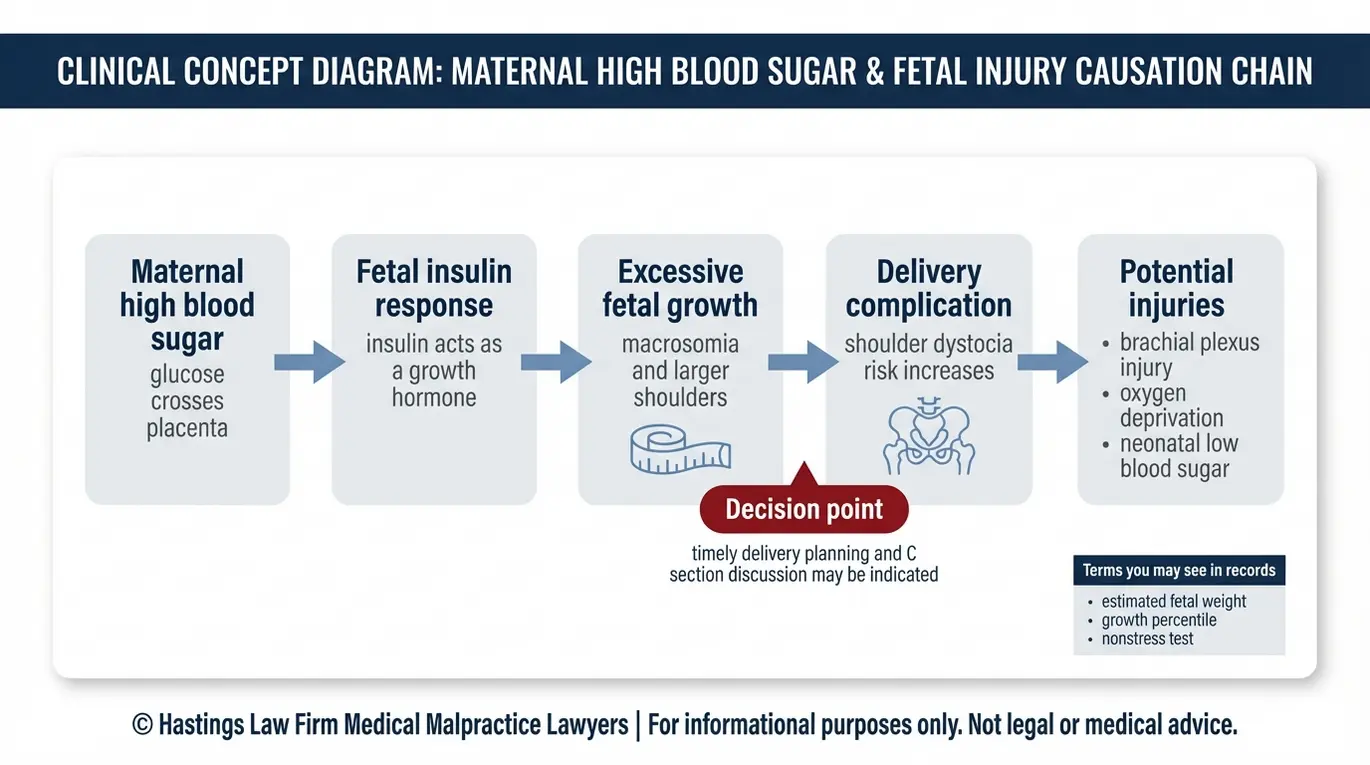
Uncontrolled gestational diabetes causes the fetus to grow excessively large (macrosomia), significantly increasing the risk of shoulder dystocia, brachial plexus injuries, and oxygen deprivation during delivery due to the physician’s failure to perform a timely C-section. Macrosomia is a condition where a baby is much larger than average, which can lead to life-threatening physical trauma during the birthing process.
The medical mechanism works like this: when a mother’s blood sugar stays elevated, the excess glucose crosses the placenta to the baby. The baby’s pancreas responds by producing more insulin, which acts as a growth hormone. This often causes the baby to grow disproportionately large, particularly in the shoulders and trunk. This sets the stage for dangerous delivery complications. A gestational diabetes malpractice lawyer can assess if these risks were ignored.
Shoulder dystocia occurs when the baby’s head delivers but one or both shoulders become lodged behind the mother’s pelvic bone. In those critical moments, excessive traction or improper maneuvers by the delivering physician can stretch or tear the brachial plexus, the network of nerves running from the neck to the arm. This can result in brachial plexus injury, commonly known as Erb’s palsy, which may cause partial or complete paralysis of the affected arm. A Texas malpractice counsel can help families pursue justice for these injuries.
In severe cases, prolonged delivery can cut off oxygen to the baby, potentially leading to brain injury. This type of oxygen deprivation is a medical emergency that requires immediate intervention to prevent permanent harm.
The table below outlines how unmanaged diabetic conditions connect to specific injuries and the preventive measures that may have been overlooked:
| Unmanaged Diabetic Condition | Resulting Injury | Preventive Measure That May Have Been Ignored |
|---|---|---|
| Macrosomia (excessive fetal growth) | Shoulder dystocia, Erb’s palsy, bone fractures | Growth monitoring via ultrasound; scheduled C-section for estimated large birth weight |
| Prolonged shoulder dystocia | Hypoxic brain injury, cerebral palsy | Timely recognition and proper delivery maneuvers; emergency C-section |
| Uncontrolled maternal hyperglycemia | Neonatal hypoglycemia and seizures after birth | Blood sugar management with insulin; neonatal monitoring protocols |
| Failure to plan for high-risk delivery | Fetal distress, emergency complications | Coordinated birth plan with Maternal-Fetal Medicine; delivery at appropriate facility level |
As detailed in a literature review on shoulder dystocia published in PubMed Central, proper anticipation and management of this emergency are essential to preventing permanent injury. An attorney for diabetic birth injuries investigates whether the delivering provider had the information needed to anticipate these risks and whether they acted on it appropriately.
Long-Term Health Risks for the Child
The harm does not always end in the delivery room. According to research on neonatal hypoglycemia diagnosis and management in PubMed Central, babies born to mothers with poorly managed GDM face a higher risk of neonatal hypoglycemia. This is a dangerous drop in blood sugar shortly after birth that can cause seizures and developmental harm if not promptly treated.
Beyond the newborn period, these children may face a higher likelihood of developing obesity and Type 2 diabetes later in life. These long-term health consequences are compensable damages in a gestational diabetes malpractice case because they represent future medical expenses and quality-of-life impacts. A Texas malpractice counsel will work with medical experts to document and project these costs as part of the family’s claim.
The Hastings Law Firm Difference
Results matter, but what truly sets us apart is how we achieve them. Every verdict, every settlement, and every Texas courtroom victory comes from one guiding promise: To treat each client’s fight for justice as if it were our own.
This balance of skill, experience, and empathy reflects our core philosophy that justice should not only compensate the injured, but also make healthcare safer nationwide.

Proving Fault: When Does Gestational Diabetes Management Become Malpractice?
To prove fault, a plaintiff must demonstrate that the provider violated the accepted standard of care, such as failing to screen for diabetes or ignoring fetal growth scans, and that this specific violation directly caused the injury rather than genetic or unavoidable factors. Establishing liability requires showing that the medical team failed in their duty to the patient. A malpractice lawyer in Texas can help handle these complex requirements.
In Texas, a medical malpractice claim requires specific proof that a provider’s error directly led to the patient’s injury. The focus of the case then shifts to breach, causation, and liability.
Breach of duty requires expert testimony from a qualified physician, typically an OB-GYN, who can explain what a prudent provider would have done differently under the same circumstances. For example, an expert may testify that the standard of care required ordering a follow-up OGTT after elevated screening results, scheduling serial growth ultrasounds, or offering a C-section when estimated fetal weight exceeded a safe threshold.
Causation is often the most contested element. The defense will argue the injury was genetic, unavoidable, or unrelated to the provider’s decisions. A Texas gestational diabetes malpractice lawyer works with medical experts in obstetrics and neonatology to reconstruct the clinical timeline and show that timely diagnosis and intervention would have, more likely than not, prevented the harm. Meeting this burden of proof is essential. This analysis may address conditions like fetal distress, which refers to signs that the baby is not doing well in the womb, or hypoxic-ischemic encephalopathy (HIE), which is a form of brain damage caused by oxygen deprivation.
Medical records are the foundation of this proof. We examine prenatal charts, lab results, nursing notes, fetal monitoring strips, and delivery logs to identify gaps in care. Our team includes in-house nurse consultants who previously worked in hospital settings and understand how to read these records with clinical precision. Combined with testimony from our national network of medical experts, this evidence-based approach is how a medical negligence attorney builds a case that can withstand the defense’s scrutiny. A medical negligence attorney plays an important role in securing fair compensation.
Recovering Compensation for Your Family’s Future
Compensation in a gestational diabetes malpractice case covers past and future medical bills for the child, rehabilitation costs, pain and suffering, and loss of earning capacity, designed to provide financial security for a child facing lifelong challenges. Recovering compensation involves calculating the total economic and physical impact of the medical error on the child’s entire life.
Damages in these cases are intended to cover the long-term medical and personal needs of the child. Recoverable damages generally fall into two categories:
Economic damages (no cap under Texas law):
- Past and future medical expenses, including surgeries, therapy, and specialist care
- Rehabilitation and occupational therapy costs
- Specialized equipment such as adaptive devices or mobility aids
- Future lost earning capacity if the child’s injuries limit their ability to work
- Home health and personal care assistance, the cost of which can be significant over a lifetime according to the Bureau of Labor Statistics
Non-economic damages (subject to Texas statutory caps):
- Physical pain and suffering
- Mental anguish experienced by the child and family
- Physical impairment and disfigurement
In cases involving children with permanent injuries, a gestational diabetes malpractice lawyer will often retain life care planners. These specialized experts calculate the projected cost of care over the child’s entire lifetime. For a child with Erb’s palsy or a brain injury, this projection can span 50 years or more and may include ongoing medical treatment and assisted living needs. This detailed life care plan is a powerful tool for demonstrating the true scope of damages at settlement negotiations or during a jury trial.
Our malpractice firm handles every case on a contingency fee basis, meaning your family pays no attorney fees or costs unless we secure a recovery on your behalf.
Contact the Texas Birth Injury Attorneys at Hastings Law Firm Today for Help
Your family does not have to face a hospital’s legal team alone. If you believe your child’s birth injury resulted from undiagnosed or mismanaged gestational diabetes, Hastings Law Firm is here to help you find answers. We offer a free, confidential case evaluation to help families understand their rights.
Our team of attorneys, former defense lawyers, and in-house medical professionals will review your records, identify what went wrong, and explain whether you have a viable claim. We handle every step of the legal process so you can focus on your child.
Hastings Law Firm works on a contingency fee basis. You pay nothing unless we win. Contact us today for a free evaluation. Let us help you uncover the truth about your care and protect your family’s future.
Call Hastings Law Firm or complete our online form to schedule your free consultation with a Texas gestational diabetes malpractice lawyer.
Frequently Asked Questions About Gestational Diabetes Malpractice in Texas


This content was researched and written by the Hastings Law Firm editorial team, which includes attorneys, medical professionals, and experienced researchers. Our writing is informed by internal knowledge and practical experience, and we cross-check critical details against authoritative sources cited throughout. Every piece undergoes human-led fact-checking and legal review. Because legal and medical information can change, if you spot an error, please contact us. Learn more about our content standards and review process on our editorial policy page.

Tommy Hastings, founder of Hastings Law Firm, is a board-certified personal injury trial lawyer dedicated exclusively to healthcare injury cases. Since 2001, he has represented injured patients and families in litigation against major hospital systems, pharmaceutical companies, and negligent healthcare providers nationwide. He has handled numerous high-profile cases that have drawn national media attention and resulted in multi-million dollar recoveries. He draws on that experience in his writing, helping readers understand how these cases work and what options may be available to them.
