


Texas Infant Arterial Ischemic Stroke Lawyer
Written by: Hastings Law Firm | Reviewed by: Tommy Hastings | Updated: July 27, 2026
An infant arterial ischemic stroke around birth can leave families facing uncertainty about what happened and what it means for a child’s future. These events may be tied to how labor and delivery were managed, including missed warning signs, delayed intervention, or problems with monitoring and diagnosis. The article discusses stroke types, symptoms that can be subtle, and why timely imaging and treatment can affect long term outcomes. If you or a loved one were harmed or worse due to infant arterial ischemic stroke in Texas, contact Hastings Law Firm for a free, confidential case review.
Top Rated Birth Injury Attorneys Helping Families Across Texas
What You Should Know About Neonatal Stroke Misdiagnosis Claims in Texas:
- Lifelong neurological harm can follow an infant arterial ischemic stroke, especially when recognition, imaging, or treatment is delayed.
- Accountability can hinge on whether labor and delivery management met the standard of care when warning signs were present.
- Options in Texas can be limited by state specific malpractice requirements, so missed formalities can affect whether a claim can move forward.
- Recovery in Texas can be shaped by limits on non economic damages even when long term care needs are extensive.
- Disputes often focus on whether the stroke was preventable or instead tied to pre existing risk factors such as clotting disorders.
- Missed or subtle early signs can delay care, including seizures and breathing pauses.
- Misdiagnosis risk can increase when newborn stroke signs are treated like adult stroke patterns.
- The choice of imaging can affect what is detected early, with MRI described as the preferred tool for early ischemic injury.
- The timing of treatment can affect the severity of lasting effects, including the use of therapeutic hypothermia in time sensitive situations.
- Records such as placental pathology and medical charts can be central to establishing when the injury likely occurred.

A Healthcare Focused Law Firm
When your newborn has suffered an arterial ischemic stroke, the shock and uncertainty can feel overwhelming. You may be searching for answers about what happened, whether it could have been prevented, and what options exist to protect your child’s future. These are the right questions to ask, and you do not have to work through them alone as you manage the next steps.
As a Texas infant arterial ischemic stroke lawyer team, Hastings Law Firm focuses exclusively on medical malpractice. Founded by Tommy Hastings in 2005, our firm is led by a trial lawyer board-certified in Personal Injury Trial Law, a distinction held by less than 2% of Texas attorneys. Our legal and medical professionals, including in-house nurse consultants and former defense attorneys, investigate birth injuries at every level. We understand both the medicine and the law behind these cases, and we use that knowledge to hold the responsible parties accountable.
If your child experienced a stroke before, during, or shortly after birth, we can review what happened and explain your options. Contact us for a free, confidential case evaluation.
Understanding Perinatal Arterial Ischemic Stroke and Medical Liability
Perinatal arterial ischemic stroke (PAIS), a cerebrovascular event that occurs between 20 weeks of gestation and 28 days after birth, happens when a blood clot blocks oxygen-rich blood from reaching the infant’s brain. This form of arterial ischemic stroke (AIS), a condition characterized by interrupted blood flow to the brain, can cause lasting neurological damage, and in many cases, the injury is tied to how labor and delivery were managed.
PAIS is not the same as a general “birth injury” label. Often referred to broadly as neonatal stroke, it is a specific medical event with identifiable causes, a traceable timeline, and diagnostic evidence that can reveal whether the care team met the standard of care, which is the level of treatment a reasonably competent medical professional would provide under similar circumstances. When providers fail to monitor warning signs, delay intervention, or mismanage a high-risk pregnancy, a preventable stroke can result.
Under Texas law, families pursuing a medical malpractice claim must follow specific procedural requirements. The Texas Civil Practice and Remedies Code Chapter 74.051 requires that written notice be provided to the healthcare provider at least 60 days before filing suit. This pre-suit notice period is one of several steps unique to Texas medical negligence cases.
As a Texas birth injury lawyer team, we investigate every stage of care to determine whether the providers involved met their obligations or whether failures in monitoring and treatment led to your child’s injury. Our infant stroke attorney team works alongside medical experts to reconstruct the clinical timeline and identify exactly where the breakdown occurred.
Types of Neonatal Stroke and Common Symptoms
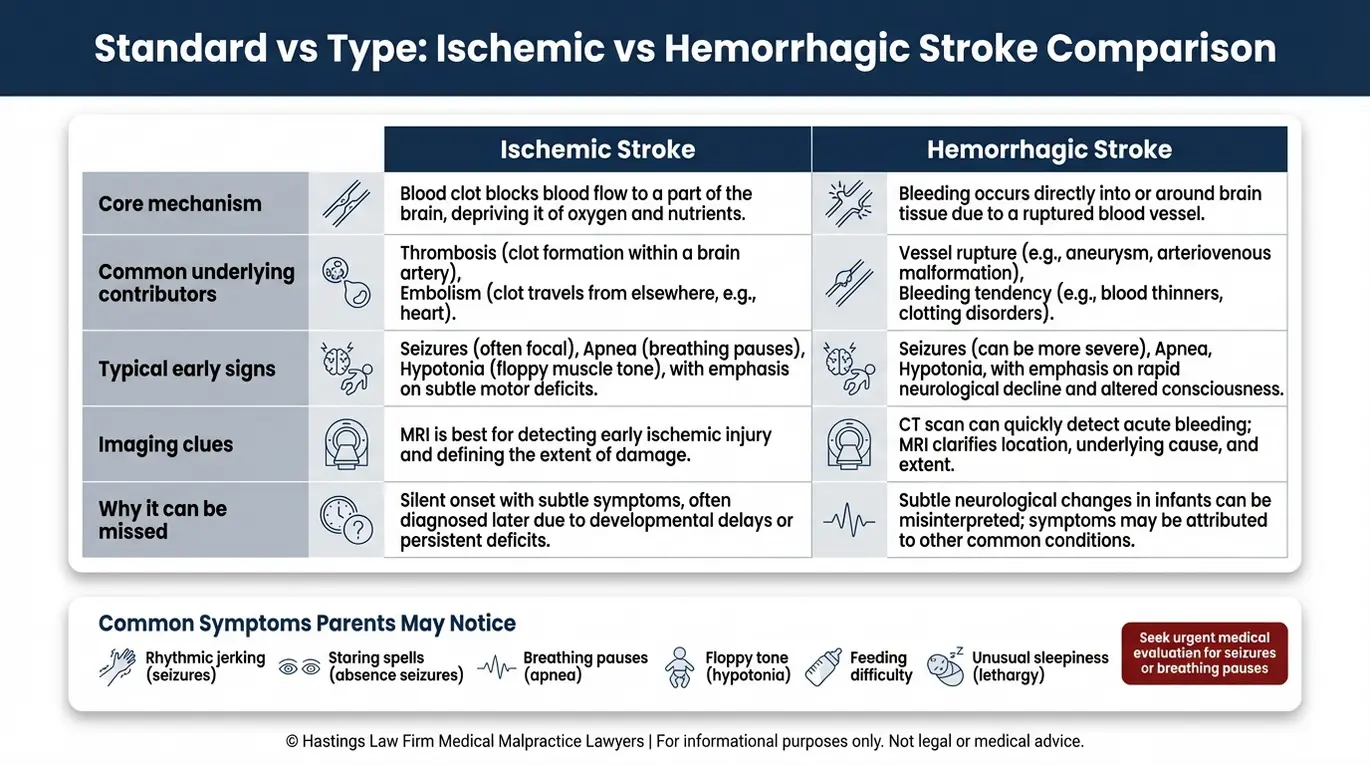
Neonatal strokes are primarily classified as ischemic (caused by a blockage of blood flow) or hemorrhagic (caused by bleeding in the brain), and their symptoms can include seizures, hypotonia, and respiratory apnea. Understanding the specific types of infant stroke your child experienced is essential for both treatment planning and any potential legal claim.
Ischemic vs. Hemorrhagic Stroke
Arterial ischemic stroke, the more common type in newborns, occurs when a blood clot or thrombosis blocks an artery supplying the brain. This interruption of blood flow starves brain tissue of oxygen, and the damage depends on how long the blockage lasts and which area of the brain is affected.
Hemorrhagic stroke, a rupture of a blood vessel in or around the brain, creates pressure on surrounding tissue and can cause widespread injury. While the mechanisms differ, both types demand rapid recognition and response.
| Feature | Ischemic Stroke | Hemorrhagic Stroke |
|---|---|---|
| Mechanism | Blood clot blocks an artery | Blood vessel ruptures and bleeds |
| Primary Cause | Thrombosis or embolism | Vessel fragility, trauma, or clotting disorders |
| Most Common Finding | Restricted blood flow on MRI | Bleeding visible on CT or ultrasound |
| Typical Onset | May present within hours to days | Often presents acutely at or near birth |
Recognizing the Symptoms
Recognizing the symptoms of a stroke is a key part of ensuring a newborn receives timely medical care. Many of the subtle signs of a stroke in newborns are sometimes missed by care teams. Symptoms a medical team should be watching for include:
- Neonatal seizures: Rhythmic jerking of the limbs or face, sometimes mistaken for normal newborn movement.
- Hypotonia: Unusually “floppy” or weak muscle tone, where the baby feels limp when held.
- Apnea: Pauses in breathing that last longer than expected.
- Feeding difficulties: Trouble latching, sucking, or swallowing.
- Lethargy or decreased alertness: The baby is unusually difficult to rouse.
The “Silent” Stroke
A silent stroke occurs when there are no immediate outward symptoms after the event. These so-called “silent” strokes may only be discovered months or years later, when a child begins missing developmental milestones such as reaching, crawling, or speaking. By then, the window for certain early interventions has passed, making the initial failure to detect the stroke all the more consequential.
The Hastings Law Firm Difference
Results matter, but what truly sets us apart is how we achieve them. Every verdict, every settlement, and every Texas courtroom victory comes from one guiding promise: To treat each client’s fight for justice as if it were our own.
This balance of skill, experience, and empathy reflects our core philosophy that justice should not only compensate the injured, but also make healthcare safer nationwide.

Causes of Perinatal Stroke: Genetic Factors vs. Preventable Medical Errors
While some infant strokes result from genetic clotting disorders, many are caused by preventable medical errors such as mismanagement of labor, failure to recognize fetal distress, or trauma during delivery. Determining which category applies is central to any malpractice investigation.
Maternal and Fetal Risk Factors
Several maternal and fetal risk factors are medical conditions that may increase the likelihood of a stroke without provider error. These pre-existing conditions can increase the risk of perinatal stroke:
- Factor V Leiden and other inherited clotting disorders (thrombophilias).
- Congenital heart disease affecting blood flow patterns.
- Placental abnormalities such as clots within the placenta.
- Maternal infections that trigger an inflammatory response.
Research from the American Society of Hematology has shown that thrombophilia risk is not necessarily increased in children after perinatal stroke, which means genetic clotting disorders may not always explain the event. This finding often becomes relevant during litigation, where the defense may attempt to attribute the injury entirely to a pre-existing condition.
Medical Negligence Factors
Often, the causes of infant stroke trace back to failures in clinical care during labor and delivery. These errors often include:
- Failure to monitor fetal heart rate patterns that indicate distress.
- Delayed emergency C-section when signs of fetal hypoxia, or oxygen deprivation, are present.
- Mismanagement of high-risk labor including improper use of forceps or vacuum extraction.
- Failure to identify and treat an embolism or other vascular event during delivery.
- Ignoring fetal distress, a condition where the baby shows signs of inadequate oxygen supply, on electronic fetal monitoring strips.
Pitocin-Induced Uterine Tachysystole and Fetal Ischemia
One specific and well-documented risk involves Pitocin, a synthetic hormone used to induce or speed up labor. When administered improperly or without adequate monitoring, Pitocin can cause uterine tachysystole, a condition where contractions occur too frequently (more than five in a ten-minute window). These excessive contractions can compress the placental blood vessels, reducing oxygen delivery to the fetus and increasing the risk of fetal hypoxia and ischemia. If the care team fails to reduce or stop Pitocin when tachysystole is detected, the resulting oxygen deprivation can contribute to a stroke.
Diagnostic Standards: MRI Imaging and Delayed Treatment Protocols
Timely diagnosis of neonatal stroke requires immediate neuroimaging, preferably MRI, as soon as seizures or neurological deficits are observed. Delays in ordering the right imaging study can result in permanent brain damage that might otherwise have been reduced through early intervention.
The Imaging Hierarchy
Not all imaging tools are equally effective at detecting early ischemic injury in newborns. MRI, particularly diffusion-weighted MRI, a specialized imaging technique that detects water movement in brain tissue, is the gold standard because it can identify areas of restricted blood flow within hours of the event. CT scans are faster but less sensitive to early ischemic changes in neonatal brain tissue. Cranial ultrasound, while readily available at bedside, may miss smaller or early-stage infarctions entirely.
A frequent cause of misdiagnosis involves training gaps; physicians experienced primarily in adult stroke care may fail to recognize the subtle, non-specific signs of a stroke in a newborn. According to the NCBI Bookshelf resource on Neuroimaging in Perinatal Stroke and Cerebrovascular Disease, early MRI is critical for confirming the diagnosis, determining the extent of injury, and guiding treatment decisions. When a provider orders only an ultrasound or delays an MRI by hours or days, the failure to diagnose a stroke in its early stages can mean the difference between targeted treatment and irreversible harm.
The Critical Treatment Window
For certain types of neonatal stroke, early intervention can limit brain damage. Therapeutic hypothermia, a controlled cooling of the infant’s body temperature, has shown benefit when initiated within six hours of a hypoxic-ischemic event. In select cases, anticoagulants such as heparin, a blood-thinning medication, or, less commonly, urokinase may be considered to address ongoing clot formation.
Research published in a systematic review on neonatal hypoxic-ischemic encephalopathy and long-term cognitive outcomes underscores the relationship between the timing of treatment and the severity of lasting neurological effects. Every hour of delay narrows the window for these interventions.
A Diagnostic Timeline: What the Standard of Care Expects
A diagnostic timeline helps determine if the standard of care was met during the treatment of an infant stroke.
- Recognition: Care team identifies neurological symptoms (seizures, apnea, hypotonia).
- Initial assessment: Rapid clinical evaluation and stabilization.
- Neuroimaging ordered: MRI should be prioritized; CT or ultrasound may serve as interim tools.
- Diagnosis confirmed: Imaging results interpreted by a qualified specialist.
- Treatment initiated: Therapeutic hypothermia, anticoagulants, or supportive care as indicated.
- Ongoing monitoring: Serial imaging and neurology follow-up to assess injury progression.
When any of these steps are delayed or skipped, we examine the records as an infant stroke diagnosis attorney team to determine whether the gap constitutes a failure to diagnose stroke and a breach of the standard of care.
The Role of Placental Pathology in Determining Stroke Timing
After delivery, the placenta can be examined by a pathologist to provide biological evidence of when the stroke likely occurred. Placental pathology, the microscopic analysis of placental tissue, can reveal signs of chronic oxygen deprivation, infection, or acute vascular events. This evidence helps our team establish the precise timing of injury, determining whether the stroke happened before labor (prenatal) or during labor and delivery (intrapartum), which is often the central question in proving or disproving negligence.
Proving Malpractice in Texas Infant Stroke Cases
To win a malpractice lawsuit for infant stroke in Texas, a plaintiff must prove through expert testimony that the medical provider violated the standard of care and that this violation directly caused the infant’s injury. Winning a legal claim requires demonstrating a direct link between a medical error and the resulting harm. This requires more than showing a bad outcome; it requires connecting a specific act or omission to the harm your child suffered through expert testimony.
Establishing Liability
Establishing liability involves proving that a healthcare provider’s mistake directly caused the child’s injury. Our investigation begins with the medical records, where we build a detailed timeline of every clinical decision from admission through delivery. Qualified medical experts then review this timeline to evaluate whether the care team responded appropriately to signs of fetal distress, ordered imaging promptly, and initiated treatment within accepted protocols.
The goal is to connect the specific error, whether it was an ignored fetal heart rate pattern, a delayed C-section, or a missed diagnosis, directly to the stroke and the resulting injury. Under Texas medical malpractice laws, this causation link must be supported by credible expert opinion.
Calculating Lifetime Damages
Infant stroke cases often involve injuries that require a lifetime of care. A life-care plan, prepared by a qualified specialist, projects the total cost of therapies, medical equipment, home modifications, educational support, and around-the-clock care your child may need. This document becomes the foundation for calculating economic damages. In any infant stroke lawsuit, Texas rules regarding compensation for future needs make accurately documenting the full scope of your child’s care essential.
Because Texas does not cap economic damages in medical malpractice cases, securing fair compensation depends on a thorough calculation of these long-term costs.
The Trial-Ready Difference
At Hastings Law Firm, every case is prepared from the outset as though it will proceed to a jury trial. This trial-ready approach means that by the time settlement discussions begin, we have already built the medical evidence, retained the experts, and prepared the case for presentation. Defense attorneys and insurance carriers recognize the difference between a firm that is ready for trial and one that is not, and that recognition directly affects the value of settlement negotiations.
Contact the Texas Birth Injury Attorneys at Hastings Law Firm Today for Help
If your child suffered a stroke before, during, or shortly after birth, you deserve to know whether it could have been prevented. Our firm helps families determine if medical negligence played a role in their child’s birth injury. At Hastings Law Firm, we are committed to helping families find the truth, restore their sense of trust, and secure the financial resources their child will need going forward.
Our team of attorneys, nurse consultants, and medical experts will review your child’s records, identify what happened, and explain whether you have a viable claim. We operate on a contingency fee basis, which means you pay no attorney fees or costs unless we recover compensation for your family.
You can reach us for a free, confidential case evaluation. Let us help you understand your options and take the first step toward protecting your child’s future.
Frequently Asked Questions About Infant Arterial Ischemic Stroke in Texas


This content was researched and written by the Hastings Law Firm editorial team, which includes attorneys, medical professionals, and experienced researchers. Our writing is informed by internal knowledge and practical experience, and we cross-check critical details against authoritative sources cited throughout. Every piece undergoes human-led fact-checking and legal review. Because legal and medical information can change, if you spot an error, please contact us. Learn more about our content standards and review process on our editorial policy page.

Tommy Hastings, founder of Hastings Law Firm, is a board-certified personal injury trial lawyer dedicated exclusively to healthcare injury cases. Since 2001, he has represented injured patients and families in litigation against major hospital systems, pharmaceutical companies, and negligent healthcare providers nationwide. He has handled numerous high-profile cases that have drawn national media attention and resulted in multi-million dollar recoveries. He draws on that experience in his writing, helping readers understand how these cases work and what options may be available to them.
