


Texas Infant Brain Damage Lawyer
A brain injury at birth can leave families overwhelmed, especially when answers feel out of reach. Newborn brain damage is often linked to oxygen deprivation or delivery trauma, and the medical record from labor, delivery, and the NICU can hold critical clues about what happened. These cases are medically complex and frequently disputed, so understanding fetal monitoring, timely intervention, and documentation can shape what families learn about the care provided. If you or a loved one were harmed or worse due to infant brain damage at birth in Texas, contact Hastings Law Firm for a free, confidential case review.

Last Updated: July 27, 2026
Legal Help for Families Impacted by Newborn Medical Negligence
When your child has suffered a brain injury during birth, the weight of that reality can feel crushing. You may be spending long hours in the NICU, searching for answers that no one seems willing to give you. If you suspect that a medical error played a role in your baby’s injury, your instincts deserve to be taken seriously.
Since 2005, Hastings Law Firm has represented families across Texas whose newborns were harmed by preventable medical negligence during labor and delivery. A Texas infant brain damage lawyer can help you understand what happened, why it happened, and whether the care your child received fell below the standard your family had every right to expect. If you have questions about your child’s birth, we can review what happened and explain your options at no cost and no obligation.

Why Specialized Legal Representation Matters for Infant Injuries
An infant brain damage case requires a lawyer who understands complex neurology and obstetrics, not just general personal injury law. Proving that a specific medical error directly caused a neurological injury in a newborn demands a level of medical fluency that most law firms simply do not have.
Birth injury litigation is fundamentally different from a car accident case or a slip-and-fall claim. The evidence is clinical and the defense is sophisticated. The timeline of what went wrong often unfolds over a matter of minutes on a fetal heart rate monitoring strip, the continuous recording of the baby’s heart rate during labor (also called cardiotocography, or CTG).
Reading and interpreting that strip correctly can make or break a case. These subtle indicators on the strip provide the objective data necessary to prove the claim.
That is why working with a Texas infant brain damage lawyer who has in-house medical expertise matters so much. At Hastings Law Firm, our team includes former defense attorneys who previously represented hospitals in cases just like these, along with experienced nurses who understand charting practices and delivery room protocols. This insider perspective allows us to anticipate how the defense will frame the case and build a stronger claim from day one. We know the strategies insurance companies use to minimize payouts, and we use that knowledge to seek the full compensation your child needs.
Early investigation is also essential. Fetal monitoring strips, nursing notes, and electronic medical records can be altered or lost if preservation demands are not made quickly. An experienced infant brain damage attorney knows to act immediately to secure this evidence, which often contains the clearest proof of what went wrong and when.
Medical malpractice claims require expert testimony and a detailed understanding of the applicable standard of care. Establishing liability in these cases is difficult because hospitals defend them aggressively, often denying that medical negligence occurred. Families deserve a team equipped for the intensive medical-legal coordination these cases require.
Common Causes of Preventable Infant Brain Damage
Preventable infant brain damage is often caused by oxygen deprivation (asphyxia) or physical trauma during delivery. Common medical errors include failing to perform a timely C-section, improper use of forceps, or mismanaging fetal distress signals.
Understanding the most frequent causes helps families recognize whether their child’s injury may have been avoidable.
Oxygen deprivation is the leading cause of birth-related brain injuries. Hypoxia, a condition where the baby’s brain receives insufficient oxygen, or anoxia, where oxygen is cut off completely, can develop rapidly when warning signs go unrecognized. Fetal distress, a term describing abnormal changes in the baby’s heart rate pattern that suggest the baby is not tolerating labor, may appear on monitoring strips well before permanent damage occurs. When medical teams fail to identify or respond to those patterns, the window for safe intervention can close.
Traumatic delivery is another frequent cause. Forceps and vacuum extraction devices are sometimes necessary, but when used improperly or with excessive force, they can cause serious head trauma and bleeding within the skull. Physicians must strictly adhere to safety protocols when using these instruments, as even a minor deviation in placement or traction can result in permanent neurological impairment.
Delayed intervention ties many of these errors together. When fetal distress is present and a provider waits too long to order an emergency cesarean section (C-section), the consequences can be devastating. Every minute counts when a baby is in distress, and a delay of even a few minutes in ordering a surgical delivery can alter the course of a child’s entire life.
Other common causes a lawyer for infant brain damage may investigate include:
- Failure to monitor the fetal heart rate continuously during high-risk labor
- Mismanagement of umbilical cord complications, such as cord prolapse or compression
- Inadequate response to maternal conditions like preeclampsia or placental abruption
- Medication errors, including improper use of labor-inducing drugs like Pitocin
Texas law protects patients’ rights to access their own medical records. Under the Texas Occupations Code Chapter 159, families can request the documentation needed to begin evaluating whether negligence occurred.
The Hastings Law Firm Difference
Results matter, but what truly sets us apart is how we achieve them. Every verdict, every settlement, and every Texas courtroom victory comes from one guiding promise: To treat each client’s fight for justice as if it were our own.
This balance of skill, experience, and empathy reflects our core philosophy that justice should not only compensate the injured, but also make health care safer nationwide.

Types of Brain Injuries Resulting from Birth Trauma
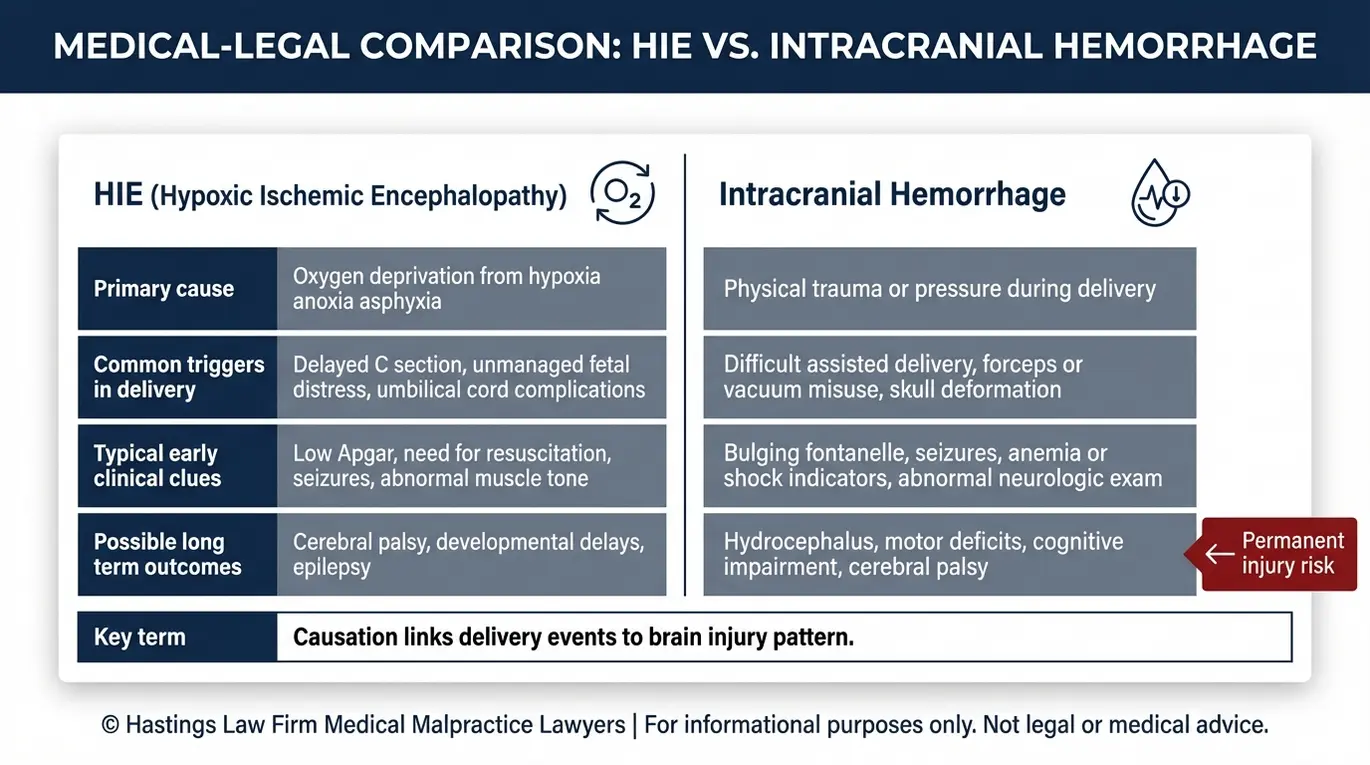
The two most common categories of birth-related brain injuries are Hypoxic-Ischemic Encephalopathy (HIE), caused by oxygen loss, and intracranial hemorrhages, caused by physical trauma. Both can lead to permanent conditions like cerebral palsy.
Hypoxic-ischemic encephalopathy (HIE), a condition where a baby’s brain is deprived of both oxygen and blood flow for a sustained period, leads to cell death and potential long-term disability. HIE can range from mild to severe, and the extent of lasting damage often depends on how quickly the oxygen deprivation was identified and treated. Medical teams often use therapeutic hypothermia (brain cooling) to mitigate this damage, but this treatment must be started within six hours of birth to be effective. A study published in PubMed Central on predictors of death or severe impairment in neonates with HIE underscores how the severity and duration of oxygen loss directly influence long-term neurological outcomes.
Intracranial hemorrhages are a separate category of infant brain injury involving bleeding inside or around the brain. Subdural hemorrhages occur between the brain’s surface and its outer covering, often caused by excessive mechanical force during delivery. Intraventricular hemorrhage (IVH), bleeding within the brain’s fluid-filled ventricles, is more common in premature infants and can lead to hydrocephalus, a dangerous buildup of fluid in the brain.
Understanding the Mechanism of Injury
When babies suffer brain injuries, the cause is often physical trauma. Physical head trauma during delivery often results from skull deformation under pressure. A baby’s skull bones are designed to shift slightly during birth. However, if vacuum extraction, a method using a suction cup to assist delivery, applies concentrated suction or forceps exert uneven force, the resulting pressure can tear blood vessels. Subdural hemorrhage from this type of mechanism is a well-documented risk when extraction tools are used aggressively or without proper indication.
| Injury Type | Common Cause | Long-Term Outcome |
|---|---|---|
| Hypoxic-Ischemic Encephalopathy (HIE) | Prolonged oxygen deprivation during labor or delivery | Cerebral palsy, cognitive disabilities, seizure disorders |
| Subdural Hemorrhage | Excessive force from forceps or vacuum extraction | Motor impairment, developmental delays, vision or hearing loss |
| Intraventricular Hemorrhage (IVH) | Prematurity, rapid pressure changes during delivery | Hydrocephalus, learning disabilities, cerebral palsy |
Texas infant brain damage attorneys evaluate the specific mechanism of injury in each case to connect the medical error to the child’s diagnosis and long-term prognosis.
Recognizing Signs and Symptoms of Brain Damage
Symptoms of brain damage may appear immediately in the NICU, such as seizures or low Apgar scores, or present later as developmental delays. Parents should monitor for missed milestones like failure to roll over, crawl, or speak at appropriate ages.
The Apgar score, a standardized assessment measuring heart rate, breathing, muscle tone, reflexes, and skin color on a scale of 0 to 10, provides the first objective data point regarding a newborn’s health. A persistently low score can signal that the baby experienced significant distress. Neonatal seizures, which are abnormal electrical discharges in a newborn’s brain, are another early red flag that may indicate underlying brain damage.
Not all signs appear right away. Some families don’t notice concerns until their child begins missing developmental benchmarks. The Centers for Disease Control and Prevention’s milestones and schedules resource provides a helpful reference for tracking normal development.
Here is a general timeline of warning signs that lawyers for brain damaged infants often see documented in medical and developmental records:
Immediate Signs (0–24 Hours After Birth)
- Seizures or abnormal body movements
- Need for emergency resuscitation at delivery
- Blue or pale skin tone lasting beyond the first few minutes
- Low Apgar scores at 5 or 10 minutes
- Difficulty breathing independently
Early Infancy (1–6 Months)
- Failure to track objects visually
- Extreme lethargy or lack of responsiveness
- Excessive or inconsolable crying
- Poor feeding or difficulty swallowing
- Muscle tone issues, such as unusual floppiness (hypotonia) or excessive stiffness
Toddler Years (12–36 Months)
- Not sitting, crawling, or walking at expected ages
- Limited or absent speech development
- Difficulty grasping objects or poor coordination
If your child is showing any of these signs and you have concerns about the care provided during birth, documenting those observations and preserving your medical records is an important first step. Detailed notes about feeding habits, sleep patterns, and physical movements can serve as important evidence during a legal investigation.

Proving Negligence and Establishing the Standard of Care
To win a malpractice claim in Texas, the family must prove that the medical provider violated the accepted standard of care and that this violation directly caused the infant’s brain injury. This requires expert testimony from qualified medical professionals.
The standard of care in obstetrics refers to the level of treatment a reasonably competent OB-GYN or delivery team would have provided under similar circumstances. It is not about perfection. It is about whether the provider’s actions fell below what the medical community considers acceptable, creating liability for the resulting injuries. Under Texas Civil Practice and Remedies Code Chapter 74, families must produce a qualified expert report early in the case to move forward. Failure to provide this detailed report within 120 days of filing the lawsuit can result in dismissal, making the selection of a knowledgeable attorney critical.
A Texas infant brain damage lawyer builds the case by working through a structured process:
- Secure and preserve evidence: We immediately request the full set of medical records, including fetal heart rate monitoring strips, labor and delivery records, NICU logs, and nursing notes before anything can be altered or destroyed
- Conduct a medical review: In-house medical staff analyze the records to identify where the care deviated from accepted protocols
- Retain qualified experts: Board-certified OB-GYNs, neonatologists, and pediatric neurologists review the case and provide opinions on both the breach and causation
- Establish the causal link: Experts must connect the specific error to the infant’s brain injury, showing that the damage would not have occurred with proper care
Documentation practices during neonatal resuscitation vary significantly between institutions, as noted in a PubMed Central study on neonatal resuscitation documentation across North America. Gaps or inconsistencies in those records can be significant evidence.
Parents can assist the process by requesting copies of prenatal records, delivery records, and any imaging studies performed on the baby. Your legal team will handle formal discovery, but early access to these records helps the investigation begin sooner.

Securing Compensation for a Lifetime of Care
Settlements in infant brain damage cases must account for the child’s entire lifetime of needs, including future medical bills, 24/7 attendant care, specialized therapy, and lost earning capacity.
A Life Care Plan is the foundation of this calculation. It is a detailed document prepared by medical and rehabilitation experts that itemizes every anticipated cost the child will face over their lifetime: surgeries, medications, physical and occupational therapy, speech therapy, adaptive equipment like wheelchairs, home modifications for accessibility, and full-time nursing or attendant care. These plans establish the long-term financial support necessary to provide for a child’s unique developmental and medical needs.
Without a thorough Life Care Plan, families risk settling for far less than what their child will actually need. We ensure that inflation and rising healthcare costs are factored into these calculations so that the funds do not run out when your child reaches adulthood.
The financial reality is significant. According to data from the Centers for Disease Control and Prevention on cerebral palsy, the lifetime cost of care for a person with cerebral palsy can reach well into the millions of dollars. An infant brain damage legal team must account for every category of damages, including economic damages like past and future medical costs and lost future earnings, as well as non-economic damages for pain, suffering, and physical impairment.
At Hastings Law Firm, we work with life care planners, economists, and medical specialists to build a damages case that reflects the true cost of your child’s injury. Our goal is to provide the financial security your child needs to access the best possible care throughout their life.
Contact the Texas Birth Injury Attorneys at Hastings Law Firm Today for Help
If your child suffered a preventable brain injury at birth, you deserve answers. You deserve to know what happened, why it happened, and whether it could have been avoided. Hastings Law Firm is dedicated to helping families find those answers and securing the financial future your child needs.
Our team focuses exclusively on medical malpractice. Founded by Tommy Hastings, a trial lawyer board-certified in Personal Injury Trial Law by the Texas Board of Legal Specialization, our Texas medical malpractice law firm has recovered millions for families affected by birth injuries.
We operate on a contingency fee basis, which means you pay nothing unless we recover compensation for your family. Consultations are free, confidential, and designed to give you clarity about your options.
Call us today or contact us online to speak with an attorney who understands what your family is going through.
Frequently Asked Questions About Infant Brain Injury in Texas


This content was researched and written by the Hastings Law Firm editorial team, which includes attorneys, medical professionals, and experienced researchers. Our writing is informed by internal knowledge and practical experience, and we cross-check critical details against authoritative sources cited throughout. Every piece undergoes human-led fact-checking and legal review. Because legal and medical information can change, if you spot an error, please contact us. Learn more about our content standards and review process on our editorial policy page.

Tommy Hastings, founder of Hastings Law Firm, is a board-certified personal injury trial lawyer dedicated exclusively to healthcare injury cases. Since 2001, he has represented injured patients and families in litigation against major hospital systems, pharmaceutical companies, and negligent healthcare providers nationwide. He has handled numerous high-profile cases that have drawn national media attention and resulted in multi-million dollar recoveries. He draws on that experience in his writing, helping readers understand how these cases work and what options may be available to them.
