


Texas Phrenic Nerve Palsy Lawyer
Written by: Hastings Law Firm | Reviewed by: Tommy Hastings | Updated: July 27, 2026
Phrenic nerve palsy is a birth related injury that can leave a newborn struggling to breathe because the diaphragm cannot work normally. It is often linked to trauma during delivery that stretches or tears nerve roots in the upper spine, and severity can range from partial impairment to life threatening respiratory failure or worse. Clear diagnosis and careful review of delivery events can help explain how the injury occurred and what long term needs may follow. If you or a loved one were harmed or worse due to phrenic nerve palsy in Texas, contact Hastings Law Firm for a free, confidential case review.

Top Rated Malpractice Attorneys for Birth-Related Injuries in Texas
What You Should Know About Infant Diaphragm Paralysis Claims in Texas:
- Life altering breathing complications can follow phrenic nerve palsy because diaphragm paralysis can prevent independent breathing.
- The severity of long term impact can differ sharply because unilateral injury may improve while bilateral injury is described as life threatening and often requires ventilation and prolonged NICU care.
- Preventable delivery trauma can be central to fault disputes because excessive lateral traction during difficult deliveries is described as a common mechanism of injury.
- Liability exposure can extend beyond one clinician because fault may be apportioned among an OB GYN, a hospital, and in some situations a device manufacturer.
- Recovery for pain and suffering can be limited in Texas because non economic damage caps apply to medical malpractice claims while economic damages are not capped.
- Options can narrow if action is delayed because Texas medical malpractice claims are subject to a statute of limitations with different treatment for parents claims and a minors claim.
- Proof disputes can intensify over timing and cause because imaging that documents diaphragm paralysis is used to distinguish birth trauma from congenital conditions.
- Diagnostic confirmation can shape medical and legal decisions because fluoroscopy sniff testing and electrodiagnostic studies are described as tools used to confirm phrenic nerve palsy.

A Healthcare Focused Law Firm
When your newborn is diagnosed with phrenic nerve palsy, the fear and confusion can feel overwhelming. You may be watching your child struggle to breathe while searching for answers about what went wrong during delivery. That instinct to question what happened is valid, and you deserve a clear, honest explanation.
Founded by board-certified trial lawyer Tommy Hastings, Hastings Law Firm focuses exclusively on medical malpractice cases, including birth injuries involving nerve damage and diaphragm paralysis. Our team of attorneys, in-house nurses, and medical consultants understands both the medicine and the law behind these injuries. If your child was harmed during delivery, a Texas Phrenic Nerve Palsy Lawyer at our firm can review your records and help you understand your legal options. Contact us for a free, confidential case evaluation.
Understanding Phrenic Nerve Palsy and Infant Diaphragm Paralysis
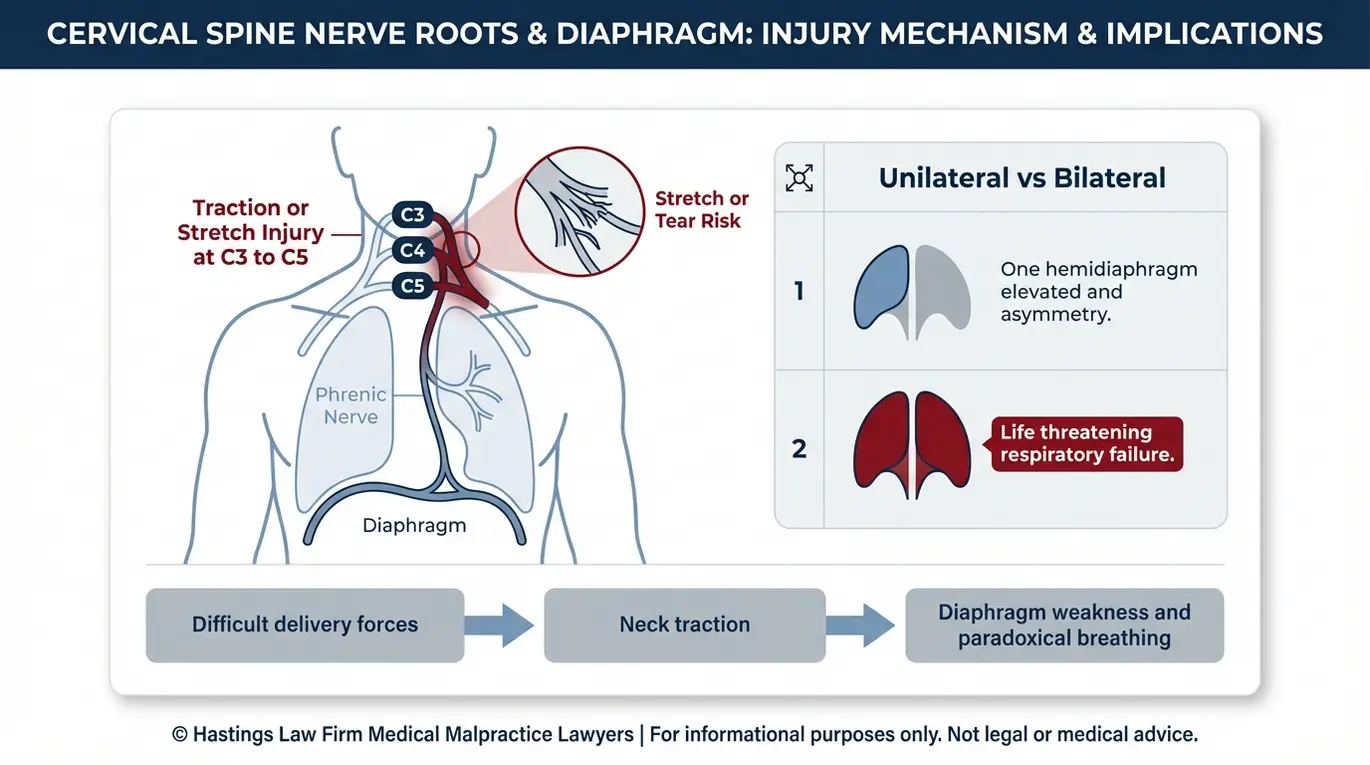
Phrenic nerve palsy is a birth injury caused by trauma to the cervical nerve roots at C3, C4, and C5, the nerve fibers in the upper spinal cord that control the diaphragm, during delivery. This condition involves the loss of function in the diaphragm muscle. When these nerves are stretched or torn, the result is partial or complete paralysis of the diaphragm muscle, which is the primary muscle responsible for breathing.
The phrenic nerve runs from the neck down through the chest to the diaphragm. It carries the signal from the brain that tells the diaphragm to contract and expand the lungs. When this nerve is damaged at or near its origin in the cervical spine, that signal is interrupted. The diaphragm on the affected side can no longer function properly, and the infant may be unable to breathe without assistance.
A Texas phrenic nerve injury attorney can help families determine whether the trauma that caused this damage was the result of preventable medical error. But first, it’s helpful to understand what the injury looks like and how it differs depending on severity.
- Unilateral phrenic nerve palsy affects one side of the diaphragm. The infant may breathe with difficulty but can often compensate partially using the unaffected side and accessory muscles. Many unilateral cases improve over time, though some require surgical intervention to stabilize breathing function.
- Bilateral phrenic nerve palsy affects both sides of the diaphragm. This is a life-threatening condition presenting with severe respiratory distress. The infant cannot breathe independently and typically requires immediate mechanical ventilation and prolonged NICU care to survive.
The distinction between unilateral and bilateral injury has a significant impact on both the child’s medical prognosis and the scope of a potential legal claim. A phrenic nerve palsy lawyer evaluates the severity of the injury alongside delivery records to assess whether the standard of care was met.
Anatomy and Mechanism of Diaphragm Paralysis
Phrenic nerve damage during birth most commonly results from excessive traction on the infant’s neck. During a difficult delivery, if the head is pulled laterally (away from the shoulder) with too much force, the nerve roots at C3 through C5 can stretch beyond their tolerance. In severe cases, the fibers tear partially or completely, disrupting the critical communication between the nervous system and the respiratory muscles.
Diaphragm paralysis occurs when the phrenic nerve cannot send signals to the breathing muscles. This mechanism produces a condition where the affected side of the diaphragm cannot contract during inhalation. Instead of moving downward to draw air into the lungs, the paralyzed side moves upward. This abnormal movement is called paradoxical breathing (also known as paradoxical respiration), where the abdomen moves inward rather than outward when the baby tries to inhale. It is one of the earliest visible indicators that the phrenic nerve has been compromised.
Recognizing Signs of Phrenic Nerve Injury in Newborns
Symptoms of phrenic nerve injury include respiratory distress, a weak or absent cry, reduced chest movement on one side, and paradoxical respiration where the abdomen pulls inward during inhalation.
Some signs are visible in the delivery room within the first minutes of life. Medical staff may observe cyanosis, a bluish discoloration of the skin caused by low oxygen levels, along with labored or irregular breathing patterns. An infant who cannot maintain adequate oxygen saturation without intervention should prompt immediate evaluation for nerve injury, particularly if the delivery involved traction or assistive instruments. Respiratory distress in a newborn often is the first indication that the phrenic nerve was compromised during the birth process.
The following checklist outlines key warning signs that may indicate phrenic nerve damage in a newborn:
- Difficulty breathing or rapid, shallow respirations
- Weak, high-pitched, or absent cry
- Visible asymmetry in chest wall movement during breathing
- Abdomen pulling inward on inhalation (paradoxical respiration)
- Bluish or pale skin tone, especially around the lips and fingertips
- Need for supplemental oxygen or ventilation shortly after birth
- Reduced or absent arm movement on one side (suggesting associated brachial plexus injury)
The Children’s Hospital of Philadelphia identifies several of these respiratory and neurological symptoms as newborn warning signs that require immediate medical attention.
Phrenic nerve palsy frequently occurs alongside other traction-related birth injuries. Brachial plexus injuries, including Erb’s palsy, involve damage to the nerve network controlling the arm and shoulder. When a newborn presents with both breathing difficulty and limited arm movement on the same side, the combination strongly suggests nerve trauma during delivery.
To confirm the diagnosis, physicians typically use a fluoroscopic sniff test, an imaging procedure where the infant’s diaphragm is observed in real-time on X-ray while the baby breathes. A paralyzed diaphragm will move upward (paradoxically) during a sniff or cry, while the healthy side moves downward. Research published in PubMed Central has validated quantitative analysis of diaphragm motion during fluoroscopy as an effective diagnostic method for hemidiaphragm paralysis.
Obtaining clear diagnostic confirmation is crucial not just for treatment, but for establishing the timing of the injury. Imaging studies that document the paralysis help differentiate birth trauma from congenital conditions. If your child showed any of these symptoms and you suspect the injury was caused by the delivery itself, a lawyer for phrenic nerve palsy can help you obtain and interpret the medical records needed to evaluate whether negligence occurred. As a Texas birth injury attorney team, we work with medical experts who can connect the clinical findings to the events of labor and delivery.
The Hastings Law Firm Difference
Results matter, but what truly sets us apart is how we achieve them. Every verdict, every settlement, and every Texas courtroom victory comes from one guiding promise: To treat each client’s fight for justice as if it were our own.
This balance of skill, experience, and empathy reflects our core philosophy that justice should not only compensate the injured, but also make healthcare safer nationwide.

How Medical Negligence Causes Phrenic Nerve Damage
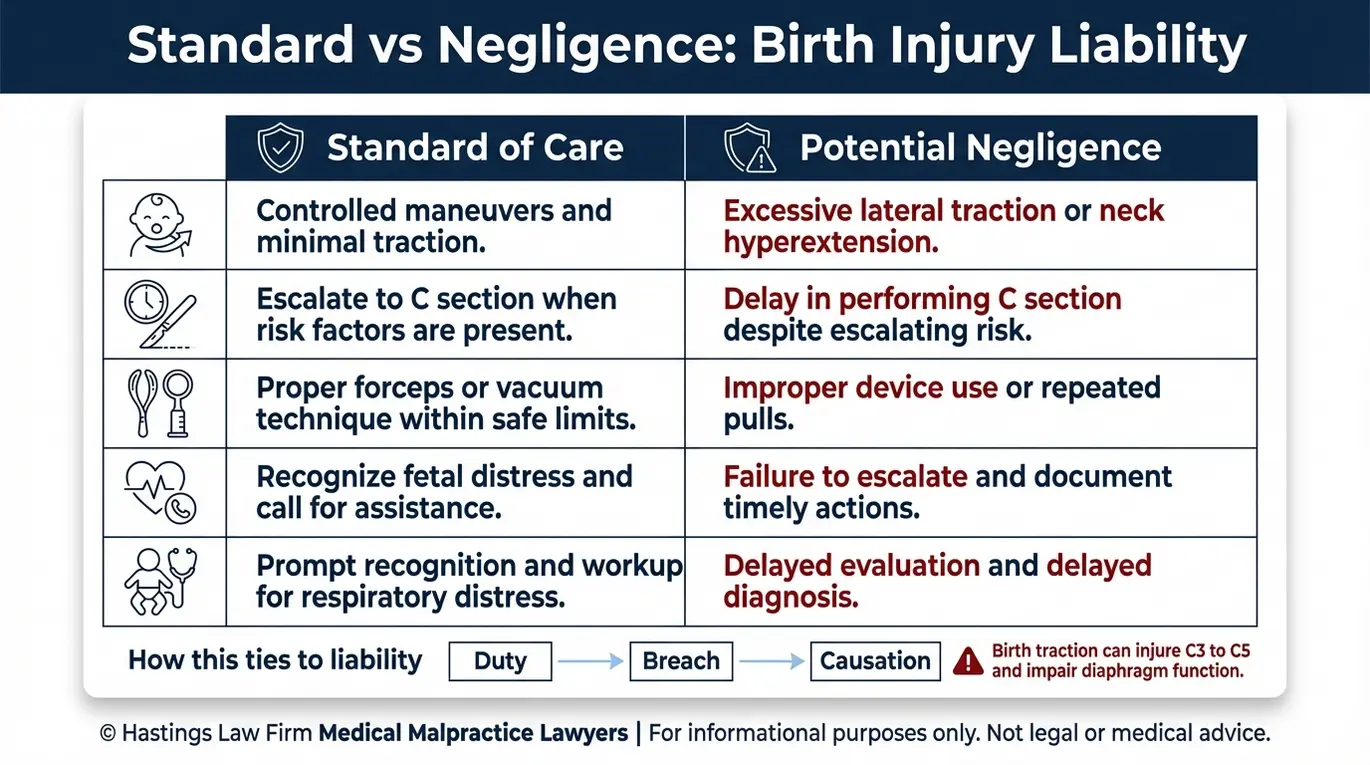
Medical negligence in phrenic nerve injury cases occurs when a physician applies excessive lateral traction to the infant’s head or neck during delivery, fails to perform a timely C-section when risk factors are present, or improperly uses birth-assistive tools such as forceps or vacuum extractors. Each of these actions can stretch or tear the C3 through C5 nerve roots that control the diaphragm.
When evaluating medical negligence, we compare the actions of the delivery team against the accepted standard of care. This legal benchmark represents what a reasonably competent physician would have done under similar circumstances to ensure a safe delivery for both mother and child.
The Mechanism: Lateral Traction During Shoulder Dystocia
Shoulder dystocia, a delivery complication where the baby’s shoulder becomes lodged behind the mother’s pubic bone after the head has delivered, is one of the most common scenarios associated with phrenic nerve damage. According to the National Center for Biotechnology Information (NCBI), shoulder dystocia requires specific maneuvers to safely resolve the obstruction without injuring the infant.
When a provider applies excessive downward or lateral traction, pulling the infant’s head forcefully away from the trapped shoulder, the neck can hyperextend beyond safe limits. Neck hyperextension refers to the forced backward or sideways bending of the cervical spine, while lateral traction describes the pulling force applied to one side of the head or neck. Both actions place direct mechanical stress on the phrenic nerve roots.
The standard of care requires physicians to use established, lower-risk maneuvers to resolve shoulder dystocia before resorting to traction. These include the McRoberts maneuver, suprapubic pressure, and repositioning techniques that shift the baby’s position without pulling on the neck.
Assistive Devices: Forceps and Vacuum Extractors
Operative vaginal delivery, the use of forceps or a vacuum extractor to assist in delivering the baby, carries its own set of risks when performed improperly. Incorrect placement, excessive force, or repeated application of these instruments can cause direct trauma to the cervical spine and surrounding nerve structures.
Failure to Act: Delayed C-Section
In some cases, the negligence occurs before the delivery itself. When prenatal assessments indicate risk factors such as macrosomia, which refers to an unusually high birth weight, a Texas Phrenic Nerve Palsy Lawyer will examine whether the provider should have recommended a cesarean delivery instead of attempting a vaginal birth.
The following table illustrates how the standard of care compares to potential acts of negligence in these situations:
| Standard of Care | Potential Negligence |
|---|---|
| Recognize and document risk factors for shoulder dystocia before delivery | Fail to identify or act on known risk factors such as macrosomia or gestational diabetes |
| Use approved maneuvers (McRoberts, suprapubic pressure) to resolve shoulder dystocia | Apply excessive lateral traction to the infant’s head or neck |
| Properly position and limit force when using forceps or vacuum extractors | Misapply instruments, use excessive force, or exceed recommended attempts |
| Recommend C-section when risk factors indicate vaginal delivery may be unsafe | Proceed with vaginal delivery despite documented contraindications |
| Monitor fetal well-being throughout labor and respond to signs of distress | Ignore or delay response to fetal monitoring abnormalities |
A medical malpractice lawyer reviews the complete delivery record, including fetal monitoring strips, nursing notes, and provider documentation, to determine whether a breach of duty occurred. As birth injury counsel, we work with independent obstetric and neonatal experts to reconstruct the timeline and evaluate whether the phrenic nerve damage was preventable.
Neck Hyperextension and Traction Injuries
The specific mechanism that damages the C3 through C5 nerve roots is a stretching force that exceeds the structural tolerance of the nerve fibers. During a difficult delivery, when the infant’s head is delivered but the shoulders remain trapped, the natural instinct may be to pull. That pulling force, particularly when directed laterally or downward, places the phrenic nerve roots under tension.
In mild cases, the nerve fibers stretch but remain intact, which may allow for gradual recovery. In more severe cases, the stretching partially or fully tears the nerve, resulting in permanent diaphragm paralysis. The degree of force applied, the angle of traction, and the duration of the delivery all factor into the severity of the injury.
Recoverable Damages for Long-Term Diaphragm Paralysis
Compensation for phrenic nerve injuries includes coverage for past and future medical bills, surgical costs such as diaphragmatic plication, physical therapy, pain and suffering, and loss of future earning capacity. The goal of a phrenic nerve palsy settlement is to account for every financial and personal impact the injury will have on the child’s life.
In legal terms, these losses fall into two categories: economic damages and non-economic damages. Economic damages cover quantifiable financial losses like medical bills and lost wages, while non-economic damages compensate for intangible losses such as physical pain and impairment. While some cases arise from natural complications, others result from specific surgical errors or improper maneuvers during delivery, entitling the family to seek recovery for both types of harm.
Medical costs for these injuries often begin in the first hours of life and can extend for years or even a lifetime. A child with diaphragm paralysis may require an extended stay in the neonatal intensive care unit (NICU), mechanical ventilation, and potentially one or more surgeries. According to the Healthcare Cost and Utilization Project (HCUP), hospital stays for children with complex conditions carry substantial costs that escalate with the severity and duration of care.
Diaphragmatic plication, a surgical procedure where the paralyzed diaphragm is sutured into a flattened position to prevent it from rising and compressing the lung, is one of the most common interventions for unilateral phrenic nerve palsy that does not resolve on its own.
Securing full compensation for diaphragm paralysis may include:
- NICU hospitalization costs, including ventilator support and monitoring
- Surgical expenses, including diaphragmatic plication and any follow-up procedures
- Respiratory therapy and pulmonary rehabilitation
- Physical and occupational therapy, particularly when Erb’s palsy or other associated injuries are present
- Future medical care, including projected costs for ongoing treatment, follow-up appointments, and potential additional surgeries
- Assistive devices and home modifications if the child has long-term respiratory limitations
- Pain and suffering, reflecting the physical discomfort and emotional distress the child endures
- Loss of enjoyment of life, accounting for limitations on the child’s ability to participate in normal childhood activities
- Loss of future earning capacity, if the injury affects the child’s ability to work as an adult
Life care planning is a critical component of these cases. Our team works with qualified life care planners who project the total lifetime cost of the injury, from childhood through adulthood. This ensures that any settlement or verdict reflects the true financial burden the family will carry, not just the bills that have already arrived.
How Our Medical Malpractice Team Investigates Your Case
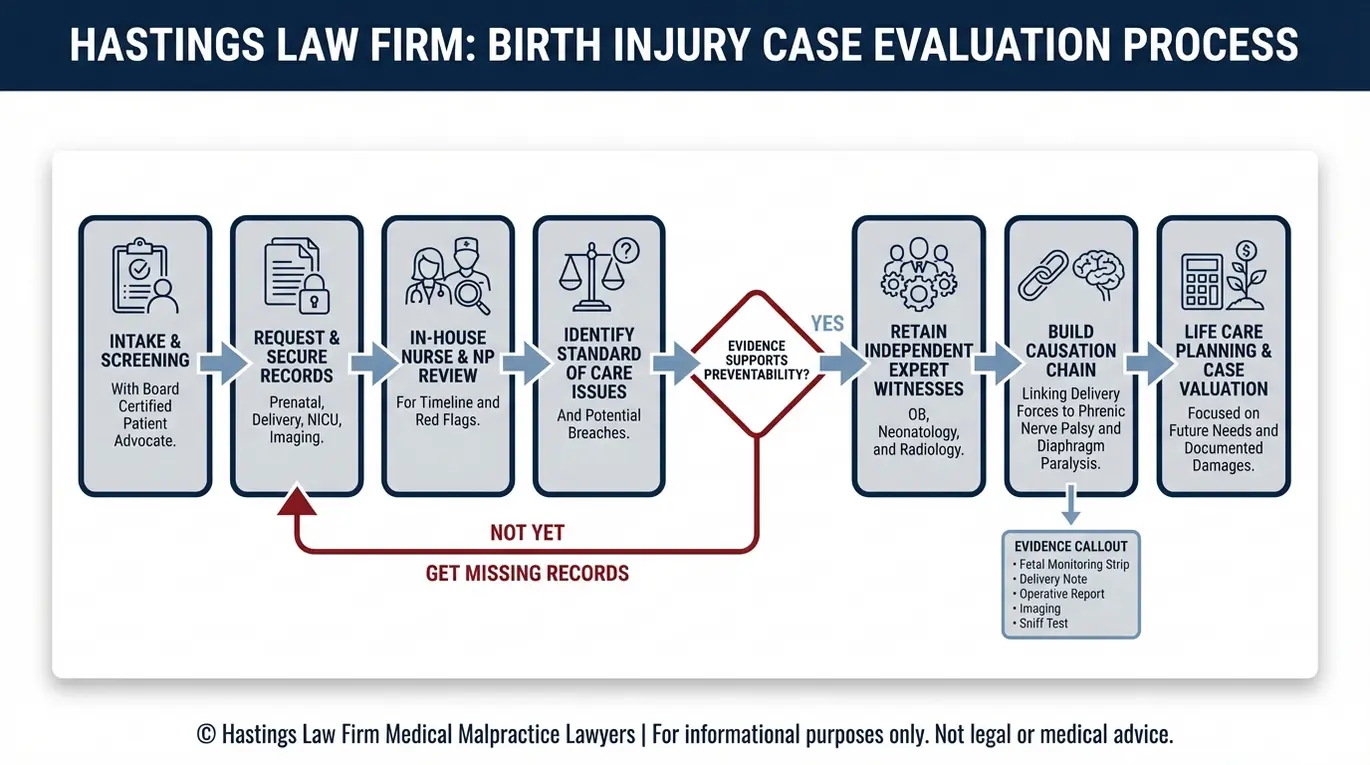
Our team obtains all prenatal and delivery records, utilizes independent medical experts to review the fetal monitoring strips, and consults with life care planners to calculate the total lifetime cost of the injury. As a Texas Phrenic Nerve Palsy Lawyer team, we approach every case with the same level of preparation we would bring to a jury trial.
Here is how the investigation process works:
- Step 1: Screening with a Board Certified Patient Advocate. Your first conversation is with a patient advocate who listens to what happened and gathers the initial details of your child’s birth and diagnosis. This call is free, confidential, and designed to determine whether the case warrants a full investigation. There is no pressure and no obligation.
- Step 2: Record collection and medical review. Once we accept the case, our in-house medical staff, which includes former hospital nurses, conducts a detailed review of every relevant record. This includes prenatal charts, labor and delivery notes, fetal heart rate tracings, nursing logs, and NICU admission records. We look for signs of fetal distress that should have prompted an earlier intervention and identify gaps in charting.
- Step 3: Independent expert analysis. We retain qualified expert witnesses, typically board-certified obstetricians, neonatologists, and neurologists, who independently evaluate whether the standard of care was met. These experts establish causation by determining if the phrenic nerve injury was caused by preventable actions during delivery and whether a different course of action would have avoided the harm.
- Step 4: Life care planning and damages calculation. For cases involving long-term or permanent injury, we work with life care planners and economists to project the full cost of your child’s future medical needs, therapy, and any impact on their earning potential. This step ensures that any demand or trial presentation accounts for decades of care, not just the expenses incurred so far.
As a plaintiff trial firm, we prepare every claim to survive the scrutiny of the courtroom. We establish clear causation by linking the specific maneuvers used by the delivery team to the resulting nerve damage, ensuring that defense attempts to blame maternal forces or congenital issues are effectively countered. This preparation allows us to negotiate from a position of strength or, when necessary, present the case to a jury with confidence.
Deadlines for Filing a Phrenic Nerve Injury Claim in Texas
Texas law generally requires medical malpractice claims to be filed within two years of the injury, but specific exceptions and tolling rules apply to minors that can extend this deadline.
Under the Texas Civil Practice & Remedies Code, Chapter 74, the standard statute of limitations for medical liability claims is two years from the date of the negligent act. For a birth injury, that clock typically starts on the date of delivery. This two-year deadline applies directly to the parents’ claims, including their right to recover medical expenses they have incurred on behalf of the child.
However, for the child’s own claim, Texas law provides tolling rules that pause the statute of limitations for minors. Generally, a minor’s claim is tolled until the child turns 12, giving the child until their 14th birthday to file. This Texas birth injury statute of limitations tolling provision exists because children cannot bring legal claims on their own and may not understand the nature of their injury until later in life. In some instances, the discovery rule may apply if the injury could not have been discovered immediately, though this is less common in evident birth injuries.
Despite the extended deadline for the child’s claim, waiting carries real risks. Medical records can be lost or destroyed. Witnesses’ memories fade. Electronic fetal monitoring data may be overwritten. Evidence that exists today may not be available in five or ten years.
This information is provided for general educational purposes and is not legal advice. Statutes of limitations involve detailed rules, and exceptions can vary depending on the specific facts of your case. We strongly encourage you to speak with an attorney as early as possible so that all applicable deadlines are identified and your family’s rights are fully protected.
Contact the Texas Birth Injury Attorneys at Hastings Law Firm Today for Help
If your child was diagnosed with phrenic nerve palsy or diaphragm paralysis after a difficult delivery, you do not have to face this alone. At Hastings Law Firm, we represent families exclusively in medical malpractice cases, and we understand the weight of what you’re going through.
Our team, which includes board-certified trial attorneys, in-house nurses, and former defense lawyers, is built to handle these medically complex cases from the first phone call through trial if necessary. We are committed to finding answers, holding negligent providers accountable, and protecting your child’s future.
We work on a contingency fee basis, which means you pay no attorney fees or costs unless we recover compensation for your family. There is no financial risk in reaching out.
Contact Hastings Law Firm today for a free, confidential case evaluation. Let us review what happened and explain your options.
Frequently Asked Questions About Phrenic Nerve Palsy in Texas


This content was researched and written by the Hastings Law Firm editorial team, which includes attorneys, medical professionals, and experienced researchers. Our writing is informed by internal knowledge and practical experience, and we cross-check critical details against authoritative sources cited throughout. Every piece undergoes human-led fact-checking and legal review. Because legal and medical information can change, if you spot an error, please contact us. Learn more about our content standards and review process on our editorial policy page.

Tommy Hastings, founder of Hastings Law Firm, is a board-certified personal injury trial lawyer dedicated exclusively to healthcare injury cases. Since 2001, he has represented injured patients and families in litigation against major hospital systems, pharmaceutical companies, and negligent healthcare providers nationwide. He has handled numerous high-profile cases that have drawn national media attention and resulted in multi-million dollar recoveries. He draws on that experience in his writing, helping readers understand how these cases work and what options may be available to them.
