


Texas Delayed Twin Delivery Injury Lawyer
Written by: Hastings Law Firm | Reviewed by: Tommy Hastings | Updated: July 27, 2026
A delayed twin delivery can leave families facing sudden and lasting harm when one or both babies are deprived of oxygen during labor. Twin births carry added risks, and the period between the first and second delivery can become especially vulnerable if warning signs are missed or urgent action is delayed. Problems like fetal distress, communication breakdowns, and delayed decisions about a cesarean delivery can contribute to severe outcomes and long term care needs. If you or a loved one were harmed or worse due to delayed twin delivery injuries in Texas, contact Hastings Law Firm for a free, confidential case review.

Top-Rated Representation for Twin Birthing Injuries
What You Should Know About Twin Birth Delivery Negligence Claims in Texas:
- Life changing injury can result when a delayed twin delivery interrupts oxygen supply during labor.
- The second twin can face heightened danger after the first birth when contractions intensify and the placenta can begin to separate.
- Permanent brain injury can be linked to delays in recognizing fetal distress and moving to an emergency cesarean delivery.
- Options for recovery in Texas can be limited for non economic losses because state law restricts pain and suffering damages.
- Financial exposure can remain substantial because Texas law does not cap economic losses such as medical care and long term support.
- Hospital liability can still be at issue even when a private physician is involved, because nursing actions and supervision theories may apply.
- Case viability can turn on objective timing evidence, because fetal monitoring data can show when distress began and how long response took.
- Proof disputes can arise from record conflicts, because charting entries may not match monitor data or other time stamped information.
- Causation can be strengthened by newborn testing, because umbilical cord blood gas results can indicate oxygen deprivation at birth.
- Medication related labor management can be central, because improper Pitocin use can trigger overly frequent contractions and worsen fetal oxygen stress.

A Healthcare Focused Law Firm
When a twin delivery goes wrong, the consequences can change your family’s life in an instant. A delay of just minutes during labor can deprive one or both babies of oxygen, leading to hypoxic-ischemic encephalopathy (HIE), a type of brain damage caused by restricted blood flow and oxygen to the brain. If your children suffered preventable harm during a delayed twin delivery, you are not alone, and what happened deserves a thorough, honest investigation.
As a Texas Delayed Twin Delivery Injury Lawyer, Hastings Law Firm focuses exclusively on medical malpractice. Our team, led by board-certified trial attorney Tommy Hastings, includes in-house nurse consultants and medical experts. We work together to determine whether the care your family received fell below the accepted medical standard. If you believe a delay during your twins’ delivery caused lasting harm, we can review what happened and explain your options in a free, confidential evaluation.
How Delayed Delivery Injuries Occur in Twin Pregnancies
Delayed delivery injuries in twins often occur when medical teams fail to recognize fetal distress in one or both babies, delaying a necessary cesarean section. This delay can lead to oxygen deprivation, known as hypoxia, and permanent brain injury such as HIE.
Twin and other multiple pregnancies carry higher risks than singleton births. The placenta must support two babies, and complications like cord entanglement, placental insufficiency, and abnormal fetal positioning are more common. These factors place greater demands on the medical team to monitor both babies closely throughout labor and to act quickly when warning signs appear.
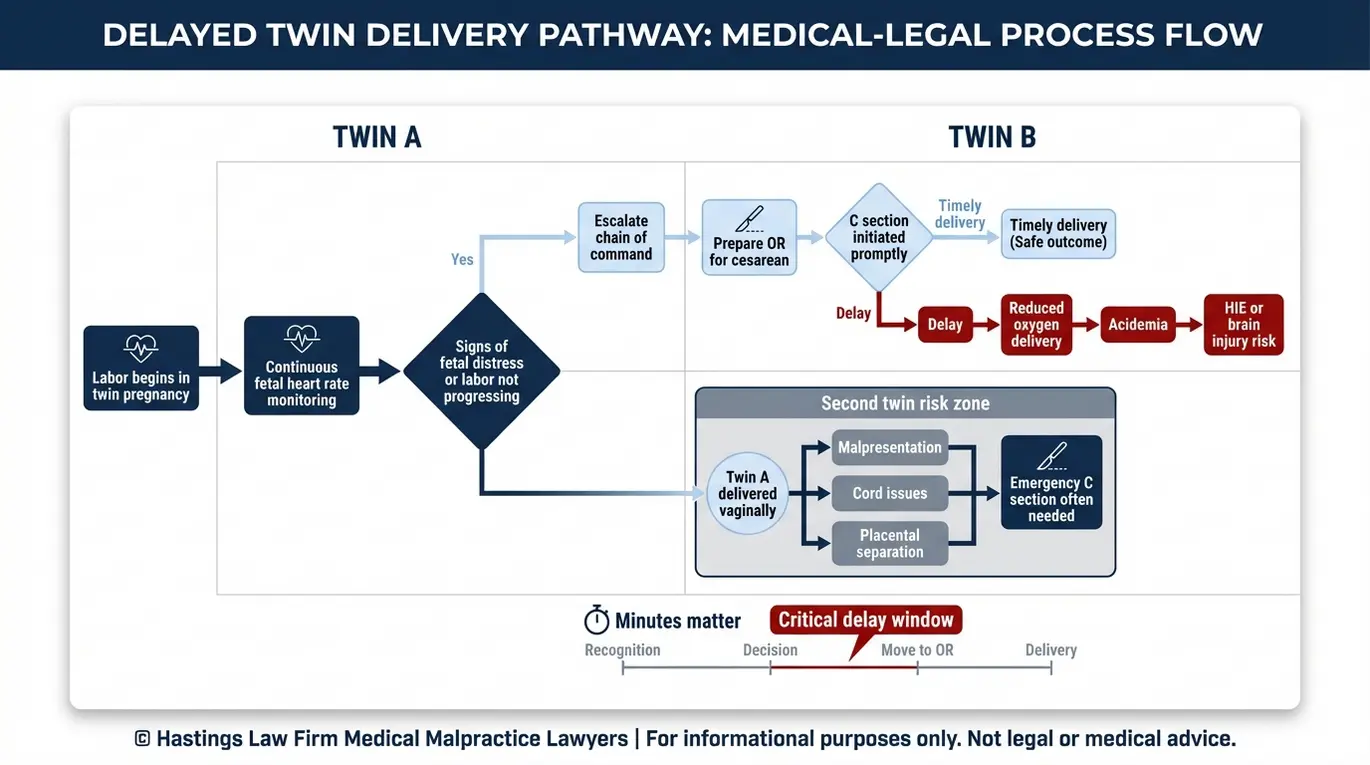
One of the most critical and often misunderstood aspects of multiple births involves specific second twin delivery risks. The second twin delivery interval, the time occurring between the birth of Twin A and Twin B, is a period of heightened vulnerability. After the first baby is born, the uterus begins to contract significantly, and the placenta can start to separate.
If Twin B is not delivered within a safe window, the remaining baby’s oxygen supply can be compromised rapidly, turning a hopeful moment into a medical emergency. In some cases, Twin A is delivered vaginally without complication, but Twin B encounters problems such as cord prolapse, abnormal presentation, or sudden heart rate changes.
This may require what is called a combined vaginal-cesarean delivery, a complex scenario where the first baby is born vaginally and the second must be delivered by emergency C-section. The transition from a vaginal birth plan to an emergency surgical delivery demands immediate action from the medical team.
Risks that delayed twin delivery injury lawyers in Texas commonly evaluate in these cases include:
- Cord compression or prolapse after Twin A is delivered, cutting off blood flow to Twin B
- Placental abruption triggered by uterine changes between deliveries
- Malpresentation of Twin B (such as a transverse lie) requiring rapid surgical intervention
- Prolonged intertwin delivery time during which oxygen deprivation silently progresses
When oxygen supply is interrupted, brain damage can begin within minutes. The longer the delay, the greater the risk of permanent hypoxic-ischemic injury. Our investigation examines where in this timeline the medical team’s response fell short and whether earlier intervention could have prevented the harm. We scrutinize the medical records to determine if the team missed critical windows for intervention that could have preserved your child’s health.
Identifying Malpractice: Failure to Perform a Timely C-Section
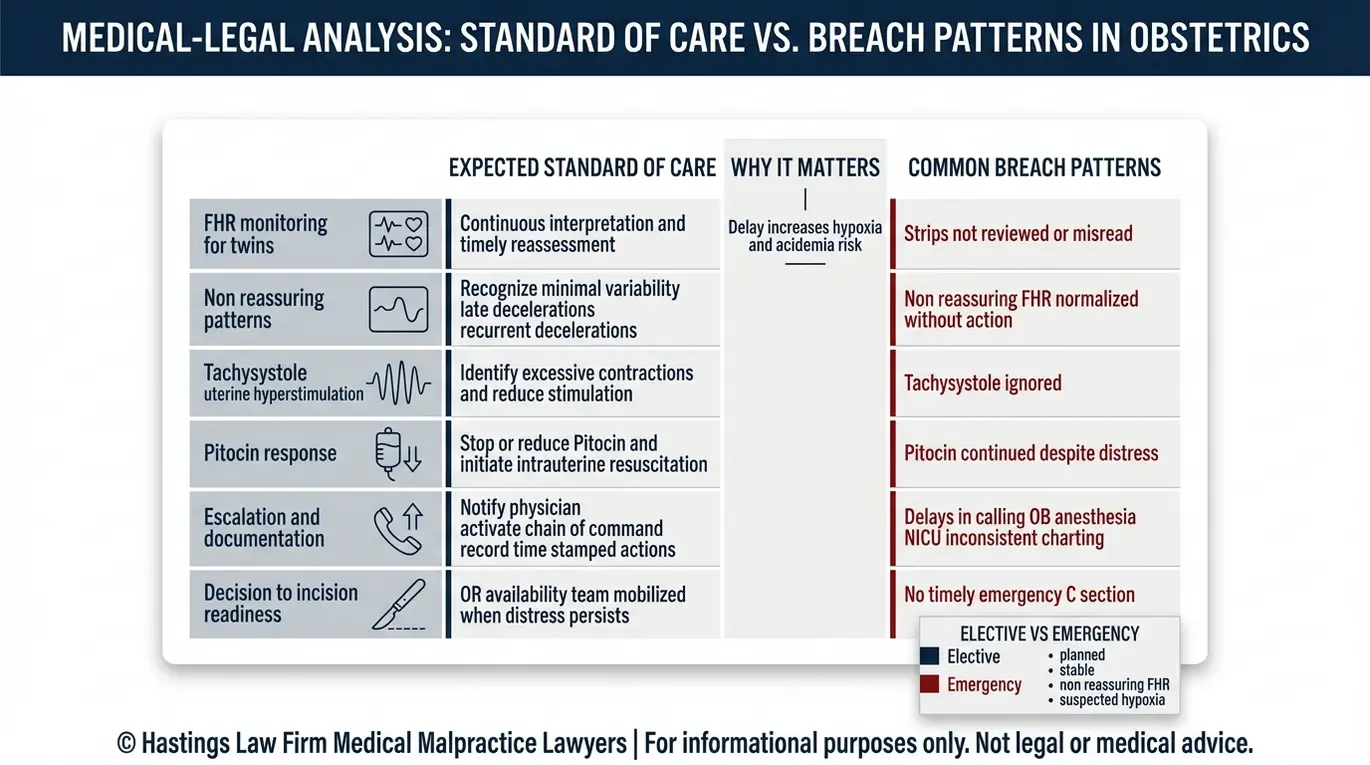
Malpractice occurs when an obstetrician or labor nurse ignores warning signs of fetal distress, such as non-reassuring heart rate patterns, and fails to order an emergency cesarean section, breaching the standard of care.
The standard of care for monitoring twins during labor requires continuous electronic fetal heart rate monitoring of both babies simultaneously. This monitoring produces tracings that reveal each baby’s heart rate response to contractions. Medical teams monitor for non-reassuring fetal heart rate (FHR) patterns, irregularities in the heart rhythm signaling that a baby may not be tolerating labor well. These patterns include late decelerations, prolonged decelerations, minimal or absent variability, and persistent tachycardia.
When labor and delivery nurses observe these tracings, the standard generally requires them to notify the obstetrician immediately. They should also initiate resuscitative measures like repositioning the mother and administering oxygen while preparing for a potential emergency C-section. Failure at any point in this chain, whether by the nurse who delays notification or the physician who delays the decision to operate, can support a medical malpractice claim.
A particularly dangerous scenario involves the misuse of Pitocin, a synthetic hormone used to induce or augment labor. When Pitocin is administered improperly or at excessive doses, it can cause uterine tachysystole, a condition where the uterus contracts too frequently, typically more than five contractions in a ten-minute window.
According to research published in the National Library of Medicine (PubMed), tachysystole, also called uterine hyperstimulation, reduces the rest period between contractions. This rest period is necessary for the baby to recover oxygen levels. In a twin pregnancy where the placenta is already under greater strain, this can rapidly push one or both babies into fetal distress.
The critical question in most delayed delivery cases is: when did the C-section become medically necessary, and how long did it take the team to act? There is often a clear decision window where the situation shifts from “monitor and reassess” to “deliver immediately.” A lawyer for delayed twin delivery injuries examines whether that window was missed and what the tracings showed at each stage. We evaluate whether communication breakdowns between nurses and doctors contributed to a delay in the decision-to-incision time, a critical factor in preventing permanent brain injury.
The table below illustrates key differences between reassuring and non-reassuring fetal heart rate findings:
| Fetal Heart Rate Finding | Reassuring (Normal) | Non-Reassuring (Abnormal) |
|---|---|---|
| Baseline Rate | 110–160 bpm | Below 110 or above 160 bpm (persistent) |
| Variability | Moderate (6–25 bpm fluctuation) | Minimal or absent variability |
| Accelerations | Present | Absent after 32 weeks gestation |
| Decelerations | Absent or early (mirror contractions) | Late, variable, or prolonged decelerations |
| Uterine Activity | Adequate resting tone between contractions | Tachysystole (>5 contractions in 10 min) |
When non-reassuring findings persist despite resuscitative interventions, the standard of care typically requires an expedited delivery. Texas delayed twin delivery injury legal counsel can help determine whether your medical team met that standard or fell short.
The Hastings Law Firm Difference
Results matter, but what truly sets us apart is how we achieve them. Every verdict, every settlement, and every Texas courtroom victory comes from one guiding promise: To treat each client’s fight for justice as if it were our own.
This balance of skill, experience, and empathy reflects our core philosophy that justice should not only compensate the injured, but also make healthcare safer nationwide.

Proving Negligence Through Medical Evidence
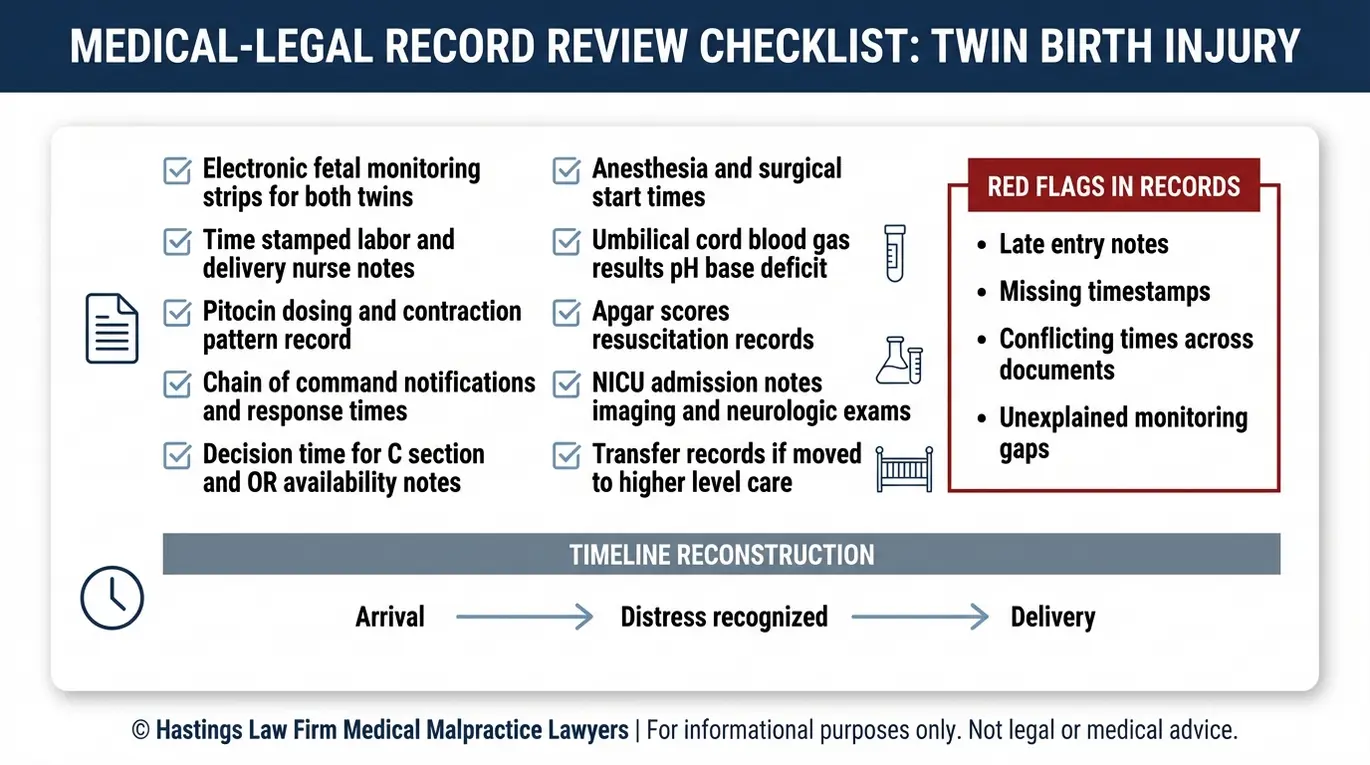
To prove negligence, your legal team must reconstruct the delivery timeline using electronic fetal monitoring strips and umbilical cord blood gas data to demonstrate that the injury occurred specifically because of the provider’s delay.
The science behind the case is essential. Fetal monitoring strips are a continuous, time-stamped record of each baby’s heart rate and the mother’s contraction pattern. By reading these strips minute by minute, our medical experts can identify exactly when distress signals first appeared, when the medical team responded, and how much time elapsed before delivery. This detailed delivery timeline reconstruction maps the gap between the first warning signs and the actual time of birth, then measures that gap against what hospital protocols and the standard of care required.
One of the most powerful pieces of objective evidence in a birth injury case is the umbilical cord blood gas analysis, a blood test taken from the umbilical cord immediately after delivery. This test measures the baby’s blood pH and base excess levels at the moment of birth. When these values are abnormal, a condition known as fetal acidemia, it provides direct evidence that the baby was deprived of oxygen before or during delivery. Research published by JAMA Network Open has demonstrated a significant association between low umbilical cord pH levels and neonatal morbidity, reinforcing the diagnostic value of this evidence.
Our team also looks carefully for charting inconsistencies, situations where the medical records may not accurately reflect what happened in real time. Nursing notes might show routine assessments when the fetal strips tell a different story. Time entries may not align with monitor data. These discrepancies can be critical in establishing that the documented version of events does not match the objective medical evidence.
As a Texas delayed twin delivery injury lawyer, Hastings Law Firm gathers and examines the following evidence in every case we accept:
- Electronic fetal heart rate monitoring strips for both Twin A and Twin B
- Umbilical cord blood gas results and NICU admission records
- Nursing flowsheets, physician orders, and triage documentation
- Pitocin administration logs and pharmacy records
- Operating room logs showing decision-to-incision time for any C-section
- Communication records between nurses, obstetricians, and anesthesia teams
- Hospital protocols for managing twin deliveries and emergency escalation
Each piece of evidence helps our team, including in-house nurse consultants and nationally recognized medical experts, determine whether the delay was the direct cause of your child’s injury. An attorney for twin birth negligence builds the case by connecting these data points into a clear, provable timeline.
Calculating Damages for Birth Injuries in Multiples
Damages in twin birth injury cases cover both economic losses, such as lifetime medical care and therapy costs, and non-economic losses like pain, suffering, and physical impairment.
When a child suffers a permanent injury like cerebral palsy or HIE, the financial reality is staggering. According to the Centers for Disease Control and Prevention (CDC), cerebral palsy is a common motor disability in childhood, and lifetime costs of care can reach millions of dollars. These costs include ongoing medical treatment, physical and occupational therapy, and specialized education. When both twins are affected, these figures can multiply significantly.
To accurately calculate long-term care costs and future expenses, a Texas delayed twin delivery injury law firm works with life care planners, economists, and medical specialists who project the full scope of each child’s needs over their expected lifetime. This process accounts for inflation, evolving medical needs, and the cost of around-the-clock care if required.
Non-economic damages address the losses that do not carry a price tag but are no less real: physical pain, loss of normal childhood experiences, loss of future earning capacity, and the emotional toll on the entire family. Texas law allows recovery for these damages, and presenting them effectively to a jury requires both medical knowledge and the ability to communicate their human impact. We work with families to document every aspect of how the injury has changed their lives, from the daily struggle of caregiving to the emotional weight of lost milestones. This thorough approach ensures that no part of your suffering is overlooked.
Why Choose Hastings Law Firm?
We built Hastings Law Firm for cases like these. Unlike high-volume firms that handle a broad range of personal injury claims, our entire practice is dedicated to medical malpractice. Every attorney, nurse consultant, and patient advocate on our team focuses on one thing: holding healthcare providers accountable when they fail their patients.
Our team includes former defense attorneys who previously represented hospitals, giving us direct insight into how the other side prepares its case. We also have in-house medical staff who review records, identify charting inconsistencies, and interpret clinical data with the trained eye of experienced healthcare professionals.
We operate on a model of client-centric care, ensuring that your family is heard and respected. We understand that families in this situation often feel overwhelmed, unsure, and even hesitant to question the medical system. Our goal is to restore your trust by providing honest answers, transparency, and a clear plan forward. We operate on a contingency fee basis, which means you pay no attorney fees or costs unless we recover compensation for your family.
Contact the Texas Birth Injury Attorneys at Hastings Law Firm Today for Help
If your twins suffered harm that you believe was caused by a delayed delivery, your family deserves answers. Understanding what went wrong is the first step toward protecting your children’s future and holding the responsible parties accountable.
Hastings Law Firm is here to listen, investigate, and stand beside your family through every stage of the process. As a Texas Delayed Twin Delivery Injury Lawyer with a team built specifically for complex birth injury cases, we have the medical knowledge and trial preparation to pursue the full scope of your claim.
Contact us today for a free, confidential case evaluation. There is no fee unless we win. Let us help you find the answers your family deserves.
Frequently Asked Questions About Delayed Twin Delivery Injury in Texas


This content was researched and written by the Hastings Law Firm editorial team, which includes attorneys, medical professionals, and experienced researchers. Our writing is informed by internal knowledge and practical experience, and we cross-check critical details against authoritative sources cited throughout. Every piece undergoes human-led fact-checking and legal review. Because legal and medical information can change, if you spot an error, please contact us. Learn more about our content standards and review process on our editorial policy page.

Tommy Hastings, founder of Hastings Law Firm, is a board-certified personal injury trial lawyer dedicated exclusively to healthcare injury cases. Since 2001, he has represented injured patients and families in litigation against major hospital systems, pharmaceutical companies, and negligent healthcare providers nationwide. He has handled numerous high-profile cases that have drawn national media attention and resulted in multi-million dollar recoveries. He draws on that experience in his writing, helping readers understand how these cases work and what options may be available to them.
