


Texas Low PAPP-A IUGR Negligence Lawyer
Written by: Hastings Law Firm | Reviewed by: Tommy Hastings | Updated: July 27, 2026
Low PAPP A in early pregnancy can be an important warning sign of placental problems that raise the risk of intrauterine growth restriction. When a provider overlooks or dismisses that result, needed monitoring and specialist referral may not happen, and a baby can suffer serious harm from reduced oxygen and poor growth. These situations often leave families grieving and searching for clear answers about what went wrong and what should have been done differently. If you or a loved one were harmed or worse due to low PAPP A IUGR negligence in Texas, contact Hastings Law Firm for a free, confidential case review.

Top-Rated Legal Help for Texas Families After Missed Prenatal Warning Signs
What You Should Know About Prenatal Screening Oversight Claims in Texas:
- Serious birth injuries can result when low PAPP A warning signs are not acted on and fetal growth restriction is missed.
- Options for financial recovery can be limited if non economic damages are a major part of the losses because Texas imposes caps in medical malpractice cases.
- Disputes often focus on whether the pregnancy should have been treated as high risk after a low PAPP A result.
- Preventable harm can be harder to connect to prenatal care when the defense claims the baby was constitutionally small rather than affected by placental insufficiency.
- A missed referral to maternal fetal medicine can be a central issue when complex risk is managed without specialist oversight.
- A missed opportunity for timely intervention can occur when Doppler flow studies are not ordered despite clear risk factors.
- Compensation can include medical care and supportive services when a preventable birth injury is tied to mismanaged IUGR.
- The ability to pursue a claim can be lost if timing rules are not met because Texas applies strict limits that can bar cases.
- Medical records such as ultrasound reports and fetal monitoring strips can be central to evaluating whether monitoring was delayed or skipped.
- Placental pathology findings can be important when distinguishing placental insufficiency from genetic size variation.

A Healthcare Focused Law Firm
When a first-trimester screening reveals low PAPP-A levels, your doctor has early, actionable information about your pregnancy. If that warning was missed and your baby later suffered from undiagnosed growth restriction, you may be dealing with an injury that could have been prevented.
We understand how painful it is to look back and wonder whether a different response would have changed everything. You deserve honest answers about what happened and whether the care you received fell short of what it should have been.
As a Texas Low PAPP-A IUGR negligence lawyer, Hastings Law Firm focuses exclusively on medical malpractice litigation. Our team includes former defense attorneys and experienced hospital nurses who understand how to read the records and identify where a breakdown in care occurred. If you have questions about your child’s birth injury, contact us for a free, confidential case evaluation. You pay nothing unless we recover for you.
The Critical Link Between Low PAPP-A and Intrauterine Growth Restriction
Low levels of Pregnancy-Associated Plasma Protein A (PAPP-A), a protein produced by the placenta in early pregnancy, are a well-established clinical indicator of poor placental function. When PAPP-A is low in the first trimester, it signals that the placenta may not sustain the baby’s growth. This raises the risk of Intrauterine Growth Restriction (IUGR), where the baby fails to grow at the expected rate.
PAPP-A supports the placenta’s ability to remodel blood vessels and deliver nutrients. When levels are deficient, the placenta can gradually lose its ability to supply adequate oxygen and nutrient and oxygen delivery to the baby. This condition, known as placental insufficiency, is one of the leading causes of fetal growth restriction, low birth weight, preeclampsia, and in severe cases, stillbirth.
Research published by IMR Press on the predictive value of PAPP-A confirms the clinical significance of this marker in identifying at-risk pregnancies. Despite this evidence, missteps can occur if the genetic screening portion of the first-trimester test comes back normal. In some cases, the clinical team may not properly track the low PAPP-A result, treating it as irrelevant.
That dismissal can have serious consequences. A normal aneuploidy screen means the baby is unlikely to have certain chromosomal conditions. It says nothing about whether the placenta will function properly over the remaining months of pregnancy.
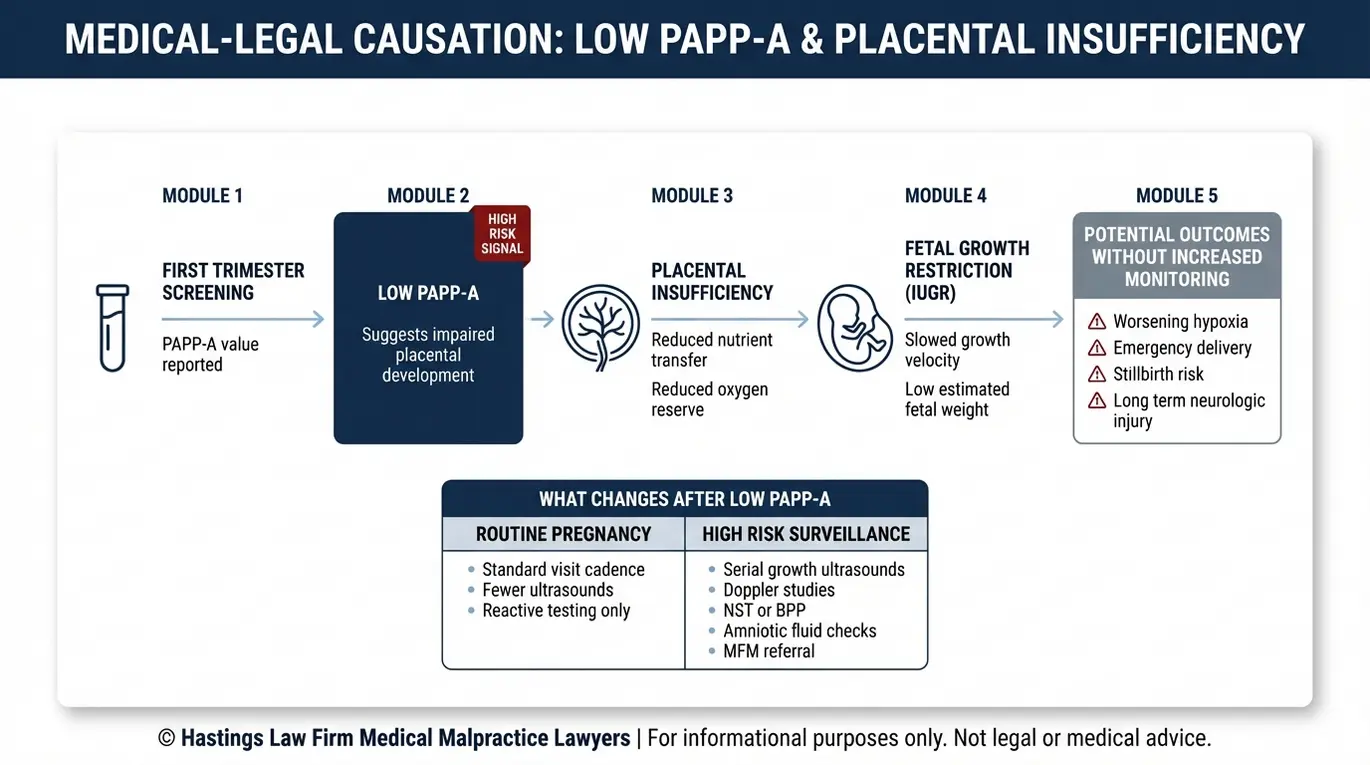
A low PAPP-A finding should trigger a specific clinical response, including:
- Reclassifying the pregnancy as high risk
- Ordering serial growth ultrasounds to track fetal development
- Planning for Doppler flow studies to assess blood supply through the umbilical cord
- Increasing the frequency of prenatal visits
- Considering referral to a maternal-fetal medicine specialist
If a provider does not act on this data, the baby may fall behind in growth without proper monitoring in place to catch it. As a Texas IUGR negligence lawyer, our firm works with medical experts to determine whether this kind of gap in care caused a preventable injury. Families across Texas dealing with this diagnosis need a placental insufficiency lawyer Texas trusts to understand both the medicine and the law.
Texas Standard of Care for Monitoring High-Risk Pregnancies
Once a low PAPP-A result is recorded, the standard of care for IUGR generally requires serial growth ultrasounds, umbilical artery Doppler flow studies, and regular fetal monitoring to track the baby’s oxygenation and growth velocity. Our founder, Tommy Hastings, is Board Certified in Personal Injury Trial Law, a distinction held by fewer than 2% of Texas attorneys. This expertise ensures a rigorous review of whether oxygenation and growth velocity were properly managed.
Referral to a Specialist
An OB/GYN malpractice attorney Texas families trust will examine whether the patient was referred to a Maternal-Fetal Medicine specialist (MFM), a physician with advanced training in managing complicated pregnancies. An MFM can coordinate the surveillance plan, interpret complex test results, and make delivery timing decisions when growth restriction is confirmed. Failure to refer, or a significant delay in referral, may suggest a breach of the standard of care.
Surveillance Protocols
According to ACOG Practice Bulletin No. 227 on Fetal Growth Restriction, pregnancies complicated by suspected or confirmed IUGR require structured, ongoing surveillance. A monitoring protocol is a structured plan used to track fetal health throughout the pregnancy. The specific tools and their frequency depend on the severity and gestational age, but the protocol typically includes the following:
- Growth ultrasounds every 3 to 4 weeks to measure the baby’s estimated fetal weight and compare it to expected growth curves
- Umbilical artery Doppler flow studies, which measure blood flow resistance in the cord to detect early signs that the baby is not receiving enough oxygen
- Weekly nonstress tests (NSTs) in the third trimester to evaluate the baby’s heart rate patterns
- Amniotic fluid measurement to assess whether the baby’s environment is adequate
- Biophysical profiles (BPPs) that combine ultrasound observation with heart rate monitoring for a more complete picture
Why Doppler Studies Matter
Umbilical artery Doppler flow studies, a specialized ultrasound that evaluates how blood moves between the placenta and the baby, are among the most important tools for detecting fetal compromise. Doppler studies are specialized ultrasounds used to evaluate blood flow between the mother and the baby. Abnormal Doppler readings, such as absent or reversed end-diastolic flow, can signal that the baby is in distress and may need immediate delivery. When these studies are not ordered despite clear risk factors, the clinical team may miss the window for safe intervention.
An OB/GYN malpractice attorney in Texas will examine whether each of these monitoring steps was followed, delayed, or skipped. Our team reviews the full medical record, including ultrasound reports, fetal monitoring strips, and provider notes, to identify where the standard of care broke down.
The Hastings Law Firm Difference
Results matter, but what truly sets us apart is how we achieve them. Every verdict, every settlement, and every Texas courtroom victory comes from one guiding promise: To treat each client’s fight for justice as if it were our own.
This balance of skill, experience, and empathy reflects our core philosophy that justice should not only compensate the injured, but also make healthcare safer nationwide.

Proving Negligence When IUGR Is Mismanaged or Undiagnosed
Proving medical negligence in these cases requires showing that the physician failed to increase monitoring frequency despite the low PAPP-A warning, and that this failure resulted in a missed diagnosis of growth restriction leading to hypoxia, brain injury, stillbirth, or wrongful death.
As a Texas Low PAPP-A IUGR negligence lawyer, our firm builds each case by establishing four elements: a duty of care existed, that duty was breached, the breach caused harm, and the harm produced measurable damages. Under Texas Civil Practice and Remedies Code, Chapter 74, medical malpractice claims require a qualified expert report early in the litigation process. This Chapter 74 requirement makes the strength of the medical evidence critical from the outset.
Failure to Act on Known Risk
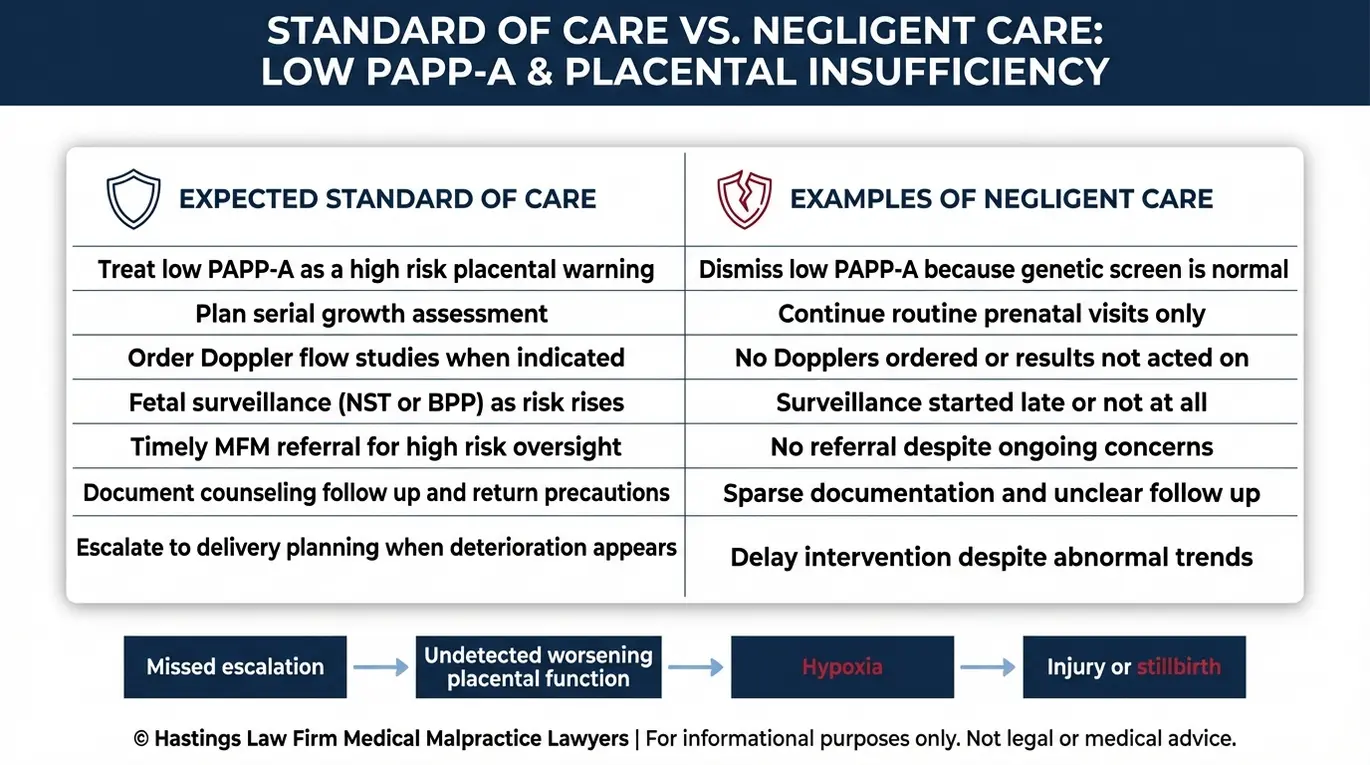
The specific error we often evaluate in failure to diagnose IUGR Texas cases is whether prenatal visits remained routine despite abnormal first-trimester screening. When a low PAPP-A result is documented in the chart but no enhanced monitoring plan follows, the gap between what the provider knew and what the provider did becomes the foundation of liability. We examine lab reports, visit notes, and referral records to determine whether the risk was acknowledged and acted upon.
| Standard of Care (High-Risk Protocol) | Potential Negligence (Missed Care) |
|---|---|
| :— | :— |
| Reclassifying pregnancy as high-risk | Maintaining “routine” low-risk schedule |
| Ordering serial growth ultrasounds | Failing to order follow-up imaging |
| Performing Doppler flow studies | Ignoring need for blood flow analysis |
| Referring to Maternal-Fetal Medicine | Managing complex risk without a specialist |
| Timely delivery interventions | Delaying delivery despite warning signs |
Symmetric vs. Asymmetric Growth Restriction
Medical teams use growth patterns to identify whether placental insufficiency is the primary cause of restricted growth. Asymmetric fetal growth restriction, where the baby’s body falls behind but the head circumference is initially preserved, typically indicates the placenta has lost the ability to deliver adequate nutrients and oxygen. Symmetric restriction, where all measurements are proportionally small, may point to earlier-onset causes. These distinctions help us determine when delivery should have occurred and what the provider should have recognized.
Connecting the Failure to the Injury
Establishing a direct link between the missed monitoring and the child’s injury is necessary for a malpractice claim. We work with medical experts to determine if the standard of care required earlier detection through proper surveillance. PAPP-A levels are often reported as a Multiple of the Median (MoM), a statistical measure comparing the patient’s result to the expected median for that gestational age. A MoM below 0.4 is a recognized red flag that, if acted upon, can change the trajectory of the pregnancy.
Overcoming the Constitutionally Small Defense
Defense attorneys in IUGR cases frequently argue that the baby was simply genetically predisposed to be small. This is often referred to as being Small for Gestational Age (SGA), meaning the baby was naturally smaller rather than restricted due to placental failure. Overcoming this defense requires strong medical evidence.
Our experts analyze growth velocity trends, placental pathology reports, and Doppler findings to distinguish between a healthy small baby and one whose growth was stunted by an inadequate placenta. A baby with asymmetric growth restriction and abnormal cord blood flow is not simply small; that baby was in distress. We use expert witnesses to evaluate developmental delays and postnatal outcomes consistent with chronic oxygen deprivation rather than genetic size variation.
Legal Remedies for Birth Injuries Caused by Placental Insufficiency
Families may recover compensation for past and future medical care, specialized therapies, lost earning capacity, and pain and suffering if a preventable birth injury resulted from mismanaged IUGR. The scope of an IUGR malpractice settlement depends on the severity of the child’s condition and the lifetime costs associated with it.
Recoverable Damages in Texas
When seeking birth injury compensation Texas laws permit recovery in both economic and non-economic damages categories:
- Past and future medical expenses, including hospitalizations, surgeries, medications, and specialist visits
- Rehabilitative therapies such as physical, occupational, and speech therapy
- Assistive equipment and home modifications needed for daily living
- Special education and developmental support services
- Lost earning capacity if the child’s injuries limit future employment
- Pain, suffering, and physical impairment experienced by the child
- Mental anguish and loss of companionship for the parents
For children diagnosed with cerebral palsy, hypoxia-related brain injury, or severe developmental delays, these costs often span an entire lifetime. A life care plan projects the full financial burden so that any recovery reflects the actual cost of care rather than an arbitrary number. This plan accounts for inflation, necessary home modifications, future surgeries, and the loss of potential income to ensure the settlement covers the child’s needs for decades.
How Settlements Are Calculated
Calculating a settlement involves projecting the total lifetime care costs over the child’s life. Damages for prenatal negligence cases are calculated based on what a jury would likely award if the case went to trial. Our trial-ready approach means every case is built with that standard in mind. Texas does impose caps on non-economic damages in medical malpractice cases under Texas House Bill Four. Economic damages are not capped, which makes thorough documentation of lifetime care costs essential to maximizing the total recovery.
Contact the Texas Birth Injury Attorneys at Hastings Law Firm Today for Help
If your child suffered a birth injury after a low PAPP-A result was overlooked or ignored, you deserve to know what happened and whether it could have been prevented. Our medical malpractice law firm Texas team was built specifically for cases like these.
Founded by Board Certified attorney Tommy Hastings in 2005, our firm manages every case with a trial-ready strategy. Our staff includes former defense attorneys and in-house medical staff who review your records with the clinical knowledge needed to find answers. We prepare every case as though it is going to trial, because that preparation is what drives fair outcomes for our clients.
The consultation is free and confidential. We work on a contingency fee basis, so you pay no attorney fees or costs unless we recover compensation for your family. Call us today or request a case evaluation online. Let us help you understand your options.
Frequently Asked Questions About Low PAPP-A IUGR Negligence in Texas


This content was researched and written by the Hastings Law Firm editorial team, which includes attorneys, medical professionals, and experienced researchers. Our writing is informed by internal knowledge and practical experience, and we cross-check critical details against authoritative sources cited throughout. Every piece undergoes human-led fact-checking and legal review. Because legal and medical information can change, if you spot an error, please contact us. Learn more about our content standards and review process on our editorial policy page.

Tommy Hastings, founder of Hastings Law Firm, is a board-certified personal injury trial lawyer dedicated exclusively to healthcare injury cases. Since 2001, he has represented injured patients and families in litigation against major hospital systems, pharmaceutical companies, and negligent healthcare providers nationwide. He has handled numerous high-profile cases that have drawn national media attention and resulted in multi-million dollar recoveries. He draws on that experience in his writing, helping readers understand how these cases work and what options may be available to them.
