


Texas Home Birth Negligence Lawyer
Written by: Hastings Law Firm | Reviewed by: Tommy Hastings | Updated: July 27, 2026
Home birth negligence can leave families facing profound grief, uncertainty, and long term medical needs when a licensed provider fails to meet accepted standards of care. In Texas, concerns often focus on missed warning signs, inadequate fetal monitoring, poor documentation, and delayed hospital transfer when complications arise. Understanding how liability works for midwives, birthing centers, and other responsible parties can clarify what went wrong and what accountability may look like. If you or a loved one were harmed or worse due to home birth negligence in Texas, contact Hastings Law Firm for a free, confidential case review.

Trusted Advocacy for Home Birth Negligence in Texas
What You Should Know About Home Delivery Malpractice Claims in Texas:
- Severe and lasting harm can result when emergency intervention is not available quickly during a home birth.
- Accountability can be harder to secure when a private midwife has limited or no malpractice coverage.
- Options for recovery can depend on whether liability extends beyond an individual midwife to a birthing center or supervising physician.
- A waiver or consent form may not block a claim when the harm is tied to substandard care or recklessness.
- The most serious disputes often focus on delayed or absent hospital transfer when complications arise.
- Proving a claim can hinge on showing a direct causal link between the provider conduct and the child injury.
- Compensation can cover both financial losses and nonfinancial harms tied to a child permanent injury.
- Recovery can be limited if filing deadlines are missed, including different timing rules for minors and parents.
- Access to key evidence can be affected when midwife charting is less detailed than hospital records.
- Medical records and expert review can be central when evaluating fetal monitoring, warning signs, and the timeline of care.

A Healthcare Focused Law Firm
A planned home birth, one where a family intentionally chooses to deliver outside a hospital under the care of a licensed provider, is a deeply personal decision. For many families, it follows careful screening to confirm low-risk pregnancy criteria, the health benchmarks indicating an out-of-hospital delivery is a reasonable option.
When something goes wrong during that delivery, the emotional weight can be overwhelming. You trusted a provider with your family’s safety, and now you may be left with more questions than answers.
A Texas home birth negligence lawyer can help you understand what happened and whether the care you received fell below the standard your family deserved. At Hastings Law Firm, our team of attorneys, in-house nurses, and medical consultants focuses exclusively on medical malpractice. If your child was injured during a home birth, we can review the circumstances and explain your legal options at no cost and with no obligation.
Understanding Liability and Midwife Negligence in Texas
Midwife negligence occurs when a provider fails to follow the accepted standard of care during a home birth, such as failing to monitor fetal vitals or delaying a necessary hospital transfer. In Texas, a licensed midwife (LM), a practitioner authorized by the state to attend out-of-hospital births, owes the same legal duty of competent care as other healthcare providers.
The standard of care for midwives includes continuous risk assessment, appropriate fetal monitoring to prevent fetal monitoring errors, and having a hospital transfer protocol, which is a predetermined emergency plan for moving the mother and baby to a hospital when complications arise. These duties are outlined through training requirements and practice standards overseen by the Texas Department of Licensing and Regulation.
In many cases of negligence in home births, the core failure involves a delayed or absent decision to transfer to a hospital. When labor and delivery complications develop, such as signs of fetal distress, abnormal bleeding, or a breech presentation, the midwife’s responsibility is to recognize those signs and act on them.
A legal difference exists between suing a hospital and suing a private midwife or birthing center. Hospitals carry institutional liability and typically have malpractice insurance. A private midwife may operate independently, sometimes with limited or no malpractice coverage, which can affect how a claim is pursued. A home birth injury attorney understands these differences and can identify every responsible party.
Red flags that may indicate negligence in a home birth include:
- Failure to monitor fetal heart rate at appropriate intervals
- Ignoring signs of maternal hemorrhage or fetal distress
- Continuing a home delivery after risk factors become apparent
- No written or practiced hospital transfer plan
- Inadequate documentation of labor progress and maternal vitals
If any of these issues occurred during your delivery, a lawyer for home birth negligence can evaluate whether the provider’s actions fell below the legal standard. Our team includes former defense attorneys and in-house medical staff who know exactly what to look for in the clinical record.

Common Preventable Injuries Associated with Home Births
Severe injuries in home birth settings often stem from a lack of immediate emergency intervention, leading to conditions like hypoxic-ischemic encephalopathy (HIE), a type of brain damage caused by oxygen deprivation during or around the time of birth, or cerebral palsy resulting from prolonged oxygen loss.
A study indexed through the National Library of Medicine (PubMed) comparing planned hospital births with planned home births has examined the differences in outcomes when emergency resources are not immediately available. A Texas home birth lawyer often finds that the gap between recognizing a problem at home and reaching a hospital operating room is where the most serious harm occurs. An attorney for home birth injuries knows that severe injuries are often preventable.
Common preventable injuries a negligence lawyer investigates include Brachial plexus injury, a nerve injury to the baby’s arm caused by shoulder dystocia, and:
| Injury | Common Cause |
|---|---|
| Hypoxia / Birth Asphyxia | Failure to detect fetal distress signals without continuous monitoring equipment |
| HIE (Hypoxic-Ischemic Encephalopathy) | Prolonged oxygen deprivation due to delayed hospital transfer |
| Brachial Plexus Injury (Erb’s Palsy) | Improper maneuvering during shoulder dystocia, a nerve injury to the baby’s arm and shoulder caused by excessive force or incorrect technique during a difficult delivery |
| Brain Injury / Cerebral Palsy | Extended time gap between complication onset and emergency C-section |
| Infant Wrongful Death | Failure to act on known risk factors or transfer in time |
Establishing a causal link between the midwife’s conduct and the child’s injury is central to birth injury lawsuits. Under Texas Civil Practice and Remedies Code Chapter 74, medical negligence claims require proof that the provider’s failure directly caused or contributed to the harm. A home birth negligence lawyer works with obstetric and neonatal experts to reconstruct the timeline and determine whether earlier intervention would have changed the outcome.
The Hastings Law Firm Difference
Results matter, but what truly sets us apart is how we achieve them. Every verdict, every settlement, and every Texas courtroom victory comes from one guiding promise: To treat each client’s fight for justice as if it were our own.
This balance of skill, experience, and empathy reflects our core philosophy that justice should not only compensate the injured, but also make healthcare safer nationwide.

Calculating Compensation and Damages for Injured Children
Texas law allows recovery for both economic damages, such as lifetime medical care, and non-economic damages like pain and suffering, to help ensure the child’s future is secure.
When a child is permanently injured due to negligence during a home birth, the financial reality can be staggering. A Texas home birth negligence lawyer works with life care planners, economists, and medical specialists to document the full scope of what your family will need. Our founder, Tommy Hastings, is board-certified in Personal Injury Trial Law, a distinction held by very few Texas attorneys. A home birth malpractice lawyer ensures we account for needs across the child’s lifetime.
Recoverable damages in a home birth malpractice case may include:
- Past and future medical expenses: Surgeries, hospitalizations, therapy, medications, assistive devices, and ongoing specialist care
- Life care planning costs: A structured projection of all medical, therapeutic, and support needs over the child’s expected lifespan
- Lost earning capacity: Compensation reflecting the income and opportunities the child may never have due to their injuries
- Pain and suffering: Recognition of the physical pain the child has endured and will continue to experience
- Emotional distress: Damages for the psychological toll on both the child and the family
- Lost wages for parents: If a parent must reduce or leave employment to serve as a caregiver
Every case is different, and a lawyer for negligence knows that the value of a settlement or verdict depends on the severity of injury, the strength of the evidence, and the long-term prognosis. Our attorney team prepares each case with the detail and rigor needed to present a full picture of damages, whether at the negotiation table or before a jury.
The Legal Process of Investigating Home Birth Claims
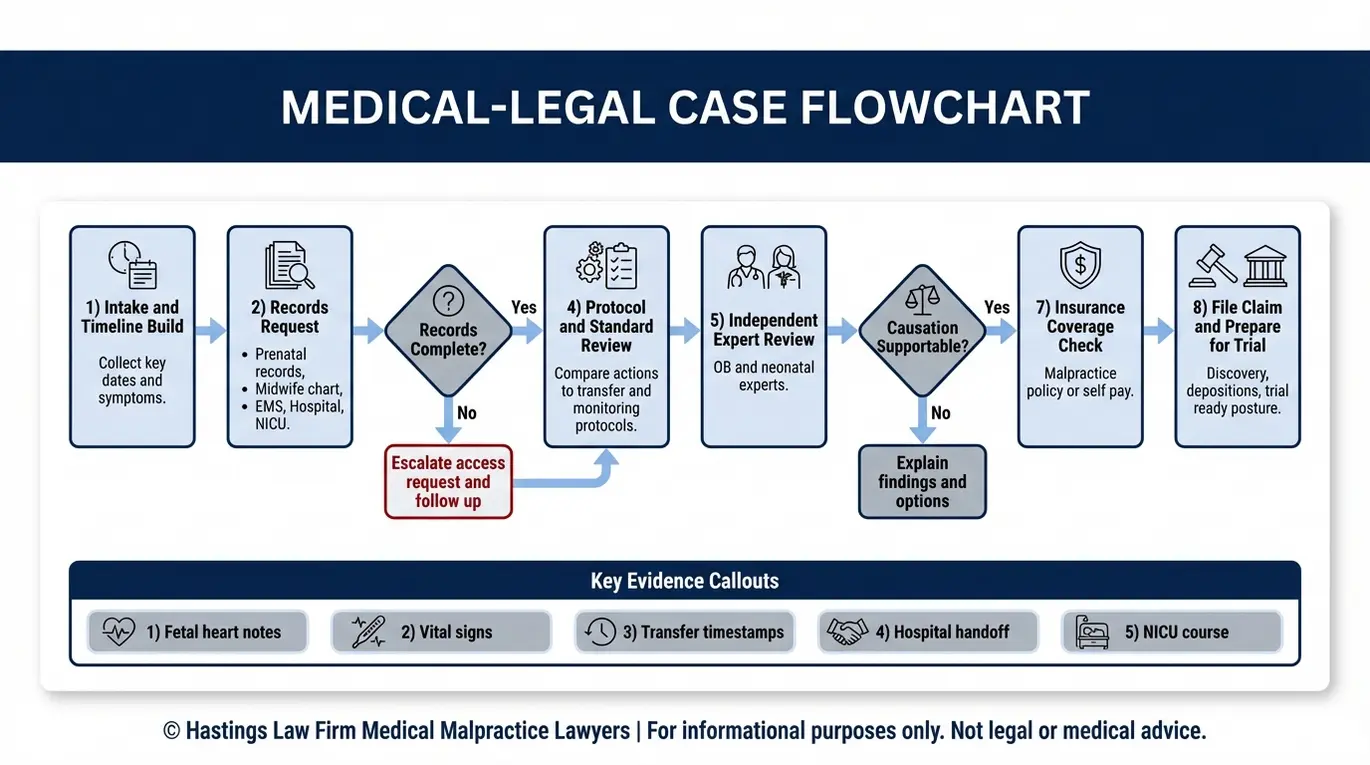
A thorough investigation involves securing prenatal records, analyzing the midwife’s notes against transfer protocols, and consulting with obstetric experts to establish causation. Here is how our home birth legal team at Hastings Law Firm approaches these cases:
- Step 1: Securing and preserving records. Midwives often maintain less detailed charting than hospitals. Your lawyer will move quickly to obtain all prenatal records, birth notes, and communication logs. Under federal law, families have the right to access their own health information as outlined by the U.S. Department of Health and Human Services’ HIPAA access guidance. We also look for fetal heart rate (FHR) monitoring, the tracking of the baby’s heart beats during labor, including any records of intermittent auscultation, where a provider periodically listens to the baby’s heartbeat rather than using continuous electronic monitoring.
- Step 2: Expert medical review. A birth injury attorney works with our national expert network including board-certified obstetricians, neonatologists, and certified nurse-midwives who review the clinical evidence. We secure testimony from an expert witness to evaluate whether the provider recognized warning signs and whether a competent midwife would have acted differently.
- Step 3: Addressing malpractice insurance and liability. Some midwives carry malpractice insurance; others do not. We identify all potential sources of recovery early, including whether a birthing center or supervising physician shares liability.
- Step 4: Filing and litigation. If the evidence supports a claim, your Texas home birth negligence lawyer handles all filings, depositions, and discovery. Because we prepare for complex litigation as though it will go to trial, your Texas birth injury lawyer negotiates from a position built on thorough preparation.
Statute of Limitations for Texas Birth Injury Cases
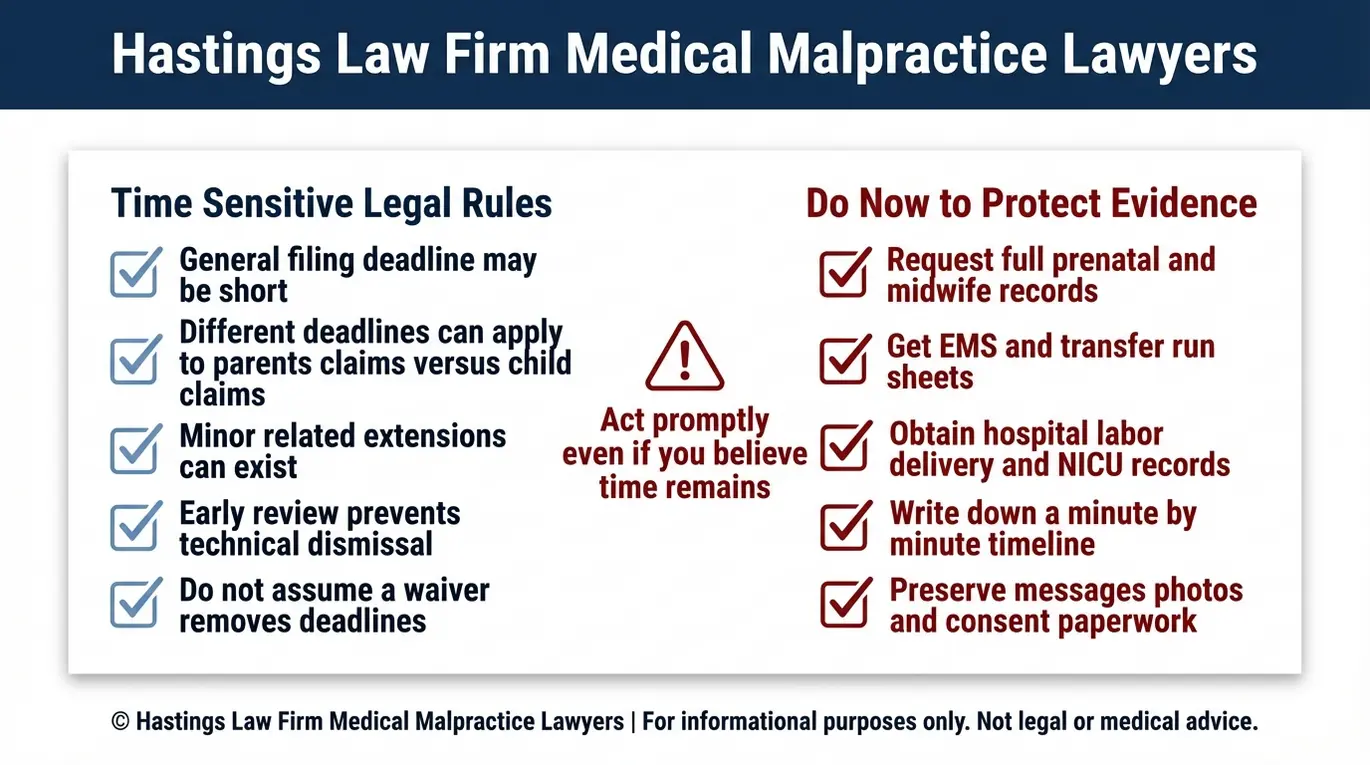
Generally, Texas law requires medical malpractice claims to be filed within two years, but specific exceptions exist for minors that can extend this deadline significantly. Under Texas Civil Practice and Remedies Code § 74.251, this statute of limitations is the standard filing deadline.
However, a minor statute of limitations rule often allows a child injured at birth until their 14th birthday to file. Parents’ personal claims typically remain bound by the two-year limit.
Prompt action is necessary to preserve records. An attorney can secure evidence before it is lost. Contact a negligence lawyer or Texas home birth negligence lawyer today to protect your case.
Contact the Texas Birth Injury Attorneys at Hastings Law Firm Today for Help
Your birth plan may have changed in ways you never expected, but your family’s right to answers and accountability has not.
At Hastings Law Firm, we represent families across Texas and nationwide who have been harmed by medical negligence. Our team of trial attorneys, in-house nurses, and medical consultants has the experience to investigate what happened during your home birth and determine whether your child’s injuries were preventable.
We operate on a contingency fee basis, meaning you pay no attorney fees or costs unless we recover compensation for your family. If you believe a midwife or birth provider’s negligence caused your child’s injury, a Texas home birth negligence lawyer at our firm is ready to listen.
Contact us for a free, confidential case evaluation. Let a lawyer help you find the answers your family deserves.
Frequently Asked Questions About Home Birth Negligence in Texas


This content was researched and written by the Hastings Law Firm editorial team, which includes attorneys, medical professionals, and experienced researchers. Our writing is informed by internal knowledge and practical experience, and we cross-check critical details against authoritative sources cited throughout. Every piece undergoes human-led fact-checking and legal review. Because legal and medical information can change, if you spot an error, please contact us. Learn more about our content standards and review process on our editorial policy page.

Tommy Hastings, founder of Hastings Law Firm, is a board-certified personal injury trial lawyer dedicated exclusively to healthcare injury cases. Since 2001, he has represented injured patients and families in litigation against major hospital systems, pharmaceutical companies, and negligent healthcare providers nationwide. He has handled numerous high-profile cases that have drawn national media attention and resulted in multi-million dollar recoveries. He draws on that experience in his writing, helping readers understand how these cases work and what options may be available to them.
