


Texas Misread Non-Stress Test Lawyer
Written by: Hastings Law Firm | Reviewed by: Tommy Hastings | Updated: July 27, 2026
Fetal monitoring is often the main way a care team detects when a baby is not getting enough oxygen during pregnancy or labor. When a non stress test or continuous electronic fetal monitoring strip is misread or ignored, critical warning signs can be missed and the result can be permanent injury and lifelong care needs. Understanding how these strips are interpreted and where communication can break down helps families make sense of what happened. If you or a loved one were harmed or worse due to fetal monitoring errors in Texas, contact Hastings Law Firm for a free, confidential case review.

Top Rated Texas Birth Injury Attorneys for Fetal Monitoring Errors
What You Should Know About Fetal Heart Trace Error Claims in Texas:
- Lifelong disability can result when fetal distress is misread or ignored and oxygen deprivation is prolonged.
- Permanent brain injury is a stated risk when non reassuring fetal heart rate patterns are not recognized and acted on promptly.
- Severe outcomes are linked to hypoxia and can include Hypoxic Ischemic Encephalopathy and Cerebral Palsy.
- Hospital liability can be implicated when communication breaks down between labor nurses and physicians after concerning tracings are identified.
- Options can be lost if Texas expert report requirements are not met because courts can dismiss the case.
- Recovery can be limited for non economic losses in Texas because state law caps certain categories of damages.
- Future care costs can drive the largest financial impact because economic damages for medical expenses and future care needs are not capped in Texas.
- Key evidence can be central in disputes because fetal heart rate strips and related records may be the main window into fetal status and provider response.

A Healthcare Focused Law Firm
When your baby’s health depended on someone reading a monitor correctly, learning that it may not have happened is deeply unsettling. You trusted your medical team to watch the signs, respond quickly, and protect your child. If that trust was broken, the confusion and grief that follow can feel impossible to sort through on your own.
Hastings Law Firm represents families across Texas and nationwide whose infants suffered preventable injuries because fetal monitoring strips were misread or ignored. As a firm built entirely around medical malpractice, our team of attorneys, in-house nurses, and former defense lawyers understands how to investigate these cases from the inside out. If you need a Texas misread non-stress test lawyer, we can review what happened during your care and explain your legal options at no cost to you.
Understanding the Non Stress Test and Electronic Fetal Monitoring
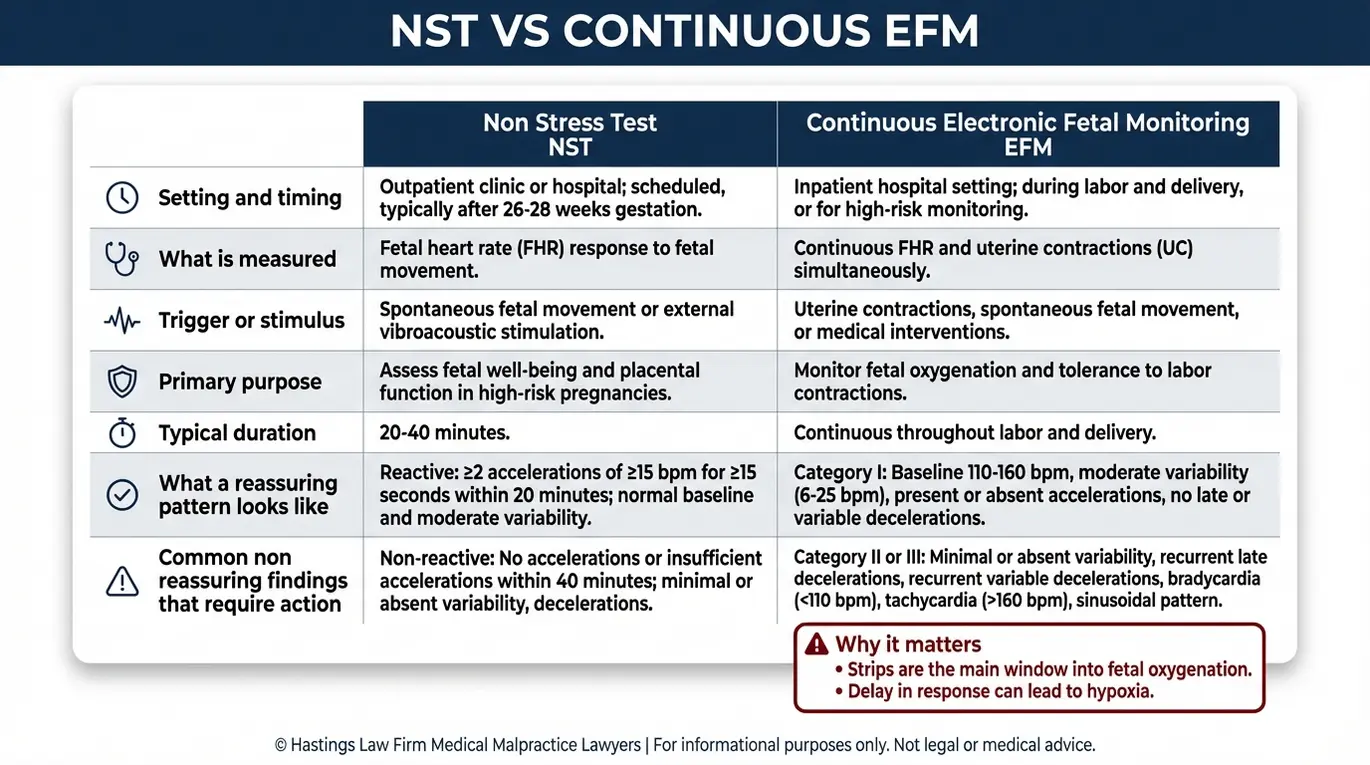
A Non-Stress Test (NST) and Electronic Fetal Monitoring (EFM) are diagnostic tools used to track a baby’s heart rate in response to movement or contractions, helping the care team confirm the baby is receiving enough oxygen. While both involve fetal heart rate monitoring, they are used in different clinical settings and serve distinct purposes.
A Non-Stress Test, a short prenatal screening typically performed in a clinic or office, records the baby’s baseline heart rate and looks for accelerations. These accelerations are temporary increases in heart rate that occur when the baby moves. A reactive result, meaning two or more accelerations within 20 minutes, is generally a sign of fetal well-being. A non-reactive result means those accelerations were absent, which may require further evaluation.
Electronic fetal monitoring, the continuous tracking of a baby’s heart rate alongside uterine contractions during labor and delivery, offers a dynamic view of fetal health. Unlike the snapshot an NST provides, continuous EFM produces an ongoing record that labor nurses and physicians must interpret in real time as labor progresses.
Both tools produce fetal heart rate strips, and these strips are often the only window the medical team has into how a baby is tolerating pregnancy or labor. Because the fetus cannot communicate pain or distress verbally, the medical team must rely on these visual data points to make critical decisions. These decisions involve the safety of continuing the pregnancy or the need for immediate delivery. A misread non-stress test attorney or fetal monitoring lawyer investigates whether the care team correctly interpreted those strips and responded appropriately.
| Feature | Non-Stress Test (NST) | Continuous Electronic Fetal Monitoring (EFM) |
|---|---|---|
| Setting | Prenatal clinic or office visit | Labor and delivery unit |
| Timing | Usually 20–40 minutes | Continuous throughout labor |
| What It Tracks | Fetal heart rate and movement | Fetal heart rate and uterine contractions |
| Purpose | Screen for fetal well-being before labor | Monitor how the baby tolerates labor in real time |
| Key Indicator | Reactive vs. non-reactive result | Reassuring vs. non-reassuring patterns |
According to MedlinePlus, the NST is one of the most common prenatal tests and carries no physical risk to the mother or baby.
How Medical Providers Negligently Misread Fetal Heart Rate Strips
Medical negligence in fetal monitoring occurs when doctors or nurses fail to identify or respond to non-reassuring patterns on a strip, such as late decelerations or minimal variability, leading to preventable oxygen deprivation. These errors can happen during a prenatal NST or during continuous monitoring in labor, and the consequences can be severe.
Fetal heart rate variability, the normal, small fluctuations in the baby’s heart rate from one beat to the next, indicates that the baby’s nervous system is functioning well. When the strip shows a “flat” line with minimal or absent variability, it can indicate the baby’s brain is not getting enough oxygen. This is one of the most significant warning signs a provider can miss.
Late decelerations, drops in the baby’s heart rate that begin at or after a contraction peaks and recover slowly, suggest the placenta may not be delivering adequate blood and oxygen. This condition is known as placental insufficiency. A single late deceleration may warrant close observation, but recurrent late decelerations demand immediate action.
Other red-flag signals on a fetal heart rate strip include:
- Variable decelerations: Abrupt drops in heart rate that may indicate umbilical cord compression.
- Bradycardia: A sustained fetal heart rate below 110 beats per minute.
- Tachycardia: A sustained heart rate above 160 beats per minute, which can signal infection or distress.
- Loss of accelerations: The absence of heart rate increases with fetal movement, suggesting compromised well-being.
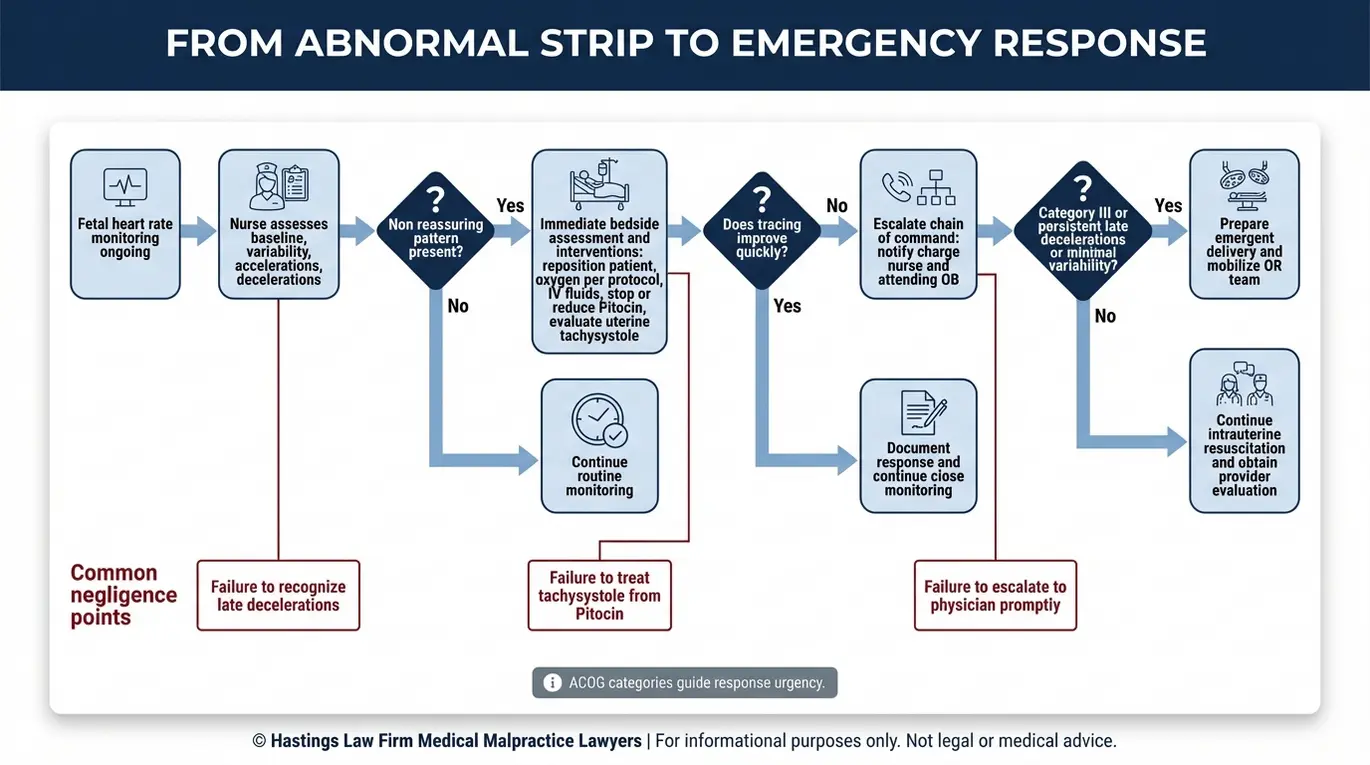
Pitocin, a synthetic form of oxytocin used to induce labor, can cause uterine tachysystole, or overly frequent contractions, if dosed improperly. When contractions come too close together, the baby does not get enough recovery time between them, and the oxygen supply can drop dangerously.
Labor and delivery nurses are often the first line of defense. They are responsible for reading the strips in real time and escalating concerns up the chain of command to the attending OB-GYN. When a nurse identifies non-reassuring patterns but fails to notify the physician, or when a physician is notified but does not respond, the breakdown in communication can lead to injury.
A lawyer for a misread NST or a Texas fetal strip attorney will examine the timeline of these events closely. We look at who saw what, when they saw it, and whether anyone acted on it.
The ACOG Framework: Category I, II, and III Tracings
The American College of Obstetricians and Gynecologists (ACOG) established a three-tier classification system that defines the standard of care for interpreting fetal heart rate strips. This framework helps medical teams evaluate fetal heart rate patterns to decide when intervention is necessary.
Category I tracings are normal. They show a stable baseline, moderate variability, and no significant decelerations. These require only routine monitoring.
Category II fetal heart rate tracings, indeterminate patterns that do not clearly fit into the normal or abnormal category, require close surveillance and continued evaluation. Most tracings during labor fall into Category II. Deciding how aggressively to respond requires clinical judgment.
Category III fetal heart rate tracings, abnormal patterns that include absent variability combined with recurrent late or variable decelerations or sustained bradycardia, require immediate intervention. This may include an emergency C-section. When a provider fails to recognize a Category III tracing or delays delivery, that failure can form the basis of a claim.
The Hastings Law Firm Difference
Results matter, but what truly sets us apart is how we achieve them. Every verdict, every settlement, and every Texas courtroom victory comes from one guiding promise: To treat each client’s fight for justice as if it were our own.
This balance of skill, experience, and empathy reflects our core philosophy that justice should not only compensate the injured, but also make healthcare safer nationwide.

The Severe Consequences of Ignored Fetal Distress
When fetal distress is ignored due to misinterpretation, the infant can suffer prolonged oxygen deprivation, a condition known as hypoxia, resulting in permanent brain damage called Hypoxic-Ischemic Encephalopathy (HIE) or Cerebral Palsy.
The developing brain is extraordinarily sensitive to oxygen loss. Research published in PubMed Central confirms that birth asphyxia is associated with increased risk of cerebral palsy. This reinforces what families and clinicians have long understood: minutes matter. A delay of even 10 minutes in ordering a cesarean delivery when a baby is in distress can mean the difference between a healthy outcome and a lifelong disability.
Hypoxia, or oxygen deprivation, triggers a cascade of damage in the brain. Hypoxic-Ischemic Encephalopathy (HIE) occurs when that oxygen loss is severe enough to destroy brain cells. The extent of the injury depends on how long the deprivation lasted and how quickly it was addressed. Some infants with HIE experience seizures within hours of birth. Others may not show symptoms until developmental milestones are missed later.
Cerebral Palsy is one of the most common long-term outcomes of birth-related oxygen deprivation. It affects muscle control, coordination, and movement. Its severity ranges from mild motor difficulties to a complete inability to walk, speak, or care for oneself. Adaptive devices, such as wheelchairs and communication boards, become essential tools for daily living.
Meconium-stained amniotic fluid, which occurs when a baby passes its first stool before delivery, can compound the danger if aspirated into the lungs. This often happens as a stress response to hypoxia.
For families, the long-term impact is profound. Children with severe HIE or cerebral palsy may require 24/7 custodial care and specialized equipment. They often need physical and occupational therapy for the rest of their lives. The financial and emotional burden is enormous, and it is why families turn to a Texas misread non-stress test lawyer to pursue accountability.
Proving Malpractice: The Role of Expert Testimony in Texas
Texas law requires a plaintiff to produce an expert report from a qualified physician that specifically details how the defendant breached the standard of care and how that breach directly caused the infant’s injury. This requirement, codified in Texas Civil Practice and Remedies Code Chapter 74, sets strict deadlines and high evidentiary standards for medical malpractice claims.
Under Chapter 74, you must serve a written expert report within 120 days after the date each defendant’s original answer is filed. If this deadline is missed, the court can dismiss the case. The report must come from a physician who practices in a similar field as the defendant. It must identify the specific standard of care violated and how that breach caused the injury.
For a misread fetal monitor lawyer building a case, the investigation process typically follows these steps:
- Obtain and preserve all medical records, including the fetal heart rate strips, nursing notes, medication logs, physician orders, and delivery summaries.
- Engage qualified maternal-fetal medicine or OB-GYN experts to perform a retrospective strip-by-strip analysis of the tracings.
- Reconstruct a minute-by-minute timeline showing when non-reassuring patterns appeared and what actions were or were not taken in response.
- Identify each provider’s role and responsibility, as the duty for nursing staff differs from the duty for physicians.
At Hastings Law Firm, our in-house nursing staff and medical consultants work alongside our attorneys and national expert network to evaluate these cases before we ever file a claim. We understand how the other side will try to reframe the strip interpretation, and we prepare for that from day one.
Uterine tachysystole, the condition caused when Pitocin overstimulates the uterus, is another area we examine closely. If the strip shows excessive contractions and no adjustment to the Pitocin drip occurs, that failure may constitute a breach of the standard of care.
Damages Recoverable for Birth Injuries in Texas
Families can recover economic damages for past and future medical bills, lost earning capacity, and custodial care, as well as non-economic damages for pain, suffering, and physical impairment, subject to state caps on certain categories. Understanding how Texas law distinguishes between these two types of damages is essential for families evaluating their legal options.
Economic damages cover the actual, measurable financial costs associated with the child’s injury. In severe birth injury cases, these costs are often calculated through a Life Care Plan. This plan is a detailed projection of every medical and therapeutic service the child will need.
Life care plans in these cases can reach into the millions of dollars. These assessments account for inflation and the escalating nature of future medical costs. This ensures the settlement remains adequate decades down the line. Texas does not cap economic damages for medical expenses or future care needs.
Non-economic damages compensate for losses that are real but harder to quantify. These include physical pain, emotional suffering, and loss of enjoyment of life. Under Chapter 74, these damages are capped at $250,000 per claimant against all individual healthcare providers combined and $250,000 per claimant per healthcare institution, with a maximum of $500,000 across multiple institutions.
| Category | What It Covers | Cap in Texas |
|---|---|---|
| Economic Damages | Medical bills, future care costs, custodial care, lost earning capacity, Life Care Plan costs | No cap |
| Non-Economic Damages | Pain and suffering, physical impairment, mental anguish, loss of companionship | $250,000 against all physicians; $250,000 per institution (up to $500,000); aggregate ~$750,000 |
The goal in every birth injury case is to secure the financial resources necessary to provide the child with the highest quality of life possible.

Contact the Texas Birth Injury Attorneys at Hastings Law Firm Today for Help
If you believe your child was harmed because a fetal monitoring strip was misread or ignored, Hastings Law Firm is here to help you find answers. Our founder, Tommy Hastings, is board-certified in personal injury trial law, a distinction held by less than 2% of Texas attorneys.
Our team includes in-house nurses, former defense lawyers, and a national network of medical experts. We understand the medicine, and we know how to present it to a jury. Every case is prepared as if it is going to trial, as this preparation drives results.
There is no cost to speak with us. We work on a contingency fee basis, meaning you pay no attorney fees or costs unless we secure a recovery for your family. Our team helps families in Houston, Dallas, Austin, and throughout the United States.
Contact Hastings Law Firm today for a free consultation. Let us review your records and help you work through what happened.
Frequently Asked Questions About Misread Non-Stress Test in Texas


This content was researched and written by the Hastings Law Firm editorial team, which includes attorneys, medical professionals, and experienced researchers. Our writing is informed by internal knowledge and practical experience, and we cross-check critical details against authoritative sources cited throughout. Every piece undergoes human-led fact-checking and legal review. Because legal and medical information can change, if you spot an error, please contact us. Learn more about our content standards and review process on our editorial policy page.

Tommy Hastings, founder of Hastings Law Firm, is a board-certified personal injury trial lawyer dedicated exclusively to healthcare injury cases. Since 2001, he has represented injured patients and families in litigation against major hospital systems, pharmaceutical companies, and negligent healthcare providers nationwide. He has handled numerous high-profile cases that have drawn national media attention and resulted in multi-million dollar recoveries. He draws on that experience in his writing, helping readers understand how these cases work and what options may be available to them.
