


Texas Magnesium Sulfate Overdose Lawyer
Written by: Hastings Law Firm | Reviewed by: Tommy Hastings | Updated: July 27, 2026
A magnesium sulfate overdose during labor and delivery can cause rapid, life threatening complications when dosing, IV pump programming, or monitoring breaks down. Because magnesium sulfate is a high alert medication, small mistakes can escalate quickly and the harm may be compounded when early warning signs are missed. Understanding how these errors happen and what records document them can help families make sense of a frightening outcome and identify where safety checks failed. If you or a loved one were harmed or worse due to a magnesium sulfate overdose in Texas, contact Hastings Law Firm for a free, confidential case review.

Top Rated Malpractice Attorneys for Birth Injuries in Texas
What You Should Know About Hypermagnesemia Toxicity Negligence Claims in Texas:
- Life threatening injury can occur when magnesium sulfate dosing or IV pump programming errors deliver an unintended continuous overdose.
- Severe outcomes can become more likely when early toxicity signs are missed, since absent reflexes can be an early warning before respiratory arrest.
- Accountability may extend beyond the initial dosing mistake when staff fail to detect and respond to a patient deterioration during an infusion.
- Recovery options in Texas can be shaped by limits on non economic damages even when long term care needs are extensive.
- Financial losses can remain fully recoverable as economic damages, including medical bills, rehabilitation costs, lost income, and needed home modifications.
- Disputes over what happened can turn on whether high alert medication safeguards were bypassed, including overrides of dispensing cabinet alerts.
- Clarity about the intended dosing schedule can be central when abbreviation confusion leads to extra dosing.
- Proof of what occurred can depend on objective records such as IV pump audit logs, pharmacy records, nursing documentation, physician orders, and lab results.

A Healthcare Focused Law Firm
When a hospital medication error harms someone you love, the shock and confusion can be overwhelming. Magnesium sulfate (MgSO4), a drug commonly used during labor and delivery to manage pre-eclampsia and prevent seizures, is classified as a high-alert medication, meaning even small errors in dosing or administration can cause serious, life-threatening harm. If your family is dealing with the consequences of a magnesium sulfate overdose, you deserve to understand what went wrong and who is responsible.
At Hastings Law Firm, our legal and medical team works together to investigate these cases and hold negligent providers accountable. As a dedicated Texas magnesium sulfate overdose lawyer, we focus exclusively on medical malpractice and bring the clinical insight needed to uncover the truth. Contact us for a free, confidential case evaluation to learn about your options.
How Magnesium Sulfate Overdoses Occur: IV Pump & Dosing Failures
Magnesium sulfate overdoses typically occur due to programmable IV pump errors, decimal point calculation mistakes during mixing, or failure to follow safety protocols when overriding automated dispensing cabinets. This medication is used to prevent seizures in pre-eclampsia patients, but because it is a high-alert drug, hospitals must follow strict safety measures.
Magnesium sulfate has been on the Institute for Safe Medication Practices (ISMP) High-Alert Medication List for Acute Care Settings for years. High-alert medications require extra safeguards because the consequences of an error are severe. Hospitals must build redundant safety checks into every step of the process. When those checks fail, patients pay the price.
Decimal point dosing errors, sometimes called tenfold dosing errors, are among the most dangerous mistakes. A simple misplaced decimal can turn a safe 4.0-gram dose into a catastrophic 40-gram dose. These errors often originate during the ordering or mixing phase and can go undetected if a pharmacist does not catch the discrepancy before the drug reaches the patient.
A smart infusion pump, an IV pump with built-in software that flags unusual dose ranges, is designed to prevent exactly this kind of error. But these safety systems only work when they are programmed correctly. A common mistake involves confusing the initial bolus dose, which is a high-concentration starting dose, with the maintenance rate.
If a nurse programs the bolus amount as the ongoing rate, the patient receives a continuous overdose. Research published in PubMed Central on the role of the pharmacist in smart infusion pump implementation confirms that pharmacist oversight is essential to catching these errors.
An automated dispensing cabinet (ADC), a computerized medication storage unit on hospital floors that controls access to drugs, includes built-in alerts. However, pharmacists and nurses can override those alerts to expedite an urgent order. When overrides bypass the independent double-check that high-alert drugs demand, a wrong dosage or wrong drug can reach the patient with no second set of eyes.
| Failure Point | Standard of Care | Negligent Action |
|---|---|---|
| Dose Calculation | Independent double-check of decimal placement and concentration | Single provider calculates dose with no verification |
| IV Pump Programming | Bolus and maintenance rate entered separately with smart pump limits active | Bolus dose entered as the continuous rate; pump alerts overridden |
| Pharmacist Verification | Pharmacist reviews order against patient weight, diagnosis, and safe ranges before dispensing | Override of ADC safety alert to rush medication without review |
| Medication Administration | Nurse confirms drug, dose, route, and rate at bedside (five rights) | Infusion started without confirming programmed rate against the written order |
Under Texas Civil Practice & Remedies Code Chapter 74, a Texas Magnesium Sulfate Overdose Lawyer must demonstrate that these specific protocols were breached and that the breach caused harm. Our team, which includes former defense attorneys and in-house nursing staff, examines pump audit logs, pharmacy records, and nursing documentation to build that case. If you suspect a dosing failure, an overdose attorney Texas families trust can help identify where the system broke down.
The Danger of Abbreviation Confusion (Q4 vs. QHS)
Medication frequency abbreviations, short codes used to indicate dosage timing, add another layer of risk. Healthcare providers use this medical shorthand to communicate dosing instructions clearly. A physician who writes “Q4” intends the drug to be given every four hours.
But sloppy handwriting or an ambiguous electronic entry can cause that order to be misread as “Q4H” (every four hours around the clock) instead of “QHS” (once at bedtime), or vice versa. This type of transcription error can multiply the intended dose many times over. When the drug involved is magnesium sulfate, even one extra dose can push a patient into toxic levels. A medication error lawyer investigates whether ordering practices, handwriting legibility, and electronic order entry contributed to the hypermagnesemia negligence.

Signs of Hypermagnesemia & Failure to Monitor
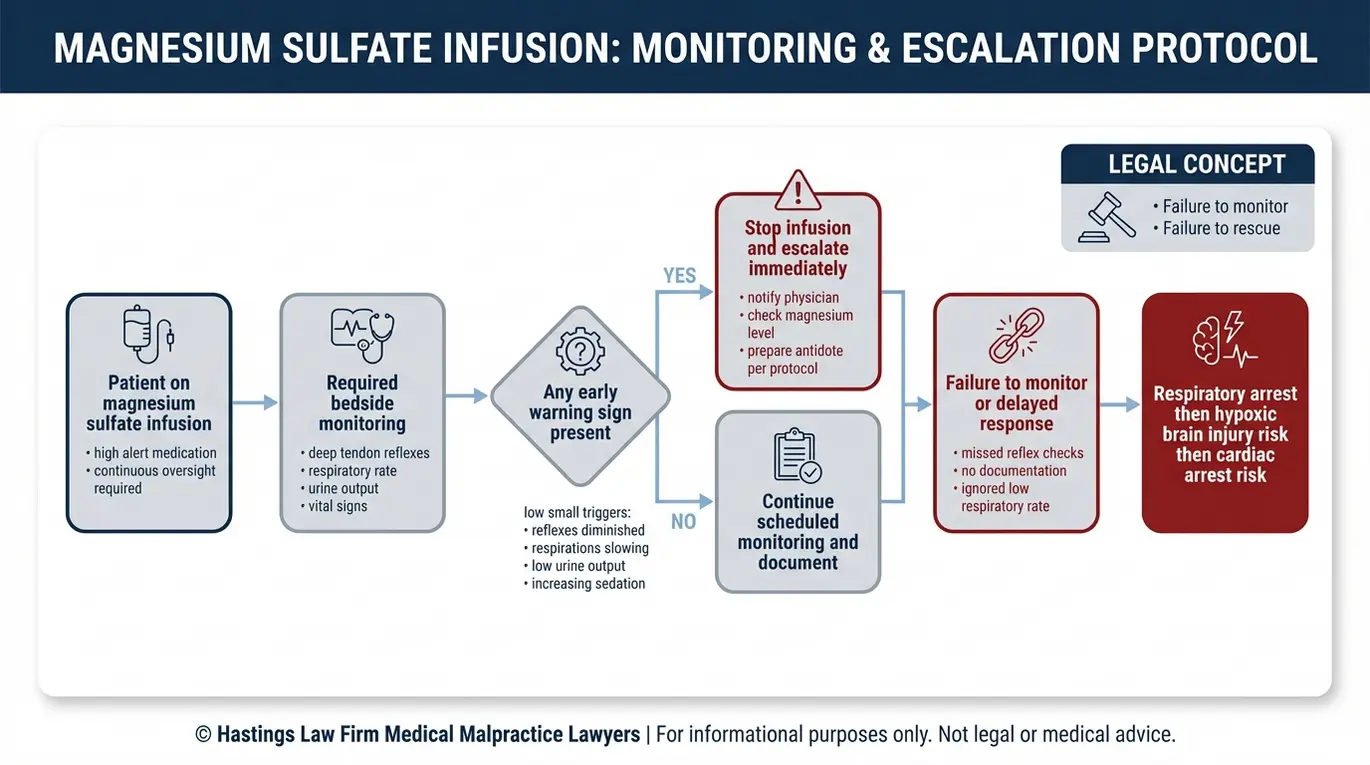
Medical staff are required to monitor deep tendon reflexes (DTRs), respiratory rate, and urine output throughout a magnesium sulfate infusion. Hypermagnesemia occurs when magnesium levels in the blood become dangerously high, often due to dosing errors or a lack of clinical monitoring. The disappearance of reflexes, tested by tapping the knee or ankle, is often the earliest clinical warning of toxicity before respiratory arrest occurs.
Hypermagnesemia follows a predictable and well-documented progression. According to a clinical review published by PubMed Central on Hypermagnesemia in Clinical Practice, nursing staff trained in magnesium sulfate administration are expected to recognize each stage and respond immediately.
The typical progression of magnesium toxicity includes:
- Loss of deep tendon reflexes (earliest warning sign, often at serum levels of 7 to 10 mEq/L)
- Nausea, flushing, and muscle weakness
- Hypotension (dangerous drop in blood pressure)
- Respiratory depression (slow, shallow breathing that may require intervention)
- Complete respiratory failure (breathing stops entirely)
- Cardiac arrest (the heart stops)
The nursing standard of care requires reflex checks, respiratory rate monitoring, and urine output measurement at regular intervals during infusion. If a nurse fails to perform these assessments, or performs them but does not recognize the significance of absent reflexes, the window to intervene closes rapidly.
The legal concept of “failure to rescue” becomes critical when medical staff miss early signs of patient distress. A Texas Magnesium Sulfate Overdose Lawyer understands that liability in an overdose case is not always limited to the initial dosing error. A hospital and its nursing staff can also be held responsible for failing to detect and respond to a patient’s deterioration. If the overdose was occurring but the signs were missed or ignored, that delay in treatment is an independent act of medical negligence.
When respiratory failure goes unaddressed for even minutes, the brain is deprived of oxygen. The result can be hypoxic brain damage, a permanent injury that may leave the patient dependent on lifelong care. A hospital negligence attorney or nursing negligence lawyer can review the monitoring records, nursing notes, and vital sign logs to determine whether the standard of care was met. To build a strong overdose injury claim, you need a medical malpractice lawyer Texas residents trust. A magnesium toxicity lawyer can expose the adverse drug event that caused the harm and ensure accountability.
The Hastings Law Firm Difference
Results matter, but what truly sets us apart is how we achieve them. Every verdict, every settlement, and every Texas courtroom victory comes from one guiding promise: To treat each client’s fight for justice as if it were our own.
This balance of skill, experience, and empathy reflects our core philosophy that justice should not only compensate the injured, but also make healthcare safer nationwide.

Calculating Damages for Magnesium Sulfate Overdose Victims
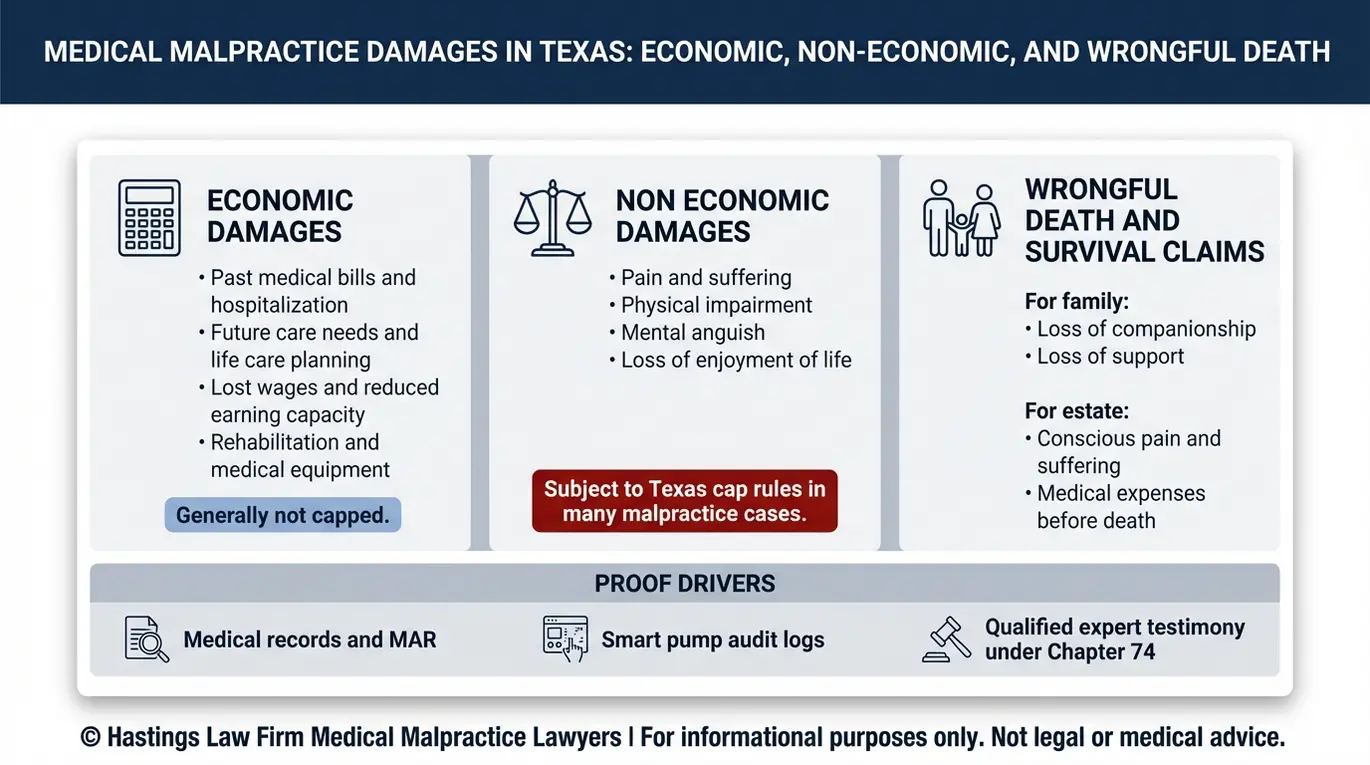
Patients harmed by magnesium toxicity in Texas can recover economic damages for life-care costs and lost wages, as well as non-economic damages for pain, suffering, and physical impairment, subject to state-imposed caps. Economic damages represent the actual financial losses incurred by the patient, such as medical bills and rehabilitation expenses.
Economic damages cover the measurable financial losses caused by the overdose. These include past and future medical bills, rehabilitation costs, lost income, and the cost of any equipment or home modifications the patient now needs. There is no cap on economic damages in Texas, which means the full cost of care can be pursued regardless of how high it reaches.
Non-economic damages compensate for pain, suffering, mental anguish, disfigurement, and loss of enjoyment of life. Texas tort reform law caps these damages at $250,000 against all physicians and individual healthcare providers and $250,000 per healthcare institution, with a maximum of $500,000 for all institutional defendants. An experienced Texas Magnesium Sulfate Overdose Lawyer structures the case to account for these limits while maximizing the total recovery.
When a magnesium sulfate overdose causes hypoxic brain injury from prolonged respiratory arrest, the economic damages are often substantial. A life-care plan, prepared by a qualified expert, projects the cost of round-the-clock nursing care, physical and cognitive therapy, adaptive equipment, and ongoing medical treatment for the rest of the patient’s life. These plans can total millions of dollars and form a central part of the magnesium sulfate lawsuit. An overdose settlement attorney ensures all avenues for medical malpractice damages are explored.
If the overdose was fatal, Texas wrongful death law allows surviving family members, including a spouse, children, and parents, to pursue compensation for their losses. A wrongful death lawyer Texas families trust can help the family recover damages for lost financial support, loss of companionship, and funeral expenses. These claims carry the same expert report requirements and deadlines as all medical malpractice cases in the state.
Settlement Example: The Cost of Negligence
In cases involving clear evidence from IV pump audit logs, liability can be difficult for the defense to dispute. For example, when pump data confirms that a bolus dose was programmed as a maintenance rate and the patient suffered respiratory arrest before anyone intervened, the documented chain of negligence often drives a settlement. Tommy Hastings and the team at Hastings Law Firm have secured significant recoveries in medication error cases, including an $8 million settlement in Dallas for a patient who suffered severe neurological injuries due to an ICU monitoring failure. Each case is different, but our trial-ready preparation means we do not accept less than what the evidence supports.
Contact the Texas Birth Injury Attorneys at Hastings Law Firm Today for Help
If your family has been affected by a magnesium sulfate overdose, the hospital likely already has a legal team working to protect its interests. You deserve someone working just as hard to protect yours.
Hastings Law Firm focuses exclusively on medical malpractice. Our team includes in-house nurses, former defense attorneys, and board-certified trial lawyer Tommy Hastings, who has spent over two decades holding healthcare providers accountable. Tommy is Board Certified in Personal Injury Trial Law by the Texas Board of Legal Specialization, a distinction held by less than 2% of attorneys in the state. We prepare every case as if it is going to trial, because that is how we get results.
You pay nothing unless we recover compensation for you. There are no upfront costs, no hourly fees, and no financial risk to your family. Contact a Texas magnesium sulfate overdose lawyer at Hastings Law Firm today for a free, confidential case evaluation. Let us review what happened and explain your options.
Frequently Asked Questions About Infant Magnesium Sulfate Overdose in Texas


This content was researched and written by the Hastings Law Firm editorial team, which includes attorneys, medical professionals, and experienced researchers. Our writing is informed by internal knowledge and practical experience, and we cross-check critical details against authoritative sources cited throughout. Every piece undergoes human-led fact-checking and legal review. Because legal and medical information can change, if you spot an error, please contact us. Learn more about our content standards and review process on our editorial policy page.

Tommy Hastings, founder of Hastings Law Firm, is a board-certified personal injury trial lawyer dedicated exclusively to healthcare injury cases. Since 2001, he has represented injured patients and families in litigation against major hospital systems, pharmaceutical companies, and negligent healthcare providers nationwide. He has handled numerous high-profile cases that have drawn national media attention and resulted in multi-million dollar recoveries. He draws on that experience in his writing, helping readers understand how these cases work and what options may be available to them.
