


Texas Monoamniotic Twins Cord Entanglement Lawyer
Written by: Hastings Law Firm | Reviewed by: Tommy Hastings | Updated: July 27, 2026
Monoamniotic twin pregnancies carry a high risk of umbilical cord entanglement, and outcomes can depend on accurate early classification, close surveillance, and timely delivery. When a care team misclassifies the pregnancy, misses warning signs on Doppler ultrasound or fetal monitoring, or delays escalation during distress, the result can be permanent injury, stillbirth, or worse. Understanding what monitoring is expected and how deviations are evaluated can help families make sense of a devastating outcome. If you or a loved one were harmed or worse due to monoamniotic twins cord entanglement in Texas, contact Hastings Law Firm for a free, confidential case review.
Top Rated Medical Malpractice Attorneys for High Risk Twin Pregnancies in Texas
What You Should Know About MoMo Twin Cord Negligence Claims in Texas:
- Permanent injury or stillbirth can result when cord entanglement is not detected or acted on during a monoamniotic twin pregnancy.
- A missed or incorrect classification of amnionicity can lead to a monitoring plan that is inadequate for the true level of risk.
- Options can narrow when inpatient surveillance is not used for a pregnancy that requires rapid response to sudden fetal distress.
- Severe outcomes can be tied to delayed cesarean delivery when distress is present or when delivery timing falls outside recommended practice.
- Liability can turn on whether the obstetrician deviated from the accepted standard of care for surveillance or delivery timing and whether that deviation caused the injury.
- Recovery can include extensive future care needs when a surviving twin has neurologic injury such as cerebral palsy or other brain damage.
- Wrongful death damages may be available in Texas when a monoamniotic twin pregnancy ends in stillbirth or intrauterine demise.
- Causation disputes can hinge on whether timely intervention would have prevented hypoxia or other irreversible harm.
- Key records can be central, including fetal monitoring strips, ultrasound and Doppler imaging, nursing notes, physician orders, and placental pathology reports.
- Placental pathology findings can matter when chronic cord compression or shared vascular connections are present and the event is claimed to be unforeseeable.

A Healthcare Focused Law Firm
If your monoamniotic twins suffered injury or loss related to cord entanglement, you are likely searching for answers about what went wrong and whether it could have been prevented. These pregnancies carry serious, well-documented risks, and the medical community has established clear protocols for monitoring and delivering MoMo twins safely. When those protocols are not followed, the consequences can be devastating.
At Hastings Law Firm, we focus exclusively on medical malpractice, and our team includes in-house medical professionals who understand the clinical details of high-risk obstetric cases. If you believe your care team failed to properly monitor or manage a monoamniotic twin pregnancy, a Texas Monoamniotic Twins Cord Entanglement Lawyer at our firm can review your records, explain your legal options, and help you understand what should have happened.
—
Diagnosing Cord Entanglement Risks in Monoamniotic Pregnancies
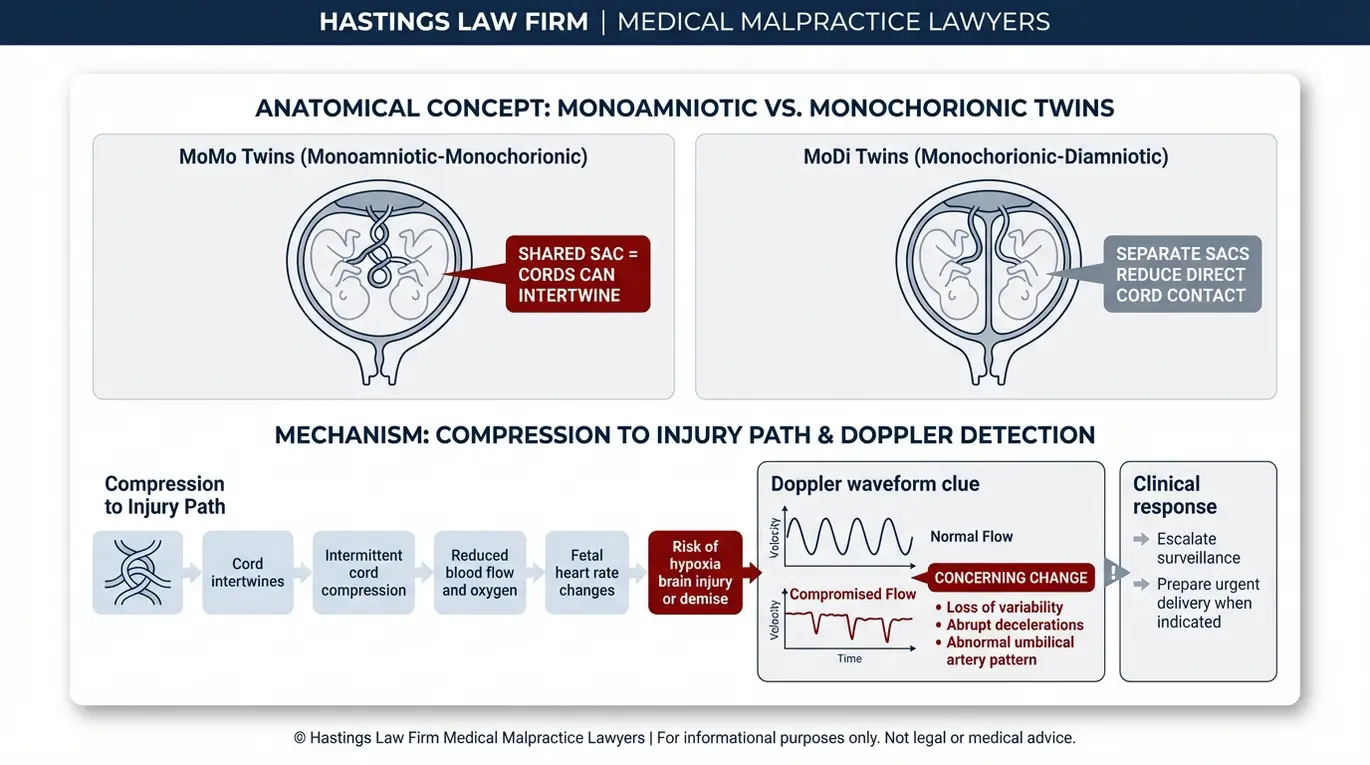
Monoamniotic twins share a single amniotic sac, which makes cord entanglement a near-certainty that demands aggressive surveillance using high-resolution Doppler ultrasound to detect compression before it causes irreversible harm.
Why MoMo Pregnancies Carry Elevated risk
A typical twin pregnancy involves two separate amniotic sacs, each providing its own protected space. Monoamniotic twins, sometimes called MoMo twins, are monochorionic-monoamniotic, meaning they share both a single placenta and a single amniotic sac. Without a membrane barrier between them, their umbilical cords float freely in the same fluid-filled space.
This shared environment creates an almost unavoidable risk of cord entanglement, where the two umbilical cords wrap around each other or around the twins themselves. While congenital anomalies, or physical birth defects, are a risk in any pregnancy, the physical threat of cords tangling is unique to this anatomy. Research published by the National Library of Medicine on cord entanglement in monoamniotic twin pregnancies confirms that cord entanglement occurs in the vast majority of these cases. The question is not whether entanglement will happen, but whether the care team is watching closely enough to intervene before it cuts off blood flow to one or both babies. A Texas cord entanglement attorney knows that early detection is key to preventing tragedy.
Correctly identifying the pregnancy’s amnionicity (the number of amniotic sacs) and chorionicity (the number of placentas) early in the first trimester is essential. This classification determines the entire monitoring plan, and a Texas Monoamniotic Twins Cord Entanglement Lawyer will verify if this was done correctly.
Misclassification as a Form of Negligence
One of the most dangerous errors in managing twin pregnancies is misclassifying MoMo twins as monochorionic-diamniotic twins (MoDi twins), who share a placenta but have two separate amniotic sacs. Because MoDi twins have a dividing membrane that reduces the risk of direct cord-to-cord contact, they are managed on a less intensive surveillance schedule. A diagnosis of amnionicity refers to the number of amniotic sacs present.
When a care team incorrectly labels a monoamniotic pregnancy as diamniotic, the result can be a monitoring plan that is entirely inadequate for the actual level of risk. A Texas cord entanglement attorney can investigate whether early ultrasound imaging was interpreted correctly and whether the classification error led to gaps in surveillance. If misdiagnosed, we investigate whether negligence occurred. Your Texas Monoamniotic Twins Cord Entanglement Lawyer works to find out what happened.
What Doppler Ultrasound Should Reveal
Doppler ultrasound is the primary tool for evaluating blood flow through the umbilical cords and detecting signs of compression. Standard grayscale ultrasound can show cord positioning, but Doppler imaging provides real-time data on how blood is actually moving through the vessels. An experienced Texas cord entanglement attorney reviews these scans for evidence of negligence.
As Stanford Medicine reported in its coverage of a monoamniotic twin case, continuous and skilled monitoring is what separates a successful outcome from a tragic one in these pregnancies. If this was missed, a Texas Monoamniotic Twins Cord Entanglement Lawyer can help.
Key diagnostic indicators a care team should be evaluating include:
- Distinct Doppler waveforms for each twin’s umbilical artery, confirming that blood flow is not being restricted
- Signs of absent or reversed end-diastolic flow, which can indicate cord compression is already occurring
- “Galloping” or overlapping fetal heart rates on monitoring strips, which may suggest the cords are interacting
- Evidence of vascular anastomoses, the shared blood vessel connections on the placenta’s surface that can contribute to imbalanced blood flow between the twins
- Changes in amniotic fluid volume, such as polyhydramnios (excessive fluid) or oligohydramnios (insufficient fluid) around either twin
A Texas cord entanglement attorney knows these signs are critical for timely intervention.
Identifying Cord Entanglement via Doppler Waveforms
Umbilical cord Doppler waveforms, visual patterns representing the velocity of blood flow within the cord, provide a window into what is happening inside the umbilical cord in real time. A Texas Monoamniotic Twins Cord Entanglement Lawyer understands these technical details. Umbilical cord compression, a reduction in blood flow caused by physical pressure on the cord, produces specific changes in these waveform patterns. When a cord is being squeezed by entanglement, the Doppler reading may show notching, variable decelerations, or intermittent absent flow.
These findings should prompt immediate clinical action. If a provider fails to order Doppler studies at appropriate intervals, or fails to recognize abnormal waveform patterns when they appear, that can constitute a deviation from the standard of care. A Texas cord entanglement attorney experienced in these cases can work with maternal-fetal medicine experts to determine whether the imaging was performed correctly and whether warning signs were missed. Contact a Texas Monoamniotic Twins Cord Entanglement Lawyer for a review.
—
Mandatory Monitoring and Treatment Protocols for MoMo Twins
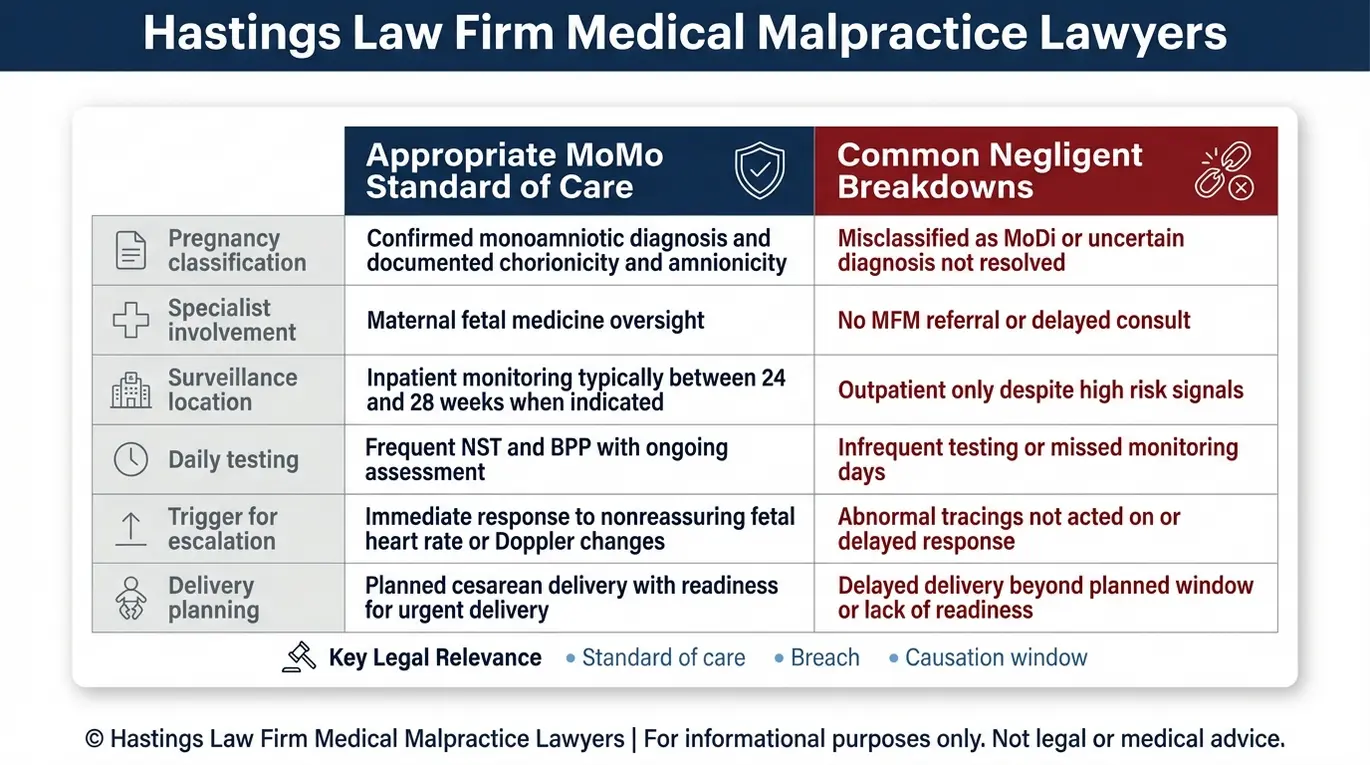
The standard of care for monoamniotic twins typically calls for inpatient monitoring starting between 24 and 28 weeks, with daily fetal surveillance to allow immediate delivery if cord compression occurs. Consistent inpatient monitoring ensures the medical team can respond to distress within minutes.
Inpatient Surveillance as the Standard
Because cord entanglement can cause sudden fetal distress with little warning, the accepted approach for MoMo twin pregnancies is hospitalized bed rest with continuous or near-continuous fetal monitoring. Research from the MONOMONO study published by Wiley Online Library examined outcomes for inpatient versus outpatient management and reinforced the importance of close, ongoing surveillance during the critical weeks before delivery. A Texas Monoamniotic Twins Cord Entanglement Lawyer can confirm if protocols were followed.
A non-stress test (NST), which tracks fetal heart rate patterns in response to the babies’ own movements, is typically performed daily or even multiple times per day. A biophysical profile (BPP), a more detailed assessment that uses ultrasound to evaluate fetal breathing, movement, muscle tone, and amniotic fluid levels alongside the NST, is often conducted regularly as well. A maternal-fetal medicine specialist should be directing this care, not a general obstetrician managing the pregnancy alone. A MoMo twin negligence lawyer is essential in these complex cases.
When these monitoring protocols are not followed, critical signs of fetal distress can go undetected. A MoMo twin negligence lawyer evaluates whether the surveillance plan met the standard of care or whether dangerous gaps existed.
Treatment Options When Complications Develop
In some monoamniotic pregnancies, twin-twin transfusion syndrome (TTTS) can develop alongside cord entanglement. TTTS occurs when shared vascular connections on the placenta cause one twin (the donor twin) to transfer too much blood to the other twin (the recipient twin). When TTTS is identified, interventions such as amnioreduction, the removal of excess amniotic fluid, or fetoscopic laser surgery to seal off the shared blood vessels, may be necessary. Your Texas Monoamniotic Twins Cord Entanglement Lawyer will consult experts to verify if these options were offered.
Research from Frontiers in Pediatrics on monochorionic twin pregnancy outcomes highlights additional risk factors that can affect these pregnancies, reinforcing the need for specialized management. Failure to diagnose TTTS or failure to offer appropriate interventions when it develops can form the basis of a malpractice claim, and a MoMo twin negligence lawyer can evaluate whether the treatment decisions were appropriate.
The Window for Safe Delivery
There is a specific window during which cesarean delivery can prevent cord entanglement from causing permanent injury or death. For monoamniotic twins, scheduled C-section delivery is generally recommended between 32 and 34 weeks of gestation. Delivering before this window carries risks associated with extreme prematurity and preterm labor. Delivering after it significantly increases the risk of stillbirth from cord accidents. A Texas Monoamniotic Twins Cord Entanglement Lawyer investigates these delays.
The “causation” question in these cases often centers on this delivery window. If a care team delayed cesarean delivery beyond the recommended timeframe, or failed to respond to signs of fetal distress that called for emergency delivery, the delay itself may be the direct cause of the injury. A MoMo twin negligence lawyer builds this argument.
| Standard of Care | Negligent Care |
|---|---|
| Correct classification of amnionicity by first trimester | Misclassification of MoMo twins as MoDi twins |
| Referral to maternal-fetal medicine specialist | Management by general OB without MFM involvement |
| Inpatient monitoring starting at 24-28 weeks | Outpatient monitoring only with weekly or biweekly visits |
| Daily or twice-daily non-stress tests | Infrequent or inconsistent fetal monitoring |
| Regular biophysical profiles with Doppler assessment | No Doppler studies or failure to interpret waveforms |
| Planned cesarean delivery at 32-34 weeks | Delayed delivery beyond 34 weeks or failure to act on distress |
| Immediate response to abnormal monitoring findings | Failure to escalate or delay in calling for emergency C-section |
A Texas Monoamniotic Twins Cord Entanglement Lawyer can compare the care documented in your medical records against these established protocols to determine whether deviations occurred. Speak to a MoMo twin negligence lawyer today to protect your rights. Our Texas Monoamniotic Twins Cord Entanglement Lawyer team is ready to help.
—
The Hastings Law Firm Difference
Results matter, but what truly sets us apart is how we achieve them. Every verdict, every settlement, and every Texas courtroom victory comes from one guiding promise: To treat each client’s fight for justice as if it were our own.
This balance of skill, experience, and empathy reflects our core philosophy that justice should not only compensate the injured, but also make healthcare safer nationwide.

Establishing Liability for Cord Entanglement Injuries in Texas
To prove malpractice in Texas, a plaintiff must demonstrate that the obstetrician deviated from the accepted medical standard of care for surveillance or delivery timing, and that this deviation directly caused the twin’s injury or death. Identifying a deviation from the standard of care requires a thorough review of medical records by qualified experts.
The Legal Framework in Texas
Medical malpractice claims in Texas are governed by the Texas Civil Practice and Remedies Code, Chapter 74, which establishes specific procedural requirements, including the need for an expert report early in the litigation. This report must come from a qualified medical professional who can identify the standard of care, explain how it was breached, and connect that breach to the harm suffered. A Texas birth injury lawyer guides families through this complex statutory process.
At Hastings Law Firm, our legal team includes in-house nurse consultants and access to a national network of maternal-fetal medicine experts who can analyze the clinical decisions made during a MoMo twin pregnancy. Founder Tommy Hastings is a board-certified trial lawyer in personal injury trial law, a distinction held by fewer than 2% of Texas attorneys. Our firm includes former defense attorneys who understand how hospitals approach these cases, and a skilled Texas birth injury lawyer prepares every case from day one as if it will go before a jury.
Proving Causation Through Medical Evidence
The central challenge in a cord entanglement case is linking the failure to monitor or deliver to the specific injury. If a twin suffered hypoxia, cerebral palsy, or intrauterine demise, the question becomes: would timely intervention have prevented the harm? A Texas Monoamniotic Twins Cord Entanglement Lawyer works to answer this affirmatively.
Placental pathology, the laboratory examination of the placenta after delivery, is often a critical piece of evidence. A pathologist can identify signs of chronic cord entanglement, vascular anastomoses (the shared blood vessel connections between the twins), and patterns of oxygen deprivation that developed over time rather than suddenly. Placental pathology can also reveal complications like Twin-Twin Transfusion Syndrome (TTTS), where blood flow differs between the donor twin and recipient twin. This type of evidence can directly rebut common defense arguments that the injury resulted from an acute, unforeseeable event or a sudden infection. A top Texas birth injury lawyer knows how to use these findings effectively.
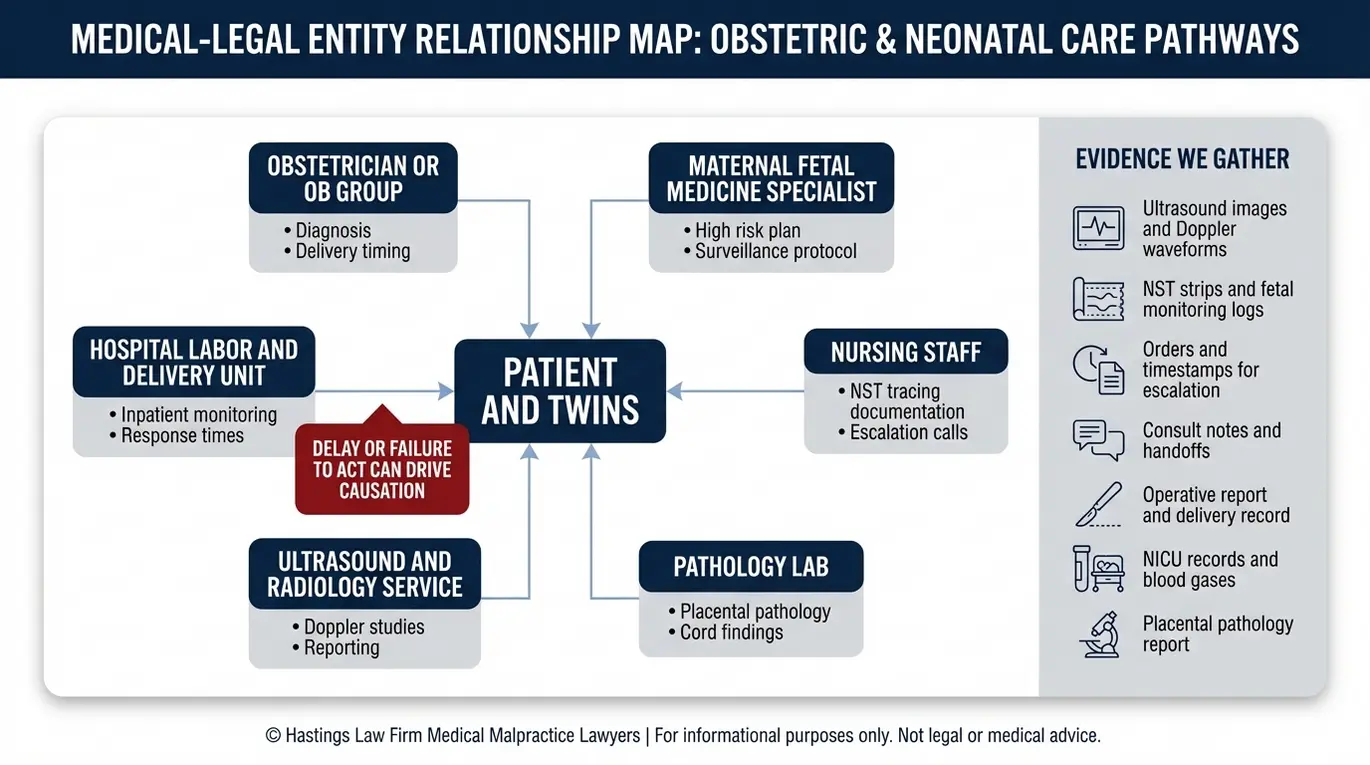
A Texas Monoamniotic Twins Cord Entanglement Lawyer handling a MoMo twin case will gather and analyze the following evidence:
- Fetal monitoring strips from the entire period of surveillance, examined minute by minute for missed signs of distress
- Ultrasound and Doppler imaging records to determine whether appropriate studies were ordered and correctly interpreted
- Nursing notes and physician orders documenting response times to abnormal findings
- Placental pathology reports showing evidence of chronic cord compression or vascular abnormalities
- Transfer records and communication logs if the patient needed referral to a higher-level facility
- Expert testimony from maternal-fetal medicine specialists who can establish what should have been done and when
Recoverable Damages
When a MoMo twin survives with neurologic injuries such as cerebral palsy or other brain damage, the damages can be extensive. A life care plan, developed by medical and economic experts, projects the full cost of future medical care, therapies, adaptive equipment, and support services the child will need over a lifetime. Families may also recover compensation for past medical expenses, pain and suffering, and loss of earning capacity. The Texas Monoamniotic Twins Cord Entanglement Lawyer you choose will work toward maximum compensation.
In cases involving stillbirth or intrauterine demise, Texas law allows families to pursue wrongful death claims. These claims can include damages for mental anguish, loss of companionship, and funeral expenses. A Texas birth injury lawyer at our firm works with qualified experts to build a thorough accounting of every category of harm, so that any settlement or verdict fully reflects the impact on your family. Let us help you find the answers you deserve after your loss. An experienced Texas birth injury lawyer can provide clarity during this difficult time. Our Texas Monoamniotic Twins Cord Entanglement Lawyer is dedicated to securing justice for you.
—
Contact the Texas Birth Injury Attorneys at Hastings Law Firm Today for Help
Injuries and losses involving monoamniotic twins are often preventable when doctors follow established monitoring and delivery protocols. If your family experienced a devastating outcome during a MoMo twin pregnancy, you deserve to know whether the care you received met the standard.
Hastings Law Firm handles these cases on a contingency fee basis, which means you pay no attorney fees or costs unless we recover compensation for you. Our team of attorneys, nurse consultants, and medical experts will review your records, identify what happened, and explain your legal options in a confidential evaluation.
You can reach us by phone or through our website. Let us help you find the answers you deserve.
—
Frequently Asked Questions About Monoamniotic Twins Cord Entanglement in Texas


This content was researched and written by the Hastings Law Firm editorial team, which includes attorneys, medical professionals, and experienced researchers. Our writing is informed by internal knowledge and practical experience, and we cross-check critical details against authoritative sources cited throughout. Every piece undergoes human-led fact-checking and legal review. Because legal and medical information can change, if you spot an error, please contact us. Learn more about our content standards and review process on our editorial policy page.

Tommy Hastings, founder of Hastings Law Firm, is a board-certified personal injury trial lawyer dedicated exclusively to healthcare injury cases. Since 2001, he has represented injured patients and families in litigation against major hospital systems, pharmaceutical companies, and negligent healthcare providers nationwide. He has handled numerous high-profile cases that have drawn national media attention and resulted in multi-million dollar recoveries. He draws on that experience in his writing, helping readers understand how these cases work and what options may be available to them.
