


Texas Midwife Malpractice Lawyer
Written by: Hastings Law Firm | Reviewed by: Tommy Hastings | Updated: July 27, 2026
A birth injury after a midwife assisted delivery can leave families facing lasting medical needs and deep uncertainty about what went wrong. Midwife negligence can involve missed warning signs, inadequate monitoring, or delayed transfer to hospital care, especially in home births or freestanding birth centers where emergency intervention is not immediately available. Texas rules also distinguish between midwife license types, which can affect the expected standard of care and the safety steps required. If you or a loved one were harmed or worse due to midwife negligence in Texas, contact Hastings Law Firm for a free, confidential case review.
Top Rated Malpractice Attorneys for Birth-Related Injuries in Texas
What You Should Know About Certified Nurse Midwife Negligence Claims in Texas:
- Life changing harm can follow a midwife assisted birth when warning signs are missed and urgent care is delayed.
- Severe outcomes can include brain injury, nerve damage, maternal hemorrhage, uterine rupture, or wrongful death.
- Options can depend on showing a direct link between the midwife specific failure and the injury.
- Accountability can turn on whether transfer to hospital care was recommended and initiated when complications developed.
- Expectations for safe care can differ by credential because Texas distinguishes Certified Nurse Midwives from Licensed Midwives and Certified Professional Midwives.
- Recovery can be affected by whether the midwife carried malpractice insurance because coverage varies by license type.
- Legal rights can be limited if filing time rules are missed because Texas applies a statute of limitations with different treatment for minors.
- Clarity about what happened can depend on complete records because prenatal charts, fetal monitoring strips, transfer records, and hospital admission notes may show missed distress.
- Disputes can arise from documentation gaps because missing monitoring strips and inconsistent charting may indicate problems in care.

A Healthcare Focused Law Firm
When a birth that should have been safe ends in serious injury, the confusion and grief can feel overwhelming. You trusted your midwife to protect you and your baby, and now you may be left with more questions than answers. That confusion is understandable, and you are not wrong for wanting to know what happened.
A Texas midwife malpractice lawyer can help you find those answers. At Hastings Law Firm, our team of attorneys, in-house nurses, and medical consultants focuses exclusively on medical malpractice. We understand the clinical details of birth injury cases, and we know how to investigate whether a midwife’s care fell below acceptable standards.
If you or your child were harmed during a midwife-assisted delivery, we welcome the chance to review what happened and explain your options. The consultation is free and confidential.
Understanding Midwife Negligence and Medical Liability
Midwife negligence occurs when a provider fails to adhere to the accepted standard of care, resulting in preventable injury or death to the mother or infant. Like any medical malpractice claim, a case involving a midwife requires proof that the provider’s actions fell short of what a reasonably competent midwife would have done in the same circumstances.
The standard of care for midwives centers on safe monitoring and timely decision-making. This includes properly assessing fetal heart tones, the baby’s heart rate patterns during labor, recognizing complications, and referring or transferring the patient to a higher level of care when problems arise. In an out-of-hospital birth, a delivery occurring at home or in a freestanding birth center, these responsibilities carry even greater weight because emergency surgical intervention is not immediately available.
However, proving that a midwife made an error is only part of the equation for a midwife malpractice attorney. Texas law also requires the injured party bringing the claim to establish “proximate cause,” meaning the midwife’s specific failure must be directly linked to the injury. For example, if a midwife failed to monitor fetal heart tones and the baby later developed brain damage from oxygen deprivation, we must demonstrate that earlier detection would have changed the outcome. Working through these legal requirements is why retaining an experienced Texas midwife malpractice lawyer is essential for building a successful case.
The Texas Midwifery Act sets the regulatory framework for midwifery practice in this state. Understanding how these rules apply to your situation is one of the first things we will evaluate when reviewing your case.
Texas Midwife Regulations and License Distinctions
Texas law distinguishes between Certified Nurse-Midwives (CNMs), who are advanced practice nurses, and Licensed Midwives (LMs/CPMs), who may lack formal medical degrees but must adhere to the Texas Midwifery Board rules.
A Certified Nurse-Midwife (CNM), an advanced practice registered nurse with graduate-level education, completes a master’s or doctoral nursing program and passes a national certification exam administered by the American Midwifery Certification Board. CNMs typically practice in hospitals or clinics under collaborative agreements with physicians. They can prescribe medications and manage higher-acuity patients within their scope.
A Licensed Midwife (LM) or Certified Professional Midwife (CPM), a provider who may not hold a nursing degree, follows a different training path. These providers often complete apprenticeship-based programs. They generally attend births in home settings or freestanding birth centers and cannot prescribe medications. Texas regulations place specific restrictions on the types of pregnancies LMs can manage, and the Texas Midwifery Board rules require them to screen for a high-risk pregnancy and refer those patients to an obstetrician. Knowing whether the provider carries malpractice insurance is a critical factor a lawyer for midwife malpractice will investigate, as coverage varies significantly between license types.
This distinction matters because the standard of care in a malpractice case depends on the midwife’s credential and scope of practice. A Texas midwife malpractice lawyer must identify exactly which type of provider was involved and which regulations apply.
Texas Administrative Code Rule 115.115 requires midwives to recommend transfer of care when certain complications develop. We will closely examine whether this rule was followed.
| Certified Nurse-Midwife (CNM) | Licensed Midwife (LM) / CPM | |
|---|---|---|
| Education | Master’s or doctoral nursing degree | Apprenticeship or accredited midwifery program (no nursing degree required) |
| Prescriptive Authority | Yes | No |
| Typical Practice Setting | Hospitals, clinics | Home births, birth centers |
| High-Risk Restrictions | Broader scope under physician collaboration | Must screen out and refer high-risk pregnancies per Texas Midwifery Board rules |

The Hastings Law Firm Difference
Results matter, but what truly sets us apart is how we achieve them. Every verdict, every settlement, and every Texas courtroom victory comes from one guiding promise: To treat each client’s fight for justice as if it were our own.
This balance of skill, experience, and empathy reflects our core philosophy that justice should not only compensate the injured, but also make healthcare safer nationwide.

Common Birth Injuries Caused by Midwife Errors
Improper monitoring or delayed medical intervention by a midwife can lead to catastrophic injuries including Cerebral Palsy, HIE, and shoulder dystocia. These injuries often stem from a failure in recognizing warning signs or a delay in transferring to hospital-level care.
Some of the most common birth injuries we see in midwife negligence cases include:
- Hypoxic-ischemic encephalopathy (HIE): A type of brain damage caused by oxygen deprivation during labor or delivery. HIE often results from unrecognized or unaddressed fetal distress. According to an ongoing research initiative published through PubMed Central on consensus diagnostic criteria for neonatal encephalopathy, early identification of oxygen deprivation is critical to outcomes. When a midwife misses or ignores signs of distress, the window for intervention can close rapidly.
- Cerebral palsy: A group of neurological disorders affecting movement and coordination, frequently linked to oxygen deprivation or trauma during birth. Many cerebral palsy cases trace back to a preventable delay in performing an emergency C-section.
- Shoulder dystocia: A delivery complication where the baby’s shoulder becomes lodged behind the mother’s pubic bone after the head has already emerged. Improper physical maneuvers to free the baby can cause nerve damage, including brachial plexus injuries that may permanently affect the child’s arm and hand.
- Maternal injuries: Mothers may suffer postpartum hemorrhage (severe bleeding after delivery) or uterine rupture, both of which can become life-threatening without immediate medical intervention. In the most tragic cases, a failure to act can result in wrongful death.
An attorney for midwife negligence will work with medical experts to determine whether earlier action could have prevented the injury. As a firm led by board-certified trial attorney Tommy Hastings, we examine every available record to trace exactly when the standard of care was breached and how that breach caused harm.
Risks of Birth Centers and Delayed Hospital Transfers
The most critical risk in out-of-hospital births is the failure to timely transfer a patient to a hospital when complications like fetal distress or failure to progress arise. Failure to progress, a condition where labor stalls or does not advance as expected, can place both the mother and baby at increasing risk.
A “wait and see” approach during a complicated labor can cost precious time. For an infant experiencing oxygen deprivation or neonatal encephalopathy, every minute matters. Medical professionals often refer to a critical window, sometimes called the “golden hour,” during which rapid intervention, often a C-Section, can significantly reduce the severity of brain injury. When a midwife delays the decision to transfer, that window may close before the baby ever reaches a hospital.
The Texas Department of State Health Services’ Hear Her Texas initiative on urgent maternal warning signs highlights the importance of recognizing and acting on danger signals.
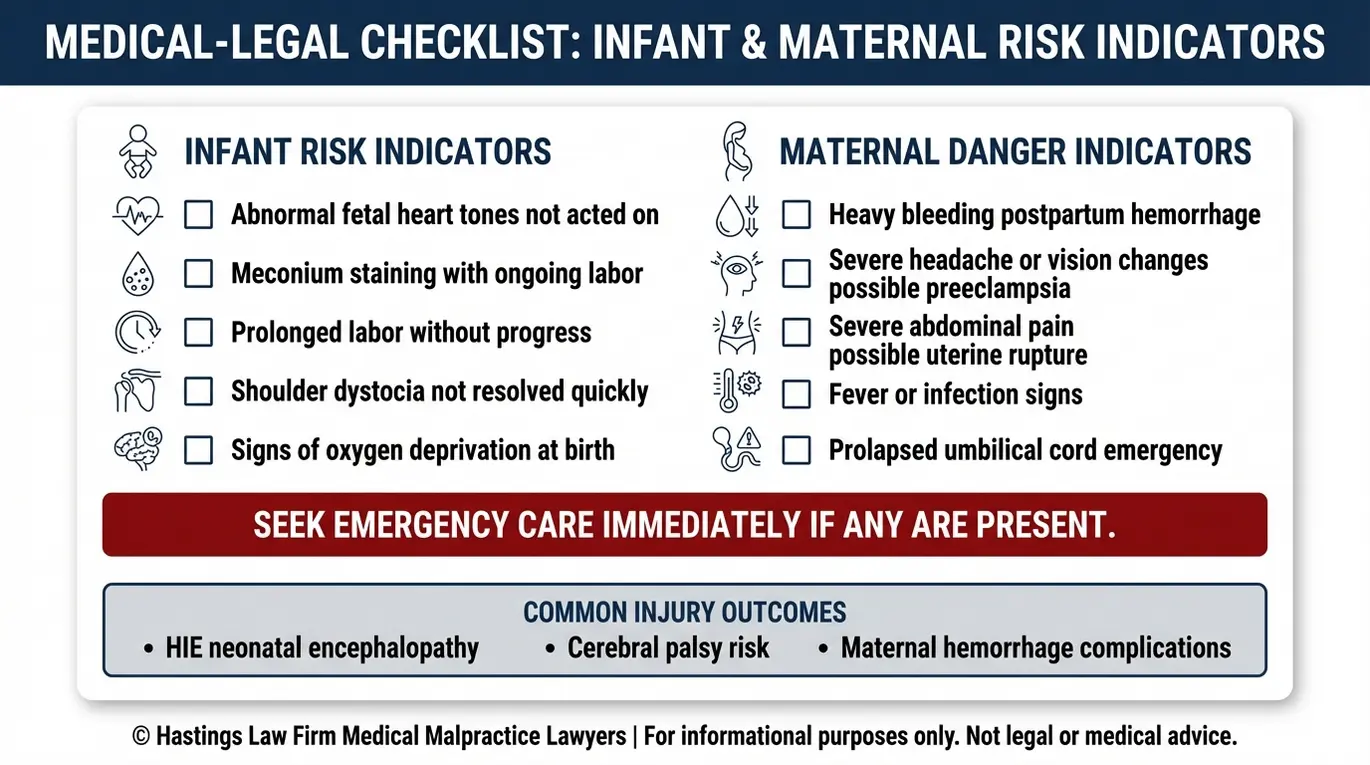
Red flags that may require immediate hospital transfer include:
- Non-reassuring fetal heart tones or sudden changes in the baby’s heart rate pattern
- Meconium-stained amniotic fluid, a condition where the baby passes stool before delivery that can indicate fetal distress
- Prolonged labor without measurable progress
- Signs of a prolapsed umbilical cord
- Heavy maternal bleeding or signs of uterine rupture
- Symptoms of preeclampsia, such as severe headaches, vision changes, or dangerously high blood pressure
Analyzing Texas Administrative Code Rule 115.115
Texas Administrative Code Rule 115.115 creates a specific legal duty for midwives to initiate immediate emergency transfer when complications develop during labor or delivery. Under the related transfer rule, §115.113, midwives must make a reasonable effort to contact the health care professional or institution to whom the client will be transferred and continue emergency care during transport.
A Texas midwife malpractice lawyer will review whether the midwife had adequate transfer preparations in place, whether the patient was given proper informed consent about the risks of out-of-hospital birth, and whether the midwife acted within the timeline that the situation demanded.

How Our Texas Midwife Malpractice Lawyers Prove Liability
We utilize a national network of medical experts and former defense attorneys to reconstruct the delivery timeline and prove that the midwife’s deviation from safety protocols directly caused the injury. Our legal team includes former defense counsel and experienced hospital nurses who previously worked for the systems we now challenge, providing a strategic advantage in identifying charting inconsistencies.
Our investigation begins with the discovery process, during which we meticulously gather all relevant documents. We obtain every available record: prenatal charts, birth center logs, transfer records, and hospital admission notes. Our team reviews these medical records to identify gaps in care, missing fetal monitoring strips, and inconsistencies in documentation that suggest negligence.
From there, we rely on expert testimony from qualified professionals who compare the midwife’s actions against the standard of care for their specific license type. Whether the provider is a CNM or an LM, we measure their conduct against what a competent professional would have done.
We also analyze our firm’s history of verdicts and settlements to benchmark the case value. We work with life-care planners to calculate the full scope of compensation a family may need, particularly when a child faces a lifetime of medical care. As your Texas midwife malpractice lawyer, our goal is to build a case that reflects the true cost of the injury, ensuring you have the resources necessary for your child’s future.
Contact the Texas Birth Injury Attorneys at Hastings Law Firm Today for Help
No amount of money can undo a birth injury. But fair compensation can provide the medical care, therapy, and resources your child will need going forward. It can also bring the accountability that prevents the same mistakes from affecting another family.
At Hastings Law Firm, we handle these cases on a contingency fee basis, meaning you pay no attorney fees or costs unless we recover for you. Our team of trial attorneys, in-house nurses, and medical consultants is ready to review your situation with the care and attention it deserves.
If your child or family was harmed during a midwife-assisted birth, we encourage you to reach out. Call us or complete our online form for a free, confidential case evaluation. Let us help you understand what happened and what options may be available to you.
Frequently Asked Questions About Midwife Malpractice in Texas


This content was researched and written by the Hastings Law Firm editorial team, which includes attorneys, medical professionals, and experienced researchers. Our writing is informed by internal knowledge and practical experience, and we cross-check critical details against authoritative sources cited throughout. Every piece undergoes human-led fact-checking and legal review. Because legal and medical information can change, if you spot an error, please contact us. Learn more about our content standards and review process on our editorial policy page.

Tommy Hastings, founder of Hastings Law Firm, is a board-certified personal injury trial lawyer dedicated exclusively to healthcare injury cases. Since 2001, he has represented injured patients and families in litigation against major hospital systems, pharmaceutical companies, and negligent healthcare providers nationwide. He has handled numerous high-profile cases that have drawn national media attention and resulted in multi-million dollar recoveries. He draws on that experience in his writing, helping readers understand how these cases work and what options may be available to them.
