


Texas Postpartum Sepsis Lawyer
Written by: Hastings Law Firm | Reviewed by: Tommy Hastings | Updated: July 27, 2026
Postpartum sepsis is a life threatening medical emergency that can follow childbirth when an infection is not recognized and treated quickly. Early symptoms can be mistaken for normal recovery, and delays in evaluation, monitoring, or antibiotics can allow a rapid decline that leads to organ failure or fatal outcomes. Families often feel shocked when concerns are dismissed and the condition worsens. Understanding warning signs and how breakdowns in care happen can clarify why these cases arise. If you or a loved one were harmed or worse due to postpartum sepsis malpractice in Texas, contact Hastings Law Firm for a free, confidential case review.

Compassionate Texas Medical Attorneys for Infection After Delivery Malpractice Claims
What You Should Know About Infection After Delivery Malpractice Claims in Texas:
- Outcomes can become life threatening when postpartum sepsis warning signs are missed or dismissed and treatment is delayed.
- Long term harm can continue after survival because post sepsis syndrome can involve chronic pain, fatigue, cognitive decline, and PTSD.
- Liability can turn on whether care delays occurred such as delayed diagnosis, ignored lab results, or failure to give timely antibiotics.
- Recovery options can be lost if the filing deadline is missed because Texas medical malpractice claims are subject to strict time limits.
- Compensation can include medical bills, lost wages, and pain and suffering, and wrongful death damages may apply when a mother does not survive.
- Non economic recovery can be limited in Texas because state law caps certain categories of non economic damages in medical malpractice cases.
- Hospital responsibility can be central when harm is tied to sterile environment failures or inadequate nursing monitoring.
- Proof can depend on a clear clinical timeline because medical records, lab results, vital sign logs, and medication records may show when sepsis was detectable and when treatment occurred.

A Healthcare Focused Law Firm
Bringing a child into the world should be a time of healing and joy. When a preventable infection turns those early days into a medical crisis, the confusion, fear, and sense of betrayal can be overwhelming. If you or someone you love developed sepsis after delivery and you suspect that warning signs were missed or ignored, you are not alone, and your instincts deserve to be taken seriously.
At Hastings Law Firm, our legal and medical team focuses exclusively on medical malpractice. We understand both the clinical details and the emotional toll these cases carry. As a Texas postpartum sepsis lawyer, founder Tommy Hastings and our team of nurse consultants and former defense attorneys are prepared to review what happened, explain your legal options, and help you take the next step toward answers. The consultation is free, confidential, and comes with no obligation.
Recognizing Symptoms of Postpartum Sepsis After Childbirth
Postpartum sepsis is a severe, life-threatening reaction to an infection that enters the bloodstream after delivery, and it typically presents with high fever, rapid heart rate, extreme pain, and confusion within days of giving birth. Left untreated, it can progress rapidly toward organ failure and death. Any mother experiencing these symptoms needs immediate medical attention, and any delay in recognizing them may raise serious legal questions for a sepsis attorney to investigate.
Postpartum sepsis often begins with a localized infection such as endometritis, an infection of the uterine lining that is one of the most common complications after childbirth. It can also stem from a cesarean incision site, a urinary tract infection, or bacteria introduced during labor. Sepsis occurs when the body’s response to an infection damages its own tissues, leading to potential organ damage. The American Pregnancy Association notes that careful monitoring of surgical sites and infection symptoms is an essential part of postpartum care.
One of the challenges mothers face is distinguishing between the normal discomforts of recovery and the early signs of a dangerous infection. Some pain, fatigue, and mild temperature fluctuations are expected after delivery. But certain symptoms should never be dismissed as routine.
Warning signs that may indicate postpartum sepsis include:
- Fever over 100.4°F, especially if persistent or rising
- Chills or shaking that won’t stop
- Rapid breathing or difficulty catching your breath
- Foul-smelling vaginal discharge
- Severe or worsening abdominal pain
- Rapid heart rate or low blood pressure
- Confusion, disorientation, or difficulty staying alert
- Skin that feels clammy, discolored, or unusually warm
When providers dismiss these symptoms as hormonal shifts or normal postpartum discomfort, the window for effective treatment narrows. Under Texas Civil Practice and Remedies Code, Chapter 74, families may have legal recourse when a healthcare provider’s failure to recognize and treat these warning signs causes harm.
If you feel your concerns were not addressed during those critical hours and your condition worsened, a postpartum sepsis attorney can help determine whether the care you received fell below accepted medical standards. An experienced sepsis lawyer in Texas understands how to trace early symptoms back through the medical records and identify where the breakdown occurred. Speaking with an infection malpractice lawyer early on can preserve the evidence needed to build a strong case.

The Progression from Infection to Postpartum Septic Shock
Sepsis is commonly described as progressing through three stages: sepsis, severe sepsis, and septic shock, with each stage representing a critical escalation in organ failure and mortality risk. Understanding this progression matters because timing is central to both medical treatment and any potential legal claim. In a medical malpractice context, understanding these stages helps identify when a provider should have intervened.
The infection that triggers sepsis can originate from several sources. Surgical site infections from cesarean wounds, urinary tract infections left untreated after catheter use, MRSA (methicillin-resistant Staphylococcus aureus) exposure in hospital settings, and even necrotizing fasciitis, a rapidly spreading soft tissue infection sometimes called “flesh-eating bacteria,” can all set the cascade in motion. According to the CDC’s Pregnancy Mortality Surveillance System, infection remains one of the leading causes of pregnancy-related death in the United States.
The table below outlines what changes clinically at each stage. This progression from initial infection to septic shock is a critical window for medical intervention:
| Stage | Physical Symptoms | Physiological Impact |
|---|---|---|
| Sepsis | Fever or hypothermia, rapid heart rate, rapid breathing, confirmed or suspected infection | Inflammatory response begins; body attempts to fight localized infection systemically |
| Severe Sepsis | Decreased urine output, sudden mental status changes, difficulty breathing, abnormal lab values | Organ dysfunction begins; blood flow to vital organs becomes compromised |
| Septic Shock | Dangerously low blood pressure unresponsive to IV fluids, loss of consciousness, multi-organ involvement | Cardiovascular collapse; high mortality rate even with aggressive ICU intervention |
Each stage narrows the treatment window. When providers miss early indicators or delay antibiotic administration, the patient’s condition can deteriorate within hours. A septic shock lawyer evaluates whether the medical team acted quickly enough at each stage, and a Texas sepsis malpractice attorney can determine if documented delays contributed to the outcome.
Post-Sepsis Syndrome and Long-Term Recovery
Even mothers who survive sepsis may face lasting consequences. Post-sepsis syndrome (PSS) is a condition affecting many sepsis survivors, characterized by chronic pain, fatigue, cognitive decline sometimes described as “brain fog,” and symptoms of PTSD. These long-term effects can interfere with a mother’s ability to care for her child, return to work, participate in rehabilitation, or maintain her quality of life.
PSS is an important factor in evaluating the full scope of harm in a postpartum infection case. A postpartum infection lawyer accounts for these ongoing challenges when assessing what a family has truly lost.

The Hastings Law Firm Difference
Results matter, but what truly sets us apart is how we achieve them. Every verdict, every settlement, and every Texas courtroom victory comes from one guiding promise: To treat each client’s fight for justice as if it were our own.
This balance of skill, experience, and empathy reflects our core philosophy that justice should not only compensate the injured, but also make healthcare safer nationwide.

When Does a Postpartum Infection Become Medical Malpractice
An infection becomes malpractice when a healthcare provider fails to follow the standard of care by delayed diagnosis, ignoring lab results, or failing to administer timely antibiotics. Not every hospital-acquired infection is the result of negligence. But when a provider misses clear warning signs or departs from accepted protocols, the consequences can be devastating, and families may have a valid legal claim.
The standard of care in obstetrics refers to the level of treatment a reasonably competent provider would deliver under similar circumstances. For postpartum patients, that standard typically includes monitoring vital signs, evaluating lab work for signs of infection, and acting promptly when red flags appear.
Some of the most common errors, such as misdiagnosis or failure to diagnose, we see in these cases involve providers dismissing a mother’s complaints as “hormonal” or attributing worsening symptoms to a difficult recovery. Failure to recheck vitals after an initial abnormal reading, premature discharge before infections are ruled out, and inadequate follow-up care all represent potential breaches of duty.
One specific area of concern involves clinical sepsis bundles, which are standardized sets of interventions that hospitals are expected to initiate within a defined window once sepsis is suspected. These bundles typically include obtaining blood cultures, measuring serum lactate (a lab value that indicates how well the body’s tissues are receiving oxygen), and starting broad-spectrum antibiotics within one hour. Failure to implement these protocols when a postpartum patient shows signs of infection can represent a clear departure from the standard of care.
A medical malpractice lawyer experienced in sepsis cases understands how to evaluate whether these steps were taken, delayed, or skipped entirely. As a hospital negligence attorney, our role is to examine the full clinical picture. A Texas postpartum sepsis lawyer can identify whether the treating physician, nursing staff, or the hospital system itself bears responsibility for the harm. The choice between a sepsis malpractice lawyer and a doctor malpractice attorney depends on where the breakdown occurred.
Proving Doctor Negligence in Postpartum Sepsis Cases
Proving negligence requires clear evidence that the physician breached their duty of care and that this specific breach directly caused the progression of sepsis and the resulting injury. This is not a matter of opinion; it requires a structured legal and medical analysis built on documentation and expert testimony to establish liability.
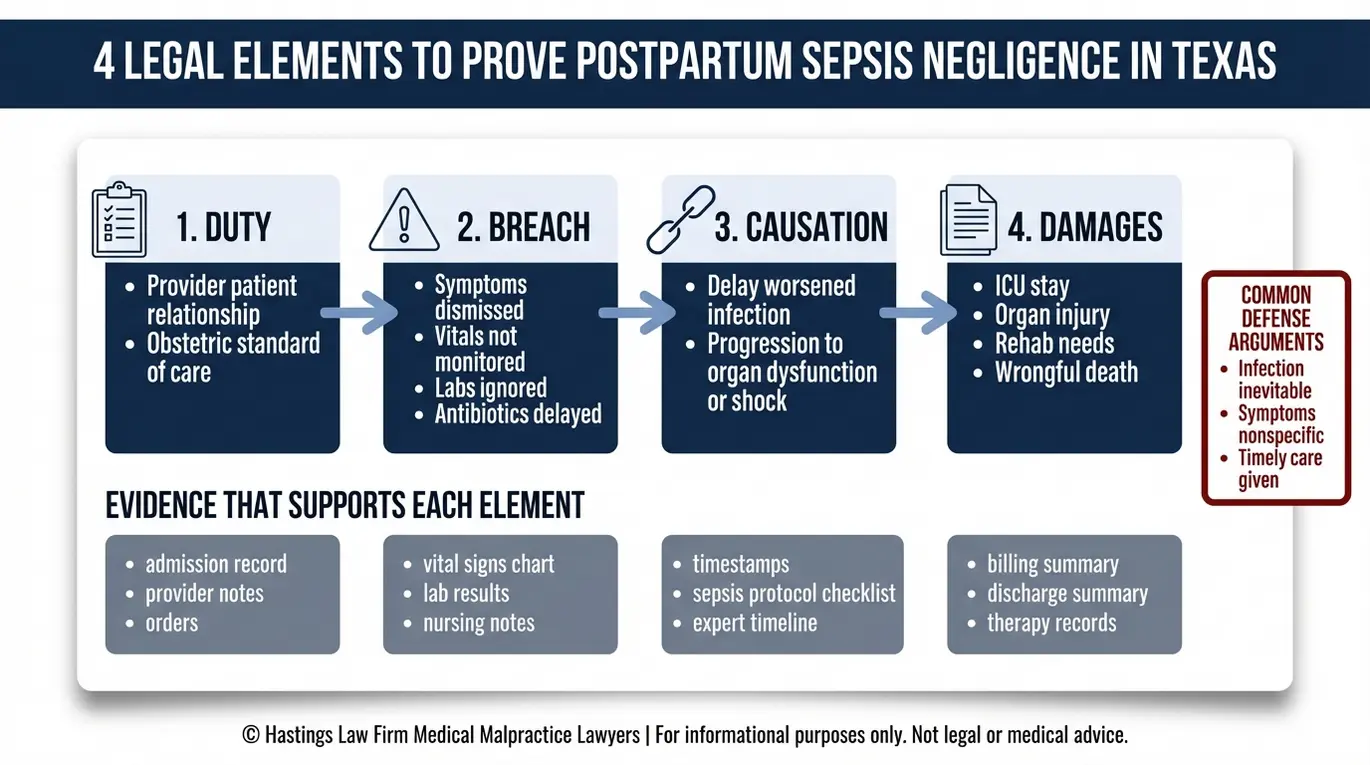
Every medical malpractice case rests on four legal elements:
- Duty: The provider had a doctor-patient relationship and an obligation to deliver competent care.
- Breach: The provider failed to meet the accepted standard of care.
- Causation: The breach directly caused or contributed to the patient’s injury.
- Damages: The patient suffered measurable harm, whether physical, financial, or emotional.
Building a case around these elements requires specific types of evidence. Our team focuses on gathering and analyzing the following:
- Medical records and charting: We look for inconsistencies, gaps in documentation, and entries that may have been altered or added after the fact. Our in-house nurses, who previously worked in hospital settings, know exactly what to look for in clinical charting.
- Lab reports and diagnostic results: Abnormal white blood cell counts, elevated lactate levels, and positive blood cultures can all indicate that sepsis was present and detectable before it escalated.
- Nursing notes and vital sign logs: These records can reveal whether symptoms were monitored appropriately or whether changes in condition went unreported.
- Witness statements: Input from family members or other staff can help fill in gaps that the records alone may not capture.
- Pharmacy and medication records: These show whether antibiotics were ordered, when they were administered, and whether the right drugs were chosen.
Under federal law, you have the right to obtain your own medical records. The U.S. Department of Health and Human Services’ HIPAA guidance on individual access rights confirms that patients and their representatives can request complete copies of their health information.
A surgical site infection, sometimes called a C-section wound infection, and exposure to methicillin-resistant Staphylococcus aureus (MRSA) are among the conditions a sepsis injury attorney will specifically investigate. As a postpartum malpractice lawyer, we use qualified medical experts to reconstruct the clinical timeline and determine whether earlier intervention would have changed the outcome. This is how a Texas medical malpractice lawyer establishes causation.
If you are considering whether to sue a doctor for sepsis, the strength of that timeline, supported by independent expert analysis, is what separates a viable claim from a denied one. A negligence attorney experienced in these cases knows how to assemble that proof. Meeting the burden of proof for negligence requires clear evidence.
Recoverable Damages for Mothers Suffering Postpartum Infections
Mothers and families affected by postpartum sepsis may recover compensation for past and future medical bills, lost wages, pain and suffering, and in tragic cases, wrongful death damages for surviving family members. In Texas, these damages are intended to provide financial relief for those harmed by clinical negligence. The scope of recovery depends on the severity of the injury, the duration of treatment, and the long-term impact on the patient’s life and family.
Economic damages compensate for financial losses that can be calculated with specificity:
- ICU hospitalization, surgeries, and emergency interventions
- Ongoing medical care, rehabilitation, and physical therapy
- Prescription medications and follow-up treatments
- Lost income during hospitalization and recovery
- Reduced future earning capacity if the injury causes lasting disability
Data from the Healthcare Cost and Utilization Project (HCUP) shows that sepsis-related hospitalizations are among the most expensive inpatient stays in the country, with costs increasing significantly when care is delayed or complications develop.
Non-economic damages address losses that are real but harder to quantify:
- Physical pain and suffering during and after the sepsis episode
- Emotional distress, anxiety, and PTSD
- Loss of enjoyment of life, including the inability to bond with a newborn during critical early weeks
- Loss of consortium, which compensates a spouse for the impact on the marital relationship
In cases where a mother does not survive, the family may pursue a wrongful death claim to recover funeral expenses, loss of financial support, loss of companionship, and mental anguish.
Texas law does place a damage cap on certain categories of non-economic damages in medical malpractice cases, a topic addressed in more detail in the FAQ section below. There is no cap, however, on economic damages such as medical bills and lost wages. A Texas sepsis lawyer can help calculate the full value of a claim. Whether through sepsis lawsuit settlements or a jury verdict, a postpartum injury compensation case requires a thorough accounting of every loss. If a loved one was lost, a wrongful death attorney can guide the family through that process.
Texas Statute of Limitations for Sepsis Malpractice Claims
In Texas, the statute of limitations for medical malpractice is generally two years from the date of the negligent act or omission. This deadline is strict, and missing it almost always means losing the right to pursue a claim entirely, regardless of how strong the evidence may be.
There are limited exceptions. In some cases, the injury may not be immediately apparent. Texas law recognizes a “discovery rule” that may toll, or pause, the deadline if the patient could not reasonably have known about the injury or its connection to negligence at the time it occurred. This can be relevant in postpartum sepsis cases where symptoms were initially attributed to normal recovery.
Texas also imposes a statute of repose, which sets an absolute outer boundary of ten years from the date of the negligent act. No matter when the injury is discovered, no claim can be filed after that ten-year window closes. This is a hard cutoff with very few exceptions.
Waiting to consult with a postpartum sepsis lawyer puts more than your filing deadline at risk. Over time, medical records can become harder to obtain, witnesses’ memories fade, and hospital staff may leave. Early legal consultation preserves evidence and protects your options. Texas medical malpractice laws, including Chapter 74, require compliance with procedural deadlines, so speaking with an attorney early helps ensure your litigation is well-positioned.
How Our Medical Attorneys Investigate Postpartum Sepsis Lawsuits
We conduct a thorough investigation using in-house medical staff and independent experts to analyze medical records, identify protocol failures, and build a trial-ready case from day one. Our process is designed to be rigorous on the legal side and supportive on your side.
It starts with a free, confidential case evaluation. During this initial conversation, one of our patient advocates will listen to what happened, review the basic facts, and help determine whether the situation warrants a full investigation. There is no cost and no obligation.
If we accept your case, our investigation unfolds in structured phases:
- Records acquisition: We obtain complete medical records, including lab reports, nursing notes, pharmacy logs, and physician orders from every facility involved.
- Medical review: Our in-house nurse consultants and Board Certified Patient Advocates analyze the records to identify gaps, inconsistencies, and potential departures from accepted protocols.
- Expert consultation: We work with independent medical experts across the country who review the clinical timeline and provide opinions on whether the standard of care was met.
- Case development: Our attorneys, including former defense counsel who know how hospitals and insurers build their arguments, develop a strategy designed to withstand the toughest challenges.
We prepare every case as if it will go to jury trial. That level of preparation strengthens our position whether the case resolves through settlement or proceeds to the courtroom.
You pay nothing upfront. We work on a contingency fee basis, meaning there are no attorney fees or costs unless we recover compensation for you. If you’re ready to hire a sepsis lawyer who will prioritize your family’s case, reach out to learn how the best medical malpractice lawyers in Texas approach these claims. As your Texas postpartum sepsis lawyer, we handle the legal complexity so you can focus on recovery.
Contact the Texas Birth Injury Attorneys at Hastings Law Firm Today for Help
You trusted your medical team to protect you during one of the most vulnerable moments of your life. If that trust was broken and a preventable infection caused serious harm, you deserve honest answers and a clear path forward.
Hastings Law Firm is rooted in Texas with offices in The Woodlands, Houston, Dallas, and Austin, and we represent families across the country. Our entire team, attorneys, nurses, and advocates, is dedicated exclusively to medical malpractice. We do not divide our attention. We focus on cases like yours.
If you or someone in your family suffered from postpartum sepsis and you believe the care fell short, we are here to listen. As your Texas postpartum sepsis lawyer, we will review the medical records, consult with qualified experts, and give you a straightforward assessment of your options.
The evaluation is free and confidential. You pay nothing unless we win. Contact Hastings Law Firm today to take the first step toward the answers and accountability your family deserves.
Frequently Asked Questions About Postpartum Sepsis in Texas


This content was researched and written by the Hastings Law Firm editorial team, which includes attorneys, medical professionals, and experienced researchers. Our writing is informed by internal knowledge and practical experience, and we cross-check critical details against authoritative sources cited throughout. Every piece undergoes human-led fact-checking and legal review. Because legal and medical information can change, if you spot an error, please contact us. Learn more about our content standards and review process on our editorial policy page.

Tommy Hastings, founder of Hastings Law Firm, is a board-certified personal injury trial lawyer dedicated exclusively to healthcare injury cases. Since 2001, he has represented injured patients and families in litigation against major hospital systems, pharmaceutical companies, and negligent healthcare providers nationwide. He has handled numerous high-profile cases that have drawn national media attention and resulted in multi-million dollar recoveries. He draws on that experience in his writing, helping readers understand how these cases work and what options may be available to them.
