


Texas Infant Injury Liability Laws
Written by: Hastings Law Firm | Reviewed by: Tommy Hastings | Updated: July 27, 2026
When a child is injured by negligence, families often face emotional strain, long term care needs, and uncertainty about how legal protections work. Texas infant injury liability laws address who can bring a claim for a minor, how time limits differ between general injury and medical malpractice, and how courts safeguard settlement funds until adulthood. These cases often depend on medical records, expert input, and careful evaluation of future losses, including earning capacity. If you or a loved one were harmed or worse due to infant injury liability in Texas, contact Hastings Law Firm for a free, confidential case review.
Understanding Legal Protections for Injured Children in Texas
What You Should Know About Neonatal Negligence Claims in Texas:
- Legal options can narrow quickly in medical malpractice matters because Texas applies a strict cutoff that can bar claims even while a child is still a minor.
- Recovery can be limited in medical negligence cases because Texas caps non economic damages while general negligence claims are not subject to the same cap.
- Settlement money can be inaccessible to parents because Texas courts require funds for a minor to be protected until adulthood through a court approved arrangement.
- Case outcomes can turn on who is authorized to act for the child because a Next Friend brings the claim while a Guardian ad Litem may be appointed to independently review settlement fairness.
- Proving fault can be more demanding in medical malpractice cases because qualified physician expert testimony is required to address the accepted standard of care.
- The strength of a claim can erode over time because records can become harder to obtain and witness memories can fade.
- Future financial harm can be a major part of damages because loss of earning capacity must be projected without a work history.
- Long term effects can be harder to document without early evaluation because neuropsychological testing can help connect an early injury to later cognitive deficits.
- Disputes about causation can depend on specialized records because fetal monitoring strips and umbilical cord blood gas testing may be reviewed in birth injury cases.
- A settlement can be delayed or rejected because court approval is required before any minor settlement becomes final.

A Healthcare Focused Law Firm
When a child is hurt because of someone else’s negligence, the emotional weight on a family can be overwhelming. You may be dealing with developmental delays, which are gaps in the physical, cognitive, or emotional milestones a child is expected to reach at a given age. Your days may now revolve around pediatric rehabilitation therapy, a combination of physical, occupational, and speech therapy designed to help children recover or adapt after an injury. On top of all that, you are trying to understand a legal system that was not built for easy reading.
Texas infant injury liability laws exist specifically to protect children who cannot protect themselves. These laws address who can file a claim on a child’s behalf, how long you have to take action, and how settlement funds must be safeguarded until the child reaches adulthood. The legal process can feel intimidating, but the protections are real and they are thorough.
If your child has been injured and you believe negligence was involved, we can review what happened and explain your options. Consultations at Hastings Law Firm are free, confidential, and carry no obligation.
Texas Statute of Limitations for Birth Injuries and Infant Claims
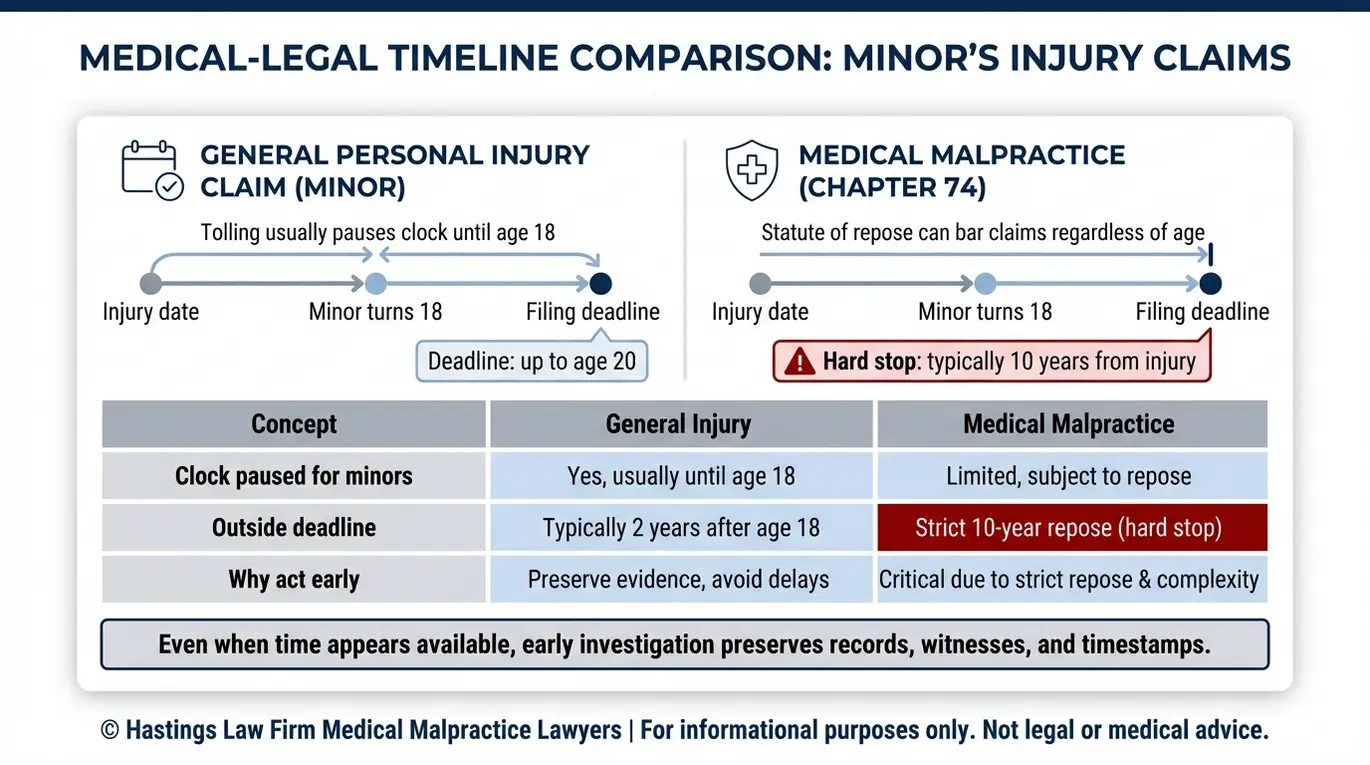
In Texas, the statute of limitations for minors is generally “tolled,” meaning it is paused, until the child turns 18. This allows the child to file a personal injury claim until their 20th birthday. However, medical malpractice claims carry stricter deadlines, typically requiring action within 10 years of the injury regardless of the child’s age.
Understanding tolling is the starting point for any family exploring Texas infant injury laws. Under the Civil Practice and Remedies Code Chapter 16, the general rule is that a minor’s filing deadline does not begin to run until they reach the age of majority. For most personal injury claims, this means the child has until age 20 to file suit.
Medical malpractice changes the picture significantly. Under Chapter 74 of the Texas Civil Practice and Remedies Code, there is a strict statute of repose. This is a hard cutoff that prevents claims from being filed more than 10 years after the date of the alleged medical negligence, even if the child is still a minor. A birth injury, which is any preventable harm that occurs during pregnancy, labor, delivery, or the immediate postnatal period, falls under these rules.
This distinction matters more than many families realize. Evidence deteriorates over time. Medical records may be harder to obtain, and witnesses’ memories fade. Even though the law may give your family years to file, early investigation protects the strength of your case.
| Claim Type | Filing Deadline | Key Rule |
|---|---|---|
| General Personal Injury (Minor) | Tolled until age 18; must file by age 20 | Chapter 16, TX Civil Practice & Remedies Code |
| Medical Malpractice (Minor) | 10-year statute of repose from date of injury | Chapter 74, TX Civil Practice & Remedies Code |
The liability laws for infants in medical malpractice cases leave less room than most parents expect. If your child suffered a birth injury, consulting with an attorney sooner rather than later helps preserve your legal options and the evidence that supports them.
Proving Liability and The Duty of Care to Minors
Establishing infant injury liability requires proving that a defendant owed a duty of care to the child and breached that duty through negligence, whether it was a doctor failing to monitor fetal distress or a facility providing inadequate supervision. That breach could involve a doctor failing to respond to signs of fetal distress, also known as nonreassuring fetal status, a condition indicating the fetus is not receiving adequate oxygen, or a childcare facility providing inadequate supervision.
The standard for proving a claim under injury liability laws depends on whether the case involves medical malpractice or general negligence. Under Texas Civil Practice and Remedies Code Chapter 74, medical negligence claims require expert testimony from a qualified physician who can explain how the provider’s actions fell below the accepted standard of care.
For example, in cases involving birth asphyxia or cerebral palsy, experts review records such as fetal monitoring strips and umbilical cord blood gas testing. This is a lab analysis performed shortly after delivery that measures oxygen and acid levels in the baby’s blood to determine whether oxygen deprivation occurred and whether it was preventable.
General liability claims, such as those involving daycare injuries or negligent supervision, follow different rules. These cases still require proof of a duty and a breach, but they do not always require the same level of specialized medical testimony. The question is typically whether the caregiver acted as a reasonably prudent person would have under the same circumstances.
Here is how the two standards compare:
- Medical Malpractice (Texas liability laws, Chapter 74): Requires qualified expert reports, focuses on clinical standards, involves medical causation analysis
- General Negligence: Based on the “reasonable person” standard, does not always require medical expert testimony, focuses on supervision and safety protocols
In both types of cases, the burden of proof rests on the family bringing the claim. That is why thorough investigation, including a detailed review of medical records, incident reports, and witness statements, is essential from the beginning. At Hastings Law Firm, our in-house medical staff, including nurses and patient advocates, work alongside our attorneys to identify exactly where the standard of care was breached and build the evidence to support it.
The Hastings Law Firm Difference
Results matter, but what truly sets us apart is how we achieve them. Every verdict, every settlement, and every Texas courtroom victory comes from one guiding promise: To treat each client’s fight for justice as if it were our own.
This balance of skill, experience, and empathy reflects our core philosophy that justice should not only compensate the injured, but also make healthcare safer nationwide.

The Role of Next Friend and Guardian ad Litem in Texas Courts
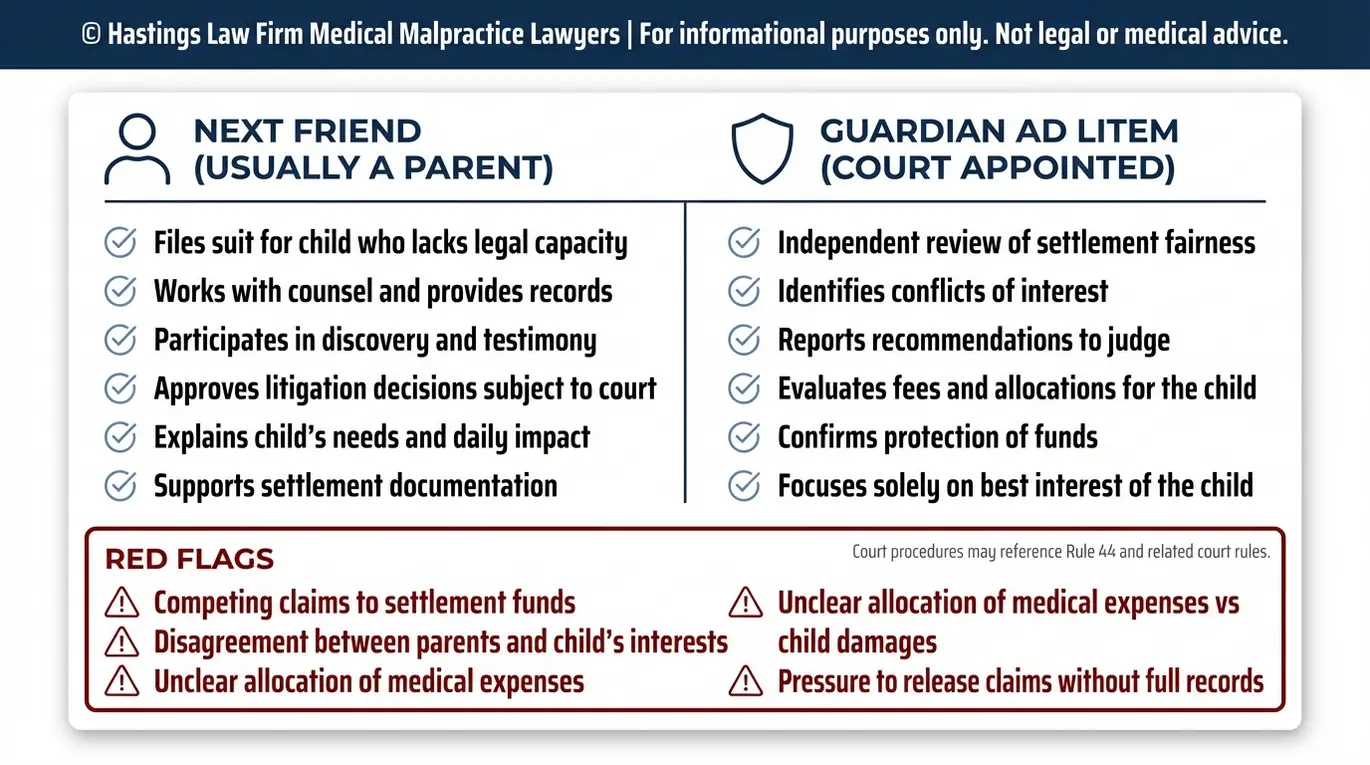
Because minors lack legal capacity, the ability to file a lawsuit or make binding legal decisions on their own, a parent or trusted adult must act as a “Next Friend” to bring the claim, while the court may appoint a Guardian ad Litem to independently verify that any settlement acts in the child’s best interest.
These two roles are distinct, and understanding each one matters for any Texas infant injury case governed by these liability laws.
The Next Friend is usually a parent. This person initiates the lawsuit, makes litigation decisions, and works directly with the attorney. The Next Friend does not need a court appointment to file suit; the role is authorized under Texas procedural rules.
The Guardian ad Litem, by contrast, is appointed by the court. This person has no allegiance to either side. Their responsibility is to independently evaluate the proposed settlement and report to the judge on whether the terms protect the child’s financial future. This safeguard helps prevent any potential conflict of interest between a parent’s personal injury claim and the child’s separate claim.
- Next Friend: Files the lawsuit on behalf of the child; typically the parent; works with the legal team throughout the case
- Guardian ad Litem: Appointed by the court; independent of both parties; reviews the settlement to confirm it is fair to the child
- Legal Capacity: Minors cannot file or settle claims on their own; both roles exist to fill that gap and protect the child’s rights
Specifics of Rule 44 Next Friend Filing Status
Texas Rules of Civil Procedure Rule 44 authorizes the Next Friend mechanism. Under this rule, a person who does not have a legal guardian may have a Next Friend file suit on their behalf. The Next Friend must act in good faith and in the minor’s interest. While the Texas Civil Practice and Remedies Code governs statutes of limitations, Rule 44 specifically handles the procedural filing status. If the court finds a conflict, it has the authority to replace the Next Friend or appoint a Guardian ad Litem to provide an additional layer of protection.
Understanding Friendly Suits and Minor Settlement Hearings
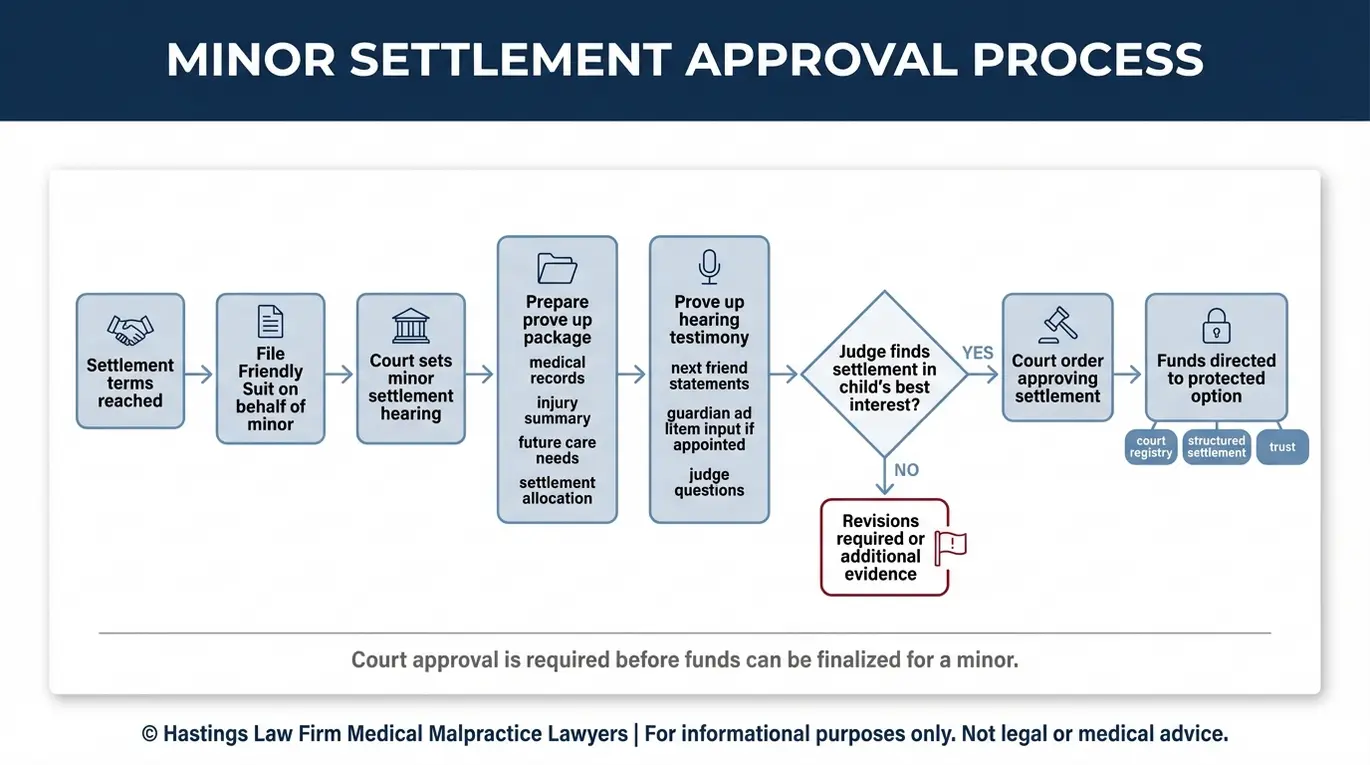
A “Friendly Suit” is a procedural hearing required by Texas law to approve a settlement on behalf of a minor. Its purpose is to ensure the compensation amount is fair and that the funds are properly protected for the child’s future use. This process reflects the court’s role as a safeguard under infant injury liability laws in Texas.
The core of this minor settlement hearing process is the prove-up hearing. Here is what typically happens:
- The petition is filed. The Next Friend files a petition with the court requesting approval of the proposed settlement.
- Evidence is presented. The child’s attorney presents the terms of the settlement, including the nature of the injury, the medical evidence, and why the amount is reasonable.
- Testimony is given. The Guardian ad Litem and the parents testify before the judge. The Guardian ad Litem confirms their independent review and recommendation.
- The judge evaluates the terms. The court examines whether the settlement adequately compensates the child and whether the proposed fund management plan protects the money.
- The order is entered. If satisfied, the judge approves the settlement and issues an order directing how the funds will be held, whether in the court registry, a trust, or a structured settlement.
This judicial oversight exists because Texas laws recognize that a child cannot evaluate or consent to a settlement. The court steps in to fill that role. No settlement involving a minor becomes final without this approval, and no parent can access the funds without the court’s authorization.
Recoverable Damages and Calculating Future Loss of Earning Capacity
Damages in infant injury cases extend well beyond immediate medical bills. They include long-term care costs, pain and suffering, and the projected loss of the child’s ability to earn a living as an adult, a category known as future loss of earning capacity.
Damages generally fall into two categories:
| Category | Examples |
|---|---|
| Economic Damages | Past and future medical expenses, a life care plan (a detailed projection of the child’s lifetime medical needs), durable medical equipment, which encompasses reusable supplies like wheelchairs or braces, rehabilitation costs, and future loss of earning capacity |
| Non-Economic Damages | Physical pain and suffering, mental anguish, physical impairment, loss of consortium (the impact on the parent-child relationship) |
Calculating future loss of earning capacity for an infant presents a unique challenge under Texas infant liability laws. The child has no work history, no academic record, and no established career path. Economists and vocational experts project what the child would likely have earned over a lifetime and compare that figure against what they can now realistically earn given their injuries. This analysis often requires testimony about cognitive function, physical limitations, and the long-term effects of the injury.
In medical negligence cases, Texas imposes a damages cap on non-economic damages: $250,000 total against all physicians and healthcare providers combined, and $250,000 per healthcare institution with a maximum of $500,000 total across all institutions. General liability laws do not impose the same caps on compensatory damages. Understanding which cap applies directly affects the potential value of a claim, and it is one of the first things we evaluate when reviewing a case.
Impact of Injury on Adolescent Brain Development
Early medical diagnosis is critical in linking an infant’s injury to long-term cognitive deficits. A hypoxic-ischemic brain injury, which occurs when the brain is deprived of both oxygen and blood flow, can have effects on brain development that unfold over months or years. A pediatric neuropsychological evaluation, a series of standardized tests that measure memory, attention, language, and reasoning in children, helps document the full scope of harm.
Expert testimony connecting the initial trauma to developmental outcomes is often the foundation of a strong damages case. The sooner these evaluations begin, the more complete the medical record becomes.
Management of Settlement Funds and Court Registry Options
Settlement funds awarded to an infant must be protected until the child reaches adulthood. These funds cannot simply be handed over to a parent. Texas law requires that the money be placed in a secure arrangement, typically through the Court Registry, a managed trust, or a structured settlement annuity.
Rule 142 trusts and managed repository funds are two common options the court may approve. A Rule 142 trust holds the funds in an interest-bearing account under court supervision. A managed repository fund operates similarly but may be administered by a court-appointed financial institution with specific investment guidelines.
Structured settlements offer another path for protecting Texas infant injury liability recoveries. Instead of a lump sum, the child receives scheduled, tax-free payments over time. These can be designed to increase at key life stages, such as when the child turns 18 or begins college.
| Option | Advantages | Considerations |
|---|---|---|
| Court Registry | Direct court oversight; simple to establish | May earn lower returns; less flexibility |
| Structured Settlement | Tax-free payments; customizable payout schedule; long-term security | Less liquid; terms are generally fixed once established |
| Rule 142 Trust / Managed Fund | Professional management; court-supervised | May involve administrative fees; requires ongoing court reporting |
The right choice depends on the size of the settlement, the child’s projected needs, and the family’s circumstances. We work with families to evaluate each option and recommend the structure that best protects the child’s financial future.
Contact the Texas Birth Injury Attorneys at Hastings Law Firm Today for Help
If your child has suffered a preventable injury, understanding Texas infant injury liability laws is the first step toward protecting their future. These cases involve specialized medical evidence, strict filing deadlines, and procedural requirements that most families have never encountered before. Having the right legal team matters.
At Hastings Law Firm, founded by board-certified trial attorney Tommy Hastings, our team has two decades of experience focusing exclusively on medical malpractice. Our attorneys, nurse consultants, and patient advocates prepare every case as if it will go to trial. Our team includes former defense attorneys who understand how hospitals and insurers approach these claims. That preparation allows us to build cases from a position of strength, whether we are negotiating a settlement or presenting evidence to a jury.
If you believe your child was harmed by medical negligence, we are here to help you find answers. Contact us for a free, confidential case evaluation. You pay no fees unless we recover compensation for your family.
Frequently Asked Questions About Infant Injury Liability Laws in Texas


This content was researched and written by the Hastings Law Firm editorial team, which includes attorneys, medical professionals, and experienced researchers. Our writing is informed by internal knowledge and practical experience, and we cross-check critical details against authoritative sources cited throughout. Every piece undergoes human-led fact-checking and legal review. Because legal and medical information can change, if you spot an error, please contact us. Learn more about our content standards and review process on our editorial policy page.

Tommy Hastings, founder of Hastings Law Firm, is a board-certified personal injury trial lawyer dedicated exclusively to healthcare injury cases. Since 2001, he has represented injured patients and families in litigation against major hospital systems, pharmaceutical companies, and negligent healthcare providers nationwide. He has handled numerous high-profile cases that have drawn national media attention and resulted in multi-million dollar recoveries. He draws on that experience in his writing, helping readers understand how these cases work and what options may be available to them.
