


Texas Fetal Macrosomia Misdiagnosis Lawyer
Written by: Hastings Law Firm | Reviewed by: Tommy Hastings | Updated: July 27, 2026
Fetal macrosomia can raise the risk of serious delivery complications when warning signs are missed or a delivery plan is not adjusted. The discussion often centers on whether prenatal screening, fetal size estimates, and documentation supported safer decisions during labor and delivery. When care falls below the expected standard, families may face lasting physical injuries, neurological harm, and extensive medical needs that affect daily life. If you or a loved one were harmed or worse due to fetal macrosomia misdiagnosis in Texas, contact Hastings Law Firm for a free, confidential case review.

Top Rated Birth Injury Attorneys Helping Families Across Texas
What You Should Know About Large Baby Birth Injury Claims in Texas:
- Long term harm can follow when fetal macrosomia is not recognized and the delivery plan is not adjusted to the level of risk.
- Permanent nerve injury and paralysis can result when excessive traction is used during a difficult delivery involving a large infant.
- Brain injury can occur when oxygen supply is compromised during prolonged labor or a delayed cesarean delivery.
- Additional trauma can occur when forceps or vacuum extraction is used on a macrosomic infant.
- Ongoing neonatal complications can require intensive treatment when metabolic or respiratory risks are not anticipated after birth.
- Options for non economic recovery can be limited in Texas because state law caps damages for pain and suffering in medical malpractice cases.
- Financial recovery can be driven by uncapped economic losses in Texas such as medical expenses and long term care needs.
- Disputes over what happened can intensify when delivery records contain vague notes, inconsistencies, or gaps in documentation.
- Accountability can hinge on whether providers tracked fetal weight progression and documented a clear plan when large for gestational age was identified.
- Case outcomes can turn on competing views of ultrasound weight estimate reliability and whether injuries were caused by provider actions or labor forces.

A Healthcare Focused Law Firm
When your child has been harmed during delivery, the confusion and grief can feel overwhelming. If your baby suffered injuries related to fetal macrosomia, a condition where a newborn weighs significantly more than average at birth, you may have questions about what went wrong and whether it could have been prevented. These are the kinds of questions that deserve honest, informed answers.
As a Texas Macrosomia Birth Injury Lawyer team, Hastings Law Firm focuses exclusively on medical malpractice. Our attorneys, nurse consultants, and Board Certified Patient Advocates work together to determine whether your child’s injuries resulted from a preventable medical error. If you believe something was missed during your prenatal care or delivery, we can review your medical records and explain your options at no cost and with no obligation.
Identifying Macrosomia Risk Factors Missed by Doctors
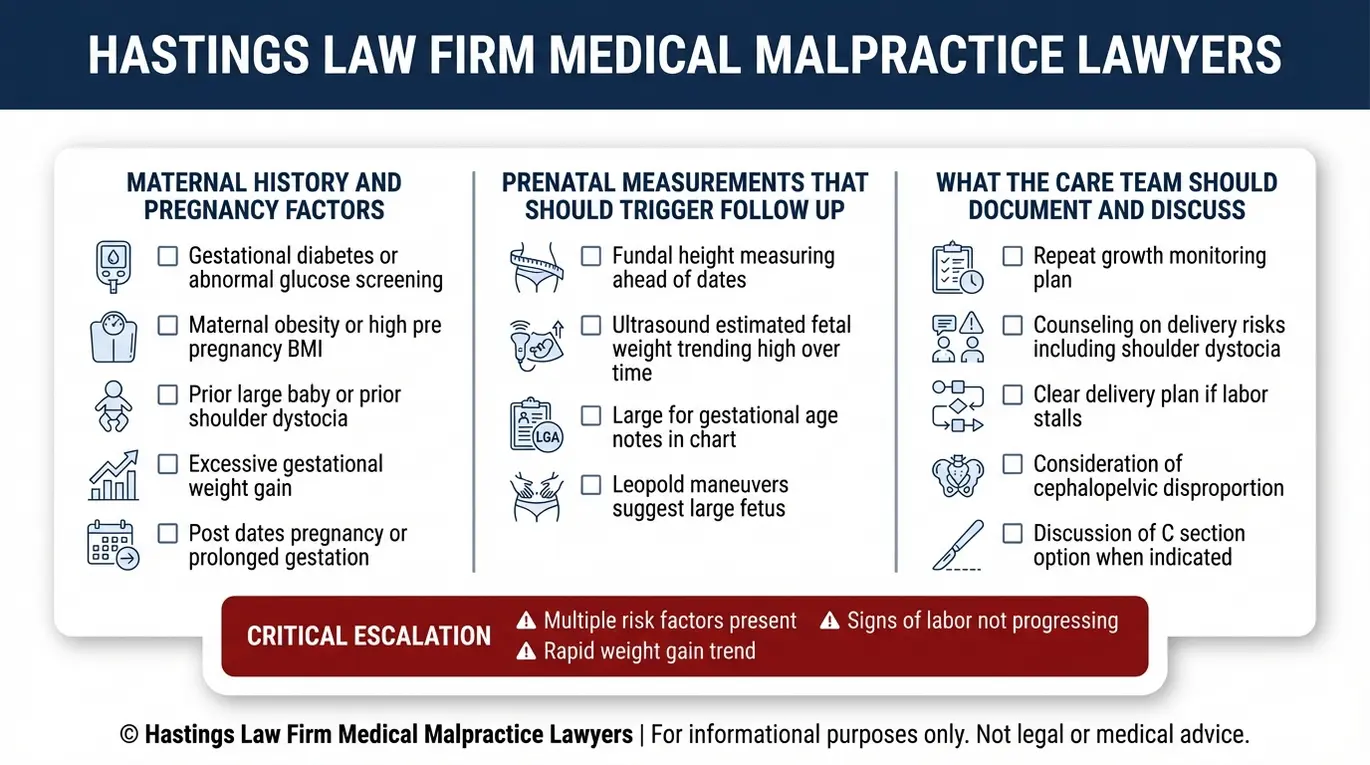
Fetal macrosomia refers to a newborn significantly larger than average (typically over 8 pounds, 13 ounces), and doctors are liable if they fail to identify risk factors like gestational diabetes or maternal obesity and adjust the delivery plan accordingly. As an experienced Texas macrosomia attorney knows, early detection gives the medical team time to plan a safer delivery. This weight threshold is a critical indicator for medical teams when choosing between a vaginal birth and a C-section. When warning signs are overlooked, the consequences for the baby can be severe and permanent.
One of the strongest predictors of macrosomia is gestational diabetes, a form of high blood sugar that develops during pregnancy and can cause the baby to grow excessively. According to the University of Washington Health, routine screening for gestational diabetes is a standard part of prenatal care. When a provider fails to test for this condition, or fails to manage it once diagnosed, the baby may continue gaining weight unchecked throughout the pregnancy.
Maternal obesity and a history of delivering large babies are also well-documented risk factors. So is a post-term pregnancy that extends beyond 42 weeks. According to the NCBI Bookshelf overview of macrosomia, providers are expected to use diagnostic tools like ultrasound estimated fetal weight (EFW). This is a calculation derived from ultrasound measurements used to approximate the baby’s size. Providers also use fundal height measurements and physical assessment techniques such as Leopold maneuvers.
When a baby is classified as large for gestational age (LGA), meaning their estimated weight falls above the 90th percentile for their gestational week, the standard of care requires closer monitoring and a documented plan for delivery. Failing to track fetal weight progression across multiple visits can represent medical negligence.
Signs your doctor should have identified:
- Gestational diabetes diagnosis or abnormal glucose screening results
- Maternal obesity or excessive weight gain during pregnancy
- Previous delivery of a macrosomic infant
- Fundal height measurements consistently above expected range
- Ultrasound estimates suggesting a baby above the 90th percentile
- Pregnancy extending past 40 weeks without reassessment of the delivery plan
The Macrosomia Grading System and Medical Definitions
Fetal macrosomia is the medical term for a baby weighing significantly more than average at birth, and not all cases carry the same level of risk. The medical community uses a grading system to classify severity based on birth weight. Grade 1 macrosomia refers to babies weighing between 4,000 and 4,499 grams (roughly 8 lbs 13 oz to 9 lbs 14 oz). Grade 2 covers weights from 4,500 to 4,999 grams. Grade 3 applies to babies weighing 5,000 grams or more. These grades help doctors decide when to recommend surgical intervention.
As the grade increases, so does the risk of delivery complications, and the standard of care rises with it. ACOG guidelines expect providers to discuss delivery options, including planned cesarean section, when estimated fetal weight reaches certain thresholds. A macrosomia birth injury lawyer in Texas will look closely at what grade was present, whether the provider recognized it, and whether the delivery plan reflected the level of risk involved.
Severe Birth Injuries Resulting from Failure to Diagnose Macrosomia
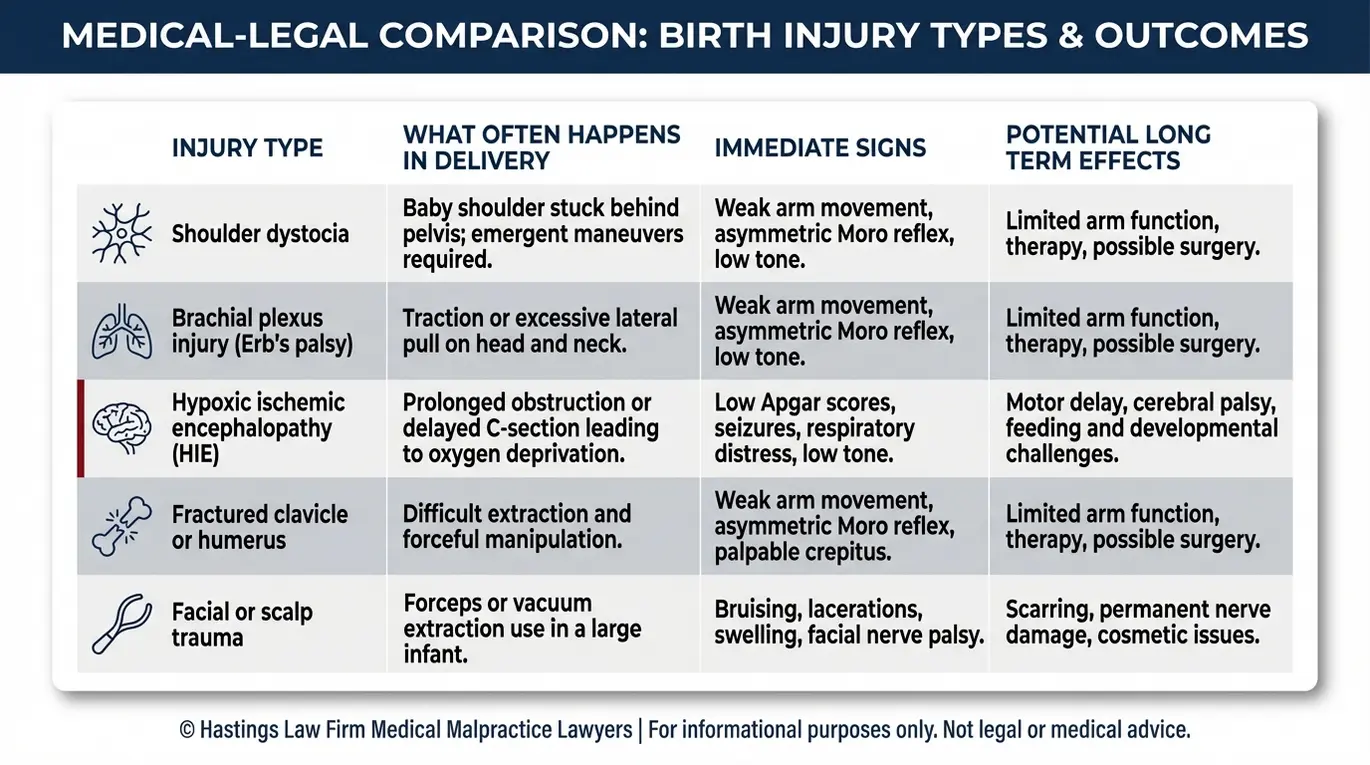
When a doctor fails to recommend a C-section for a macrosomic baby, it often leads to shoulder dystocia, brachial plexus injuries (Erb’s Palsy), or oxygen deprivation due to prolonged labor. Each of these injuries has a distinct mechanism, and understanding how they occur is essential to any legal claim. A lawyer for macrosomia injuries can help investigate these physical causes of harm.
Shoulder dystocia, a delivery emergency where the baby’s shoulder becomes trapped behind the mother’s pelvic bone, is the most common complication in macrosomia cases. According to a literature review published in PubMed Central, shoulder dystocia can escalate rapidly when providers do not anticipate the risk based on the baby’s estimated size. The danger is not limited to the physical obstruction itself; it is what happens next that often causes the most harm.
A brachial plexus injury, which is damage to the network of nerves running from the neck into the arm, can occur when excessive traction is applied to the baby’s head and neck during a difficult delivery. When these nerves are stretched or torn, the result may be Erb’s palsy, a condition that causes partial or complete paralysis in the affected arm. In mild cases, some function may return. In severe cases, the damage is permanent.
If a baby remains lodged in the birth canal for too long, the oxygen supply can be compromised, often due to a delayed C-section or difficult extraction. This can lead to hypoxic-ischemic encephalopathy (HIE), a type of brain injury caused by oxygen deprivation. HIE can result in cerebral palsy, developmental delays, seizure disorders, and other lifelong neurological conditions.
The use of forceps or vacuum extraction on a macrosomic infant can further increase the risk of skull fractures, intracranial hemorrhage, and additional nerve damage. A Texas macrosomia birth injury lawyer will examine the delivery records to determine whether the provider had reason to anticipate these complications and whether different decisions could have prevented them.
| Injury Type | Mechanism | Potential Long-Term Impact |
|---|---|---|
| Shoulder Dystocia | Baby’s shoulder trapped behind pelvic bone | Nerve damage, fractures, oxygen loss |
| Brachial Plexus Injury / Erb’s Palsy | Excessive pulling on head and neck during delivery | Partial or full arm paralysis |
| Hypoxic-Ischemic Encephalopathy (HIE) | Oxygen deprivation from prolonged labor or cord compression | Cerebral palsy, cognitive disability, seizures |
| Fractured Clavicle | Force applied during shoulder dystocia | Pain, limited mobility; usually heals but may signal excessive force |
| Forceps/Vacuum Injuries | Mechanical instruments applied to a large infant | Skull fractures, brain hemorrhage, facial nerve damage |
Metabolic and Respiratory Complications in Large Infants
Birth injuries from macrosomia are not limited to physical trauma during delivery. Large babies also face higher metabolic risks and respiratory problems in the hours and days after birth. Neonatal hypoglycemia, a condition where the newborn’s blood sugar drops dangerously low, is common in macrosomic infants, particularly those whose mothers had uncontrolled gestational diabetes. If not identified and treated quickly, severe hypoglycemia can cause seizures and brain injury.
These metabolic issues require immediate neonatal intervention to prevent long-term neurological damage. Other complications include hyperbilirubinemia (elevated bilirubin levels leading to jaundice) and respiratory distress. These conditions may require NICU admission and prolonged treatment. When a provider fails to anticipate these risks based on known macrosomia, that failure can form part of a broader malpractice claim that a macrosomia lawyer can help you pursue.
The Hastings Law Firm Difference
Results matter, but what truly sets us apart is how we achieve them. Every verdict, every settlement, and every Texas courtroom victory comes from one guiding promise: To treat each client’s fight for justice as if it were our own.
This balance of skill, experience, and empathy reflects our core philosophy that justice should not only compensate the injured, but also make healthcare safer nationwide.

Proving Medical Malpractice in Texas Macrosomia Cases
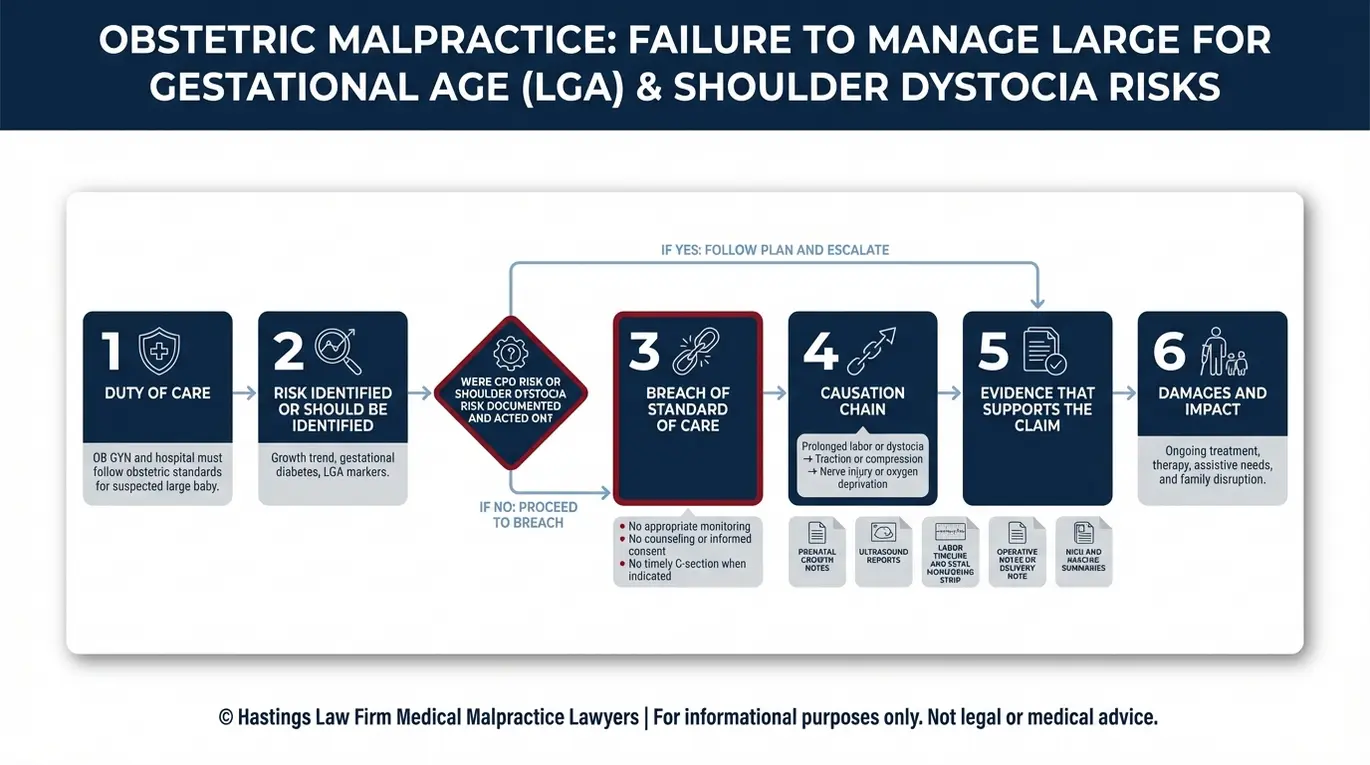
To prove malpractice, your attorney must demonstrate that the obstetrician violated the standard of care by failing to diagnose fetal size or failing to recommend a Cesarean section (C-section) to avoid birth trauma. Establishing medical negligence in Texas involves proving that a provider’s actions fell below the accepted standard of care. The standard of care is the accepted level of treatment a reasonably competent provider would deliver under similar circumstances, and establishing it often involves referencing ACOG or IOM guidelines.
Texas medical malpractice cases are built on four connected elements: duty, breach, causation, and damages. The provider owed a duty of care to the mother and baby. The question we investigate is whether they breached that duty, and whether the breach directly caused the injuries. Your birth injury attorney will work to show that a breach occurred.
Breach of the standard of care establishes liability for negligence in macrosomia cases and can take several forms:
- Failing to order or properly interpret ultrasound estimates of fetal weight
- Ignoring risk factors such as gestational diabetes, maternal obesity, or a prior macrosomic delivery
- Not offering a planned C-section when cephalopelvic disproportion (CPD), a mismatch between the baby’s size and the mother’s pelvis, was suspected or an emergency cesarean section was required
- Proceeding with operative vaginal delivery despite contraindications
- Applying excessive traction during a shoulder dystocia emergency
- Charting inconsistencies or vague documentation that obscures what actually happened during delivery
Our legal team includes former defense attorneys who previously represented hospitals. That background gives us a direct understanding of how the defense builds its case, and we use that knowledge to identify altered records, vague clinical notes, and gaps in documentation that might otherwise go unnoticed.
Causation is established through qualified medical expert testimony. A Texas macrosomia birth injury lawyer at our firm works with obstetricians, neonatologists, and other specialists to reconstruct the timeline of care and show that a different course of action would have, more likely than not, prevented the injury. Consulting with a macrosomia malpractice lawyer is essential to building a strong case.
Recovering Compensation for Life-Long Macrosomia Complications
Settlements and verdicts for macrosomia injuries in Texas can cover past and future medical bills, life care costs for children with permanent disabilities, and pain and suffering, though non-economic damages are subject to state caps. Compensation in these cases aims to provide financial security for a child who will require lifelong medical support. A lawyer for birth injury compensation will structure your claim to maximize recovery.
Economic damages are uncapped in Texas and often make up the largest portion of a recovery. These include:
- Past and future medical expenses, including surgeries, physical therapy, and adaptive equipment
- The cost of ongoing rehabilitation and specialized education
- Loss of earnings capacity if the child’s disability limits their ability to work as an adult
- Life care plan expenses calculated by professional life care planners who project the total cost of care over the child’s lifetime
Hiring a qualified life care planner is one of the most important steps in a macrosomia birth injury case. These experts document every anticipated need, from assistive devices to home modifications to long-term nursing support, so that no future cost is left out of the claim during insurance company negotiations.
Non-economic damages cover pain, suffering, mental anguish, and loss of quality of life. While deeply significant, these are harder to quantify and are subject to settlement offers and state limitations.
Impact of Texas Damage Caps on Your Claim
Texas tort reform places statutory caps on non-economic damages in medical malpractice cases. These caps limit the recovery for intangible losses like pain and suffering, while medical expenses remain uncapped. Under current Texas caps, non-economic damages are generally capped at $250,000 per defendant. If the case involves both a hospital and an individual physician, each defendant may be subject to a separate cap, which can increase the total non-economic recovery when multiple parties are liable.
A Texas macrosomia birth injury lawyer will structure the case to identify every responsible party. This strategy is especially important in cases where the total lifetime economic damages are high, because the uncapped economic damages portion of the claim often far exceeds the statutory limits on non-economic recovery.
Why Texas Families Trust Hastings Law Firm with Complex Birth Injury Cases
Unlike high-volume settlement mills, Hastings Law Firm assigns a specialized team of medical experts and trial lawyers to every case, preparing for trial from day one to ensure maximum leverage against hospital insurers. Choosing a firm with specialized medical knowledge is essential when challenging hospital systems and insurance carriers. Every attorney, nurse consultant, and patient advocate on our team is focused on holding negligent medical providers accountable for the harm they cause.
Our Texas macrosomia birth injury lawyer team operates with a trial-ready approach, meaning we prepare every case from day one as though it will go before a jury. That level of preparation sends a clear message to hospital insurers and defense attorneys, and it consistently produces stronger outcomes for our clients. Our team includes former defense counsel who know how hospitals and insurance carriers build their strategies, giving us a direct advantage in anticipating and countering those arguments.
Our founder, Tommy Hastings, is Board Certified in Personal Injury Trial Law by the Texas Board of Legal Specialization. This credential is held by fewer than 2% of Texas attorneys and reflects a high level of expertise in medical malpractice cases. We also understand that families going through this experience need more than legal representation. Our Board Certified Patient Advocates provide support throughout the process, helping you understand your child’s medical records and what they reveal.
There is no financial risk in working with us. We operate on a no-win no-fee contingency fee basis, which means you pay no attorney fees or costs unless we recover compensation on your behalf. Many of our cases come from peer referrals, a testament to our reputation in the field. When you hire a macrosomia lawyer at Hastings Law Firm, you are choosing a partner dedicated to your family’s future.
Contact the Texas Birth Injury Attorneys at Hastings Law Firm Today for Help
If your child was injured during delivery and you suspect that warning signs of macrosomia were missed, you deserve answers. Hastings Law Firm was built to help families in exactly this situation, to uncover the truth about what happened and to protect your child’s future. Reaching out for a case review helps families understand their legal standing and the potential timeline for a claim.
Our free, confidential case evaluation is the first step. A patient advocate will review your experience and help determine whether your child’s injuries may have been preventable. Time limits do apply to medical malpractice claims in Texas, so reaching out sooner gives us the best opportunity to preserve important evidence.
Call us or complete our online form to schedule your risk-free consultation. You pay nothing unless we win.
Frequently Asked Questions About Fetal Macrosomia Misdiagnosis in Texas


This content was researched and written by the Hastings Law Firm editorial team, which includes attorneys, medical professionals, and experienced researchers. Our writing is informed by internal knowledge and practical experience, and we cross-check critical details against authoritative sources cited throughout. Every piece undergoes human-led fact-checking and legal review. Because legal and medical information can change, if you spot an error, please contact us. Learn more about our content standards and review process on our editorial policy page.

Tommy Hastings, founder of Hastings Law Firm, is a board-certified personal injury trial lawyer dedicated exclusively to healthcare injury cases. Since 2001, he has represented injured patients and families in litigation against major hospital systems, pharmaceutical companies, and negligent healthcare providers nationwide. He has handled numerous high-profile cases that have drawn national media attention and resulted in multi-million dollar recoveries. He draws on that experience in his writing, helping readers understand how these cases work and what options may be available to them.
