







Trusted Legal Representation for Medical Malpractice Claims in North Dallas
Written by: Hastings Law Firm | Reviewed by: Tommy Hastings | Updated: May 11, 2026
What You Should Know About Healthcare Negligence Lawsuits in North Dallas:
- Whether harm was avoidable under accepted medical standards, rather than an inherent risk of treatment, is often the central question in a malpractice case.
- Diagnostic errors, including missed or delayed diagnoses, can lead to conditions that worsen beyond the point where treatment would have been effective.
- Texas law requires a qualified expert report early in the litigation process, and failing to meet that deadline can end a case before it starts.
- Hospitals in North Dallas can face direct liability for institutional failures even when the physician who provided care is not a hospital employee.
- Non-economic damages in Texas are subject to statutory caps, but economic damages for medical costs, lost income, and future care needs have no limit.
- The two-year statute of limitations begins on the date of injury or the date the injury was discovered, and missing that window almost always eliminates the right to file.
- Evidence preserved early, including medical records, imaging, and diagnostic materials, can determine whether a case moves forward or stalls.
- Rapid population growth in Collin and Denton counties has brought new hospitals and clinics online quickly, and the pace of that expansion can create staffing and protocol risks that affect patient safety.

A Medical Injury Focused Law Firm
Patients who suspect something went wrong during their care often struggle to get clear answers. Medical records are difficult to interpret without clinical training, and providers rarely volunteer that an error occurred. That uncertainty is one of the most frustrating parts of the experience, and it’s one of the first things we help resolve.
Hastings Law Firm represents patients and families across North Dallas who have been injured by preventable medical errors. Our legal team works alongside in-house nurses and medical consultants who focus exclusively on medical malpractice, giving us the clinical depth to identify what happened and whether it should have been prevented.
If you or someone in your family received care at a North Dallas area facility and the outcome doesn’t match what you were told to expect, you deserve a clear explanation. And if negligence caused the harm, you deserve to be compensated for it.
How Medical Negligence is Defined Under Texas Law
A medical malpractice claim requires more than a bad outcome. The legal question is whether the healthcare provider deviated from the standard of care, which is the level of skill and treatment that a competent provider in the same specialty would deliver under similar circumstances. When a provider falls below that standard and a patient is injured as a result, that’s medical negligence.
Some complications are unavoidable. Not every surgery goes as planned, and not every condition responds to treatment the way a physician expects. The line that separates a compensable claim from an unfortunate result is whether the harm could have been prevented by a provider acting with reasonable skill and judgment.
When a Complication May Actually Be Negligence
Every case we evaluate as North Dallas medical malpractice lawyers starts with that question. Texas law, specifically Chapter 74 of the Civil Practice and Remedies Code, sets out specific procedural requirements for how these claims must be filed, including the early submission of a qualified expert report.
Certain patterns suggest negligence rather than an unavoidable complication:
- A serious safety event occurred that should not happen when proper protocols are followed, such as a surgery performed on the wrong site or a foreign object left inside a patient
- An unexpected outcome resulting in death or severe harm was not reported or investigated by the facility
- Diagnostic results that indicated a problem were available in the chart but not reviewed or acted on in time
- The patient was not informed of known risks before a procedure, which may constitute a failure of informed consent
- Institutional failures like inadequate nurse-to-patient ratios, poor handoff communication, or missing safety checks contributed to the injury
When hospitals and their insurers respond to these claims, they often characterize the outcome as an accepted risk of treatment. That framing doesn’t mean the case is weak. It means you need medical and legal professionals who can reconstruct the timeline and determine whether the standard of care was met.
Hospitals and Medical Facilities Serving North Dallas
The healthcare landscape across North Dallas and the northern suburbs has expanded rapidly over the past two decades. Collin County’s population has grown from roughly 780,000 in 2010 to well over one million today, and the medical infrastructure has followed. That growth has brought significant hospital investment, but it has also introduced the kinds of risks that come with rapid expansion, including new facilities working to establish consistent protocols, staffing shortages during peak growth, and a high volume of patients moving through systems that are still scaling.
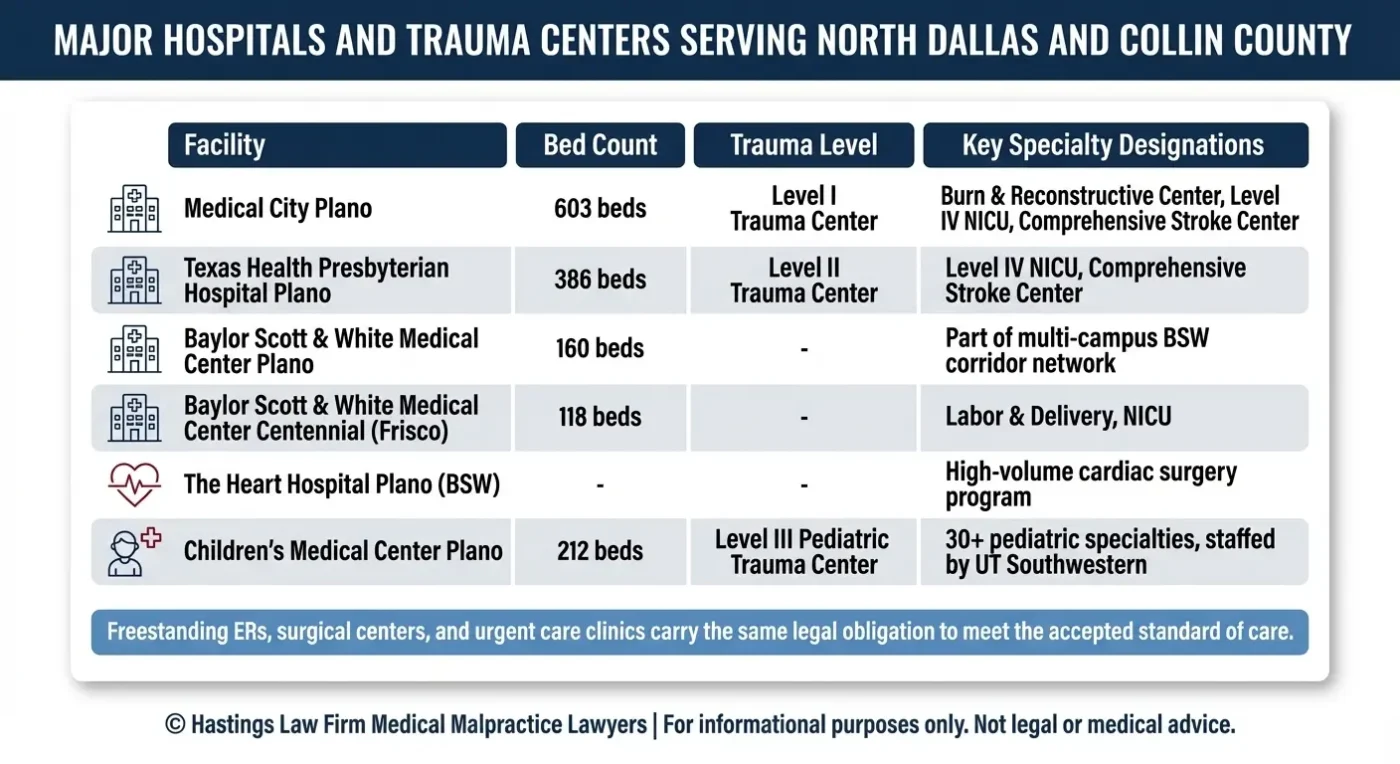
Medical City Plano is the largest hospital in Collin County, a 603-bed acute care facility and the only Level I Trauma Center in the county. It also operates the only American Burn Association verified Burn and Reconstructive Center in Collin County, a Level IV NICU, and a Comprehensive Stroke Center. The hospital has been undergoing a $108 million expansion to add patient beds, ICU capacity, and rooftop helipads.
Texas Health Presbyterian Hospital Plano is a 386-bed Level II Trauma Center with a Level IV NICU and Comprehensive Stroke Center designation. It serves Plano, Frisco, Richardson, Carrollton, and McKinney, and is currently building a new eight-story patient tower as part of a $343 million expansion.
Baylor Scott & White Health operates multiple hospitals across the North Dallas corridor, including a 160-bed facility in Plano, a 118-bed hospital in Frisco (Baylor Scott & White Medical Center Centennial), and a newer campus at PGA Parkway in Frisco that includes labor and delivery, a NICU, and plans for continued expansion. Baylor Scott & White also runs The Heart Hospital Plano, one of the highest-volume cardiac surgery programs in the country.
Children’s Medical Center Plano, part of the Children’s Health system, opened a new eight-story patient tower in December 2024 that nearly tripled its bed count to 212. It offers more than 30 pediatric specialties and is staffed by specialists from UT Southwestern. The campus is designated as a Level III Trauma Center for pediatric patients.
Methodist Richardson Medical Center and Methodist McKinney Hospital serve the eastern and northern portions of the corridor. Medical City McKinney and Texas Health Allen round out the major hospital presence in the area.
Beyond hospitals, North Dallas has seen a significant expansion of freestanding emergency rooms, ambulatory surgical centers, and urgent care clinics, particularly along the US-75 and Dallas North Tollway corridors. These facilities carry the same legal obligation to meet the accepted standard of care as any hospital. When they fall short and a patient is harmed, they can be held accountable under the same Texas medical liability standards.
Damages Available in North Dallas Medical Malpractice Cases
Compensation in a medical malpractice case falls into two primary categories: economic damages and non-economic damages. Texas law treats these categories differently, and understanding the distinction shapes the entire case strategy.
| Damage Type | What It Covers | Cap in Texas |
|---|---|---|
| Economic Damages | Past and future medical expenses, lost wages, diminished earning capacity, rehabilitation, home modifications, long-term care needs | No cap |
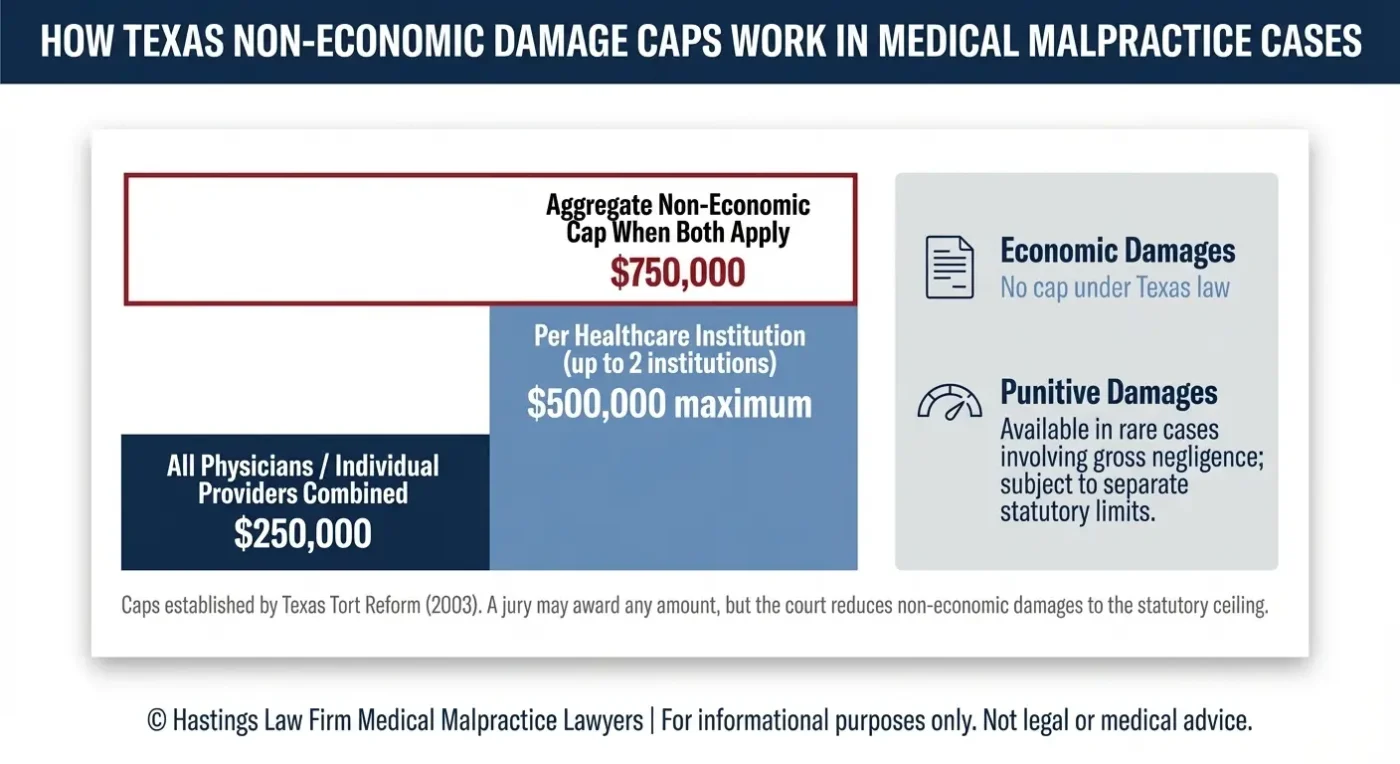
| Non-Economic Damages | Physical pain, emotional distress, disfigurement, loss of companionship, mental anguish | $250,000 against all physicians/providers combined; $250,000 per healthcare institution (up to $500,000 for two or more institutions); aggregate maximum of $750,000 when both providers and multiple institutions are involved |
| Punitive Damages | Available in rare cases involving gross negligence or willful misconduct | Subject to separate statutory limits |
These caps were established by Texas Tort Reform in 2003. A jury is free to award whatever amount it considers fair, but the court will reduce the non-economic portion to the statutory ceiling. Economic damages are not subject to any cap, which is why our North Dallas medical malpractice attorneys build every case with detailed documentation of current and projected financial losses.
Wrongful death claims carry their own structure. A surviving spouse, children, or parents may each pursue compensation for their individual losses, including both economic components like loss of financial support and funeral expenses, and non-economic components like loss of companionship and mental anguish.
Because the caps limit one category of recovery, our approach to every case prioritizes thorough documentation of the economic harm. Future medical costs, lost earning capacity, and long-term care needs can represent the largest portion of a recovery, and quantifying those losses accurately from the beginning is how we work to ensure the caps do not define the outcome.
How Our Malpractice Attorneys Prove Liability
Every medical malpractice claim in Texas requires proof of four elements: a duty of care owed to the patient, a breach of that duty, a causal connection between the breach and the injury, and measurable damages. Each element must be supported by evidence, and a weakness in any one of them can undermine the entire case.
Here is how each element works:
- Duty of care: Once a doctor-patient relationship exists, the provider has a legal obligation to deliver competent treatment. This duty extends to all members of the care team, including nurses, anesthesiologists, and specialists involved in the patient’s treatment.
- Breach of duty: The provider’s actions or omissions fell below what a reasonably competent provider in the same specialty would have done under similar conditions. In diagnostic cases, this can involve anchoring bias, where a physician fixates on an initial diagnosis and overlooks test results or symptoms that point in a different direction.
- Causation: A direct link must connect the breach to the harm. Showing that a provider made a mistake is not enough on its own; we have to prove that the specific mistake caused the specific injury.
- Damages: The patient experienced measurable harm, whether physical, emotional, or financial.
Texas Chapter 74 requires that a qualified expert report be served on each defendant within 120 days of their original answer. The report must address all four elements. HB 3984 reflects continued legislative focus on how expert report requirements are applied in practice. A report that is late or fails to meet the statutory threshold can lead to dismissal with prejudice, meaning the case cannot be refiled.
Our team prepares these reports with the support of a national network of medical experts who provide independent analysis and expert witness testimony. Because our staff includes former defense attorneys, we know what arguments hospitals and their counsel will raise to challenge each element, and we build the case to address those challenges before they’re filed.
Hospital Liability and Independent Contractor Physicians
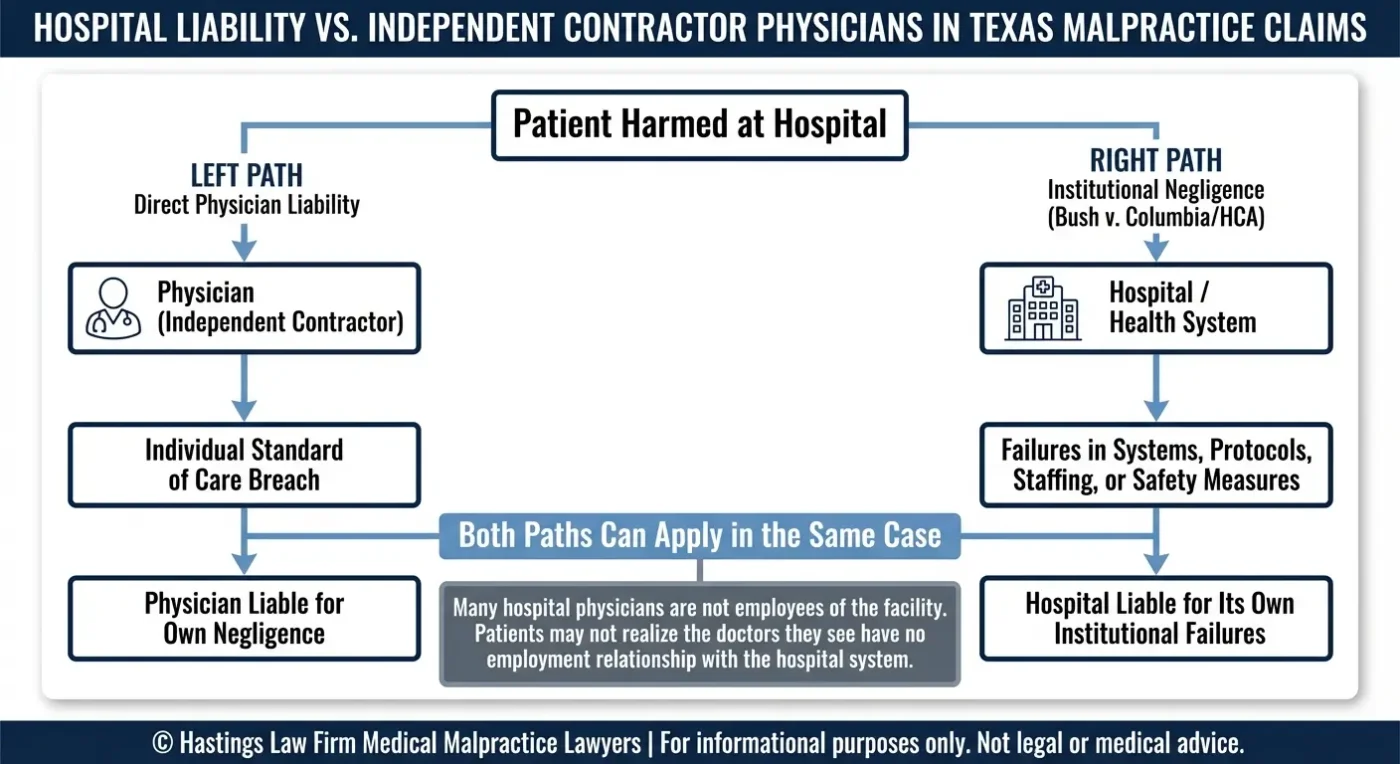
One of the more common issues in North Dallas malpractice cases involves the relationship between a hospital and the physicians who practice there. Many patients assume their doctor is employed by the hospital. In most suburban facilities across Collin and Denton counties, that is not the case. Emergency physicians, anesthesiologists, radiologists, and hospitalists are frequently independent contractors.
The Texas Supreme Court addressed this directly in *Bush v. Columbia Medical Center/HCA*. Under that ruling, a hospital can face direct liability for failing to maintain adequate systems, protocols, or safety measures, even when the physician who delivered the care was not an employee. The legal theory is **institutional negligence**, and it holds the facility accountable for its own failures separate from any individual provider’s conduct.
This distinction matters in North Dallas because many of the newer suburban hospital campuses operate under strong system-level branding. A patient may interact with a facility bearing the name of a major health system without realizing the doctors inside have no employment relationship with that system. If the institution’s own policies, staffing decisions, or safety protocols contributed to the harm, the hospital itself may bear legal responsibility.
We examine these employment and credentialing relationships in every case we evaluate.

“Cases aren’t won by the lawyer with the fanciest tie, but by the lawyer who works the hardest and cares the most.”
– Tommy Hastings, founding attorneyA North Dallas Medical Law Firm That Gets Results
Hastings Law Firm was founded in 2005 by Tommy Hastings, a board certified personal injury attorney who has spent his entire career representing patients and families harmed by medical negligence. He is one of the only attorneys in Texas who still handles medical malpractice cases exclusively, and that focus shapes every part of how this firm operates.
The preparation and intensity we bring to every case has earned us a reputation that defense attorneys and insurance carriers recognize. Medical malpractice is all we do, and that matters when you’re going up against hospitals, insurance carriers, and defense teams with unlimited resources.
Experienced & Dedicated Medical Injury Lawyers Near You
Patients and families across the North Dallas area trust Hastings Law Firm because we combine deep medical knowledge with aggressive litigation strategy. Tommy has obtained millions of dollars in compensation for his clients, and the attorneys and medical professionals on our team bring that same standard to every case we take on.
Where North Dallas Medical Malpractice Cases Are Filed
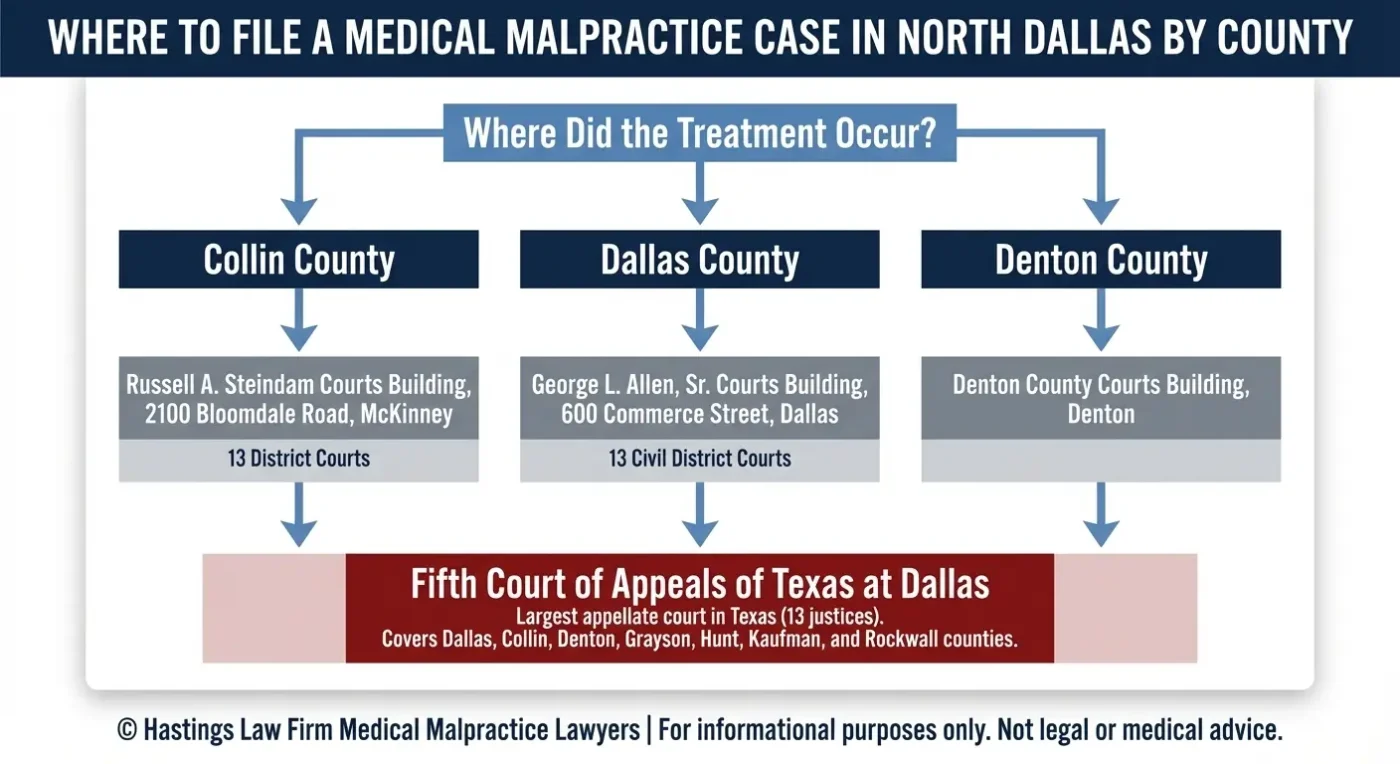
Where your case is filed depends on where the treatment took place. Patients treated at facilities in Collin County file civil lawsuits at the Russell A. Steindam Courts Building at 2100 Bloomdale Road in McKinney. Collin County has 13 district courts with jurisdiction over medical malpractice claims.
Patients treated at facilities in Dallas County, including parts of Far North Dallas and Richardson that fall within Dallas County lines, file at the George L. Allen, Sr. Courts Building at 600 Commerce Street in downtown Dallas. Dallas County also has 13 civil district courts.
Cases originating in Denton County are filed at the Denton County Courts Building in Denton.
All three counties fall under the jurisdiction of the Fifth Court of Appeals of Texas at Dallas for appellate matters. The Fifth Court covers Dallas, Collin, Grayson, Hunt, Kaufman, and Rockwall counties, and with 13 justices, it is the largest appellate court in Texas.
Our attorneys regularly file and appear in courts across all of these jurisdictions. That experience with local rules, scheduling expectations, and procedural norms in each county affects how we manage case timelines and prepare for trial.
The Statute of Limitations for Medical Malpractice in Texas
Texas requires medical malpractice lawsuits to be filed within two years of the date the injury occurred or the date it was discovered. If that deadline passes, the right to bring a claim is almost always lost, regardless of how clear the evidence of negligence may be.
The baseline rule is straightforward: two years from the date of the breach. But three exceptions can alter that timeline:
- Discovery rule: When an injury is not immediately apparent, the statute may begin running on the date the patient discovered, or should have reasonably discovered, the harm. A surgical sponge left inside a patient that doesn’t cause symptoms for months is a common example.
- Minors: Texas allows children under the age of 12 to have a claim filed on their behalf until their 14th birthday.
- Statute of repose: An absolute 10-year outer boundary applies. No matter when the injury was discovered, no claim can be filed more than 10 years after the negligent act. Exceptions to this cutoff are extremely limited.
Research from the Agency for Healthcare Research and Quality (PSNet) has documented how disparities in healthcare access can delay both the recognition of harm and the ability to seek legal remedies. Those delays make it even more important to understand your filing deadline early.
If you aren’t sure whether your time to file has expired, talking to a North Dallas medical malpractice lawyer is the most reliable way to find out.
Pursuing a Medical Malpractice Claim in North Dallas
The process of bringing a malpractice case in North Dallas follows a structured path, and each step builds on the one before it. Here is a general overview of how it works.
We start by obtaining your complete medical records from the facility where you received care, whether that’s Medical City Plano, Texas Health Presbyterian Plano, Baylor Scott & White, Children’s Medical Center Plano, or any other provider in the area. Our in-house medical team reviews those records in detail to reconstruct the timeline of your treatment and identify where the standard of care may have been violated.
Once we’ve identified a potential breach, we work with qualified medical experts to prepare the expert report required under Chapter 74. Courts in both Collin and Dallas counties enforce the 120-day deadline strictly, so we begin expert coordination as soon as a case is accepted.
After the expert report is served, the case enters discovery. Both sides exchange documents, take depositions of treating physicians and expert witnesses, and develop their positions on liability and damages. In many cases, mediation or settlement negotiations occur during this phase.
A significant number of malpractice cases resolve before trial. But the cases that settle for fair value are the ones where the defense knows the plaintiff’s team is prepared to go in front of a jury. We build every case with that standard in mind, so that whether the resolution comes at the negotiation table or in a courtroom, our clients are in the strongest possible position.
You Need an Experienced Medical Lawyer for Malpractice Litigation
We combine the resources of a national firm with the personalized attention of a smaller practice to ensure you are treated as a partner, not just a case file. Hastings Law Firm was built specifically for medical malpractice litigation, and that singular focus shapes everything we do.
Here is what sets our North Dallas medical malpractice lawyer team apart:
- Trial-ready from day one: Every case is prepared as if it will go to a jury trial. This level of preparation signals to insurance carriers and defense counsel that we will not accept an inadequate settlement. It also positions us to pursue a jury verdict when a fair resolution cannot be reached through negotiation.
- Exclusive focus on medical malpractice: We do not handle car accidents, slip-and-falls, or general personal injury. Our trial lawyer team, nurse consultants, and patient advocates work only on medical negligence cases, giving us a depth of knowledge that general practice firms cannot match.
- Former defense insight: Several members of our team previously represented hospitals and their insurers. That experience gives us a clear understanding of how the other side builds its defense, and it allows us to anticipate and counter those strategies early.
- In-house medical professionals: Our staff includes nurse practitioners and Board Certified Patient Advocates who analyze medical records, including electronic fetal monitoring (EFM), the tracking of fetal heart rate during labor, to identify charting inconsistencies and help translate clinical data into evidence a jury can understand.
- We understand the intimidation factor: Many of our clients tell us they felt hesitant to question a doctor or a hospital system – we refer to this as the white coat effect. We help you move past that hesitation by giving you the information and support you need to pursue accountability.
We work on a contingency fee basis. You pay no attorney fees or costs unless we recover compensation on your behalf.
North Dallas and Suburban Communities We Serve
We represent patients and families across North Dallas and the surrounding suburbs from our North Dallas office. Our clients come from communities throughout the northern DFW corridor, including Far North Dallas, Preston Hollow, Lake Highlands, Richardson, Plano, Frisco, McKinney, Allen, Prosper, Celina, Denton, Carrollton, Lewisville, Flower Mound, The Colony, Little Elm, Coppell, Grapevine, and Southlake.
Patients treated in Collin County facilities file cases in McKinney. Those treated in Dallas County, including parts of Richardson and Far North Dallas, file in downtown Dallas. Denton County cases are filed in Denton. All three jurisdictions share the same appellate path through the Fifth Court of Appeals.
Our Central Dallas office serves clients across the rest of the metro, including Downtown, Oak Cliff, East Dallas, South Dallas, Arlington, Grand Prairie, and the surrounding communities.
Wherever in the DFW metro the injury occurred, our team manages the full process from investigation through resolution.
Talk to a North Dallas Healthcare Malpractice Attorney About Your Case
If you or someone in your family was harmed by a healthcare provider in North Dallas, Plano, Frisco, McKinney, or anywhere in the northern DFW suburbs, we can help you understand what happened and whether negligence played a role. Your first conversation with our team is free, confidential, and carries no obligation. We’ll review the facts of your situation, explain your legal options, and give you an honest assessment of whether your case has merit. If we move forward together, you pay no attorney fees or costs unless we recover compensation on your behalf. Call or use the contact form on this page to schedule your free case review.
Injured by a Healthcare
Professional?
We’re Available 24/7!
North North Dallas Medical Injury Claim Questions

Key Medical Malpractice Terms:
- Standard of care
- The level of skill and treatment that a reasonably competent healthcare provider in the same medical specialty would deliver under similar circumstances. In Texas medical malpractice cases, the plaintiff must prove that the provider deviated from this benchmark and that the deviation caused the patient’s injury. Expert witness testimony is typically required to establish this standard for the jury.
- Never event
- A serious, preventable medical error that should never occur when proper safety protocols are followed, such as performing surgery on the wrong body part or leaving a foreign object inside a patient. These events are recognized indicators of healthcare negligence because accepted procedures exist specifically to prevent them.
- Sentinel event
- An unexpected occurrence in a healthcare setting that results in death, serious injury, or significant risk of either. Facilities are expected to investigate these events to identify systemic failures, and their occurrence can serve as evidence of negligence in a medical malpractice claim.
- Informed consent
- The legal and ethical obligation requiring a healthcare provider to explain the risks, benefits, and alternatives of a proposed treatment or procedure before the patient agrees to it. A failure of informed consent may support a malpractice claim when a patient was not told about a known risk that ultimately caused harm.
- Anchoring bias (diagnostic error)
- A cognitive error in which a healthcare provider fixates on an initial diagnosis and fails to consider alternative explanations as new symptoms or test results emerge. This type of diagnostic mistake can lead to a missed or delayed diagnosis and may establish a breach of the standard of care when it results in preventable harm.
- Differential diagnosis
- The systematic process a physician uses to identify a condition by evaluating symptoms and ruling out alternative diagnoses one by one. In malpractice litigation, a provider’s failure to conduct an adequate differential diagnosis can demonstrate negligence, particularly when it leads to a missed diagnosis of a serious or time-sensitive condition.
- Institutional negligence
- A legal theory under which a hospital or healthcare facility is held directly liable for its own systemic failures, such as inadequate staffing, deficient safety protocols, or poor credentialing practices, independent of any individual physician’s conduct. In Texas, the ruling in Bush v. Columbia Medical Center/HCA established that hospitals can face this type of liability even when the treating doctor is an independent contractor.
- Electronic fetal monitoring (EFM)
- A technology used during labor and delivery to continuously track the fetal heart rate and the timing of uterine contractions. Proper interpretation of EFM tracings and timely response to signs of fetal distress are critical elements of the obstetric standard of care, and failures in monitoring can lead to birth injury claims involving oxygen deprivation and neurological harm.
- Expert witness
- A medical professional qualified to provide testimony in a malpractice case regarding the applicable standard of care, whether the defendant breached it, and how that breach caused the patient’s injury. Under Texas Chapter 74, a qualified expert report addressing these elements must be served early in the litigation or the case may be dismissed.
- Statute of repose
- An absolute outer time limit beyond which a legal claim cannot be filed, regardless of when the injury was discovered. In Texas medical malpractice cases, the statute of repose bars claims filed more than 10 years after the date of the negligent act, with very limited exceptions.
- Retained surgical item (RSI)
- A foreign object such as a sponge, instrument, or needle unintentionally left inside a patient’s body following a surgical procedure. This preventable error can cause infection, chronic pain, and the need for additional surgery, and is classified as a never event that constitutes medical negligence.
- Contingency fee
- A fee arrangement in which the attorney collects a percentage of the compensation recovered on the client’s behalf and charges no fees if there is no recovery. This structure allows patients and families to pursue medical malpractice claims without paying legal costs upfront.
- Texas Civil Practice and Remedies Code, Chapter 74 | Texas Legislature Online
- HB 3984 Introduced Bill Text | Texas Legislature Online
- Equity in Patient Safety | AHRQ Patient Safety Network (PSNet)
- Interventions for reducing wrong site surgery and invasive clinical procedures | PubMed Central
- Request Medical Records | UT Health East Texas
- Licensee Complaint Form | Texas Medical Board
Get Answers Today
If you think that medical negligence, a dangerous drug, or a failed medical product caused harm to you or someone you love, our team is standing by to offer guidance. We’ll explain your options under current laws and help you move forward with clarity and understanding. Case reviews are free and 100% confidential.