


Dallas Brachial Plexus Injury Lawyer
Written by: Hastings Law Firm | Reviewed by: Tommy Hastings | Updated: July 27, 2026
An obstetric brachial plexus injury during childbirth can leave a child with lasting weakness, limited movement, or permanent loss of function in the arm and hand. Families often struggle to understand whether the injury was unavoidable or tied to delivery room errors such as excessive traction, improper instrument use, or delayed decisions during emergencies like shoulder dystocia. Clear information about how these injuries happen and what long term needs can look like helps families plan for care and support. If your child suffered harm due to brachial plexus malpractice in Dallas, Texas, contact Hastings Law Firm for a free, confidential case review.

Trusted Dallas Malpractice Attorneys for Preventable Birth Injuries
What You Should Know About Infant Shoulder & Arm Nerve Injury Claims in Dallas:
- Long term function and independence can be affected when childbirth related nerve damage causes weakness, paralysis, or permanent loss of motor control in an arm.
- Preventability can turn on whether the delivery team used excessive force or failed to change the delivery plan when complications were known.
- Severe outcomes can be more likely when shoulder dystocia is handled with forceful pulling rather than accepted repositioning maneuvers.
- Recovery options can narrow when a nerve is torn or pulled away from the spinal cord, since these injuries may require surgery and can lead to permanent paralysis.
- Financial strain can grow over time because care may extend beyond initial hospital bills into therapy, adaptive equipment, and home changes.
- Compensation can reflect both economic and personal losses, including medical expenses, pain and suffering, and long term disability impacts.
- Legal options can be lost if Texas time limits are missed, including an absolute cutoff that can apply even when negligence is discovered later.
- Case outcomes can depend on what delivery records show, including fetal monitoring strips, nursing notes, and charting gaps.
- Disputes often focus on whether the injury came from natural forces of labor or from provider actions during delivery.
- Claims involving military or VA hospitals can be limited by stricter administrative requirements under federal law.

A Healthcare Focused Law Firm
When your child has been diagnosed with an obstetric brachial plexus injury (OBPI), a type of nerve damage that occurs during childbirth, the weight of that news can be overwhelming. You may be facing difficult questions about what went wrong and what your child’s future will look like. If your baby was diagnosed with Erb’s palsy, a condition caused by damage to the upper nerves controlling the shoulder and arm, you deserve honest answers about whether preventable medical errors played a role.
As a Dallas brachial plexus injury lawyer, Hastings Law Firm focuses exclusively on medical malpractice. Our team of attorneys, in-house nurses, and medical consultants works alongside families to determine what happened during delivery and whether negligence caused the injury. If you believe your child was harmed by a medical error, we can review the details of your case and explain your legal options in a free, confidential consultation.
Understanding Brachial Plexus Injuries and Erb’s Palsy
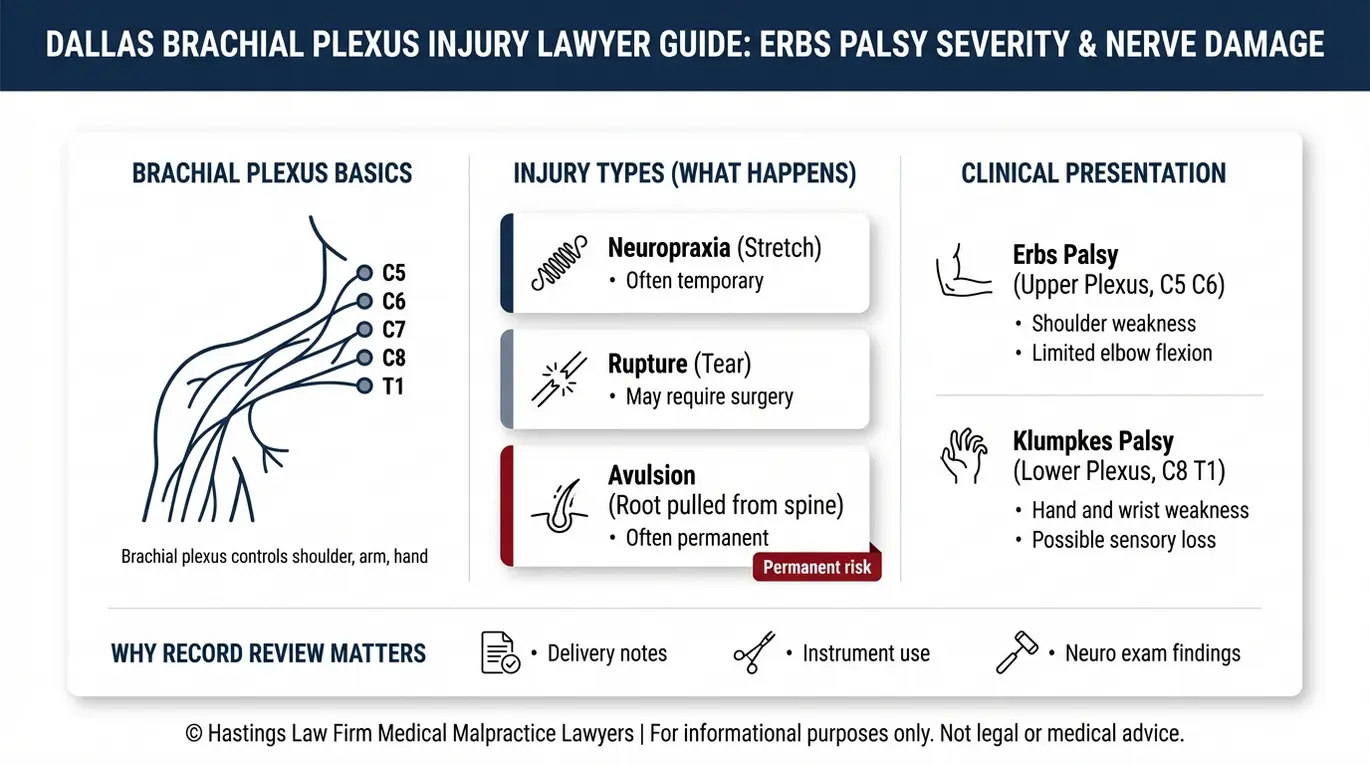
A brachial plexus injury occurs when the network of nerves controlling the arm and hand is damaged during childbirth, often resulting in conditions like Erb’s Palsy or Klumpke’s palsy. The brachial plexus is a bundle of five nerve roots that runs from the spinal cord in the neck, through the shoulder, and down into the arm. These nerves control all movement and sensation in the shoulder, elbow, wrist, and fingers. When excessive stretching or tearing damages these nerves during delivery, the consequences can range from temporary weakness to permanent loss of motor function.
Not all brachial plexus injuries are the same. According to the University of Rochester Medical Center, the severity depends on which type of nerve damage occurred. Understanding these classifications helps families and their medical teams determine what treatment and long-term support may be needed.
Brachial Plexus Injury Severity Classifications
Medical professionals classify these birth injuries based on the type and extent of nerve damage to determine the proper course of care.
- Neuropraxia (Stretch): The mildest form, where the nerve is stretched but not torn. Many neuropraxia injuries, a temporary disruption of nerve signaling without structural damage, heal on their own within a few months.
- Neuroma: The nerve is more seriously damaged and scar tissue forms during healing, which can press on healthy nerve fibers and limit recovery.
- Rupture: The nerve is partially or fully torn but not separated from the spinal cord. Surgical repair is often required.
- Avulsion: The most severe form, where the nerve root is torn completely away from the spinal cord. Avulsions can result in permanent paralysis of the affected arm.
Erb’s Palsy specifically involves damage to the upper nerve roots (C5 and C6), typically causing weakness or paralysis in the shoulder and upper arm. Klumpke’s palsy, a rarer condition caused by injury to the lower nerve roots (C8 and T1), affects the forearm, wrist, and hand. In some cases, a posterior cord injury may also occur, which is damage to the back of the brachial plexus network that impacts the ability to extend the wrist.
For families in Dallas dealing with a brachial plexus injury diagnosis, consulting a Dallas birth injury attorney is often the next step. Understanding the type and severity of the damage helps determine what a legal investigation will focus on. The degree of force required to cause a rupture or avulsion is often far greater than what should occur during a properly managed delivery.
Identifying Medical Malpractice in Delivery Room Errors
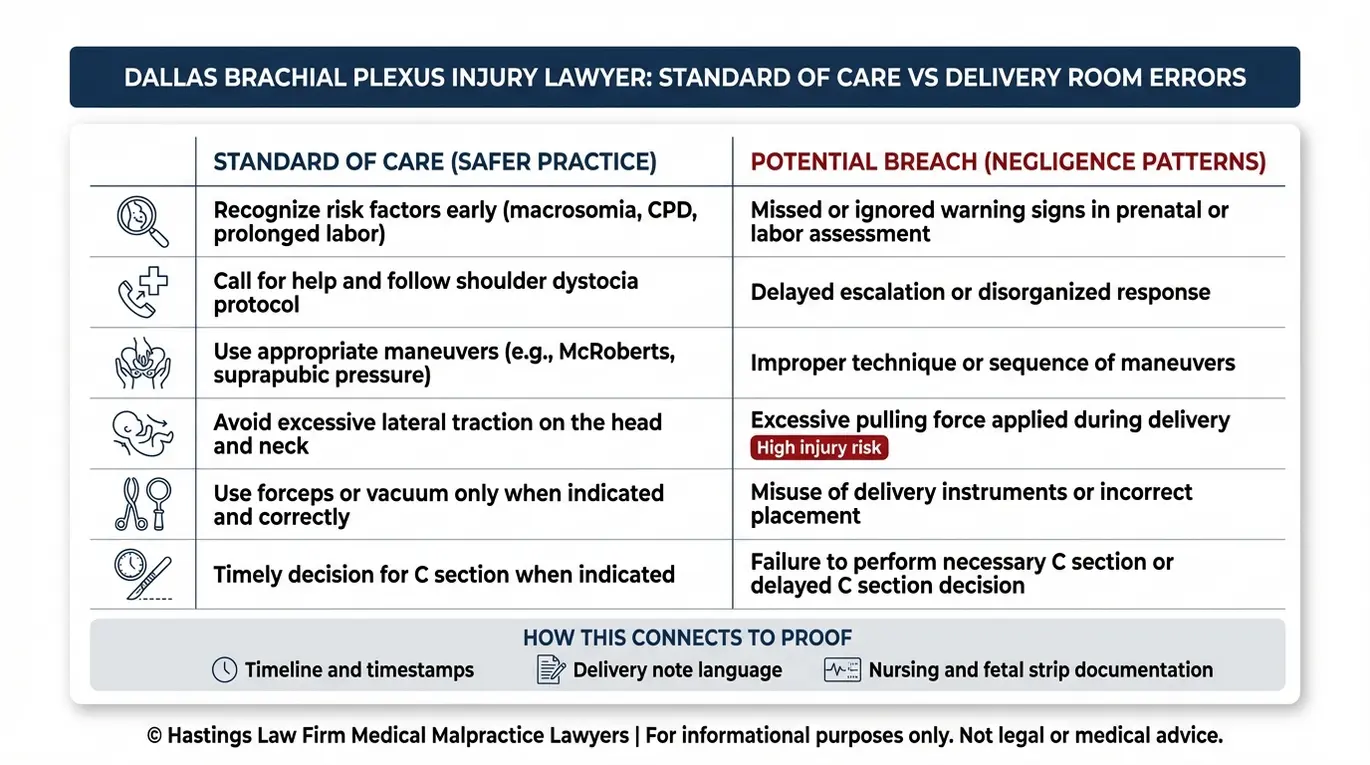
Medical malpractice causes brachial plexus injuries when healthcare providers fail to adhere to the standard of care, such as using excessive force or failing to perform a necessary C-section. This failure can include misusing instruments like forceps or vacuum extractors when risk factors are present. The standard of care refers to the level of care and skill that a reasonably competent healthcare professional would provide under similar circumstances.
Many of these injuries are linked to how the delivery team responds to known complications. For example, fetal macrosomia, a condition where the baby is significantly larger than average, increases the risk of the baby’s shoulder becoming lodged behind the mother’s pelvic bone. Cephalopelvic disproportion (CPD), where the baby’s head or body is too large to pass safely through the birth canal, presents a similar risk. When providers identify these risk factors but fail to adjust the delivery plan, preventable injuries can result.
The misuse of delivery instruments is another area we examine closely. Forceps and vacuum extractors are tools that can assist in a difficult delivery, but improper technique or excessive traction on the baby’s head and neck can stretch or tear nerves. A brachial plexus injury lawyer in Dallas will review medical records to determine if instrument use was appropriate and consistent with accepted medical protocols.
Shoulder Dystocia and Improper Maneuvers
Shoulder dystocia, a delivery emergency where the baby’s shoulder becomes stuck behind the mother’s pubic bone after the head has already been delivered, is one of the most common events leading to brachial plexus injuries. According to the Cleveland Clinic, this complication requires immediate, skilled intervention.
When shoulder dystocia occurs, the standard of care calls for specific, well-practiced maneuvers. The McRoberts maneuver, which involves flexing the mother’s legs sharply toward her abdomen to widen the pelvic opening, is typically the first-line response. It is performed alongside suprapubic pressure applied above the pubic bone. In extreme situations, the Zavanelli maneuver may be attempted to push the baby back for a C-section, though this is rare.
| Accepted Medical Response | Potential Negligence Pattern |
|---|---|
| McRoberts maneuver to reposition the pelvis | Applying excessive downward traction on the baby’s head or neck |
| Suprapubic pressure to dislodge the shoulder | Using fundal pressure (pushing on top of the uterus), which can worsen impaction |
| Rotational maneuvers to free the shoulder | Pulling forcefully instead of repositioning |
| Emergency C-section when maneuvers fail | Continuing vaginal delivery despite failed maneuvers or prolonged labor |
The critical question in these cases is whether the delivering physician responded appropriately and within accepted guidelines. Our team evaluates whether errors such as excessive force, improper technique, or delayed decision-making caused the birth injury. Our legal and medical team reviews the delivery timeline, nursing notes, and fetal monitoring strips to evaluate exactly what happened.
The Hastings Law Firm Difference
Results matter, but what truly sets us apart is how we achieve them. Every verdict, every settlement, and every Dallas courtroom victory comes from one guiding promise: To treat each client’s fight for justice as if it were our own.
This balance of skill, experience, and empathy reflects our core philosophy that justice should not only compensate the injured, but also make healthcare safer nationwide.

Securing Financial Resources for Your Child’s Future
Compensation in brachial plexus cases covers past and future medical expenses, therapy costs, pain and suffering, and the long-term financial impact of the child’s disability. A child with a serious nerve injury may need years of treatment. Families deserve the resources to provide every opportunity for recovery and independence.
The financial impact of these injuries extends well beyond initial hospital bills. Depending on the severity, your child may require ongoing care from pediatric specialists, adaptive equipment, and modifications to your home as they grow. Because these injuries can affect arm length and muscle development, your child may also need specialized clothing or help with daily tasks like dressing and hygiene. Economic damages must account for these subtle but accumulating costs that parents might otherwise pay out of pocket.
A Dallas brachial plexus injury lawyer works to build a case that accounts for the full scope of your child’s needs, not just today’s expenses. Damages commonly pursued in brachial plexus cases include:
- Past and future surgeries, including nerve graft or nerve transfer procedures
- Physical therapy and occupational therapy, often needed for years
- Lost future earning capacity if the injury limits your child’s abilities as an adult
- Adaptive equipment and home modifications, such as specialized tools or accessibility changes
- Pain and suffering, including the physical pain and emotional distress caused by the injury
- Disfigurement and impairment affecting the child’s quality of life
- Mental anguish experienced by both the child and the family
One of the most important tools in calculating long-term compensation is a Life Care Plan. This is a detailed, professionally prepared document that projects every category of medical care, therapy, equipment, and support your child will need over their lifetime. It translates a child’s diagnosis into concrete financial figures that a jury or negotiating party can evaluate. In cases involving nerve root avulsion, the complete separation of a nerve from the spinal cord, a Life Care Plan is especially important because the costs extend across decades.
Texas Statute of Limitations for Birth Injury Claims
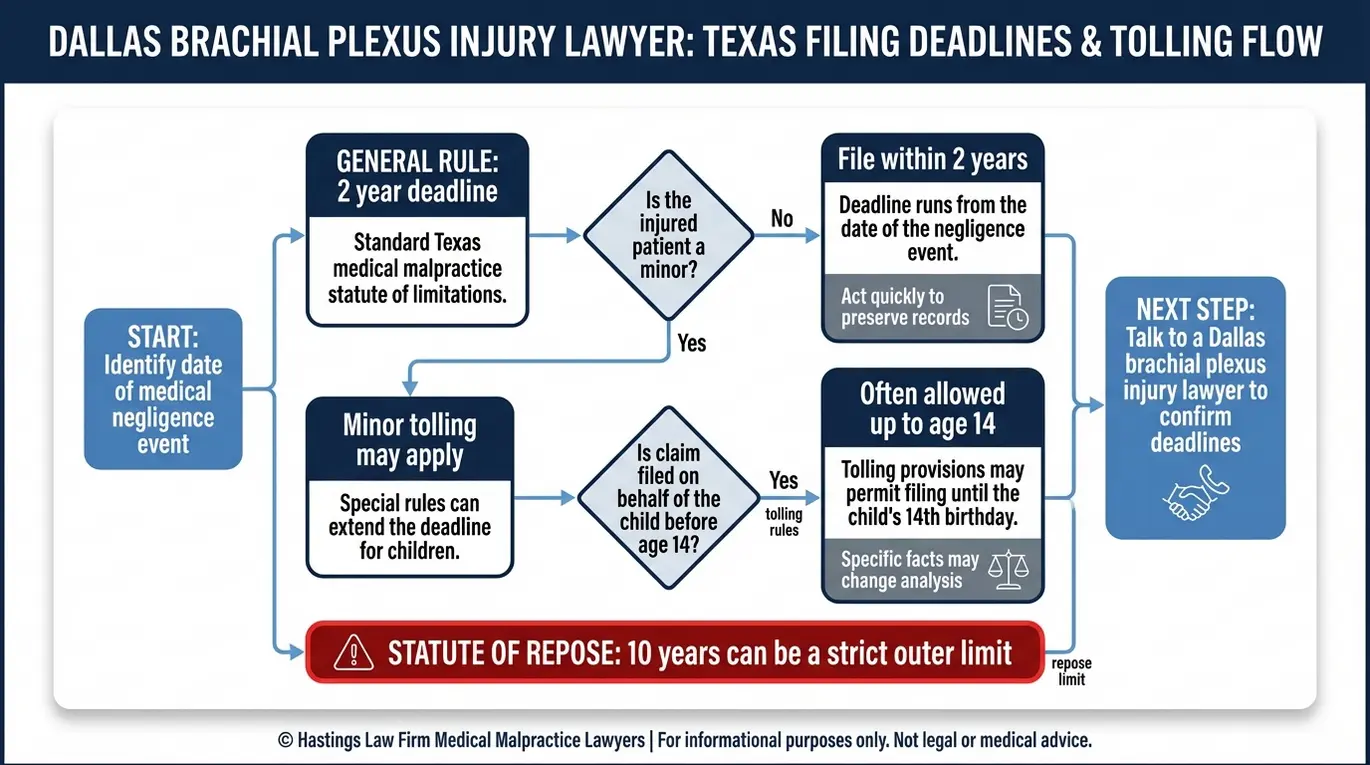
In Texas, the statute of limitations for medical malpractice is generally two years, but specific tolling rules apply to minors, often allowing claims to be filed until the child reaches age 14. This means that even if time has passed since your child’s birth, you may still have a valid legal claim.
Under Texas Civil Practice & Remedies Code, Chapter 74, the two-year deadline is paused, or “tolled,” for children who were injured before the age of 12. Parents or legal guardians can file a claim on the child’s behalf. The extended deadline gives families additional time to recognize the full extent of the injury and seek legal advice.
There is, however, a strict outer boundary. Texas law imposes a 10-year statute of repose, which acts as an absolute cutoff regardless of when the injury was discovered. This strict 10-year limit applies even if you did not discover the negligence until years later. Because of this hard deadline, and because medical records and witness memories become harder to preserve over time, contacting a Dallas brachial plexus injury lawyer sooner protects both your legal rights and the strength of your case.
The Advantage of a Board Certified Medical Malpractice Firm
Choosing a board-certified firm ensures your case is handled by specialists with a proven record in complex medical litigation, not general practitioners handling malpractice cases on the side. Board certification means the attorney has met high standards for experience and knowledge in a specific area of law. At Hastings Law Firm, medical malpractice is all we do. As a dedicated Dallas brachial plexus injury lawyer, our firm understands the systemic issues highlighted in research on medical error reduction and prevention, and we use that knowledge to prove negligence.
Founder Tommy Hastings is Board Certified in Personal Injury Trial Law by the Texas Board of Legal Specialization, a distinction held by fewer than 2% of Texas attorneys. He is also a 2025 inductee into ABOTA (American Board of Trial Advocates), an invitation-only organization recognizing elite trial lawyers. Our team includes former defense attorneys who previously represented hospitals, giving us direct insight into how the other side prepares its cases.
Every case we accept is prepared from day one as though it will go to a jury. This trial-ready approach strengthens negotiations and signals to defense teams and insurance carriers that we will not accept less than what the case is worth. Your initial evaluation is led by a patient advocate, is completely confidential, and there is no fee unless we win.
Contact the Dallas Birth Injury Attorneys at Hastings Law Firm Today for Help
A brachial plexus injury during delivery can change the course of your child’s life. If you suspect that medical negligence contributed to your child’s condition, you have every right to ask questions and seek accountability. These injuries are often preventable, and your family deserves to know what happened.
Hastings Law Firm is here to help you find those answers. As a Dallas brachial plexus injury lawyer with a team of attorneys and medical professionals focused entirely on malpractice cases, we have the experience and resources to investigate your child’s delivery and determine whether the standard of care was met.
Contact us today for a free, confidential case evaluation. There is no fee unless we win. The sooner you reach out, the sooner we can begin preserving the evidence that matters most to your child’s future.
Frequently Asked Questions About Brachial Plexus Malpractice in Dallas


This content was researched and written by the Hastings Law Firm editorial team, which includes attorneys, medical professionals, and experienced researchers. Our writing is informed by internal knowledge and practical experience, and we cross-check critical details against authoritative sources cited throughout. Every piece undergoes human-led fact-checking and legal review. Because legal and medical information can change, if you spot an error, please contact us. Learn more about our content standards and review process on our editorial policy page.

Tommy Hastings, founder of Hastings Law Firm, is a board-certified personal injury trial lawyer dedicated exclusively to healthcare injury cases. Since 2001, he has represented injured patients and families in litigation against major hospital systems, pharmaceutical companies, and negligent healthcare providers nationwide. He has handled numerous high-profile cases that have drawn national media attention and resulted in multi-million dollar recoveries. He draws on that experience in his writing, helping readers understand how these cases work and what options may be available to them.
